William Powell and Myrna Loy made screen marriage look like the most entertaining arrangement two people could possibly invent. Their secret was not simply romance. It was the sense that their characters genuinely liked one another: they traded jokes, understood each other’s weaknesses and usually looked happiest when they were sharing the fun.
In this countdown we will rank every film in which Powell and Loy appeared together. That means the six Thin Man mysteries, their other starring partnerships and one famous technicality at the bottom of the list. If you only want a first film, start with our number one. If you already love Nick and Nora Charles, the middle of this ranking is where you will find several lighter pleasures that are too often ignored.
 Publicity image of the American actor William Powell. Image credit: George Hurrell for Metro-Goldwyn-Mayer / [1] / Public domain, via Wikimedia Commons.
How many movies did William Powell and Myrna Loy make together?
The usual answer is 14, although it needs a small explanation. Powell and Loy starred together in 13 features. Loy then made an uncredited cameo in Powell’s 1947 political satire The Senator Was Indiscreet. We have included it because it completes the familiar 14-film tally, but we have ranked it last because it is not a genuine Powell–Loy partnership.
How we ranked the films
We chose this order by asking four practical questions: How well does the film use their chemistry? How satisfying is the film around them? How well has it aged? And where should a first-time viewer begin? Historical importance matters, but this is mainly a viewing guide. A film that gives Powell and Loy room to tease, challenge and enjoy one another therefore has an advantage over a grand production that keeps them apart.
The complete William Powell and Myrna Loy ranking
14. The Senator Was Indiscreet (1947)
Let us clear up the technicality first. Powell plays Melvin G. Ashton, a spectacularly unsuitable politician who decides he ought to be President. George S. Kaufman’s satire belongs to Powell, and he plays the candidate with a lovely mixture of vanity, innocence and dangerous confidence.
Loy appears only briefly and without a screen credit. Her presence is a private joke for viewers who knew the partnership, not a reason to watch the whole film as a Powell-and-Loy event. The comedy itself is amiable and Powell is worth seeing, but anyone expecting Nick and Nora will spend most of the running time waiting for a reunion that never really arrives.
What makes the film an interesting Powell vehicle is the way it turns his usual polish against him. Ashton looks as though he ought to know exactly what he is doing, and Powell can still make an empty declaration sound beautifully composed. The joke is that confidence has become detached from judgement. He is not a monster or even a conventional crook; he is a man so pleased by his own public image that the presidency begins to seem like its natural frame.
That makes Loy’s fleeting appearance feel even more pointed. MGM audiences had spent more than a decade watching her recognise the weakness behind Powell’s elegance, usually before anybody else did. Here we receive only a flash of that familiar intelligence. It is a delightful in-joke, but it also reminds us how much a genuine Powell–Loy film required her active presence. Without somebody capable of meeting him, correcting him and enjoying him, the balance is deliberately missing.
Best for: Powell completists who want the footnote as well as the essential films.
13. Evelyn Prentice (1934)
Released in the same year as The Thin Man and Manhattan Melodrama, this courtroom drama shows how quickly MGM realised that Powell and Loy could sell almost any kind of relationship. Powell is a brilliant lawyer whose professional self-absorption has left his wife, played by Loy, lonely and vulnerable. Her attempt to reclaim some excitement leads towards blackmail, violence and a trial with a painfully personal secret at its centre.
The film is compact and absorbing, and Loy gets more emotional weight than she was often given at this stage. What it does not offer is much of the relaxed equality we associate with the pair. Their marriage is the problem to be repaired, so the chemistry feels anxious rather than sparkling.
 Lobby card for Evelyn Prentice (1934). Image credit: MGM / Public domain, via Wikimedia Commons.
The most interesting choice is that the film allows Loy’s Evelyn to carry a private story that her celebrated husband cannot see. She is not simply “the lawyer’s wife” waiting for him to notice her unhappiness. We watch loneliness become flattery, flattery become danger and danger become a secret she cannot safely explain. Loy keeps those transitions quiet. The performance asks us to read the room with her rather than wait for a courtroom speech to tell us what she feels.
Powell’s John Prentice is impressive in court and inattentive at home, a combination that suits his ability to make professional brilliance look effortless. The later legal machinery is undeniably convenient, but the marriage gives it urgency. We ranked the film low as a partnership because Powell and Loy spend so much of it emotionally divided. As a demonstration of how seriously MGM could use them only months before Nick and Nora changed their screen identities, however, it is far more than a curiosity.
Best for: viewers who want to see their dramatic range rather than their comic rhythm.
12. The Great Ziegfeld (1936)
This enormous musical biography won the Academy Award for Best Picture and gave Powell one of his grandest star vehicles. He plays showman Florenz Ziegfeld Jr.; Loy enters relatively late as actress Billie Burke, his second wife. She is warm, poised and touching, particularly when the spectacle finally slows down long enough to notice the family behind it.
Why is such a famous film this low? Because it is a Ziegfeld pageant before it is a Powell–Loy picture. The elaborate production numbers, rise-and-fall structure and parade of performers leave comparatively little time for the conversational intimacy that made the pairing special. It is worth seeing, but not where we would send somebody who asked why audiences loved them together.
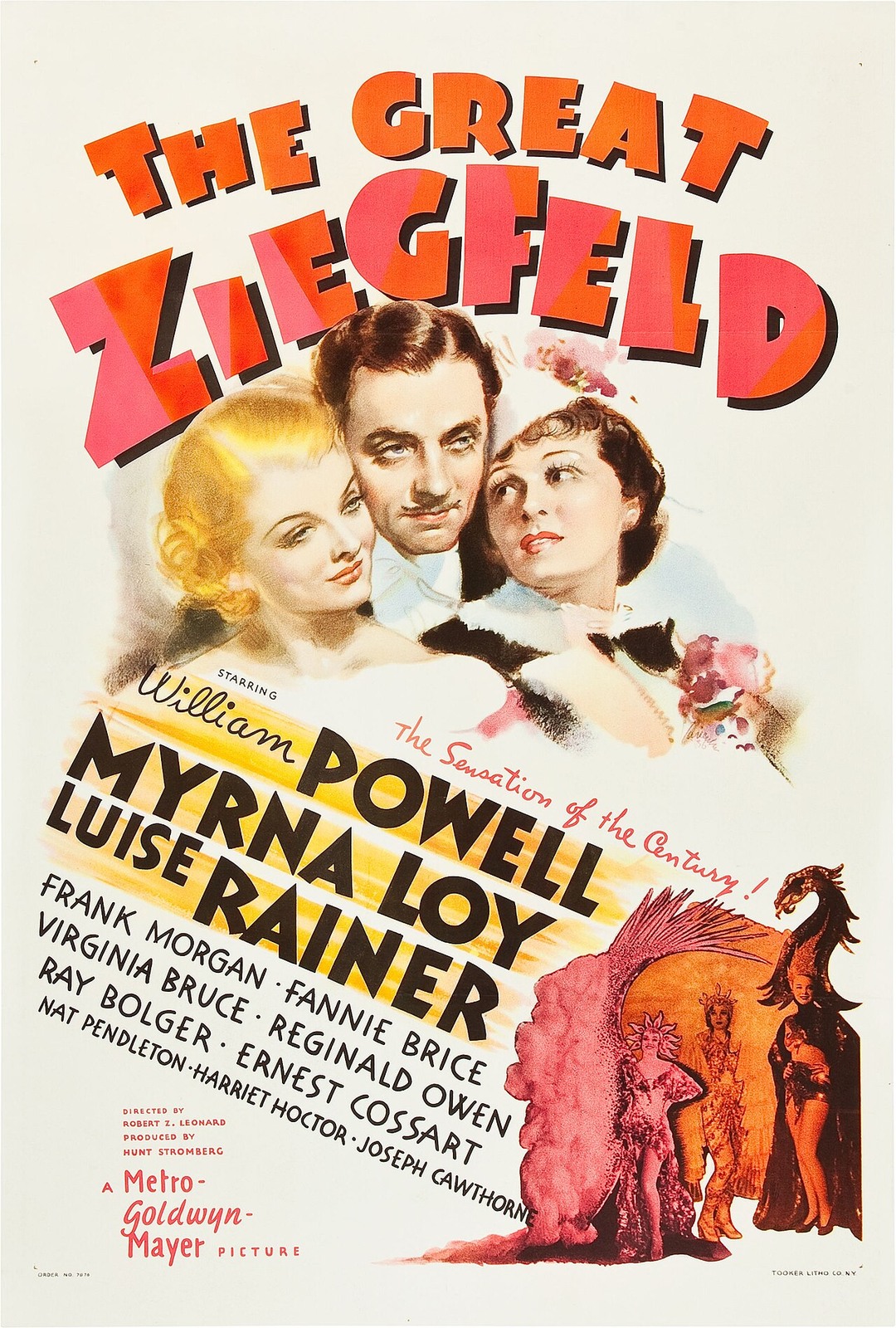 Theatrical poster for The Great Ziegfeld (1936). Image credit: Metro-Goldwyn-Mayer / Public domain, via Wikimedia Commons.
The film is built on an almost architectural scale. Sets expand, costumes multiply and the famous “A Pretty Girl Is Like a Melody” number keeps climbing until a stage revue has become a rotating monument to extravagance. Powell has to remain visible inside all that machinery. His Ziegfeld sells impossible dreams with the smooth certainty of a man who assumes the money will appear after the applause, and Powell makes charm look both productive and ruinous.
Loy’s Billie Burke arrives after Luise Rainer’s Anna Held has supplied the film’s most openly dramatic relationship. That structure gives Loy little chance to establish the kind of scene-by-scene rhythm she normally shared with Powell. What she does provide is a sense of home after spectacle: Billie understands the showman without competing with the show. It is graceful work, but we are ranking partnerships rather than Oscar-winning pageants. The film’s very size is the reason Powell and Loy can seem like guests in their own shared title.
Best for: fans of lavish 1930s musicals and studio-era spectacle.
11. Shadow of the Thin Man (1941)
The fourth Thin Man film sends Nick and Nora to the racetrack, where a jockey’s murder opens another web of gamblers, reporters and suspicious characters. Powell and Loy are still charming, and young Nicky Jr. is used lightly enough that the marriage retains its grown-up playfulness.
The mystery, however, is busier than it is memorable. Several suspects arrive before we have had time to enjoy the previous ones, and the series is beginning to repeat moves that once felt effortless. There are still good jokes, a lively wrestling-match sequence and the comforting pleasure of spending time with the Charles family. It is a pleasant later chapter, just not the chapter that converts new viewers.
 Lobby card for Shadow of the Thin Man (1941). Image credit: MGM / Public domain, via Wikimedia Commons.
The racetrack setting should be ideal for Nick and Nora. It provides money, gossip, crooked loyalties and a crowd in which every confident stranger might know more than he admits. The film’s most enjoyable stretches let Powell drift through that world as though investigation were simply another form of socialising. Loy is just as important: Nora’s questions can sound innocent while nudging a witness into revealing exactly what Nick needs.
By the fourth entry, though, the series is negotiating its own familiarity. We know the dinner-table questioning, the eccentric suspects and the moment when Nick gathers everybody together. Comfort is part of the appeal, but repetition makes the plot feel more crowded than dangerous. The wrestling sequence briefly restores the old unpredictability because it drops the immaculate couple into a noisy public spectacle. Watch Powell and Loy during the commotion rather than only at the centre of it; their reactions still create a private comedy even when the mystery is working too hard.
Best for: established Thin Man fans who already enjoy the recurring world.
10. Song of the Thin Man (1947)
Nick and Nora’s final case moves through jazz clubs, musicians and a murder aboard a gambling ship. The setting gives the series a slightly different pulse, and the film has fun with Nick trying to translate the slang of a younger musical crowd. Keenan Wynn adds welcome energy as clarinet player Clarence “Clinker” Krause.
There is also an unavoidable feeling of farewell. Powell and Loy remain more appealing than the mystery built around them, yet the once-dangerous socialites have become respectable screen parents. We still believe their affection, which is why the film works as a goodbye. Watch it after the earlier mysteries and it feels cosy; watch it first and you may wonder what all the excitement was about.
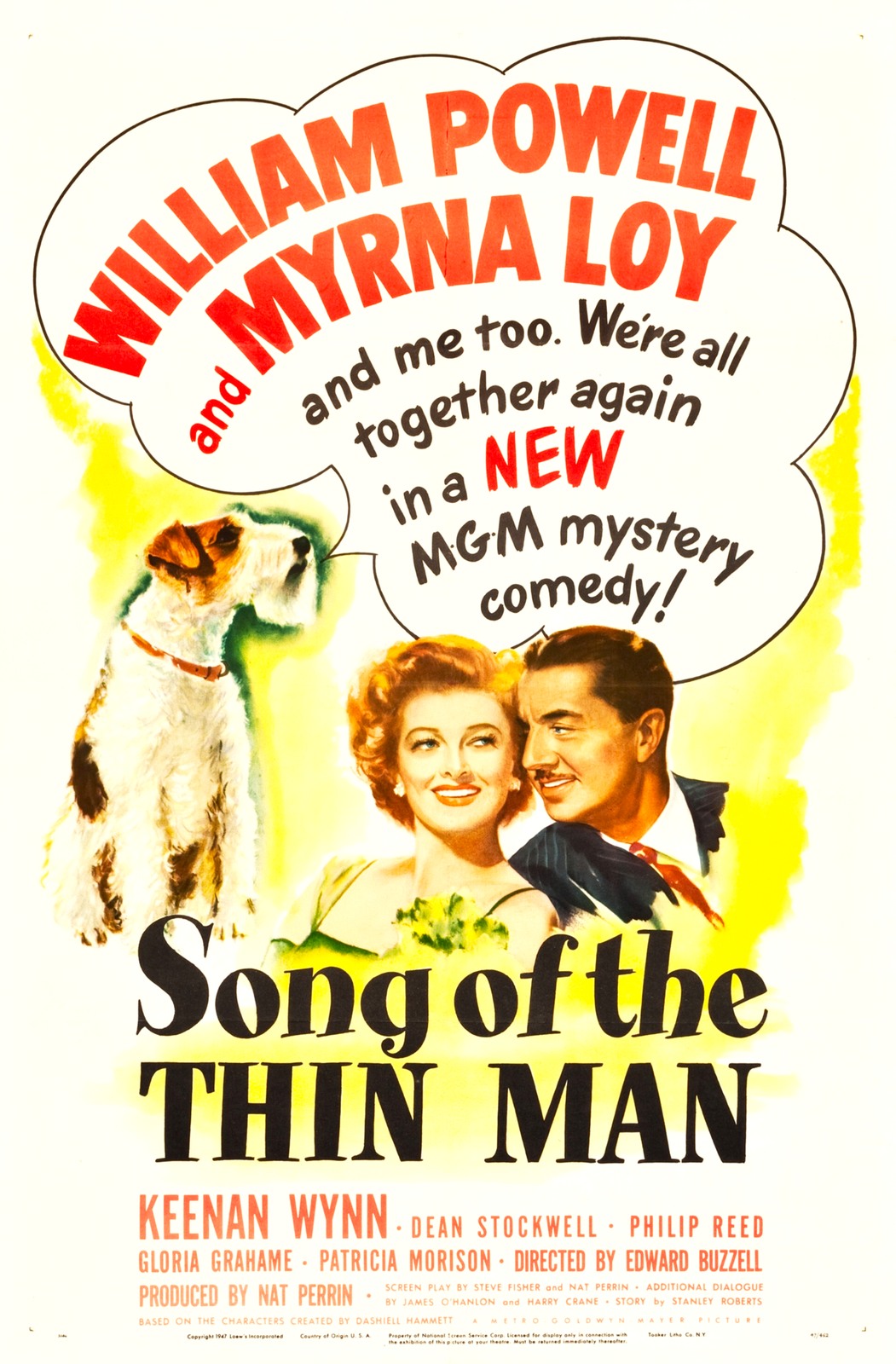 Theatrical poster for Song of the Thin Man (1947). Image credit: Loew’s Inc. / Public domain, via Wikimedia Commons.
The jazz world gives the final mystery a useful generational tension. Nick has always been a man who can move between respectable drawing rooms and less respectable night life, but now the younger musicians possess a language and tempo that even he must decode. Keenan Wynn’s Clinker becomes a comic guide, and the slang jokes work best when Powell lets Nick’s bewilderment show without sacrificing his authority.
There is a melancholy pleasure in seeing Powell and Loy refuse to force the earlier films’ speed. Nora still delights in Nick’s methods, and Nick still treats her curiosity as part of the investigation rather than an inconvenience. Yet the atmosphere has changed around them. The dangerous newlyweds of 1934 now have a family, a reputation and a son old enough to observe the performance. The film is not a triumphant finale, but it is an affectionate one. Its value grows when you arrive after the other five cases and recognise how long the Charleses have been keeping each other amused.
Best for: completing the series in order.
9. The Thin Man Goes Home (1945)
The fifth mystery takes Nick back to his childhood home, where his father remains unimpressed by the famous detective. The change of setting is useful: instead of another hotel suite or nightclub, we get small-town suspicion, family embarrassment and Nora’s determined attempt to prove that Nick is every bit as impressive as she thinks he is.
Wartime production conditions altered the series’ usual cocktail-soaked tone, and W. S. Van Dyke was no longer directing. The mystery can feel mechanically plotted, but Loy is delightful whenever Nora decides to help and makes everything more complicated. The film survives because the marriage does. You may forget the culprit, but you will remember Nora buying Nick an absurd birthday present and refusing to lose faith in him.
 Theatrical poster for The Thin Man Goes Home (1945). Image credit: Loew’s Inc. / Public domain, via Wikimedia Commons.
Sending Nick home creates a revealing comic reversal. Everywhere else he is the famous detective whose relaxed manner conceals control. In Sycamore Springs he becomes somebody’s son, and his father’s disappointment reduces him to the role of a clever boy who never chose the proper profession. Powell lets a little adolescent defensiveness disturb Nick’s usual ease without turning the character petulant.
Nora understands the situation immediately. Her campaign to make the family appreciate Nick is loving, meddlesome and completely consistent with the woman we met in the first film. Loy is particularly funny when Nora believes she is improving matters while Nick can see the next embarrassment approaching. The reduced emphasis on cocktails is noticeable, and the small-town suspects lack the metropolitan sparkle of the early cases. Even so, the film finds something new in the marriage: Nora is not merely fascinated by her husband. She is proud of him and cannot resist organising a demonstration.
Best for: viewers who like the Charleses most when family life disrupts the detective work.
8. Double Wedding (1937)
Powell plays a bohemian trailer-dweller who decides that Loy’s tightly organised Margit needs to stop managing everybody else’s life. She naturally considers him intolerable. He naturally decides to prove that she is not as immune to him as she believes. The plot pushes hard, but the stars make the battle feel like a private game.
This is Powell and Loy in full screwball-comedy mode, without a corpse to organise the story. Loy’s controlled irritation is especially funny because we can see curiosity growing underneath it. The film lacks the elegance of their very best comedies, and some of Powell’s romantic tactics belong firmly to their era, yet their timing carries it over the rough patches.
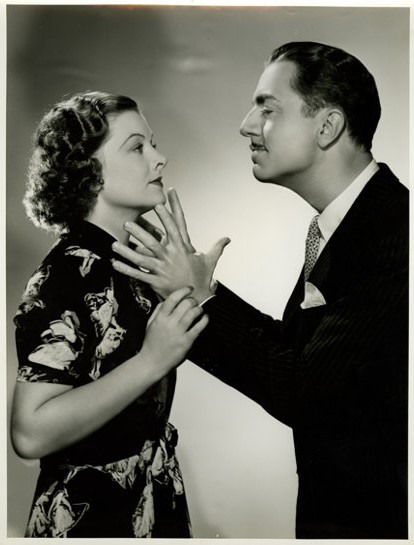 MGM publicity still of William Powell and Myrna Loy in the film Double Wedding (1937) Image credit: Photo by Clarence Bull / Public domain, via Wikimedia Commons.
The film works because Powell and Loy understand that romantic combat needs pleasure as well as resistance. Powell’s Charlie behaves outrageously, but his eyes keep inviting Margit to recognise the game. Loy answers by making control look like a genuine temperament rather than a temporary obstacle to romance. Margit has built her identity around managing the people she loves; surrendering a little authority therefore feels riskier than the plot admits.
The bohemian-versus-planner opposition is broad, and modern viewers may reasonably object to some of Charlie’s determination to “liberate” a woman who has not requested his help. What saves the comedy is Loy’s refusal to be overpowered as a performer. She can freeze a room with disapproval, then reveal in the smallest pause that Margit is tempted by the disorder. The picture also carries a difficult production history: filming was interrupted by Jean Harlow‘s death, a devastating loss for Powell. That knowledge adds poignancy to the professionalism and energy he brings to the finished comedy.
Best for: anyone who wants the pair bickering their way into love.
7. Manhattan Melodrama (1934)
Their first film together is better known for its off-screen place in American history, but the movie itself deserves attention. Powell and Clark Gable play boyhood friends who grow into opposite sides of the law, while Loy’s Eleanor becomes emotionally connected to both men. The result is a brisk moral drama about loyalty, ambition and the price of choosing a code.
Powell and Loy had not yet developed the teasing intimacy of The Thin Man, released later that year. Even so, you can already see how naturally they listen to one another. Loy is not merely the woman between two men; she makes Eleanor’s decisions feel thoughtful and costly. This is the partnership before it knew exactly what it could become.
 Theatrical poster for Manhattan Melodrama (1934). Image credit: MGM / Public domain, via Wikimedia Commons.
The triangle is more interesting than a simple contest between the good man and the dangerous man. Gable’s Blackie is loyal within his own code; Powell’s Jim is honourable but increasingly tied to public responsibility; Loy’s Eleanor has to decide which kind of life she can inhabit. The film keeps asking whether private affection can survive choices that have public consequences.
Loy and Powell’s scenes are quieter than the ones that would make them famous, but the quiet is useful. Jim listens to Eleanor, and Powell gives the listening weight. Loy, meanwhile, makes her change of allegiance feel like moral recognition rather than a screenwriter moving the heroine towards the safer husband. W. S. Van Dyke’s pace prevents the melodrama from becoming solemn. The film’s association with John Dillinger’s final night later became part of its legend, but the better reason to watch is on screen: we can see three stars sharpening one another just before Powell and Loy discovered an entirely different kind of partnership.
Best for: seeing the first appearance of a screen team in a serious register.
6. Another Thin Man (1939)
The third series entry introduces Nick Jr. without entirely domesticating his parents. Nick and Nora visit a wealthy industrialist who fears for his life, a murder follows and the Charleses move through another crowded field of secrets. The climactic birthday party, filled with ex-convicts from Nick’s past, is the film’s warmest reminder that respectability will never quite contain him.
The mystery is less clean than the first two, but the household comedy is very good. Powell’s Nick is amused by fatherhood rather than transformed by it, while Loy lets Nora be affectionate, intelligent and mischievous at once. We ranked it above the later sequels because the series still feels connected to the sophisticated, slightly disreputable world that made it distinctive.
 Theatrical poster for Another Thin Man (1939). Image credit: MGM / Public domain, via Wikimedia Commons.
Fatherhood could easily have ruined the series by converting Nick and Nora into conventional screen parents. Instead, the baby becomes another object around which their unusual household arranges itself. Nick does not acquire a lecture about responsibility, and Nora does not lose her appetite for a case. Their nursery is simply added to the cocktails, criminals and late-night visitors that already make up life with the Charleses.
The birthday party is the film’s inspired answer to domestic respectability. Nick’s old acquaintances arrive with prison records and genuine affection, turning the child’s celebration into a reunion no polite family would plan. Powell plays Nick’s comfort among them without condescension, while Loy treats the guests as part of the world she married into. The murder plot has too many moving parts, but the social details keep the film alive. It is the last sequel in which the series’ competing elements—wealth, crime, marriage and affectionate disorder—still feel naturally housed together.
Best for: viewers who want the Charles family expansion without losing the original tone.
5. I Love You Again (1940)
Powell begins as Larry Wilson, a painfully respectable civic leader who is struck on the head and discovers that he was once con man George Carey. Loy plays the wife who was preparing to divorce the dull version of him and becomes far more interested when his old personality returns. That premise gives both stars plenty to do.
Powell is wonderful at switching between wounded respectability and criminal confidence. Loy, meanwhile, refuses to play a passive reward: she watches, tests and gradually joins the joke. The film is sillier than their best work but beautifully suited to their ability to suggest a whole argument with a glance. It is one of the strongest recommendations on this list for viewers who have finished the major titles and want a discovery.
 Theatrical poster for I Love You Again (1940). Image credit: MGM / Public domain, via Wikimedia Commons.
Amnesia stories often ask an actor to play two people. Powell does something more entertaining: he lets George Carey discover the humiliating evidence of Larry Wilson’s life and then attempt to impersonate the man he used to be. Every civic honour, cautious habit and dreary acquaintance becomes a clue in a comic investigation of the self. Powell’s face can register criminal calculation and wounded vanity at the same time.
Loy’s Kay is the person best qualified to judge the transformation. She had stopped loving a husband who seemed embalmed in respectability; the arrival of danger and spontaneity makes him visible again. Yet Loy never lets Kay become a prize awarded to the more exciting personality. She tests George, recognises his tricks and chooses when to participate. The film’s real pleasure lies in watching the couple renegotiate a marriage through performance. It is also a fine example of director W. S. Van Dyke’s gift for moving quickly enough that an absurd premise feels like an opportunity rather than a problem.
Best for: a fast, playful amnesia comedy with real star chemistry.
4. Love Crazy (1941)
On their fourth wedding anniversary, a series of misunderstandings convinces Loy’s Susan that Powell’s Steve has been unfaithful. To delay the divorce, Steve attempts to prove that he is legally insane. This leads to disguises, physical comedy and Powell appearing in a form that first-time viewers should be allowed to discover for themselves.
The story sometimes strains for one complication too many, but Powell commits so completely that resistance becomes difficult. Loy is essential because Susan cannot merely stand outside the madness; she has to be smart enough to challenge it. Their characters spend much of the film separated or arguing, yet the comedy depends on our certainty that these two belong together.
 Theatrical poster for Love Crazy (1941). Image credit: MGM / Public domain, via Wikimedia Commons.
Powell’s performance is a sustained exercise in comic escalation. Steve begins by trying to repair a misunderstanding and ends up constructing a legal identity as an insane man, with every attempted solution creating a new piece of evidence against him. Powell could preserve elegance while falling downstairs, but here he repeatedly sacrifices it. The willingness to look ridiculous is what keeps Steve sympathetic when the plot becomes frantic.
Loy supplies the structure. Susan’s anger must be credible or Steve’s campaign has no stakes, yet the film cannot afford to make her humourless. Loy lets affection keep flickering through disbelief. Gail Patrick, as the woman at the centre of the misunderstanding, and Jack Carson add pressure without stealing the marital focus. The disguises are famous, but watch the smaller exchanges in which Susan decides whether to believe the latest impossible explanation. Powell creates the chaos; Loy tells us whether it has gone too far.
Best for: broad screwball comedy and Powell at his most shamelessly inventive.
3. After the Thin Man (1936)
The first sequel begins almost immediately after Nick and Nora return to San Francisco. Nora’s respectable family drags them into a case involving her cousin, a missing husband and a nightclub performer, while James Stewart appears in one of his most interesting early roles.
Sequels often repeat the surface of a hit. After the Thin Man understands its deeper pleasure: Nick and Nora are partners. Nora is not protected from the investigation; she is inside it, noticing people and puncturing Nick’s poses. The mystery is involving, the final revelation lands and the New Year’s Eve setting gives everything an extra fizz. It is longer than the original, but it earns most of that time.
 Lobby card for After the Thin Man (1936). Image credit: Metro-Goldwyn-Mayer / Public domain, via Wikimedia Commons.
The sequel widens Nora’s world by giving us her formidable San Francisco relatives. Their chilly respectability makes Nick’s amused informality feel almost rebellious, and Loy enjoys letting Nora be simultaneously part of the family and delighted by her husband’s refusal to behave for it. That tension gives the opening party more character than a routine return to the formula would have done.
James Stewart’s presence now carries the fascination of hindsight, but his performance works even if you forget the career ahead of him. He brings nervous sincerity to a mystery filled with people performing loyalty. The nightclub material also restores the first film’s movement between wealth and the urban night. Most importantly, Powell and Loy still seem to be discovering new ways to share a scene. Nora watches Nick think; Nick notices Nora noticing; a marriage becomes the film’s most reliable investigative partnership. The ending earns its effect because the actors have made every relationship readable before the explanation arrives.
Best for: anyone who finishes The Thin Man and wants the rare sequel that genuinely continues the fun.
2. Libeled Lady (1936)
This newspaper comedy surrounds Powell and Loy with Jean Harlow and Spencer Tracy, then lets all four stars compete for the sharpest scene. Powell plays a fixer hired to trap Loy’s wealthy Connie Allen in a compromising situation so that a newspaper can defeat her libel suit. The invented romance becomes inconveniently real.
Loy and Powell do not have the whole film to themselves, but every encounter matters. The trout-fishing sequence is a miniature lesson in comic performance: Powell tries to maintain control while nature, equipment and Connie quietly defeat him. Loy understands exactly when to let Connie see through the scheme and when to enjoy it. The ensemble is so strong that ranking it second is no consolation prize.
 Theatrical poster for Libeled Lady (1936). Image credit: Employee(s) of MGM / Public domain, via Wikimedia Commons.
The screenplay is a machine built from conflicting obligations. Spencer Tracy’s editor wants to save his newspaper, Jean Harlow’s Gladys wants him to honour their wedding plans, Powell’s Bill Chandler wants to prove he can still control a scheme, and Loy’s Connie wants to punish the paper without becoming anybody’s fool. Every solution requires somebody to pretend to love the wrong person, which means the comedy grows more dangerous as the feelings become real.
Powell and Loy are superb at letting expertise collapse. Bill enters as a professional manipulator; Connie gradually turns observation into power and makes him improvise. The trout sequence is not an isolated slapstick holiday. It is the moment his carefully manufactured persona meets a woman who is comfortable enough to enjoy his failure. Harlow’s open-hearted force and Tracy’s exasperation keep the film from becoming a two-star display, but Powell and Loy give it its romantic intelligence. Their chemistry is less cosy than Nick and Nora’s and, for one film, wonderfully uncertain.
Best for: viewers who want one of the great four-star comedies of the 1930s.
1. The Thin Man (1934)
This is where you should start. Powell’s Nick Charles is a former detective hoping to enjoy retirement, Loy’s Nora is his wealthy and delighted wife, and a missing inventor draws them into a murder case. The mystery is neat, but the marriage changed the temperature of the detective film.
Nick and Nora flirt, drink, investigate and laugh at the same world. Nora does not ask Nick to become respectable; she wants to come along. Powell makes deduction look like a social skill, while Loy turns curiosity into an expression of love. Their ease feels modern because the film allows a married couple to be friends, equals and romantic partners at the same time.
Other films on this list are bigger, stranger or more polished. None captures the reason for the partnership so completely. If you only watch one William Powell and Myrna Loy film, make it The Thin Man.
 Theatrical poster for The Thin Man (1934). Image credit: Employee(s) of MGM / Public domain, via Wikimedia Commons.
The speed still feels miraculous. Scenes begin late, jokes land while the mystery is advancing and Nick’s famous final gathering of suspects turns exposition into a dinner party. Director W. S. Van Dyke understood that the solution mattered less than the social pleasure of watching Nick move among people. Powell never seems to push for authority; he lets everyone underestimate how closely Nick has been listening.
Loy’s achievement is just as important. Nora could have been a rich wife decorating a detective story. Instead, she arrives in a bar carrying Christmas packages, falls over, orders a line of drinks to catch up with her husband and instantly changes the film. Her appetite—for experience, for gossip, for Nick—is the audience’s way into the story. Asta helps, the supporting cast is marvellously eccentric and the pre-Code atmosphere permits a looseness later sequels could only imitate. Yet the essential discovery is simple: the most exciting relationship in the room is the marriage.
Best for: first-time viewers, mystery fans and anybody who thinks screen marriage cannot be sexy or funny.
The best viewing order for beginners
If you want a short route through the partnership, watch The Thin Man, Libeled Lady, After the Thin Man, I Love You Again and Double Wedding. That gives you mystery, ensemble screwball comedy, a strong sequel and two examples of the pair working outside the Charles marriage.
If Nick and Nora are the main attraction, watch the six Thin Man films in release order. The quality gradually falls, but the changing portrait of the Charles household is part of the pleasure.
Final thoughts
Powell and Loy did not need to convince us that their characters had just fallen in love. Their greater trick was making us believe that love could become more entertaining once two people knew one another well. Across mysteries, melodramas, musicals and screwball comedies, they kept finding variations on that trust.
The list has one obvious winner, but it also has several films that deserve to escape the shadow of The Thin Man. Start at number one, then try Libeled Lady or I Love You Again. You may arrive for the sophistication. You will probably stay because these two always seem so pleased to find each other in the same scene.
Frequently asked questions
Did William Powell and Myrna Loy date in real life?
No. Their famous romance was a screen creation and a professional friendship. The ease between them was acting, timing and mutual trust rather than an off-screen affair.
How many Thin Man movies were there?
There were six, released between 1934 and 1947: The Thin Man, After the Thin Man, Another Thin Man, Shadow of the Thin Man, The Thin Man Goes Home and Song of the Thin Man.
Which Powell and Loy film should I watch first?
Start with The Thin Man. If you prefer pure comedy to mystery, choose Libeled Lady.