 Clark Gable in a colour studio portrait from 1949.
Clark Gable : Personal Info
Full name : William Clark Gable
Born : February 1, 1901, Cadiz, Ohio
Died : November 16, 1960, Los Angeles, California
Nationality : American
Occupations : Actor, United States Army Air Forces officer
Years active : 1924-1960
Known for : Red Dust, It Happened One Night, Mutiny on the Bounty, San Francisco, Gone with the Wind, Mogambo, Run Silent, Run Deep, The Misfits
Major honors : Academy Award for Best Actor for It Happened One Night; two additional Best Actor nominations; military decorations for Second World War service
Clark Gable : Introduction
Clark Gable was called the “King of Hollywood,” a title that sounds like pure studio publicity until you watch how naturally he occupies the centre of a film. He could command a room without appearing formal, make arrogance entertaining and allow a flash of embarrassment to keep masculine confidence from turning into a monument.
That combination made him invaluable to MGM during the 1930s. Gable could play adventurers, reporters, test pilots, gamblers, plantation owners and men carrying more charm than moral discipline. Opposite stars including Joan Crawford, Jean Harlow, Myrna Loy, Claudette Colbert, Vivien Leigh and Ava Gardner, he adjusted the balance without surrendering his identity.
The famous roles remain famous for good reasons. It Happened One Night reveals an unexpectedly relaxed comedian. Gone with the Wind uses his amused scepticism to puncture romantic grandeur even as Rhett Butler participates in it. The Misfits, completed shortly before his death, strips the star image down to a tired man confronting a world that no longer values his code.
Gable’s life also contained losses and contradictions that resist the smoothness of legend: a difficult climb through touring companies, five marriages, the death of Carole Lombard, military service in middle age and a daughter he did not publicly acknowledge. The most useful biography does not use those facts to cancel the star. It asks how a carefully trained actor made effort look effortless.
Clark Gable : Childhood in Ohio
William Clark Gable was born in Cadiz, Ohio, to William Henry Gable, who worked in oil drilling, and Adeline Hershelman Gable. His mother died before he was a year old. His father later married Jennie Dunlap, who encouraged Clark’s interest in music and presentation while the family moved through Ohio communities.
Gable left school as a teenager and worked in a tyre factory. Seeing a stage production awakened an ambition that had little practical support. He found low-level theatre work, returned home during his stepmother’s final illness, worked with his father in the Oklahoma oil fields and then resumed the uncertain life of a travelling performer.
The Los Angeles Times obituary published after Gable’s death preserves the rough outline: stock-company failures, labouring jobs, a period selling neckties and work as a telephone lineman in Portland. The story later fitted Hollywood’s preferred image of self-made masculinity, but the climb depended upon training as well as endurance.
Clark Gable : Josephine Dillon and Learning the Craft
In Portland, Gable met Josephine Dillon, an actress and acting coach who became his first wife. She was older, professionally experienced and instrumental in developing his voice, posture and stage technique. Accounts that describe her contribution only as a makeover miss the seriousness of the work. The deepened vocal placement and disciplined physical stillness became essential parts of the screen performer.
The couple moved to Hollywood, where Gable found extra work in silent films, but immediate success did not follow. He returned to theatre, toured and gained Broadway experience. His marriage to Dillon ended in 1930. He then married Maria Franklin Prentiss Lucas Langham, another older and financially secure woman, as his film career was beginning to move.
Gable’s early history complicates the myth that the camera simply discovered a naturally commanding man. His screen ease was built through years of coaching, rejection and stage repetition. By the time sound cinema needed actors who could speak without theatrical stiffness, he was prepared.
Clark Gable : Villains, Gangsters and MGM
Gable’s force registered quickly in early sound films. In The Painted Desert and Night Nurse, he played hard men without asking the audience for approval. A Free Soul placed him opposite Norma Shearer as a gangster whose sexuality and violence are equally dangerous. MGM recognised that the same threatening energy could be redirected into romantic stardom.
He appeared with Joan Crawford in films including Dance, Fools, Dance, Possessed and Dancing Lady. Their chemistry helped establish a durable Gable pattern: the woman was not merely conquered but allowed to challenge, mock or expose him. He made several memorable films with Jean Harlow, including Red Dust, Hold Your Man and China Seas. Harlow’s quick irreverence prevented his confidence from becoming solemn.
Red Dust (1932) is particularly revealing. Gable’s plantation manager appears to control the environment, yet the film is most alive when Harlow disrupts his authority. The later remake Mogambo would return Gable to a related role with Ava Gardner and Grace Kelly, allowing age and weariness to alter the same basic romantic geometry.
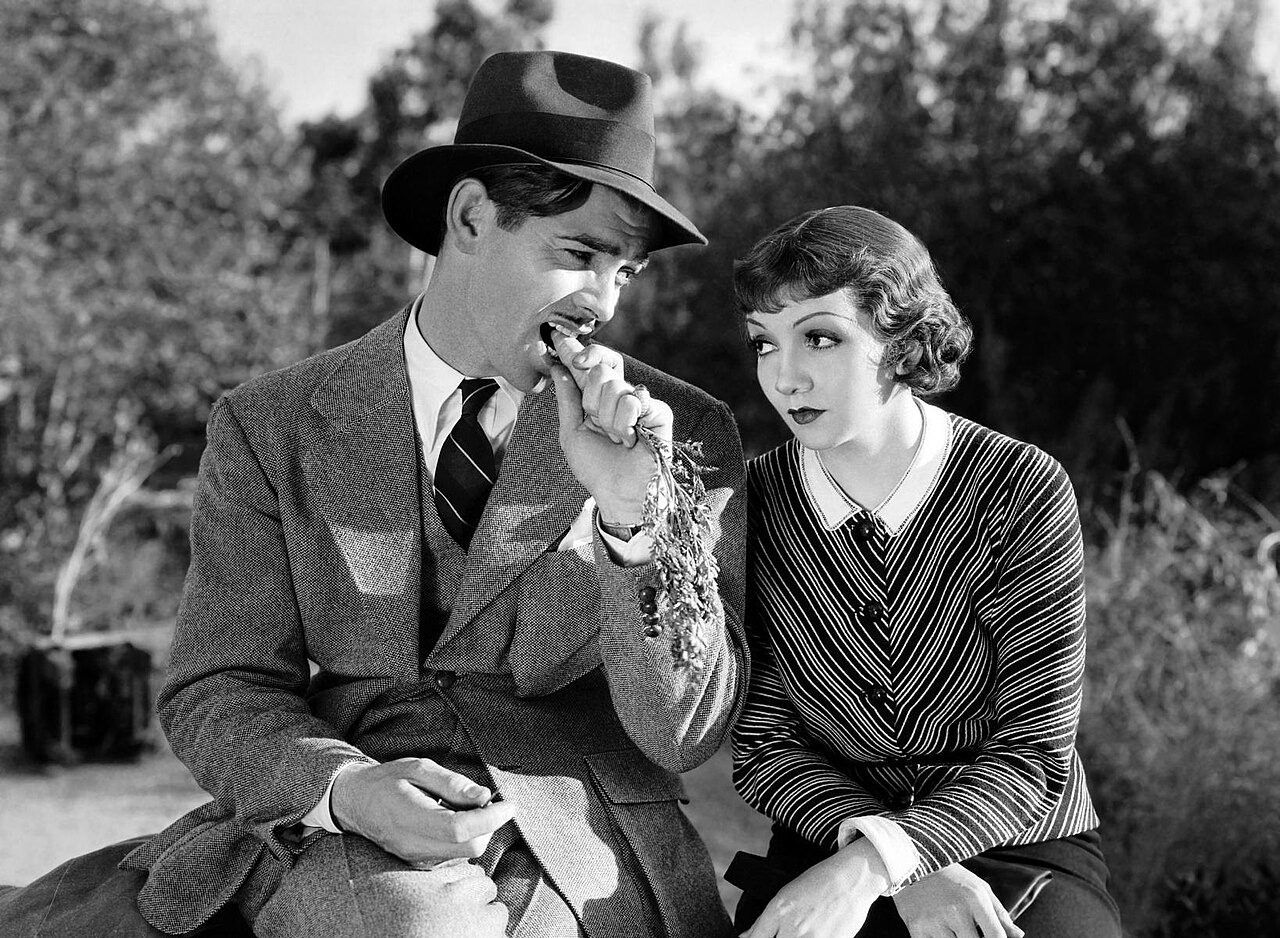 Clark Gable and Claudette Colbert in It Happened One Night (1934).
Clark Gable : It Happened One Night and an Oscar
MGM loaned Gable to Columbia for Frank Capra’s It Happened One Night (1934), a production later surrounded by stories that its stars expected little from it. Whatever their initial feelings, Gable and Claudette Colbert created one of the defining romantic-comedy partnerships.
Gable plays Peter Warne, a reporter who discovers that a runaway heiress is his route back to a headline. The performance loosens nearly every element of the MGM image. Peter is clever but frequently ridiculous, masculine but not invulnerable, and most attractive when forced into companionship rather than conquest. Gable’s comic timing depends on reaction: the moment after confidence fails is often funnier than the boast that preceded it.
The film became the first to win the five major Academy Awards then recognised as picture, directing, adapted screenplay, actor and actress. The Academy’s 1935 ceremony record confirms Gable’s Best Actor win. The Oscar did more than reward a hit. It established that his personality could carry sophisticated comedy as securely as melodrama.
Clark Gable : Mutiny, San Francisco and the MGM Peak
Gable’s 1930s career demonstrates how effectively MGM built variety around a stable star identity. In Mutiny on the Bounty (1935), his Fletcher Christian resists Charles Laughton’s Captain Bligh with a combination of moral anger and physical command. The role brought another Oscar nomination.
San Francisco (1936) pairs him with Spencer Tracy and Jeanette MacDonald in a story that moves from entertainment-world rivalry to civic catastrophe. Gable’s saloon owner Blackie Norton begins by treating affection and loyalty as extensions of possession. The earthquake breaks the confidence on which the character’s authority depends.
He also made adventure films, aviation dramas and romantic melodramas. Gable rarely disappeared into a role in the manner later associated with transformational acting. His value lay elsewhere. He brought a recognisable public character into new moral weather and let the audience measure how far that character could bend.
The “King” title became part of the brand. Turner Classic Movies’ career profile describes the appeal as a mixture of roguish charm and masculine command. The description is accurate, but the humour matters equally. Gable’s authority remained popular because he so often allowed a co-star to puncture it.
Clark Gable : Rhett Butler and Gone with the Wind
Rhett Butler in Gone with the Wind (1939) was the role audiences already associated with Gable before production began. The casting joins star and character so completely that it can be difficult to see the craft. Rhett watches other people perform their beliefs. His raised eyebrow and delayed smile make him the film’s sceptical spectator as well as its romantic lead.
Opposite Vivien Leigh’s Scarlett O’Hara, Gable balances attraction, irritation and recognition. Rhett understands Scarlett’s appetite because he shares it, but he also underestimates how completely survival has organised her emotional life. Their scenes work through shifts of power rather than simple seduction.
The film’s enormous cultural position requires historical honesty. Its romance is built within a nostalgic representation of slavery and the Confederacy that distorts the realities of the American South. A modern viewer can admire performance and filmmaking while refusing the racial mythology surrounding them. Gable’s Oscar-nominated work remains important, but importance is not the same as moral innocence.
Clark Gable : Carole Lombard
Gable married actor Carole Lombard in March 1939. Their relationship became one of classic Hollywood’s most enduring love stories, strengthened in public memory by its brevity and tragic end. Lombard was a major comedy star with a strong professional identity, not simply the lively wife who softened a king.
On January 16, 1942, Lombard was returning from a war-bond tour when her plane crashed near Las Vegas, killing everyone aboard. Gable joined the search and was devastated by confirmation of her death. Later accounts sometimes turn every subsequent decision into a direct consequence of the loss. Grief clearly marked him, but biography should be cautious about claiming access to motives he did not fully document.
The marriage nevertheless occupies a central place in his story because friends and colleagues recognised its importance and because Gable preserved a connection to Lombard’s memory for the rest of his life. His decision to enter military service later that year occurred within both personal grief and a wider national mobilisation.
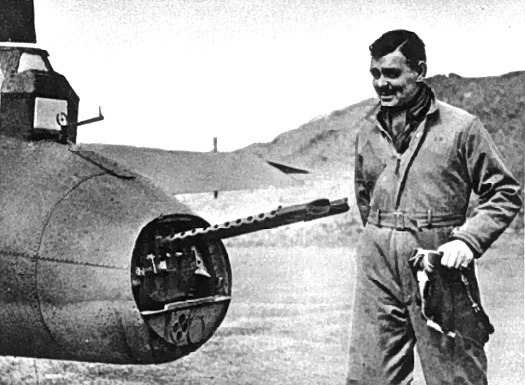 Clark Gable with the Eighth Air Force in Britain in 1943.
Clark Gable : Second World War Service
Gable enlisted as a private in the United States Army Air Forces on August 12, 1942, when he was forty-one. He completed officer training, attended aerial-gunnery school and went to England to work on a film about aerial gunners.
His assignment was not simply ceremonial. The National Museum of the United States Air Force records that Gable flew operational missions in B-17 aircraft to obtain combat footage for Combat America. He returned to the United States in 1943 and left active duty as a major in 1944.
Hollywood stars performed many different forms of wartime service, from combat duty to training films, bond tours and morale work. Gable’s fame made the assignment useful to military publicity, but fame did not remove the physical danger. The experience added a real military history to a screen image already associated with risk and command.
Clark Gable : Return to MGM
Gable returned to films with Adventure (1945). The advertising promised that “Gable’s back,” but the postwar career could not simply restore 1939. He was older, the studio system was changing and the carefree edge of the earlier persona had darkened.
There were notable successes. The Hucksters satirised advertising and commercial compromise. Command Decision gave him a demanding role as an officer responsible for sending men into lethal missions. Mogambo (1953), directed by John Ford, revisited the terrain of Red Dust in colour and on African locations, pairing him with Ava Gardner and Grace Kelly.
Gardner’s vitality and Kelly’s control place the ageing Gable between different forms of female stardom. His performance accepts fatigue rather than pretending the old romantic formula has not changed. The film was a major success and demonstrated that maturity could add texture to the image.
His long MGM contract ended after Betrayed (1954). Freelancing gave him greater financial control and led to films including The Tall Men, Teacher’s Pet and Run Silent, Run Deep. The results varied, but leaving MGM freed him from the obligation to behave as though the studio-era king still ruled an unchanged kingdom.
Clark Gable : Marriages, Fatherhood and Private Contradictions
After Lombard’s death, Gable married British socialite and former actor Sylvia Ashley in 1949; they divorced in 1952. In 1955 he married Kay Williams Spreckels. Their son, John Clark Gable, was born several months after Gable’s death.
Gable was also the biological father of Judy Lewis, born to actor Loretta Young in 1935 after they worked together on The Call of the Wild. Lewis was raised publicly as Young’s adopted daughter and later wrote about discovering her parentage. Gable did not publicly acknowledge her as his daughter during his lifetime.
The circumstances of the relationship between Gable and Young have been described differently across decades, including serious claims relayed by Young’s family after both stars had died. Because the principals did not leave a jointly testable account, this article does not claim certainty about private events beyond Lewis’s parentage and Gable’s lack of public acknowledgement. The history deserves recognition without turning unresolved evidence into dramatic fact.
Clark Gable : The Misfits and Final Performance
Gable’s final film was John Huston’s The Misfits, written by Arthur Miller and co-starring Marilyn Monroe, Montgomery Clift and Thelma Ritter. He plays Gay Langland, an ageing cowboy who captures wild horses for sale. The character’s freedom has become an economic and emotional trap.
The film uses Gable’s history with unusual candour. Gay still carries physical authority, but the world around him questions its purpose. His independence depends on avoiding lasting responsibility, and Monroe’s Roslyn recognises cruelty where he sees tradition. Their conflict makes the performance more than a late variation on rugged charm.
Filming in Nevada was difficult, and stories later connected the production’s physical demands to Gable’s death. A responsible account should avoid claiming a direct medical cause that cannot be established from production legend. Gable suffered a heart attack on November 6, 1960, and died in hospital on November 16. The contemporary Los Angeles Times report recorded that he had completed his final scenes shortly before being taken ill.
The Misfits was released in 1961. Knowledge of what followed gives the film unavoidable sadness, but the performance should not be reduced to an obituary. Gable is attentive, weathered and willing to let the myth of masculine freedom become a subject of criticism.
Clark Gable : Acting Style and Legacy
Gable’s technique depended on economy. He used posture and vocal weight to establish authority, then introduced a small hesitation, grin or sideways glance that made the authority human. He was particularly responsive to strong female co-stars. Crawford, Harlow, Colbert, Leigh, Gardner and Monroe do not merely orbit him; they change the temperature and meaning of his confidence.
The screen masculinity can now look tied to its period, especially when films excuse coercion or treat dominance as romance. Yet his best work is more flexible than the stereotype. Peter Warne is funny because he fails. Rhett Butler is compelling because scepticism cannot protect him from emotional blindness. Gay Langland becomes tragic because the code that shaped him has outlived its usefulness.
Gable remains one of the central figures of classic Hollywood because he made a manufactured title feel conversational. The “King” was built by MGM, publicity and audience desire, but the actor underneath survived the crown through humour, rhythm and the intelligence to share a scene.
Selected Clark Gable Filmography
1931 – A Free Soul : Breakthrough gangster role opposite Norma Shearer
1931 – Possessed : Important early pairing with Joan Crawford
1932 – Red Dust : Defining adventure romance with Jean Harlow
1934 – It Happened One Night : Academy Award-winning romantic comedy
1935 – Mutiny on the Bounty : Oscar-nominated role as Fletcher Christian
1936 – San Francisco : Major MGM disaster drama
1939 – Gone with the Wind : Oscar-nominated performance as Rhett Butler
1940 – Boom Town : Oil-field drama with Spencer Tracy
1948 – Command Decision : Serious postwar military drama
1953 – Mogambo : Adventure romance with Ava Gardner and Grace Kelly
1955 – The Tall Men : Successful freelance western
1958 – Teacher’s Pet : Mature comedy opposite Doris Day
1958 – Run Silent, Run Deep : Submarine drama with Burt Lancaster
1961 – The Misfits : Final film, released after his death
Clark Gable : Frequently Asked Questions
Why was Clark Gable called the King of Hollywood?
The title grew from studio publicity and his exceptional popularity during the 1930s. It endured because he remained a leading man across comedy, romance, adventure and drama.
What Oscar did Clark Gable win?
He won Best Actor for It Happened One Night. He was also nominated for Mutiny on the Bounty and Gone with the Wind.
Was Clark Gable really in the military?
Yes. He enlisted in the Army Air Forces in 1942, trained as an aerial gunner, flew operational missions while gathering footage for Combat America and left active duty with the rank of major.
How many times was Clark Gable married?
He married five times: Josephine Dillon, Maria Langham, Carole Lombard, Sylvia Ashley and Kay Williams Spreckels.
What happened to Clark Gable and Carole Lombard?
They married in 1939. Lombard was killed in a plane crash in January 1942 while returning from a war-bond tour.
What was Clark Gable’s final film?
His final film was The Misfits, co-starring Marilyn Monroe and Montgomery Clift. It was completed in 1960 and released after Gable’s death in 1961.
Related Articles
20 Classic Hollywood Actors Everyone Should Know
20 Movie Stars Who Defined Old Hollywood Glamour
Top 20 Best Black-and-White Movies for New Classic Film Fans