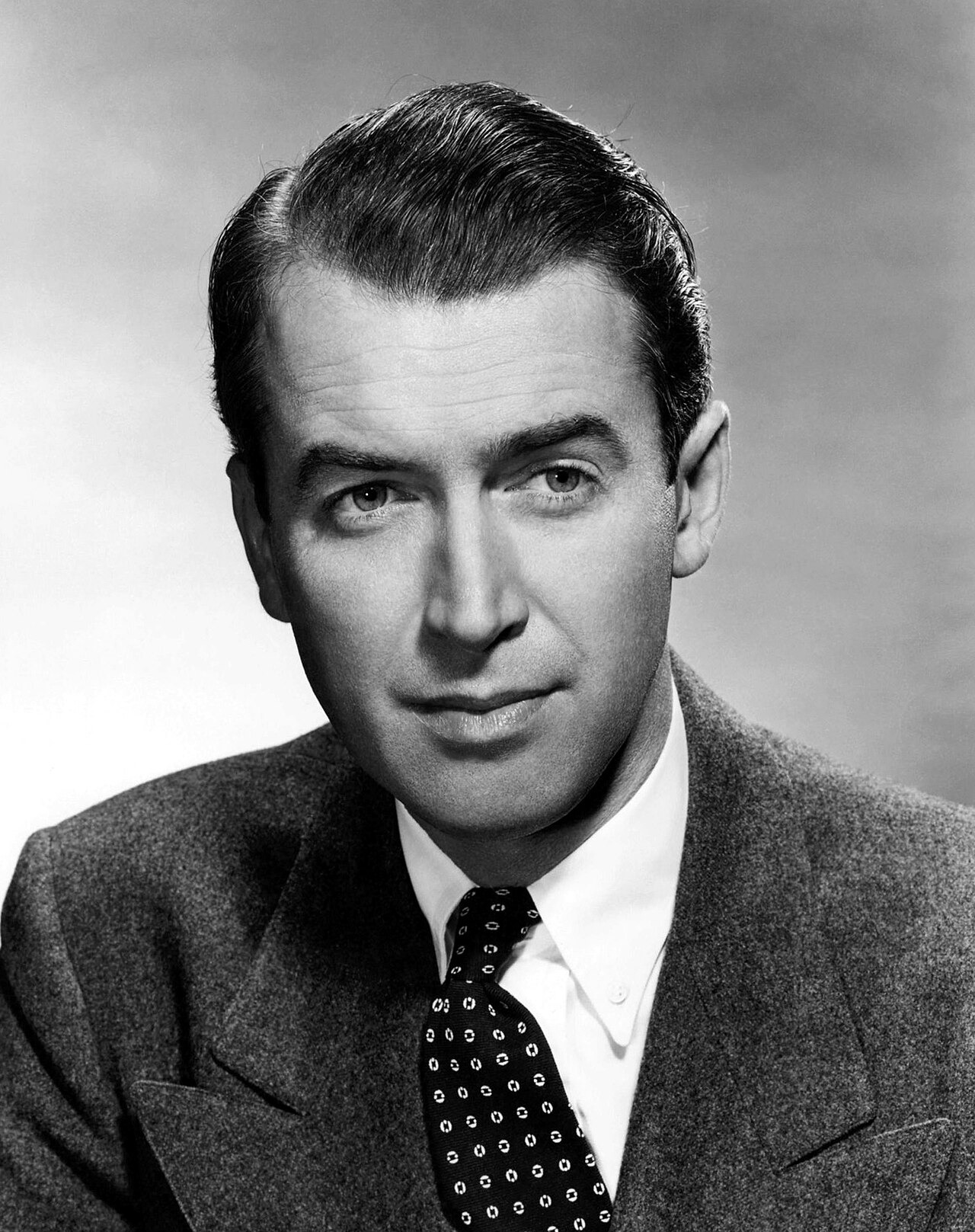
 James Stewart in a studio portrait associated with Call Northside 777.
James Stewart : Personal Info
Full name : James Maitland Stewart
Born : May 20, 1908, Indiana, Pennsylvania
Died : July 2, 1997, Beverly Hills, California
Nationality : American
Occupations : Actor, military officer, producer
Years active : 1932-1991 as a performer; 1941-1968 in active and reserve military service
Known for : Mr. Smith Goes to Washington, The Philadelphia Story, It’s a Wonderful Life, Harvey, Winchester ’73, Rear Window, The Man Who Knew Too Much, Vertigo, Anatomy of a Murder, The Man Who Shot Liberty Valance
Major honors : Academy Award for Best Actor; five competitive acting nominations; Honorary Academy Award; Presidential Medal of Freedom; Kennedy Center Honor; retired Air Force Reserve brigadier general
James Stewart : Introduction
James Stewart became one of Hollywood’s most trusted images of ordinary decency, then spent the second half of his career revealing the fear, anger and obsession that image could contain. The drawling voice, hesitant phrasing and long, slightly awkward body suggested a man inventing his words in the moment. Underneath the apparent naturalness was an exact performer with an unusually sharp understanding of reaction.
His best-known roles form part of American cultural memory: Jefferson Smith collapsing at the end of a filibuster, George Bailey raging against a life that feels trapped, Elwood P. Dowd introducing an invisible rabbit, L.B. Jefferies watching his neighbours and Scottie Ferguson trying to remake a woman into an image. These characters are linked by Stewart’s recognisable presence, but they are not one repeated everyman. They range from idealism to voyeurism, tenderness to coercion.
Stewart’s wartime service is inseparable from the career. He left Hollywood as an Oscar-winning star, flew combat missions in Europe and returned with experiences that altered both his private life and the emotional weight of his acting. The BFI’s career survey identifies the post-war darkness as central to his achievement. His authority came from allowing the good man to look breakable.
James Stewart : Pennsylvania Roots and Princeton
James Maitland Stewart grew up in Indiana, Pennsylvania, where his family operated a hardware store. The town later became central to the public idea of Stewart as a small-town American, but he was not simply waiting to be discovered as his future screen self. He studied architecture at Princeton University and showed enough ability to consider the profession seriously.
Theatre changed the direction of his life. At Princeton he became involved with the Triangle Club, then joined the University Players in Massachusetts after graduation. The company brought him into a circle that included Henry Fonda and Margaret Sullavan. Fonda became a lifelong friend and, for a time, a roommate in New York and Hollywood.
Stewart’s early stage work taught him to use qualities that conventional leading men might have tried to hide. The pauses, loose limbs and apparent uncertainty could create intimacy with an audience. Margaret Sullavan, an important early colleague, encouraged him to trust his own speech and manner rather than imitate a polished theatrical type.
James Stewart : MGM and the Discovery of a Screen Voice
MGM signed Stewart in the mid-1930s. Small roles gradually revealed that the camera responded to his listening. In Wife vs. Secretary and After the Thin Man he was not yet the fully formed star, but directors could see how a scene changed when his unease or sincerity entered it.
Frank Capra provided the decisive early vehicles. You Can’t Take It with You placed Stewart inside an ensemble comedy about individual freedom and family eccentricity. Mr. Smith Goes to Washington turned his apparent innocence into political drama. Jefferson Smith is naive, but the performance is not. Stewart makes idealism physically exhausting, allowing hope, humiliation and anger to occupy the same body.
Destry Rides Again, opposite Marlene Dietrich, demonstrated another useful variation: the mild man who understands violence but prefers not to advertise it. The Shop Around the Corner, directed by Ernst Lubitsch, used Stewart’s sensitivity in a more intimate register. His clerk Alfred Kralik can be proud, cruel, romantic and embarrassed, often within the same exchange.
James Stewart : The Philadelphia Story and an Oscar
In The Philadelphia Story, Stewart joined Katharine Hepburn and Cary Grant as tabloid reporter Macaulay Connor. The role combines outsider judgement, drunken romance and a grudging recognition of social complexity. Stewart’s loose, comic intoxication on the terrace remains one of his most delightful sequences.
He won the Academy Award for Best Actor. The Academy’s 1941 ceremony record confirms the win, although Stewart later treated it as recognition delayed from Mr. Smith Goes to Washington. His father displayed the statuette in the family hardware store, an anecdote that neatly joined Hollywood achievement to the Pennsylvania identity.
The Oscar might have marked the start of an uninterrupted star ascent. Instead, world events forced a different passage. Stewart was already a licensed pilot and became the first major American movie star to enter military service during the Second World War.
James Stewart : World War II Service
Stewart enlisted in the Army in March 1941 after initially failing the weight requirement. He did not want a ceremonial publicity assignment. After training and instructing, he joined combat operations with heavy bomber units in Europe, serving with B-24 Liberators and rising rapidly through responsibility as well as rank.
The U.S. Air Force Reserve’s account records twenty combat missions and his eventual retirement from the reserve as a brigadier general. Official histories also note decorations including the Distinguished Flying Cross and Air Medal. Military records are the proper basis for these claims; studio-era publicity often simplified or embellished wartime service.
Combat was not material Stewart exploited easily in later interviews. Biographers and colleagues describe its psychological cost, but diagnosis at a distance would be irresponsible. What can be observed is the change in his acting. The post-war voice carried more strain, anger arrived with frightening suddenness and moral certainty became harder to sustain.
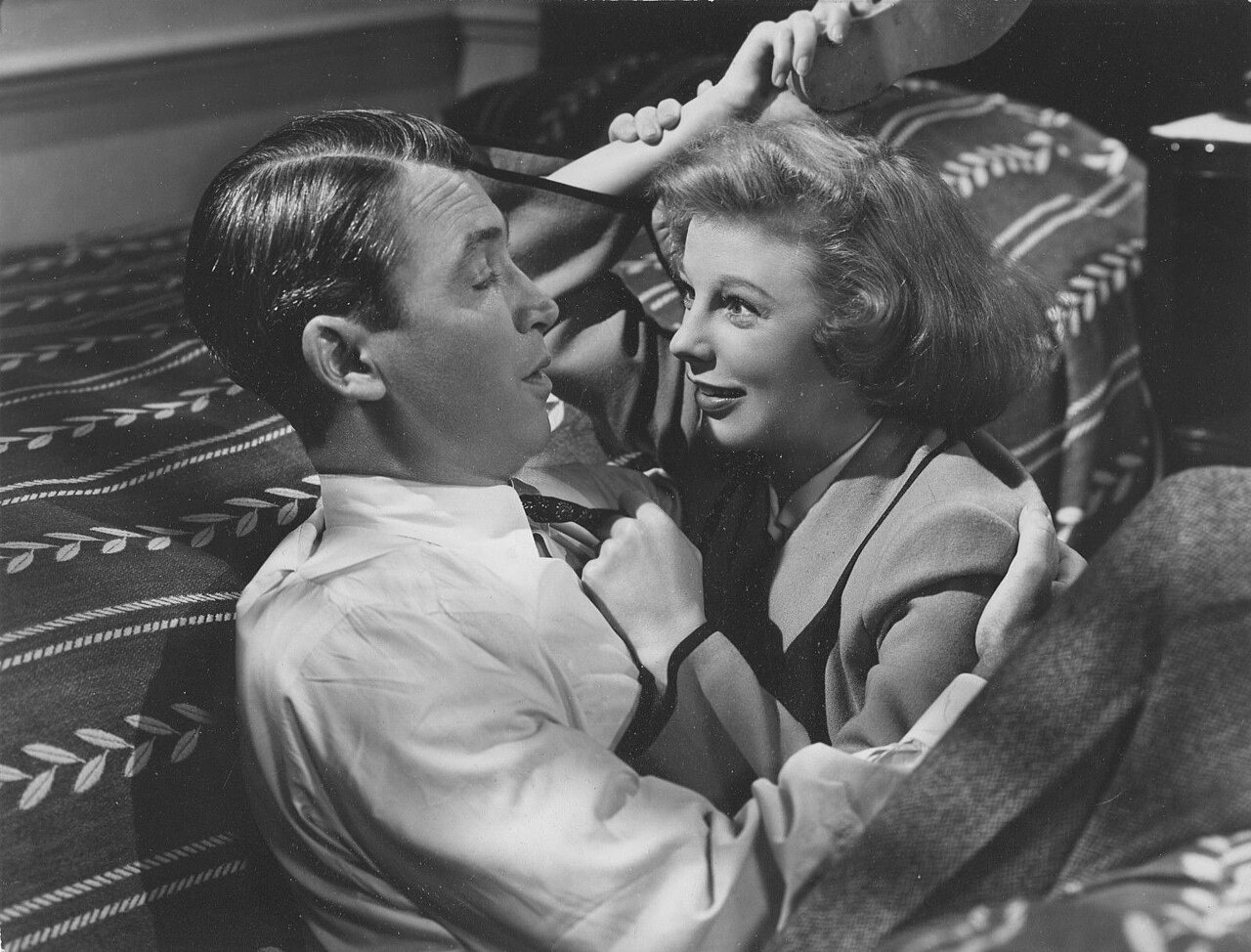 James Stewart and June Allyson in a publicity still for The Stratton Story (1949).
James Stewart : It’s a Wonderful Life and Post-War Disillusion
It’s a Wonderful Life was Stewart’s first film after the war and Frank Capra’s most enduring work. George Bailey is remembered as an emblem of decency, yet the performance spends much of its running time inside frustration. George resents sacrifice, wounds the people he loves and reaches a point at which he believes his absence would improve the world.
That darkness makes the final release meaningful. Stewart does not play despair as abstract nobility; he makes it humiliating, angry and frightening. The Academy notes that the film received five nominations, including Best Actor for Stewart and Best Picture. Its present status grew over time rather than emerging from immediate box-office triumph.
The film’s later association with Christmas can soften its severity. Watched closely, it is a drama about economic pressure, deferred ambition and the social networks that prevent individual collapse. Stewart’s performance connects the idealist of Mr. Smith to the wounded men who would dominate his 1950s work.
James Stewart : Harvey and the Uses of Gentleness
Harvey gave Stewart one of his most beloved roles as Elwood P. Dowd, a courteous drinker whose closest companion is an invisible six-foot rabbit. The temptation is to play Elwood as harmless whimsy. Stewart leaves open a more unsettling possibility: that Elwood’s gentleness is a deliberate withdrawal from a world organised around status and coercion.
The role earned another Oscar nomination and became a part Stewart returned to on stage and television. His control of pauses is essential. Elwood never rushes to prove his reality; he gives other people time to reveal their impatience. Stewart’s apparent passivity becomes a form of comic power.
This side of the actor remained important even as westerns and thrillers complicated his image. The contrast between kindness and volatility made both qualities more convincing. He could still offer reassurance, but audiences increasingly understood that reassurance as a choice rather than an absence of darkness.
James Stewart : Anthony Mann and the Psychological Western
Winchester ’73 began Stewart’s major collaboration with director Anthony Mann. Their westerns replaced uncomplicated frontier virtue with grievance, obsession and unstable violence. In Bend of the River, The Naked Spur, The Far Country and The Man from Laramie, Stewart’s characters carry histories they would prefer to hide.
The films also changed the economics of stardom. Stewart’s profit-participation arrangement on Winchester ’73 became an influential example of a leading actor accepting a stake in a film rather than only a conventional salary. The choice joined artistic reinvention to greater professional control.
In The Naked Spur, Stewart plays a bounty hunter whose moral purpose has become entangled with money and humiliation. His outbursts are startling because they emerge from the familiar voice and face. Mann uses landscape not as reassuring grandeur but as an external pressure on damaged men.
James Stewart : Hitchcock, Voyeurism and Obsession
Alfred Hitchcock understood that Stewart’s reputation could make morally compromised spectatorship feel intimate. Rope cast him as a teacher forced to confront how his ideas have been corrupted. Rear Window makes him a photographer confined to an apartment, turning curiosity about neighbours into a suspense plot and a study of voyeurism.
Opposite Grace Kelly, Stewart’s L.B. Jefferies is charming but evasive. His reluctance to commit and his pleasure in watching other lives are not treated as neutral. The suspense depends on whether he has seen a murder, but the emotional drama asks what kind of man prefers observation to participation.
The Man Who Knew Too Much uses family anxiety and an ordinary tourist’s helplessness. Vertigo goes much further. Scottie Ferguson becomes complicit in an attempt to transform Judy into the dead Madeleine, making romantic longing inseparable from control. The film’s later critical elevation reflects, in part, a willingness to confront how disturbing Stewart can be when the audience’s trust is turned against itself.
 James Stewart with Harry Morgan, Lisa Lu and fellow cast members in a press photograph for The Mountain Road.
James Stewart : Anatomy of a Murder and Mature Authority
Otto Preminger’s Anatomy of a Murder gave Stewart a role that appears relaxed but is strategically formidable. His small-town lawyer Paul Biegler uses humour, patience and apparent informality to control a courtroom. The performance draws on the old everyman manner while revealing its professional calculation.
The film’s frank treatment of rape, sexual history and legal strategy challenged Production Code conventions. Modern viewers should also recognize that the woman at the centre of the case is frequently interpreted through male argument. Stewart’s performance is compelling partly because it does not settle every question about Biegler’s ethics.
In John Ford’s The Man Who Shot Liberty Valance, Stewart plays an idealist whose public career depends on a violent act committed by another man. The famous conflict between fact and legend applies to Stewart’s own screen identity. The decent American figure remains useful, but the film asks what has been omitted to preserve him.
James Stewart : Acting Technique and the Art of Reaction
Stewart sometimes described his method modestly as reacting rather than acting. The phrase captures an important truth without explaining the preparation behind it. He listened with his whole body: head tilted, hands uncertain, sentences beginning before thought appeared complete. The effect invited viewers to discover emotion alongside him.
His voice was an instrument of unusual range. The familiar stammer could express shyness, moral effort or strategic delay. When anger arrived, the same voice could crack or harden. Directors built scenes around the audience’s awareness of what Stewart usually sounded like and the shock of hearing that sound under pressure.
Physical awkwardness was equally controlled. He could fold himself into furniture for comedy, stride with uneasy determination or make stillness feel like a pilot’s concentration. The technique looked unmanufactured because its visible purpose was always thought rather than display.
James Stewart : Family, Politics and Public Image
Stewart married Gloria Hatrick McLean in 1949 and adopted her two sons; the couple also had twin daughters. Their marriage lasted until Gloria’s death in 1994. Family life strengthened his public image as a stable private citizen, though a biography should distinguish that image from unknowable domestic complexity.
He was a conservative Republican and supported political candidates across several decades. His friendship with Henry Fonda survived profound political differences, an often-repeated example of personal loyalty that should not be used to erase the convictions themselves.
Stewart’s military record, marriage and screen roles combined into an image of national reliability. He participated in that construction but also repeatedly played characters who exposed its limits. The most honest account of his legacy holds both facts together.
James Stewart : Later Career, Honors and Death
Later films included Cheyenne Autumn, The Flight of the Phoenix and The Shootist, while television brought series and special appearances. Age reduced the range of leading roles, but Stewart’s voice and moral associations made even brief appearances culturally legible.
The Academy presented him with an Honorary Award in 1984. An official Academy centennial tribute summarises his five acting nominations, competitive win and honorary recognition. He also received the Presidential Medal of Freedom and a Kennedy Center Honor.
Stewart died in 1997. The tributes understandably emphasized decency, yet his greatest films resist simple reassurance. They show ideals tested by money, war, desire, fear and the human wish to believe a legend. He remains beloved because he could make goodness moving; he remains great because he knew goodness was difficult.
Selected James Stewart Filmography
1938 – You Can’t Take It with You : First major Frank Capra success
1939 – Mr. Smith Goes to Washington : Oscar-nominated political drama
1939 – Destry Rides Again : Comic western opposite Marlene Dietrich
1940 – The Shop Around the Corner : Ernst Lubitsch romantic comedy
1940 – The Philadelphia Story : Academy Award-winning performance
1946 – It’s a Wonderful Life : Defining post-war role as George Bailey
1950 – Harvey : Oscar-nominated performance as Elwood P. Dowd
1950 – Winchester ’73 : First major western with Anthony Mann
1953 – The Naked Spur : Dark psychological western
1954 – Rear Window : Hitchcock suspense classic with Grace Kelly
1958 – Vertigo : Obsessive Hitchcock masterpiece
1959 – Anatomy of a Murder : Oscar-nominated courtroom performance
1962 – The Man Who Shot Liberty Valance : John Ford’s meditation on legend
1965 – The Flight of the Phoenix : Survival drama
James Stewart : Frequently Asked Questions
Did James Stewart serve in combat?
Yes. He flew combat missions with heavy bomber units in Europe during the Second World War, remained in the Air Force Reserve and retired as a brigadier general.
What Oscar did James Stewart win?
He won Best Actor for The Philadelphia Story and later received an Honorary Academy Award. His other competitive nominations were for Mr. Smith Goes to Washington, It’s a Wonderful Life, Harvey and Anatomy of a Murder.
Why is It’s a Wonderful Life so important?
The film joins a hopeful communal ending to one of Stewart’s darkest performances. Its portrait of economic pressure, sacrifice and despair grew into a holiday tradition after its original release.
How many films did James Stewart make with Alfred Hitchcock?
He made four: Rope, Rear Window, The Man Who Knew Too Much and Vertigo.
What is the best James Stewart film to watch first?
It’s a Wonderful Life is the broadest introduction. Rear Window is ideal for suspense, The Shop Around the Corner for romance and Vertigo for the darkest challenge to his familiar image.
Related Articles
20 Classic Hollywood Actors Everyone Should Know
Top 20 Best Black-and-White Movies for New Classic Film Fans
20 Best Film Noir Movies Starring Hollywood Legends