Jean Harlow became a symbol before Hollywood discovered how funny she was. The platinum hair, pale satin dresses and open sexuality made her one of the most recognisable women of the early 1930s. Publicity treated her as pure physical effect. Her best films reveal a quicker and more practical performer, someone who could throw a line into a room, recognise hypocrisy and make glamour look like a job she understood better than the men paying for it.
Harlow died at twenty-six, so the career is often told as a rush towards tragedy. In this biography, we will slow it down. We will look at the teenager who entered films almost accidentally, the Howard Hughes production that created the platinum image, the pre-Code comedies that allowed female desire to be direct and the MGM years in which she became a genuine comic star. We will also discuss Paul Bern’s death and Harlow’s final illness without repeating scandal and medical myths as fact.
The surprise is not that Harlow achieved so much while young. It is how clearly the work was still developing. By Bombshell, Libeled Lady and Personal Property, she could stand among experienced comedians and make the artificial image part of the joke. Hollywood had sold the public a body. Harlow learned how to let the woman inside it answer back.
 Publicity photo of Jean Harlow, public domain.
Jean Harlow at a glance
- Birth name: Harlean Harlow Carpenter
- Born: 3 March 1911 in Kansas City, Missouri
- Died: 7 June 1937 in Los Angeles, California
- Occupation: Actor
- Years active: 1928 to 1937
- Best-known films: Hell’s Angels, Platinum Blonde, Red-Headed Woman, Red Dust, Dinner at Eight, Bombshell, China Seas and Libeled Lady
- Frequent co-star: Clark Gable, with whom she made six films
- Marriages: Charles McGrew, Paul Bern and Harold Rosson
- Distinctive quality: A combination of sexual confidence, comic timing and surprising emotional directness
Harlean Carpenter grew up around an adult dream of Hollywood
Harlean was the daughter of Mont Clair Carpenter, a dentist, and Jean Poe Carpenter. Her parents separated when she was young, and her mother, also called Jean, took her to Hollywood in the hope of becoming an actor. The attempt did not produce a career, and mother and daughter returned to Kansas City.
The shared names matter because Harlean later borrowed Jean Harlow from her mother. Publicity could then treat the new identity as though it belonged naturally to the platinum star. In reality, it carried a family ambition that had begun before she was old enough to choose it.
Harlean attended several schools and experienced periods of ill health. At sixteen, she eloped with Charles McGrew, a wealthy young man several years older. The couple moved to Los Angeles. Marriage gave her financial comfort and distance from parental control, but it did not provide a durable adult identity. They divorced in 1929.
Her entry into films began through friends and visits to studio lots rather than formal training. She registered with Central Casting, initially using her mother’s maiden name. Small appearances followed, often uncredited. She worked in Laurel and Hardy’s Double Whoopee, where her entrance in an evening dress demonstrated that the camera already understood her effect.
These early parts required little character, yet they taught the mechanics of production. Harlow learned marks, angles and the difference between being looked at by a room and being photographed for an audience. That distinction became central. Her image could appear effortless only because she understood exactly how much the camera was asking her to supply.
 Publicity photo of Jean Harlow (1930s). Image credit: Metro-Goldwyn-Mayer Studio, public domain.
Hell’s Angels created a star by replacing one kind of film with another
Howard Hughes had begun Hell’s Angels as a silent aviation epic. The arrival of sound led him to reshoot substantial sections and replace the original female lead. Harlow became Helen, the woman involved with two brothers who enter the First World War.
The film’s aerial sequences were dangerous and expensive. Pilots were killed during production, and Hughes pursued spectacle with a willingness to accept risks that would be judged very differently now. Harlow’s part existed mainly to supply sexual modernity between the combat sequences.
Her line asking whether the audience would be shocked if she put on something more comfortable became central to the publicity. The voice was high and not yet controlled, while the performance could be stiff. Hughes and the campaign did not need subtlety. They needed a young woman whose appearance announced that the moral rules had changed.
Hell’s Angels made Harlow famous in 1930, but fame arrived before technique. Reviews were not uniformly kind, and the industry could easily have treated her as a brief sensation. Hughes managed her contract and loaned her to other studios, where directors gradually found that the image could support more than display.
The title “Platinum Blonde” was reinforced by Frank Capra’s 1931 film. A publicity contest reportedly offered money to a hairdresser who could reproduce Harlow’s shade, encouraging women to use damaging bleach mixtures. The hair became a commercial object separate from the actor. Harlow’s scalp reportedly suffered from repeated treatment, one more cost hidden inside supposedly natural glamour.
 Promotional photograph for the film Hell’s Angels starring Jean Harlow and Ben Lyon. Image credit: United Artists / Photoplay, March 1936 (page 48), public domain.
The Public Enemy and Platinum Blonde tested the image in stronger films
Harlow appeared opposite James Cagney in The Public Enemy (1931). Her Gwen Allen is a glamorous woman encountered after the gangster has risen socially. The role is limited, and Harlow’s manner can appear mannered beside Cagney’s speed. The film nevertheless placed her inside one of the defining productions of the early sound gangster cycle.
Capra’s Platinum Blonde gave her more useful territory. The film was originally associated with the title Gallagher, after Loretta Young’s working journalist character, but Columbia renamed it to exploit Harlow’s image. Harlow plays Anne Schuyler, a wealthy woman who marries a reporter and discovers that money cannot make him comfortable inside her family.
Anne is privileged and controlling, yet Harlow begins to understand how comedy works through confidence rather than volume. She can allow the character’s certainty to become ridiculous without asking the audience to admire every choice. The film belongs as much to Young as Harlow, a fact the marketing tried to obscure.
That imbalance followed Harlow. A production could use her name and body to sell a story whose most developed woman was played by someone else. Her solution was not to compete for sympathy. She made selfishness energetic and let audiences enjoy the character’s refusal to apologise before the script restored conventional order.
Red-Headed Woman let female desire drive the plot
Jack Conway’s Red-Headed Woman (1932), adapted by Anita Loos, gave Harlow a role built around ambition, sex and comedy. Lil Andrews pursues her married employer, breaks his marriage and continues moving towards wealth. The film belongs to the pre-Code period, before enforcement of the Production Code narrowed what Hollywood could show and allow women to get away with.
Lil is not a moral example disguised as liberation. She is opportunistic, cruel when frustrated and delighted by the power of attraction. Harlow makes her funny because the character treats respectable society’s hypocrisy as an obstacle rather than a command. Men condemn the behaviour they are eager to participate in.
The red wig means the famous platinum hair is temporarily displaced, allowing Harlow’s expression and timing to become more visible. She uses sudden changes of mood, physical confidence and a willingness to look foolish. When Lil performs innocence, Harlow makes sure we can see the work of the performance without making it ineffective on the men inside the story.
MGM acquired Harlow’s contract from Hughes around this period and gave her a more stable professional base. The studio understood the commercial value of the image. It also possessed writers, directors and co-stars capable of turning that value into character.
Red-Headed Woman remains important because it does not punish Lil with the finality later censorship would require. The ending is cynical and comic rather than morally cleansed. Harlow’s pleasure in the role helps modern audiences understand why pre-Code Hollywood still feels startling.
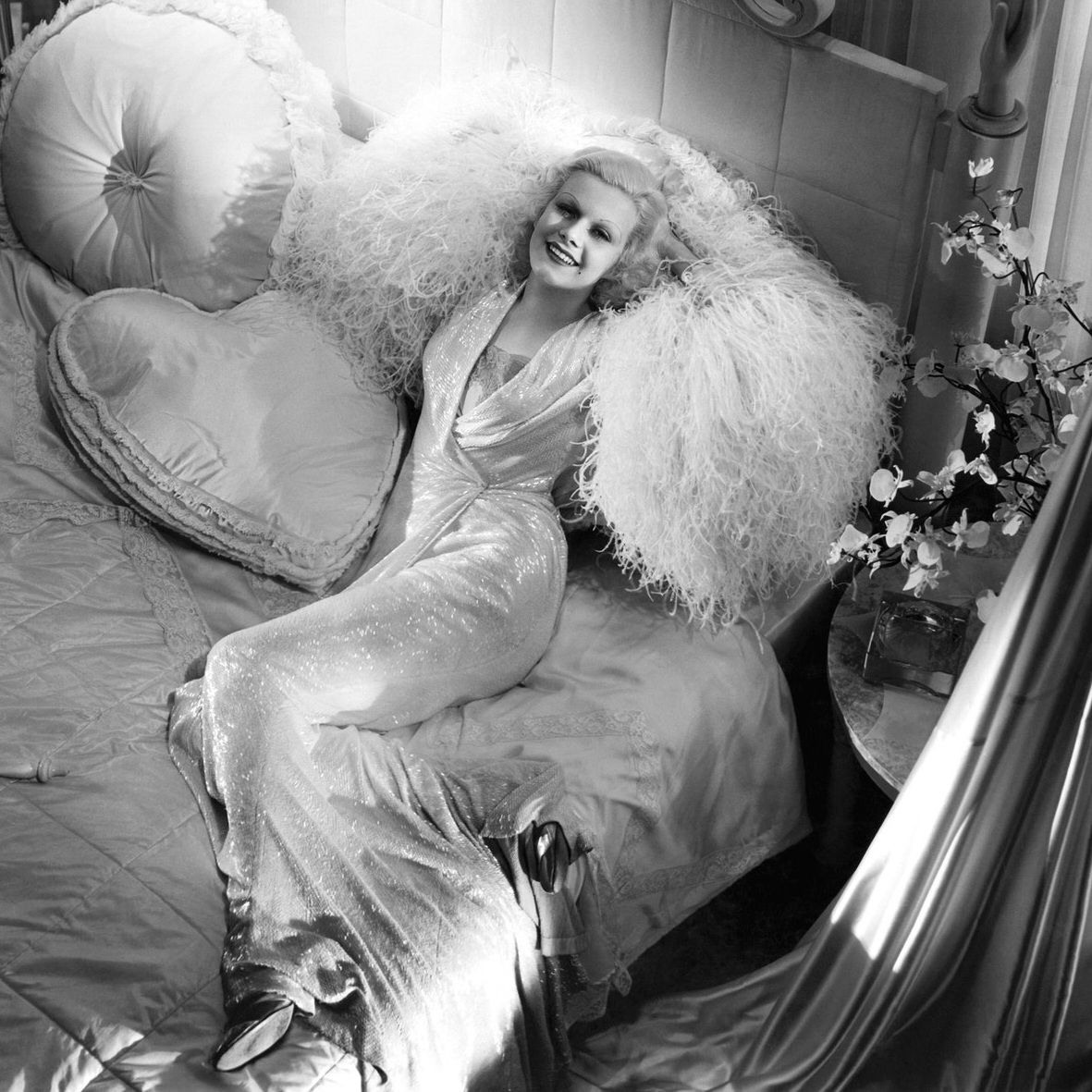 Jean Harlow in Dinner at Eight (1933).
Red Dust made her partnership with Clark Gable essential
Victor Fleming’s Red Dust (1932) paired Harlow with Clark Gable in French Indochina, recreated largely on MGM sets. Gable plays plantation manager Dennis Carson. Harlow is Vantine, a sex worker whose frankness and humour contrast with the married Barbara Willis, played by Mary Astor.
The colonial setting is built from Hollywood fantasy. Local people function mainly as labour, atmosphere or comic stereotype, and the story centres white romantic choices. That context should remain visible when we discuss the performances.
Vantine is one of Harlow’s best early roles because the character’s social position frees her from pretending to respect rules designed to exclude her. She jokes, bathes in a water barrel and watches Barbara’s respectability collapse under desire. Harlow gives Vantine emotional intelligence without polishing away the roughness.
The chemistry with Gable depends on equality of appetite. He does not have to introduce her character to desire, and she does not have to disguise interest as surrender. Their arguments move quickly because both performers understand that attraction is already established. The question is whether either will admit attachment.
Harlow and Gable made six films together, including Hold Your Man, China Seas, Wife vs. Secretary and the unfinished Saratoga. The pairing helped define MGM’s 1930s appeal: his amused masculine confidence meeting her modern refusal to be impressed by it.
 Clark Gable & Jean Harlow publicity photo for the film Red Dust (1932). Image credit: Metro-Goldwyn-Mayer, public domain.
Paul Bern’s death turned a private tragedy into studio crisis
Harlow married MGM producer Paul Bern in July 1932. Two months later, Bern was found dead from a gunshot wound in their home. Authorities ruled the death a suicide. The event immediately produced scandal, competing stories and intense studio management.
A note found at the scene was interpreted in several ways, and later writers proposed theories involving impotence, violence or murder. Bern’s previous relationship with Dorothy Millette, who died shortly afterwards after disappearing from a riverboat, added further mystery. The available evidence does not justify choosing the most dramatic reconstruction because it makes a better Hollywood story.
MGM executives acted quickly to manage information and protect Harlow, one of the studio’s valuable new stars. That intervention has encouraged suspicion, partly because studios did conceal damaging facts in other cases. Suspicion is not proof of a specific alternative account.
Harlow was twenty-one. She experienced bereavement while newspapers discussed intimate possibilities about a marriage that had barely begun. The studio required her to return to work, and publicity emphasised innocence, courage and professionalism. Those qualities may have been present, but the campaign also converted grief into a test of commercial reliability.
The responsible conclusion is limited. Bern died by gunshot, the official finding was suicide, unresolved aspects encouraged later speculation and Harlow was placed under extraordinary public pressure. We do not need to solve the death in order to understand its effect on her life and image.
Dinner at Eight showed how precisely she could land a line
George Cukor’s Dinner at Eight (1933) brought together Marie Dressler, John Barrymore, Lionel Barrymore, Wallace Beery, Billie Burke and Harlow in a comedy-drama about wealthy New Yorkers gathering for a dinner party while private disasters multiply.
Harlow plays Kitty Packard, the wife of Beery’s businessman. Kitty is vain, bored, sexually independent and much sharper than her husband assumes. Harlow uses the character’s babyish voice as a weapon. Kitty can sound frivolous while understanding the financial and romantic bargain perfectly.
Her scenes with Dressler are famous, particularly the final exchange about machinery replacing every profession. Harlow’s answer lands because she does not pause to announce a punchline. Kitty hears the claim, applies it to the one kind of work she believes remains protected and continues moving.
Cukor was skilled with actors and allowed ensemble scenes to develop through reaction. Harlow listens. Her face changes while someone else speaks, and the comic response is prepared before the line arrives. That ability distinguishes a screen comedian from a personality reciting good dialogue.
The film also complicates the idea that Harlow could play only women defined by male desire. Kitty is certainly sexual, but her funniest moments concern status, boredom and the practical limitations of marriage. She knows the men are ridiculous and sees no reason to become dignified on their behalf.
 A formal MGM portrait of Jean Harlow in 1935, when her comic confidence had become as important as the platinum-blonde image. Image credit: Harvey White / Time Magazine cover, 19 August 1935.
Bombshell turned Harlow’s own publicity into comedy
Bombshell (1933), directed by Victor Fleming, is the film to watch if you want to understand what Harlow knew about being Jean Harlow. She plays Lola Burns, a movie star surrounded by a studio publicist, relatives, servants, fans and opportunists who profit from controlling access to her.
The parallels are deliberate without making Lola a factual portrait. Her family wants money, the studio manufactures scandal and every attempt at privacy becomes another story. Lola dreams of respectability and adoption, only to discover that the men around her can sabotage normal life more easily than she can purchase it.
Harlow plays the chaos at speed. She shouts, changes costume, throws people out and is pulled into the next crisis before completing the previous one. The comedy would become exhausting if Lola were only a victim. Harlow gives her vanity, bad judgement and a star’s confidence that the world should briefly organise itself around her needs.
The title referred directly to the label attached to Harlow. MGM could therefore profit from satirising the publicity machine it operated. That contradiction does not weaken the film. It is the film’s subject. Lola understands that the image is absurd but cannot afford to stop being it.
Bombshell proves that Harlow’s comic development was not accidental. She could use speed, self-mockery and frustration while remaining glamorous. The joke is not that a beautiful woman is secretly ordinary. It is that an entire industry has mistaken the work of being beautiful for the absence of intelligence.
 Jean Harlow by George Hurrell.
The platinum hair became less important as the acting became better
MGM softened Harlow’s hair colour in later films and gave her roles that relied less completely on sexual shock. Hold Your Man reunited her with Gable in a story that moves from comic confidence into pregnancy, reform school and emotional sacrifice. The moral framework becomes more conventional, but Harlow creates genuine feeling without abandoning the character’s toughness.
In China Seas (1935), she plays China Doll, again opposite Gable, with Wallace Beery as a dangerous passenger aboard a ship threatened by pirates and typhoon. The imperial setting is dated, yet Harlow’s performance remains lively because China Doll refuses to treat respectability as the only measure of value.
Wife vs. Secretary (1936) placed her between Gable and Myrna Loy. The title encourages rivalry, but the film is more interested in suspicion and the social intimacy of office work. Harlow’s secretary Whitey Wilson is competent, loyal and aware of the attraction between herself and her employer. She does not need to become a scheming threat for the marriage to feel vulnerable.
Playing competence changed how audiences saw her. Whitey dresses attractively and understands desire, but work is not a temporary setting before romance. Harlow makes the secretary’s judgement part of the business. The role suggests a direction the career might have taken: modern women whose sexuality and professional ability occupy the same scene without cancelling one another.
Libeled Lady placed her inside one of MGM’s finest comic ensembles
Libeled Lady (1936) teamed Harlow with William Powell, Myrna Loy and Spencer Tracy. Loy plays Connie Allenbury, an heiress suing a newspaper for libel. Tracy’s editor recruits Powell’s former reporter Bill Chandler to create a situation that will make the accusation appear true. Harlow plays Gladys, the editor’s long-suffering fiancee, who is asked to marry Bill as part of the scheme.
The plot is complicated, but the performances keep emotional positions clear. Harlow’s Gladys has spent years being postponed by Tracy’s Warren Haggerty. Her anger is justified, and Harlow refuses to make the working-class fiancee look foolish beside Loy’s polished heiress.
Powell and Loy had already established their sophisticated partnership through The Thin Man. Harlow enters that rhythm with a different energy. She is louder, more direct and unwilling to pretend that romantic manipulation is elegant. The contrast gives the film balance rather than hierarchy.
Harlow and Powell were in a serious relationship off screen. They did not marry, although Harlow reportedly wanted to. Biographical accounts differ on Powell’s reasons and the exact status of an engagement. We can safely say that they were close and that his grief after her death was profound. We should not use the relationship to claim that every shared scene contains private truth.
Libeled Lady shows Harlow holding her place among three experienced stars. The platinum bombshell had become a performer who could change the film’s social rhythm whenever she entered.
 Cropped screenshot of Jean Harlow from the trailer for the film Libeled Lady (1936).
Three marriages and the limits of studio respectability
Harlow’s first marriage to Charles McGrew ended before she became famous. The marriage to Bern ended with his death. In 1933 she married cinematographer Harold Rosson, who was more than fifteen years older and had photographed several of her films.
The marriage lasted less than a year. It has often been described as a studio-arranged attempt to calm scandal. MGM certainly had an interest in her public image, and Rosson was a trusted professional. The private motives of both people cannot be reduced entirely to studio orders without stronger evidence.
After the divorce, Harlow’s relationship with Powell became central to her life. MGM publicity had to balance the value of romance against the danger of appearing unstable. A young woman who had been married three times could be treated more harshly than male stars whose relationships were equally complicated.
Harlow’s mother remained close and influential. Later accounts frequently present her as controlling, especially around money, religion and medical decisions. Mother and daughter were deeply connected, and there were financial and emotional tensions. The caricature of “Mama Jean” as the villain who caused Harlow’s death is not supported by the medical timeline.
Her final illness was kidney failure, not a morality tale
Harlow became ill during production of Saratoga in 1937. Reports from the set included fatigue, nausea, abdominal pain and increasing weakness. She had experienced health problems before, and early symptoms were attributed to influenza, gallbladder trouble or the effects of dental work.
Her condition worsened rapidly. Doctors diagnosed kidney failure, and she was taken to hospital. She died on 7 June 1937. The official cause involved cerebral oedema resulting from renal failure, commonly described as uraemic poisoning. She was twenty-six.
Rumours claimed that her mother, a Christian Scientist, refused medical treatment. Contemporary records and later medical research show that doctors attended Harlow and that she was hospitalised. Medicine in 1937 had no dialysis or kidney transplant capable of reversing advanced renal failure. The story that one religious decision simply killed her survives because it supplies blame where the medical reality offers tragedy.
The underlying reason for the kidney failure cannot be established with complete certainty from a modern distance. Biographers have proposed damage following childhood scarlet fever or another infection. We should distinguish those theories from the documented final condition.
MGM completed Saratoga using long shots, a double and rewritten material. Mary Dees stood in for Harlow, and the editing tried to preserve the illusion that the star had finished the role. Audiences came knowing she was dead, turning an ordinary romantic comedy into an uncomfortable farewell.
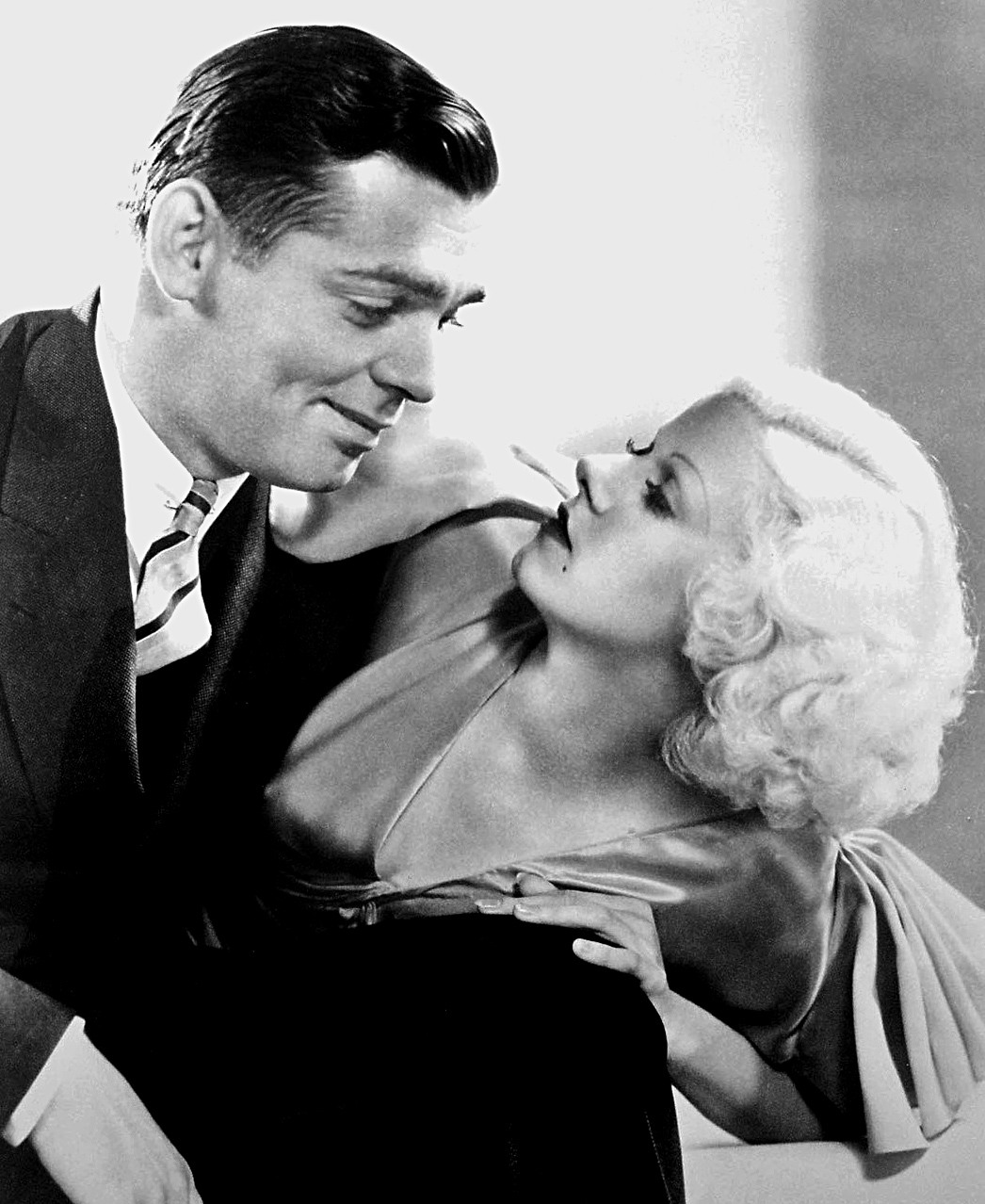 Clark Gable and Jean Harlow in a Hold Your Man publicity portrait, one example of the relaxed chemistry behind their repeated pairing.
Why Jean Harlow still feels modern
Harlow’s modernity does not come only from pre-Code sexuality. Plenty of early 1930s performers played women who wanted sex, money or independence. Harlow’s distinction was the practical intelligence she brought to being watched.
Her characters often understand that beauty has exchange value. They know when men are buying attention, when respectability is being used as a weapon and when marriage is another business arrangement. Harlow does not always ask us to approve of the response. She asks us to notice that the woman has read the contract.
The voice, sometimes criticised as harsh or unrefined, became a comic advantage. It punctured the sculptural stillness of glamour photography. A perfect image would open its mouth and reveal impatience, slang and a refusal to behave like expensive decoration.
Her influence can be seen in later screen blondes, including Marilyn Monroe, but the comparison should not erase difference. Monroe often turned softness and apparent innocence into complex performance. Harlow was harder, faster and less interested in pretending that desire had surprised her.
Hold Your Man let comedy and punishment occupy the same story
In Hold Your Man (1933), Harlow and Clark Gable play lovers pulled between criminal schemes, prison and reform. The film begins with the rough ease audiences expected from the pair, then changes direction as consequences become harder to escape.
Harlow’s Ruby is neither an innocent corrupted by a man nor a comic opportunist without feeling. She understands Gable’s Eddie and participates in the excitement, while the later sections ask her to absorb a disproportionate share of moral correction.
The Production Code was not yet fully enforced, but pressure for screen morality was increasing. The story’s punishment reflects that climate. Harlow keeps Ruby recognisable through the tonal change. Humour does not vanish simply because the institution around the character has become severe.
The film is valuable because it places her pre-Code energy beside the reform narratives that studios would soon use more rigidly. She makes the contradiction emotional rather than theoretical.
Personal Property showed how far the comic acting had developed
Personal Property (1937), one of Harlow’s final completed films, paired her with Robert Taylor. He plays a man hired to guard furniture belonging to a woman whose financial situation is less secure than appearances suggest.
The plot gives Harlow another character managing money, desire and social presentation at once. By this stage, she no longer needs the aggression of Red-Headed Woman to command a scene. A delayed answer or controlled look can make Taylor’s polished confidence appear inexperienced.
Her voice had also changed. The hard speed of the earliest talkies became warmer and more varied, allowing jokes to arrive without being punched. This is the performer that the platinum-blonde label most often conceals.
Harlow also wrote a novel, Today Is Tonight, which was published after her death. Its existence complicates the publicity image of an instinctive, unreflective star. The manuscript does not turn her into a major novelist, but it records an ambition to create stories rather than only serve as their photographed subject.
The final years suggest a career still expanding. Harlow was moving towards a form of comedy in which glamour could remain present without doing all the work.
The unfinished career should not make the existing technique invisible
It is natural to wonder what Harlow might have done in the 1940s. The question becomes unfair when possibility receives more attention than completed work. By twenty-six, she had already moved from uncertain early sound performances to precise ensemble comedy.
The improvement is visible and should be treated as achievement rather than promise.
Where should you begin with Jean Harlow’s films?
Begin with Red Dust. It gives you Harlow and Clark Gable at their most naturally matched, while also revealing the colonial limitations of the setting. Then watch Dinner at Eight for precision inside an ensemble.
Move next to Bombshell. It is the key film because Harlow plays a star trapped inside publicity that looks suspiciously like her own. Libeled Lady shows the mature comic performer holding her own with William Powell, Myrna Loy and Spencer Tracy.
For the pre-Code edge, choose Red-Headed Woman. Follow it with Wife vs. Secretary to see how much the image had changed within four years. Hell’s Angels matters historically, but it is better watched after the stronger films, when you can see how much Harlow learned after fame arrived.
Jean Harlow did not live long enough to have a late career, a reinvention or the interviews in which an older actor corrects the stories other people have told. The films have to do that work. They show a young woman becoming funnier, quicker and more assured while the publicity kept insisting that platinum hair was the explanation. It never was.