Humphrey Bogart and Lauren Bacall: At a Glance
First film together: To Have and Have Not (1944)
Other films together: The Big Sleep (1946), Dark Passage (1947) and Key Largo (1948)
Married: May 21, 1945, at Malabar Farm near Mansfield, Ohio
Children: Stephen Humphrey Bogart and Leslie Howard Bogart
Marriage ended: With Humphrey Bogart’s death on January 14, 1957
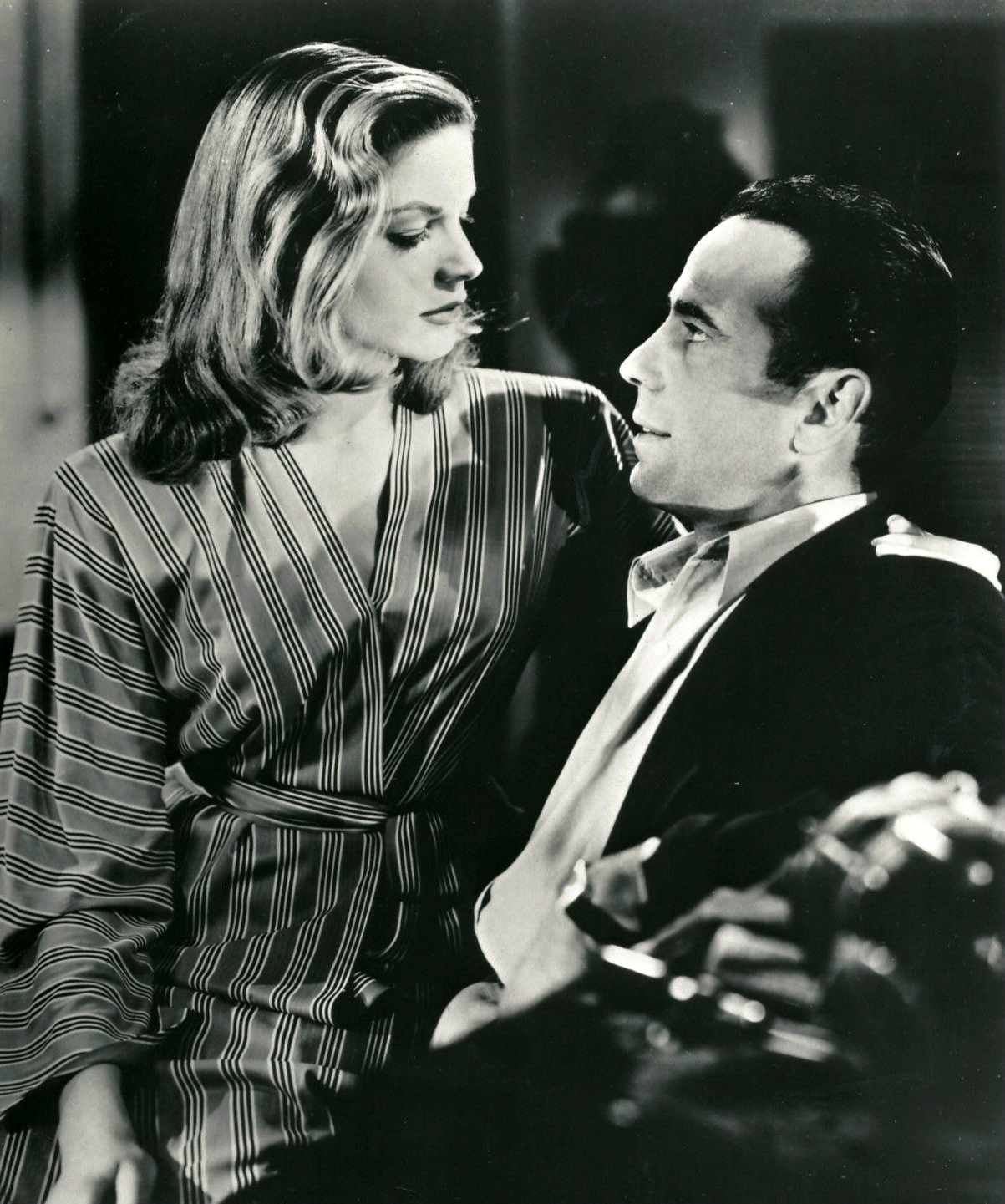 Humphrey Bogart and Lauren Bacall in a 1944 publicity photograph for To Have and Have Not. Image: Liberty Publishing; Public domain.
Why the Bogart and Bacall Story Still Fascinates
Humphrey Bogart and Lauren Bacall belong to the small group of Hollywood couples whose screen image and private history became almost impossible to separate. Audiences first saw them testing one another in To Have and Have Not: she was a nineteen-year-old newcomer with a low voice and an unnervingly steady gaze; he was an established star more than twice her age. Their scenes did not merely advertise romance. They made attraction look like a contest between equals.
The Academy’s account of Bacall’s career identifies the film as her debut and records that the pair’s real-life romance continued through three further screen pairings. Yet the familiar legend can flatten both people. Bacall was not simply “Bogart’s wife,” and Bogart was not always the invulnerable figure suggested by his screen persona. Their marriage brought happiness, children, professional collaboration and real strains created by age, fame, work and Bogart’s declining health.
This is therefore both a film story and a love story. The films reveal how directors and writers turned their rapport into different forms: flirtation, partnership, suspicion and loyalty. The marriage explains why those performances have acquired an emotional afterlife, but it should not replace the work itself.
Meeting on To Have and Have Not
Betty Joan Perske had modelled in New York and appeared on the cover of Harper’s Bazaar before Howard Hawks brought her to Hollywood, changed her professional name to Lauren Bacall and cast her as Marie Browning in To Have and Have Not. She was inexperienced and nervous. The famous downward tilt of her head, with her eyes raised toward the camera, partly developed as a way of controlling a tremble.
Bogart, born in 1899, had already survived years of secondary gangster roles before The Maltese Falcon and Casablanca made him one of Warner Bros.’ defining stars. He was married to actor Mayo Methot when filming began. Bacall’s youth and Bogart’s marital status make the beginning of their relationship less tidy than later publicity often suggests. What is clear is that they fell in love during production and that Hawks recognised how powerfully the camera registered their attention to one another.
The film’s most remembered exchanges are demonstrations of control. Bacall’s “Slim” does not wait to be chosen; she enters, observes and sets the terms. Bogart’s Harry Morgan answers with amusement rather than domination. Their chemistry depends on pauses, glances and the sense that each performer is listening for a shift in the other.
The Big Sleep and a Screen Partnership Perfected
The Big Sleep transformed the first film’s flirtation into a full noir partnership. Bogart plays private detective Philip Marlowe and Bacall plays Vivian Rutledge, a wealthy woman whose family has become entangled in blackmail and murder. The plot is famously labyrinthine, but the emotional line is clear: Marlowe and Vivian test whether desire can coexist with trust.
The Library of Congress description of *The Big Sleep* explains that scenes were revised after audiences responded to To Have and Have Not, heightening Bacall’s insolent quality and the couple’s chemistry. That production history matters. The finished film does not simply capture spontaneous attraction; it deliberately builds a vehicle around what Warner Bros. had learned audiences wanted to see.
The BFI’s account of the film describes its unusual combination of film-noir darkness and near-screwball repartee. The pair’s best scenes work because Vivian is not a prize waiting at the end of Marlowe’s investigation. She withholds information, makes counteroffers and occasionally gains the advantage. Their romance is written as negotiation.
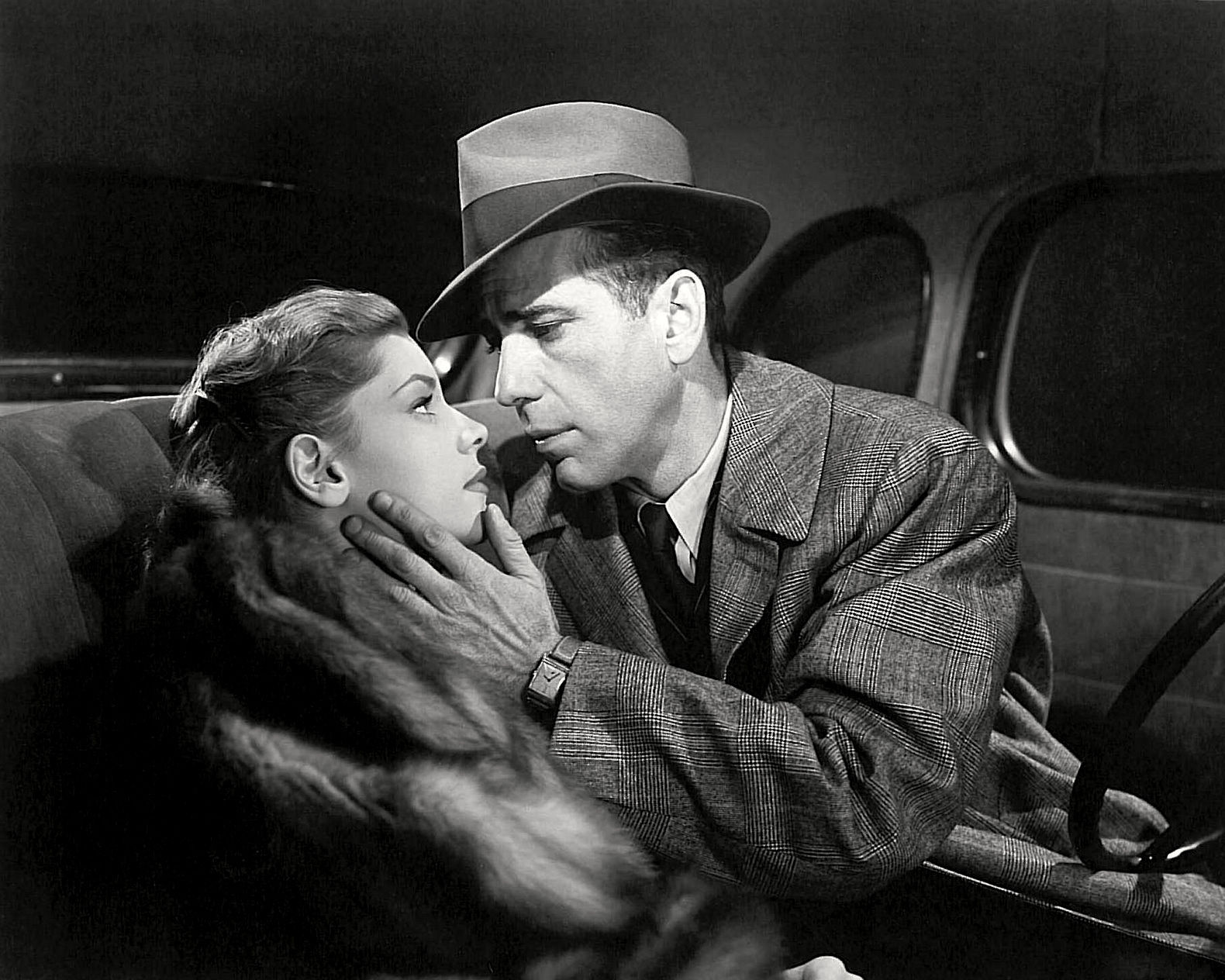 Lauren Bacall and Humphrey Bogart in a 1946 publicity photograph for The Big Sleep. Image: Warner Bros.; Public domain.
Marriage at Malabar Farm
Bogart and Methot divorced in 1945. Bogart and Bacall married on May 21 that year at Malabar Farm, the Ohio home of writer Louis Bromfield. Photographs of the ceremony show a less polished world than their Warner Bros. publicity portraits: a country setting, a small gathering and two stars briefly outside the studio machine.
Their twenty-five-year age difference attracted attention, as did the speed with which a screen romance became a marriage. Yet the relationship lasted twelve years, until Bogart’s death. They built a home in Los Angeles, sailed together and became part of a social circle that included writers, actors and directors. Their son Stephen was born in 1949 and named in part for Bogart’s character in To Have and Have Not; their daughter Leslie was born in 1952 and named for Leslie Howard, whose support had helped Bogart secure his breakthrough in The Petrified Forest.
The public image was glamorous, but Bacall’s later writing presents marriage as daily life rather than uninterrupted legend. Bogart could be witty, loyal and affectionate; he could also drink heavily and carry habits formed long before they met. Bacall’s own career ambitions did not disappear when she became a wife and mother.
Dark Passage: Love Built on Recognition
Delmer Daves’s Dark Passage uses subjective camera for much of its opening, delaying a clear view of Bogart’s face. He plays Vincent Parry, an escaped prisoner seeking to prove he did not murder his wife. Bacall’s Irene Jansen shelters him and believes him before his identity can be safely revealed.
The film reverses the usual star arrangement. Bacall’s face and judgment anchor the early story while Bogart is partly withheld. Their relationship is founded less on verbal sparring than on recognition: Irene sees a person worth saving when the world sees only a wanted man. That makes Dark Passage the most tender of their collaborations, even if its plot is less celebrated than those of the Hawks films.
Key Largo: Loyalty Under Pressure
John Huston’s Key Largo places the couple within an ensemble dominated by Edward G. Robinson’s gangster Johnny Rocco and Claire Trevor’s Oscar-winning performance as Gaye Dawn. Bogart plays war veteran Frank McCloud; Bacall plays Nora Temple, the widow of a soldier who served with him. A hurricane traps the characters in a Florida hotel while Rocco’s gang takes control.
The romantic element is restrained. Frank’s moral courage matters more than courtship, and Nora watches him decide whether exhaustion can justify inaction. Their chemistry has matured into trust. The Academy’s Bacall profile lists Key Largo as the last of their four feature films together, and its seriousness makes it an appropriate conclusion: the lovers of the earlier films have become adults measuring character under pressure.
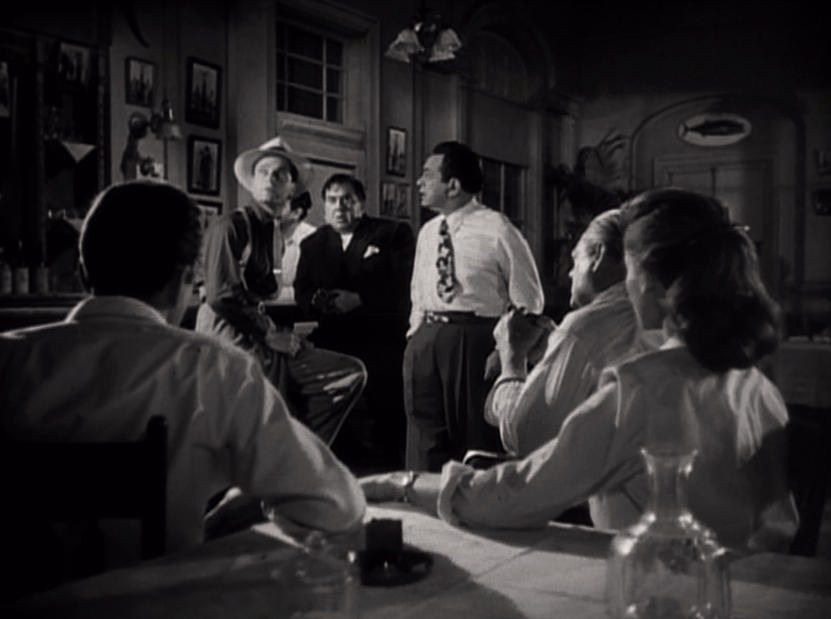 Humphrey Bogart and Lauren Bacall in a trailer image from Key Largo (1948). Image: film trailer screenshot (Warner Bros.); Public domain.
The Final Years of Their Marriage
After Key Largo, Bogart and Bacall did not make another feature together, although their public identities remained linked. Bogart entered one of the strongest periods of his career with In a Lonely Place, The African Queen, The Caine Mutiny and The Barefoot Contessa. Bacall made films including Young Man with a Horn, How to Marry a Millionaire, Written on the Wind and Designing Woman.
They also took political action. In 1947 they joined the Committee for the First Amendment and travelled to Washington during the House Un-American Activities Committee hearings. Their involvement, and the retreat that followed pressure from the studios, reflects how difficult it was for stars to separate personal conviction from corporate employment during the blacklist era.
Bogart developed oesophageal cancer in the mid-1950s. Surgery and treatment could not save him. He died in January 1957 at fifty-seven, leaving Bacall a widow at thirty-two with two young children. Turning this period into romantic tragedy risks overlooking the practical reality of illness and caregiving. Bacall had to grieve while raising a family and rebuilding a professional life.
Lauren Bacall After Bogart
Bacall’s later life demonstrates why her story cannot end with Bogart. She returned to Broadway and won Tony Awards for Applause and Woman of the Year. She wrote candidly about her life in By Myself, which received the National Book Award, and continued acting in films including Murder on the Orient Express, The Shootist, Misery, The Mirror Has Two Faces and Dogville.
She married Jason Robards in 1961; they had a son, Sam, and divorced in 1969. Her later interviews could be impatient with the expectation that every question return to Bogart. The marriage remained central, but it was one part of a life that extended for nearly six decades after his death.
Why Their Four Films Work
Each Bogart-Bacall film gives the partnership a different dramatic function:
To Have and Have Not (1944): attraction as verbal challenge.
The Big Sleep (1946): attraction complicated by secrecy and mistrust.
Dark Passage (1947): devotion founded on belief in a persecuted man.
Key Largo (1948): respect tested by fear, violence and moral choice.
The BFI’s guide to essential Bogart films notes that To Have and Have Not began a four-film screen partnership. Watching the films in order reveals more than chemistry. Bacall grows more assured, while Bogart adjusts his established persona to make space for her. He does not need to become less forceful for her to become more powerful.
Love Story, Studio Story and Myth
The safest conclusion is neither cynical nor sentimental. Bogart and Bacall genuinely loved one another, built a family and remained married through his final illness. Their affair began in complicated circumstances, their age difference was considerable and the marriage was not free of tension. All of those facts can coexist.
Hollywood helped turn the relationship into a brand because audiences responded to it. Publicity stills, magazine profiles and the films themselves encouraged viewers to see no boundary between Harry and Slim, Marlowe and Vivian, Bogie and Bacall. The myth survives because the performances give it evidence: two people repeatedly seem more alert, amused and alive when the other enters the frame.
Humphrey Bogart and Lauren Bacall: Frequently Asked Questions
How many films did Humphrey Bogart and Lauren Bacall make together?
They made four feature films together: To Have and Have Not, The Big Sleep, Dark Passage and Key Largo.
When did Bogart and Bacall meet?
They met while making To Have and Have Not in 1943. The film was released in 1944.
When were Humphrey Bogart and Lauren Bacall married?
They married on May 21, 1945, at Malabar Farm in Ohio.
Did Humphrey Bogart and Lauren Bacall have children?
Yes. They had two children, Stephen Humphrey Bogart and Leslie Howard Bogart.
Which Bogart and Bacall film should a beginner watch first?
Start with To Have and Have Not to see their chemistry emerge, then watch The Big Sleep for its most polished expression.