 Ingrid Bergman in a 1940 studio portrait by Whitey Schafer.
Ingrid Bergman : Personal Info
Full name : Ingrid Bergman
Born : August 29, 1915, Stockholm, Sweden
Died : August 29, 1982, London, England
Nationality : Swedish
Occupations : Actress, stage performer
Years active : 1932-1982
Known for : Intermezzo, Casablanca, For Whom the Bell Tolls, Gaslight, Spellbound, Notorious, Stromboli, Journey to Italy, Anastasia, Murder on the Orient Express, Autumn Sonata
Major honors : Three Academy Awards from seven acting nominations; two Primetime Emmy Awards; Tony Award for Joan of Lorraine; Golden Globe and international film-festival honors
Ingrid Bergman : Introduction
Ingrid Bergman became one of Hollywood’s greatest stars while giving the impression that stardom itself was never quite enough for her. She left an established Swedish career for America, moved between studios rather than settling into one house style, worked with Alfred Hitchcock at the height of his Hollywood period, and then risked her position by going to Italy to make severe, unconventional films with Roberto Rossellini.
That restlessness makes her career unusually rich. Bergman could express moral certainty without stiffness, romantic longing without sentimentality and fear without surrendering a character’s intelligence. In Casablanca, her face carries a history the screenplay can only partly explain. In Notorious, desire and humiliation coexist in the same glance. In Autumn Sonata, made more than three decades later, warmth has hardened into self-protection.
Her life was also shaped by the distance between public image and private choice. American audiences first embraced her as an apparently natural, wholesome alternative to manufactured glamour. When her relationship with Rossellini became public while both were married, that image collapsed into one of the loudest celebrity controversies of the postwar period. The comeback that followed was not simply a return to respectability. It confirmed that the work could survive the moral story imposed upon the woman.
Ingrid Bergman : Childhood in Stockholm
Ingrid Bergman was born in Stockholm to Justus Samuel Bergman, a Swedish artist and photographer, and Friedel Adler Bergman, who was German. Her mother died when Ingrid was two. Her father documented his daughter in photographs and home movies, leaving an unusually vivid visual record of her childhood, but he too died while she was young. Bergman then lived with relatives.
The early losses are tempting material for psychological certainty, and biographers have often linked them to her independence or need for movement. The safer conclusion is that performance became a durable ambition during an unsettled childhood. The BFI’s account of Bergman’s early years describes a girl already comfortable before her father’s camera and fascinated by the film studio when she first worked as an extra.
Bergman studied at Stockholm’s Royal Dramatic Theatre School, the institution associated with Sweden’s distinguished stage tradition. Film work soon drew her away. Her early Swedish performances were not crude rehearsals for Hollywood: they established the emotional transparency, alert listening and refusal of decorative fuss that later made her seem so unusual in American studio films.
Ingrid Bergman : Intermezzo and the Move to Hollywood
The Swedish Intermezzo (1936), in which Bergman played a young pianist involved with a married violinist, brought her international attention. Producer David O. Selznick arranged an English-language remake, released in 1939 with Leslie Howard. Bergman arrived in Hollywood with a screen presence that the publicity machine promoted as “natural,” although naturalness on camera is itself a carefully managed effect.
Selznick signed her to a long-term contract but frequently loaned her to other producers and studios. The arrangement was financially useful to him and artistically useful to Bergman, who worked opposite leading actors and avoided being confined to one production unit. The BFI’s career overview notes that those loan-outs placed her with performers including Humphrey Bogart, Cary Grant, Gary Cooper and Gregory Peck.
Her early American roles tested different aspects of the emerging persona. Dr. Jekyll and Mr. Hyde let her play the vulnerable barmaid Ivy rather than the more respectable female lead. For Whom the Bell Tolls turned her into a romantic heroine against the violence of the Spanish Civil War and brought her first Academy Award nomination. She appeared direct and unguarded, but the strongest performances already suggested how much calculation could exist beneath apparent openness.
 Ingrid Bergman with Paul Henreid in Casablanca (1942).
Ingrid Bergman : Casablanca and the Power of Uncertainty
No Ingrid Bergman biography can avoid Casablanca (1942), yet the film is sometimes discussed as though its reputation automatically explains her performance. Bergman plays Ilsa Lund, who unexpectedly encounters Rick Blaine, the American lover she left in Paris, while trying to escape Vichy-controlled Morocco with her resistance-leader husband.
The character could have become a prize passed between two heroic men. Bergman instead makes uncertainty the centre of the film. Ilsa’s choices are constrained by war, marriage and incomplete information, but she is never emotionally blank. The famous close-ups register hope, guilt, calculation and grief before the dialogue settles upon a decision.
Her partnership with Humphrey Bogart depends on contrast. His guarded stillness makes her emotional availability look even more dangerous; her appeal reveals the cost of his cynicism. The film’s ending belongs partly to Rick’s sacrifice, but Bergman ensures that Ilsa’s divided history remains present after the plot has resolved it.
Ingrid Bergman : Gaslight and Her First Oscar
In Gaslight (1944), Bergman plays Paula, a woman whose husband systematically manipulates her perception of reality. The title later became everyday language for psychological abuse, but the performance is more precise than the modern shorthand. Paula’s fear grows through small disruptions: missing objects, sounds no one else admits hearing and the weakening of her confidence under constant correction.
Bergman resists playing the character as foolish. The tragedy is that Paula’s intelligence is turned against itself by someone she trusts. Her physical tension and fluctuating voice show a person trying to preserve reason while being trained to doubt it. The Academy’s record of the 1945 ceremony confirms that the role brought Bergman her first Oscar for Best Actress.
She followed it with The Bells of St. Mary’s, playing a practical, quietly competitive nun opposite Bing Crosby’s priest. Another Best Actress nomination demonstrated how comfortably audiences accepted her moral authority. That acceptance would later intensify the backlash when her private life no longer matched the image.
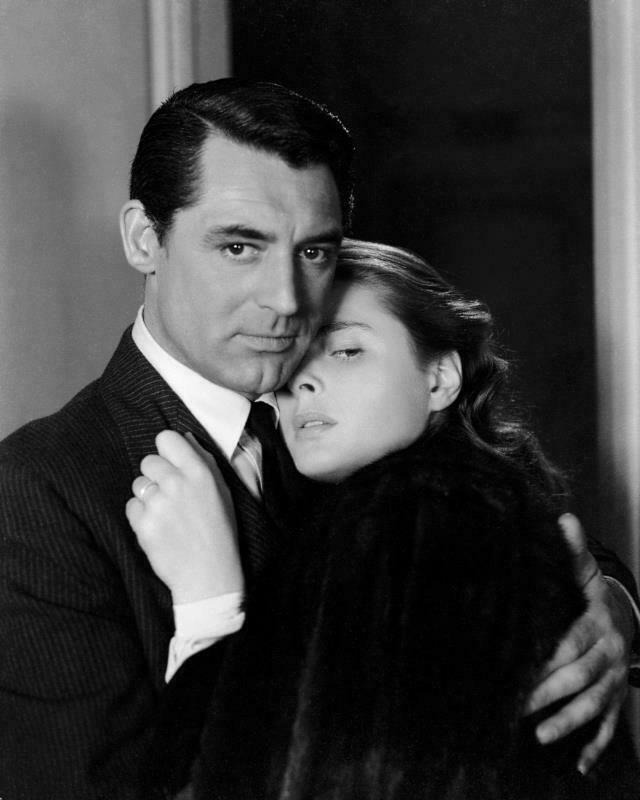 Cary Grant and Ingrid Bergman in Notorious (1946).
Ingrid Bergman : Alfred Hitchcock, Spellbound and Notorious
Bergman made three films with Alfred Hitchcock: Spellbound (1945), Notorious (1946) and Under Capricorn (1949). Each uses her apparent sincerity differently. In Spellbound, she is a psychoanalyst whose professional assurance gives way to romantic commitment. The film’s psychology is dated, but Bergman gives thought an active screen presence rather than treating intelligence as an obstacle to emotion.
Notorious is the masterpiece of the collaboration. Bergman plays Alicia Huberman, the daughter of a convicted Nazi agent, who is recruited by American intelligence to infiltrate a group operating in Brazil. Cary Grant’s Devlin falls in love with her but repeatedly punishes her for the sexual reputation his own mission exploits.
The film’s suspense machinery is immaculate, yet its deepest tension concerns trust. Alicia risks herself for men who question her worth and then demand proof of loyalty. Opposite Cary Grant, Bergman lets toughness, shame and longing remain visible at once. Hitchcock photographs her as an object of scrutiny, but the performance keeps returning the gaze.
Under Capricorn is less successful as a whole, though Bergman’s long, emotionally difficult scenes show her appetite for technical and dramatic challenge. Hitchcock’s extended takes deny her the protection of conventional editing. Even when the film’s rhythms falter, her willingness to expose a character’s disorder is unmistakable.
Ingrid Bergman : Joan of Arc, Theatre and a Carefully Built Image
Bergman wanted demanding stage work as well as films. Her Broadway performance in Joan of Lorraine brought a Tony Award, and she carried the role into the ambitious film Joan of Arc (1948). The production received mixed responses, but Bergman earned another Academy Award nomination.
Joan also intensified an existing public association between the actress and moral purity. Bergman’s publicity emphasized minimal makeup, domestic respectability and European seriousness. Those qualities differentiated her from other Hollywood stars, but they also narrowed the terms on which audiences believed they knew her.
The lesson is not that the image was entirely false. Bergman did value work, family and a comparatively unornamented screen style. The problem was the expectation that a star’s commercial persona should function as a complete moral biography. When her life diverged from that simplified image, public disappointment became punitive.
Ingrid Bergman : Roberto Rossellini and the Hollywood Backlash
After seeing Roberto Rossellini’s Rome, Open City and Paisan, Bergman wrote to the Italian director offering to work with him. The letter began a professional collaboration and then a relationship. During the production of Stromboli, Bergman became pregnant. She was still married to physician Petter Lindström, with whom she had a daughter, Pia; Rossellini was also married.
The chronology matters because contemporary condemnation often treated rumor, adultery, pregnancy and artistic rebellion as one offence. Bergman’s son Roberto was born in 1950. She divorced Lindström and married Rossellini that year; twin daughters Isabella and Isotta were born in 1952. The choices caused pain within the family, something a modern reassessment should not erase. Neither, however, should biography repeat the disproportionate public punishment as though it were neutral fact.
American politicians and commentators turned the relationship into a debate about national morality. The intensity revealed how much the wholesome Bergman image had been treated as public property. She worked primarily in Europe for several years, making films with Rossellini that were radically different from her Hollywood successes.
Stromboli, Europe ’51 and Journey to Italy place Bergman’s characters in landscapes and relationships that refuse comforting resolution. Their acting style can appear exposed beside the loose textures of Italian neorealism: a famous performer searching for emotional footing in worlds that do not rearrange themselves around stardom. The films divided contemporary critics but later became central to the history of modern cinema. The BFI’s selection of essential Bergman films places the Rossellini period within her core achievement rather than treating it as a detour.
Ingrid Bergman : Anastasia and the Hollywood Comeback
By the mid-1950s Bergman and Rossellini’s personal and professional partnership was ending. Anastasia (1956), produced in Europe for Twentieth Century-Fox distribution, offered her a role perfectly suited to the idea of return. She plays a vulnerable woman trained to impersonate the missing Russian grand duchess, only for performance, memory and identity to become inseparable.
The part drew upon the public’s knowledge of Bergman without reducing the character to autobiography. Her second Best Actress Oscar was accepted by Cary Grant; the Academy’s 1957 ceremony record confirms the award. Hollywood’s embrace was often described as forgiveness, but that language assumes an industry had the right to grant moral absolution. Artistically, the more important fact was that Bergman returned with her authority intact.
She reunited with Grant in Indiscreet (1958), a sophisticated romantic comedy that uses their maturity rather than pretending it away. Stage work, international films and television prevented the return from becoming a retreat into old Hollywood formulas.
Ingrid Bergman : Later Roles and Autumn Sonata
Bergman’s later career remained varied. She appeared in The Inn of the Sixth Happiness, The Yellow Rolls-Royce, Cactus Flower and A Walk in the Spring Rain. In Murder on the Orient Express (1974), her small, deliberately unglamorous performance as a Swedish missionary brought an Academy Award for Supporting Actress. During her acceptance speech she praised fellow nominee Valentina Cortese, an act recorded in the Academy’s account of the 1975 ceremony.
Her final major theatrical film, Autumn Sonata (1978), united her with Swedish director Ingmar Bergman, to whom she was not related. She plays Charlotte, a celebrated concert pianist confronted by the adult daughter who believes career and self-absorption made her an absent mother.
The casting gives the film an unavoidable biographical echo, but Ingrid Bergman does not ask the audience to acquit Charlotte. She allows charm to become evasion and professional discipline to become emotional defence. Opposite Liv Ullmann, she moves from confidence to shock, counterattack and temporary self-knowledge. The performance brought her seventh Oscar nomination.
Her final screen role was Israeli prime minister Golda Meir in the television drama A Woman Called Golda. Bergman had been treated for breast cancer and was seriously ill during her final years, but continued working. She died in London on August 29, 1982, her sixty-seventh birthday.
Ingrid Bergman : Acting Style and Legacy
Bergman’s celebrated naturalness should not be confused with the absence of technique. She listened with unusual concentration, allowed contradictory thoughts to pass across her face and used her height without making physical authority rigid. Directors could place a complicated moral situation before her and trust that the audience would follow the changes before the character explained them.
Her international career also resists a simple Hollywood-centred story. Swedish films formed her; American studio cinema made her globally famous; Italian modernism dismantled the protections of that fame; theatre and television extended her range. Few stars of comparable magnitude moved so repeatedly between languages, countries and performance traditions.
The controversy with Rossellini remains part of the biography because it affected her family, career and public reputation. It should not become the biography’s verdict. Bergman’s legacy rests on the difficult emotions she made legible: divided loyalty in Casablanca, endangered trust in Notorious, damaged identity in Anastasia and the cruelties of maternal self-protection in Autumn Sonata.
Selected Ingrid Bergman Filmography
1936 – Intermezzo : Swedish romantic drama that brought international attention
1939 – Intermezzo: A Love Story : Hollywood debut opposite Leslie Howard
1942 – Casablanca : Enduring wartime romance with Humphrey Bogart
1943 – For Whom the Bell Tolls : First Academy Award nomination
1944 – Gaslight : First Oscar-winning performance
1945 – Spellbound : First film with Alfred Hitchcock
1946 – Notorious : Hitchcock espionage romance with Cary Grant
1948 – Joan of Arc : Oscar-nominated title performance
1950 – Stromboli : First released feature with Roberto Rossellini
1952 – Europe ’51 : Radical study of grief and social alienation
1954 – Journey to Italy : Influential modernist drama
1956 – Anastasia : Hollywood return and second Best Actress Oscar
1958 – Indiscreet : Mature romantic comedy with Cary Grant
1974 – Murder on the Orient Express : Supporting Actress Oscar
1978 – Autumn Sonata : Final theatrical-film role and seventh Oscar nomination
1982 – A Woman Called Golda : Final screen performance
Ingrid Bergman : Frequently Asked Questions
How many Oscars did Ingrid Bergman win?
She won three Academy Awards: Best Actress for Gaslight and Anastasia, and Best Supporting Actress for Murder on the Orient Express. She received seven acting nominations in total.
What is Ingrid Bergman’s most famous film?
Casablanca is her most widely recognised film, but Notorious, Gaslight, Journey to Italy and Autumn Sonata reveal more of her range.
How many films did Ingrid Bergman make with Alfred Hitchcock?
She made three: Spellbound, Notorious and Under Capricorn.
Why did Ingrid Bergman leave Hollywood?
She went to Italy to work with Roberto Rossellini and began a relationship with him while both were married. The resulting controversy made American work difficult, but the move was also an artistic choice that produced several influential films.
Was Ingrid Bergman related to Ingmar Bergman?
No. They shared a surname but were not related. Ingmar Bergman directed her in Autumn Sonata.
What is the best Ingrid Bergman film to watch first?
Casablanca is the most accessible introduction. Notorious is ideal for romantic suspense, while Autumn Sonata shows her mature dramatic power.
Related Articles
20 Classic Hollywood Actresses Everyone Should Know
20 Movie Stars Who Defined Old Hollywood Glamour
Top 20 Best Black-and-White Movies for New Classic Film Fans