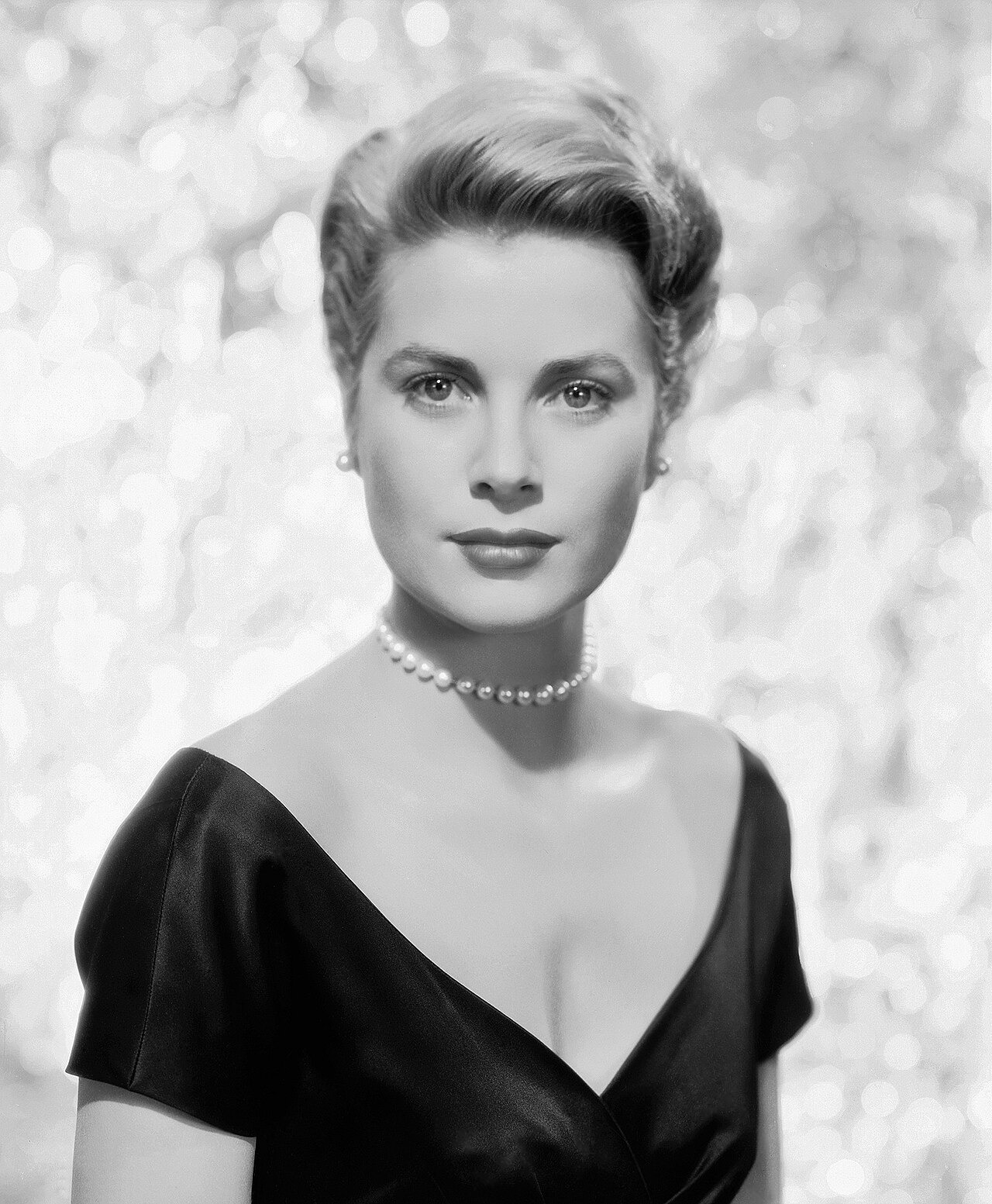
 Grace Kelly in a 1955 publicity portrait.
Grace Kelly : Personal Info
Full name : Grace Patricia Kelly
Born : November 12, 1929, Philadelphia, Pennsylvania
Died : September 14, 1982, Monaco
Nationality : American; Princess of Monaco by marriage
Occupations : Actress, Princess of Monaco, arts patron, charitable leader
Years active : 1949-1956 as an actress; 1956-1982 in public and charitable duties
Known for : High Noon, Mogambo, Dial M for Murder, Rear Window, The Country Girl, To Catch a Thief, High Society
Major honors : Academy Award for Best Actress; Academy Award nomination for Supporting Actress; Golden Globe and New York Film Critics Circle honors
Grace Kelly : Introduction
Grace Kelly’s film career lasted barely five years at full intensity, yet it produced an unusually concentrated legacy. She worked with Fred Zinnemann, John Ford and Alfred Hitchcock; acted opposite Gary Cooper, Clark Gable, Ava Gardner, James Stewart, William Holden and Cary Grant; and won the Academy Award for Best Actress before leaving Hollywood at twenty-six.
The fairy-tale summary is familiar: Philadelphia actress becomes movie star, meets Prince Rainier III and becomes Princess of Monaco. That outline is true but incomplete. Kelly was a trained performer who pursued acting against family resistance, worked rapidly in live television and learned to use stillness as a dramatic instrument. Her apparent serenity often concealed calculation, fear, desire or defiance.
Hitchcock understood the tension. He presented Kelly as an image of immaculate control, then placed that image in danger. In Rear Window, Dial M for Murder and To Catch a Thief, clothes and composure attract attention, but the performances depend on decisiveness. Kelly’s screen women are watched; they also act.
Grace Kelly : Philadelphia Family and Early Ambition
Grace Patricia Kelly was born into a prominent Irish Catholic family in Philadelphia. Her father, John B. Kelly Sr., was an Olympic rowing champion and successful businessman. Her mother, Margaret Majer Kelly, had taught physical education and modelled. Achievement was expected, but acting did not initially command the family’s respect.
Kelly was quieter and less athletically dominant than some relatives, drawn instead to reading, theatre and private imaginative life. Family connections included the playwright George Kelly, an uncle whose theatrical success offered one example of an artistic profession even when he did not actively advance her ambitions.
After school, Kelly moved to New York and entered the American Academy of Dramatic Arts. She supported herself partly through modelling and built experience in theatre and the expanding world of live television. These productions demanded speed and discipline: scripts changed, rehearsal time was short and performance occurred under immediate technical pressure.
Grace Kelly : Television, Stage Work and Film Debut
Kelly appeared in numerous television dramas before Hollywood treated her as a star. The work ranged across literary adaptations and contemporary stories, allowing her to test accents, emotional registers and camera scale. The screen image was developing before a studio publicity department fixed it.
Her feature debut came with a small role in Fourteen Hours (1951). High Noon (1952) gave her far greater visibility as Amy Fowler Kane, the Quaker bride of Gary Cooper’s marshal. Modern viewers may find the age difference conspicuous, and the role limits Kelly for much of the film to moral opposition and anxious waiting. Even so, she brings conviction to Amy’s shift from pacifist refusal to active defence.
Mogambo (1953), directed by John Ford and shot in Africa, placed her opposite Clark Gable and Ava Gardner. Kelly’s restrained Linda Nordley contrasts with Gardner’s warmer, more openly wounded Eloise Kelly. The role earned Grace an Academy Award nomination for Supporting Actress, recorded in the Academy’s 1954 ceremony history.
Grace Kelly : Hitchcock and the Meaning of Cool
Alfred Hitchcock found in Kelly a face that could appear composed while the smallest change became legible. Dial M for Murder first presents Margot Wendice through elegance and guilt: she has ended an affair but remains trapped in a marriage that turns murderous. During the attempted strangling, polish gives way to physical survival.
Rear Window made more complex use of the image. Lisa Fremont enters James Stewart’s apartment as if materialising from a fashion photograph, but Jeff initially treats her elegance as evidence that she cannot share his dangerous life. The film gradually proves him wrong. Lisa crosses the courtyard, enters a suspected killer’s apartment and finds the evidence Jeff can only watch.
That reversal is central to Kelly’s value in Hitchcock. The camera and male characters may frame her as an object, but narrative energy shifts when she moves. Her coolness is not emotional emptiness. It is concentration under observation.
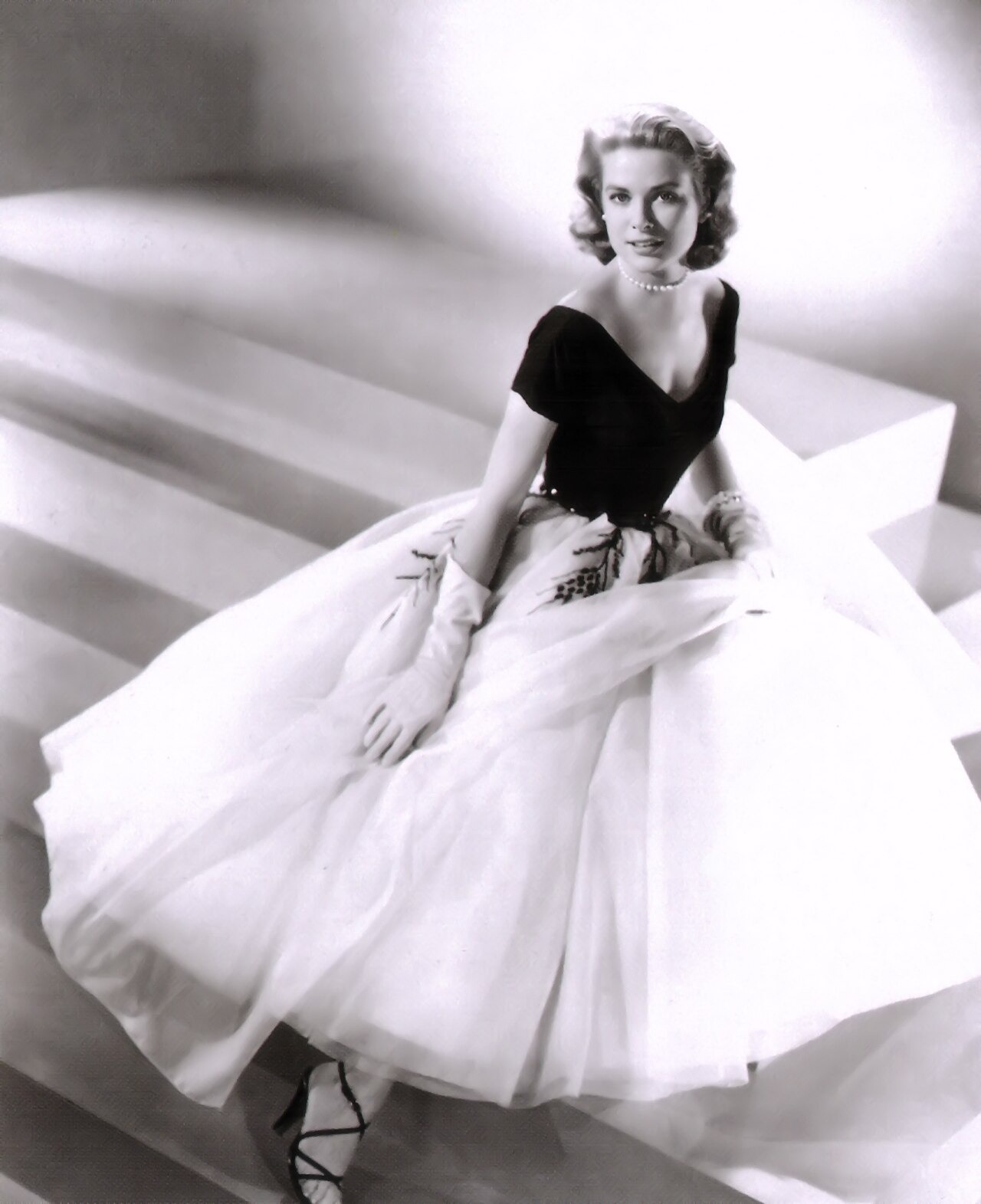 Grace Kelly in a Paramount publicity photograph for Rear Window (1954).
Grace Kelly : Rear Window and James Stewart
Rear Window depends on the chemistry between Kelly and James Stewart. His L.B. Jefferies is immobilised and commitment-shy; her Lisa is socially poised but increasingly impatient with being underestimated. The romance and murder plot reflect each other because both concern the ethics of looking without participating.
Kelly’s wardrobe, designed by Edith Head, remains among the most analysed in classic cinema. The dresses establish Lisa’s wealth and fashion knowledge, but their dramatic function changes. The immaculate first entrance announces distance from Jeff’s world; later, practical movement through the courtyard exposes the courage beneath the surface.
The film also shows Kelly’s gift for listening. In close-up she can register scepticism, attraction and fear without breaking the calm that defines the character. Hitchcock’s suspense is visual, but it would be less effective without an actor capable of making tiny shifts feel consequential.
Grace Kelly : The Country Girl and an Academy Award
The Country Girl challenged the assumption that Kelly could only play polished socialites. As Georgie Elgin, the wife of an alcoholic actor played by Bing Crosby, she adopts plain clothes, tired posture and defensive severity. William Holden’s director initially misreads her as the controlling cause of her husband’s failures; the film gradually reveals the exhaustion beneath her discipline.
Kelly won the Academy Award for Best Actress for the performance. The role is sometimes described as a complete rejection of glamour, but the achievement is subtler. She uses the same control seen in Hitchcock and changes its meaning. Georgie’s stillness is not social perfection; it is the posture of someone containing another person’s chaos.
The win confirmed that the speed of Kelly’s rise was supported by industry respect, not celebrity alone. Within a short period she had moved from supporting parts to an Oscar-winning dramatic lead, while continuing to appear in major commercial productions.
Grace Kelly : To Catch a Thief and Cary Grant
To Catch a Thief returned Kelly to glamour, pairing her with Cary Grant on the French Riviera. Her Frances Stevens recognises the possibility that Grant’s retired jewel thief may be lying and treats uncertainty as part of the attraction. Rather than wait for seduction, she conducts it.
The film is lighter than Hitchcock’s most psychologically disturbing work, but Kelly’s performance remains active. Frances uses wealth and beauty with amused awareness, teasing Grant’s character because she understands the persona he is trying to preserve. Their scenes make star image itself into flirtation.
The costumes and locations helped create the version of Grace Kelly most often reproduced in fashion retrospectives. Yet the pleasure of the performance comes from wit. The clothes frame a woman who enjoys control and is willing to take risks, not a silent mannequin.
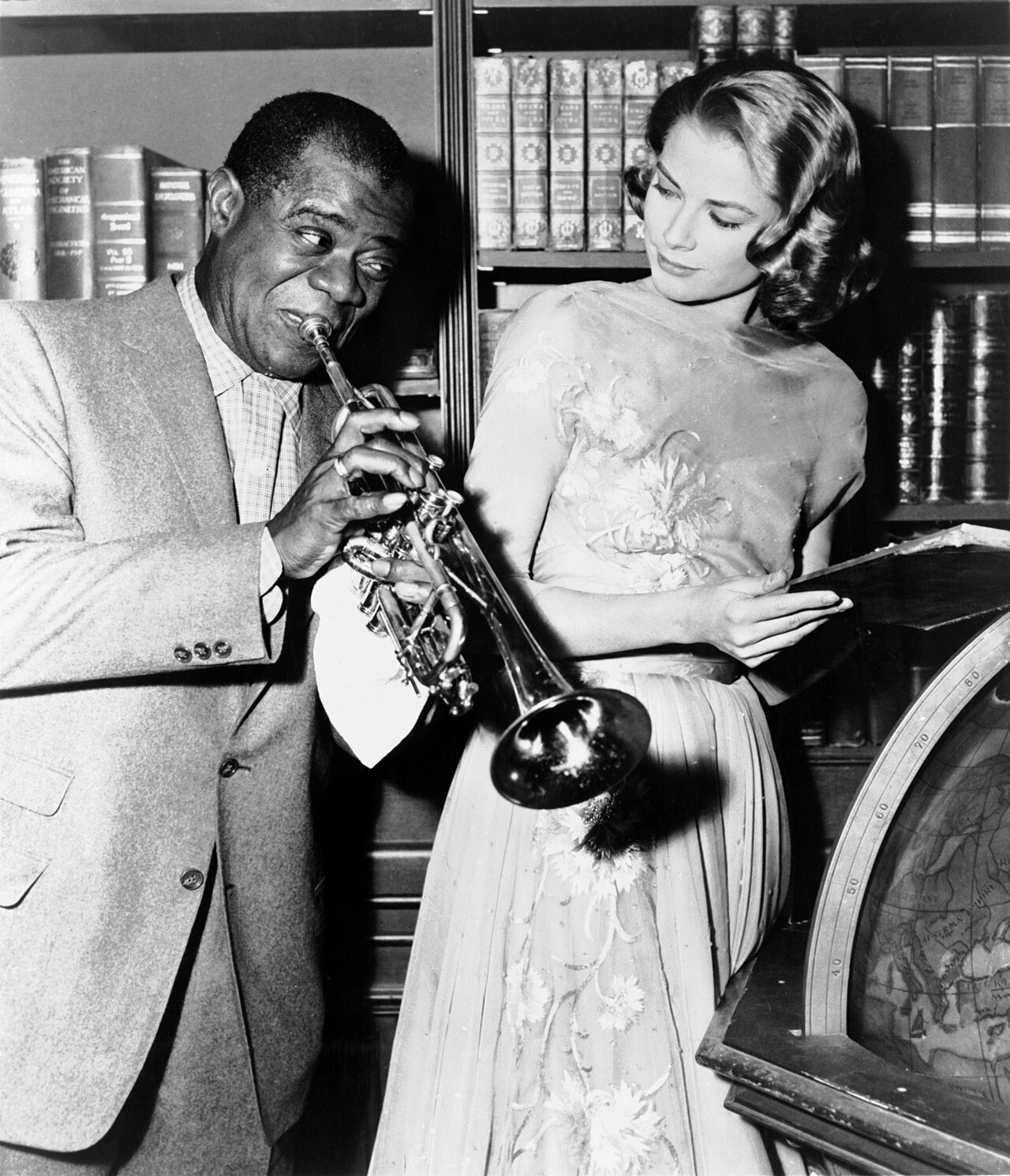 Louis Armstrong and Grace Kelly together during production of High Society (1956).
Grace Kelly : High Society and the End of a Film Career
High Society (1956) remade The Philadelphia Story as a Technicolor musical with Kelly in the Katharine Hepburn role, Bing Crosby as the former husband and Frank Sinatra as the reporter. Louis Armstrong and his band provide musical commentary, giving the film an atmosphere of elegant self-awareness.
Kelly’s Tracy Lord is warmer than Hepburn’s and shaped by the star’s own imminent transition. The film was released during the year of her marriage to Prince Rainier, so audiences could hardly separate the high-society romantic plot from the public story. The screen role became a farewell even though it was not designed as a solemn final statement.
Kelly recorded no later feature performance. Projects were discussed during her years in Monaco, most famously Hitchcock’s Marnie, but royal, political and family considerations made a return difficult. It is important not to turn that fact into a simple claim that she was either rescued from Hollywood or imprisoned by royalty. The transition offered status, responsibility and family while closing a rapidly developing artistic career.
Grace Kelly : Meeting Prince Rainier and the Monaco Wedding
Kelly met Prince Rainier III during the 1955 Cannes Film Festival, when she participated in a photographed visit to Monaco. Their engagement was announced in January 1956 at the Kelly family home in Philadelphia. The Prince’s Palace later documented the restoration of that house and its place in the family story.
The civil ceremony took place on April 18, 1956, followed by the religious ceremony on April 19. Global media coverage transformed the wedding into one of the defining celebrity events of the decade. MGM filmed the proceedings, and Kelly’s Helen Rose wedding dress became a lasting reference point in bridal design.
The phrase “fairy-tale wedding” captures the publicity but can obscure the institutional reality. Kelly was not only marrying a man; she was entering a sovereign household with public duties, diplomatic expectations and intense scrutiny. Her performance training, command of languages and understanding of publicity became practical resources.
Grace Kelly : Princess of Monaco
As Princess Grace, Kelly and Rainier had three children: Caroline, Albert and Stéphanie. She assumed ceremonial duties and supported charitable and cultural initiatives, including work connected with the Monaco Red Cross and arts organisations. Her public role required continuity rather than the project-based visibility of film acting.
She founded the Princess Grace Foundation in Monaco to support artists and traditional crafts. After her death, the Princess Grace Foundation-USA was established to provide grants and awards for emerging artists. These institutions extend the artistic side of her legacy beyond fashion and royal image.
Kelly’s life in Monaco should not be narrated solely through rumour about private happiness. Public records establish duties, family and philanthropy; personal letters and testimony can add perspective but rarely justify absolute psychological conclusions. The gap between public serenity and private complexity is real, but it should invite care rather than speculation.
Grace Kelly : Acting Style and Screen Presence
Kelly’s technique relied on economy. Her voice could be low and measured, her face still, her movements deliberate. In weaker material those qualities risked being mistaken for passivity. With Hitchcock, Zinnemann or George Seaton, they became a surface against which danger and desire registered sharply.
She was especially effective when a character was misread. Amy in High Noon appears too morally rigid to act; Lisa in Rear Window appears too fashionable for risk; Georgie in The Country Girl appears too controlling for sympathy. Kelly lets the audience revise its judgement without announcing the change.
Her brief career also means the image was never eroded by decades of unsuitable roles. That concentration contributes to the legend, but it can make development harder to see. From High Noon to The Country Girl and Rear Window, the growth is substantial.
Grace Kelly : Death and Its Aftermath
On September 13, 1982, Princess Grace suffered a medical incident while driving on a mountain road above Monaco. The car left the road; her daughter Stéphanie survived the crash, while Grace died the following day. She was fifty-two.
Because the death was sudden and the public image so powerful, speculation multiplied. Reliable accounts identify a stroke or cerebral event as the cause that led to the crash. Claims that assign blame to Stéphanie or invent dramatic conspiracies should not be repeated without credible evidence.
Grace was buried in Monaco Cathedral. The Prince’s Palace biography of Prince Albert II records her Philadelphia birth and Monaco death within the official family history. Public mourning joined two identities that had never fully separated: Hollywood star and Princess of Monaco.
Grace Kelly : Legacy
Grace Kelly remains a central figure in discussions of 1950s cinema, Hitchcock heroines, fashion, celebrity marriage and the relationship between performance and public duty. Her images are reproduced so often that the actor can disappear behind them. Returning to the films restores the intelligence within the surface.
Rear Window is the strongest single demonstration of her screen power, while The Country Girl shows the dramatic range obscured by fashion iconography. To Catch a Thief captures her wit, and High Society preserves the moment when Hollywood farewell and royal future became inseparable.
Her legacy also raises an unresolved question: what might a longer career have become? The available work cannot answer it, but it shows enough growth to make the question serious. Kelly did not leave behind only a perfect image. She left a compact body of performances still capable of surprising viewers who think they already know her.
Selected Grace Kelly Filmography
1951 – Fourteen Hours : Feature-film debut
1952 – High Noon : Breakthrough role opposite Gary Cooper
1953 – Mogambo : Supporting Actress Oscar nomination
1954 – Dial M for Murder : First Alfred Hitchcock collaboration
1954 – Rear Window : Defining Hitchcock role opposite James Stewart
1954 – The Country Girl : Academy Award-winning performance
1954 – Green Fire : Adventure drama
1954 – The Bridges at Toko-Ri : Korean War drama with William Holden
1955 – To Catch a Thief : Riviera thriller with Cary Grant
1956 – The Swan : Royal romance released during her transition to Monaco
1956 – High Society : Final feature film
Grace Kelly : Frequently Asked Questions
How many Oscars did Grace Kelly win?
She won one Academy Award for Best Actress, for The Country Girl, and received an earlier Supporting Actress nomination for Mogambo.
How many Hitchcock films did Grace Kelly make?
Three: Dial M for Murder, Rear Window and To Catch a Thief.
Why did Grace Kelly stop acting?
She left film acting after marrying Prince Rainier III in 1956 and assuming the duties of Princess of Monaco. Later screen projects were discussed but did not proceed.
How old was Grace Kelly when she became a princess?
She was twenty-six when she married Prince Rainier in April 1956.
What is the best Grace Kelly film to watch first?
Rear Window is the best introduction because it combines Hitchcock’s visual suspense with Kelly’s glamour, wit and growing narrative agency.
Related Articles
20 Classic Hollywood Actresses Everyone Should Know
20 Movie Stars Who Defined Old Hollywood Glamour