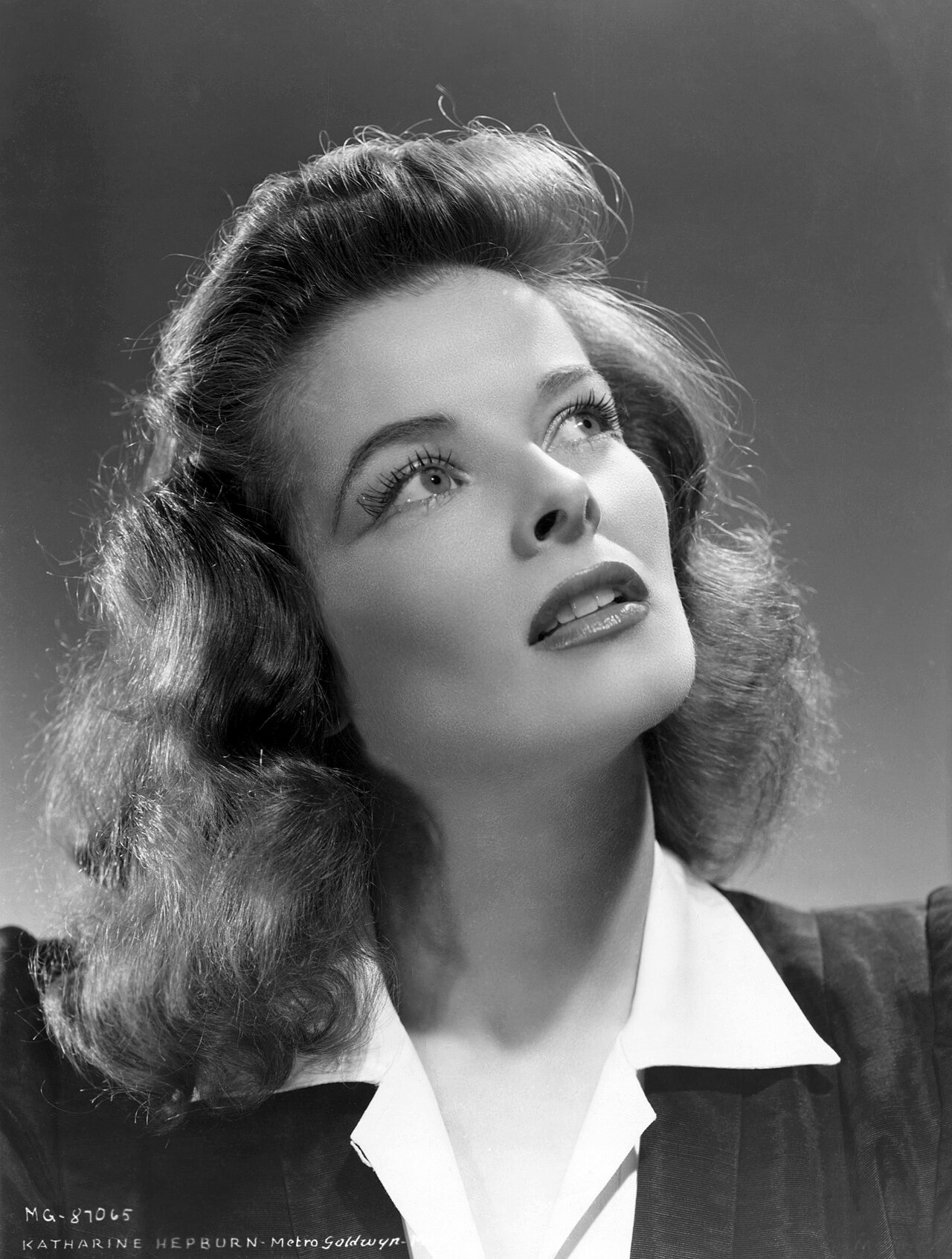
 Katharine Hepburn in an MGM publicity portrait from the early 1940s.
Katharine Hepburn : Personal Info
Full name : Katharine Houghton Hepburn
Born : May 12, 1907, Hartford, Connecticut
Died : June 29, 2003, Fenwick, Old Saybrook, Connecticut
Nationality : American
Occupations : Actress, stage performer
Years active : 1928-1994 in theatre, film and television
Known for : Little Women, Stage Door, Bringing Up Baby, The Philadelphia Story, Woman of the Year, Adam’s Rib, The African Queen, The Lion in Winter, On Golden Pond
Major honors : Record four Academy Awards for Best Actress from twelve nominations; Kennedy Center Honor; American Film Institute’s leading female screen legend
Katharine Hepburn : Introduction
Katharine Hepburn did not fit Hollywood’s preferred idea of a compliant leading lady, so she made independence part of the attraction. Her voice was clipped, her posture athletic and her characters frequently impatient with rules designed to contain them. Across six decades she moved from 1930s eccentricity to mature dramatic authority without surrendering the impression that she had chosen the terms.
The statistics are extraordinary. The Academy’s acting records list twelve Best Actress nominations and four wins, still the record for acting Oscars. Yet the record alone does not explain her durability. Hepburn was equally persuasive in screwball comedy, literary drama, romantic conflict and late-career family stories. She could make hauteur funny, vulnerability private and intelligence dramatically active.
Her public image also carried a modern charge. The trousers, unvarnished speech and resistance to publicity became emblems of self-possession in an industry built on carefully managed femininity. That image was partly authentic and partly cultivated, as every durable star image is. The fascination lies in the way Hepburn converted personality, training and strategic career choices into screen art.
Katharine Hepburn : A Hartford Childhood
Katharine Houghton Hepburn was born into a prosperous and politically engaged Connecticut family. Her father, Thomas Norval Hepburn, was a physician who campaigned for public-health education. Her mother, Katharine Martha Houghton Hepburn, worked for women’s suffrage and birth-control reform. Debate, physical activity and independence were treated as ordinary parts of family life rather than privileges reserved for sons.
That background helps explain the confidence Hepburn later brought to public disagreements, but her childhood also contained trauma. In 1921 she discovered the body of her older brother Tom, who had died while the siblings were visiting New York. The family disputed how the death should be understood, and responsible biography should avoid certainty beyond the available record. What is clear is that the loss marked Hepburn deeply and contributed to periods of withdrawal.
At Bryn Mawr College she studied history and became increasingly serious about acting. The work did not come easily at first. Her voice, restless energy and lack of conventional polish could seem undisciplined on stage. She learned by doing: stock companies, understudy assignments, dismissals and returns. The eventual assurance was built on repetition and resilience, not effortless destiny.
Katharine Hepburn : Broadway, Hollywood and Morning Glory
Hepburn’s Broadway appearance in The Warrior’s Husband attracted the attention of Hollywood, and director George Cukor became one of the decisive collaborators of her career. Her film debut in A Bill of Divorcement (1932) placed her opposite John Barrymore, but she did not behave like a newcomer waiting to be noticed. The angular movement, direct gaze and unusual speech rhythms were already present.
Morning Glory brought her first Academy Award for Best Actress for work released in 1933. Little Women, also directed by Cukor, gave her an ideal early role in Jo March: ambitious, physically expressive and resistant to the narrow future offered to women. The identification between actor and character was so strong that it helped establish the Hepburn persona for decades.
Success did not make her universally popular. Audiences and studio executives could read the same qualities as refreshing independence or chilly superiority. Films such as Alice Adams showed her emotional range, while Sylvia Scarlett revealed a playful approach to gender presentation that feels strikingly modern. Other projects failed commercially, and a trade advertisement eventually grouped her among performers labelled “box-office poison.”
The phrase has become a convenient legend, but the important point is what Hepburn did next. She did not wait for a studio to repair her. She returned to the stage, secured a vehicle built around her particular qualities and used ownership of the screen rights to negotiate a Hollywood comeback.
Katharine Hepburn : The Philadelphia Story and a Career Reclaimed
Philip Barry wrote The Philadelphia Story with Hepburn in mind. The Broadway production restored her standing, and Howard Hughes acquired the film rights for her. Hepburn then arranged a deal with MGM that allowed her to star in the adaptation and helped determine the principal collaborators. It was an unusually clear act of career authorship.
The 1940 film paired her with Cary Grant and James Stewart. As Tracy Lord, Hepburn confronted a version of her own public reputation: wealthy, imperious, admired and accused of lacking ordinary human tolerance. The performance works because she neither apologizes for Tracy’s intelligence nor protects her from comic exposure. Pride gradually becomes self-knowledge.
James Stewart won the acting Oscar, but the film’s larger consequence was Hepburn’s return to bankable stardom. It demonstrated that the qualities once treated as liabilities could become the centre of a sophisticated popular entertainment. Her comeback was not a surrender to the industry’s old terms. It was proof that she could alter them.
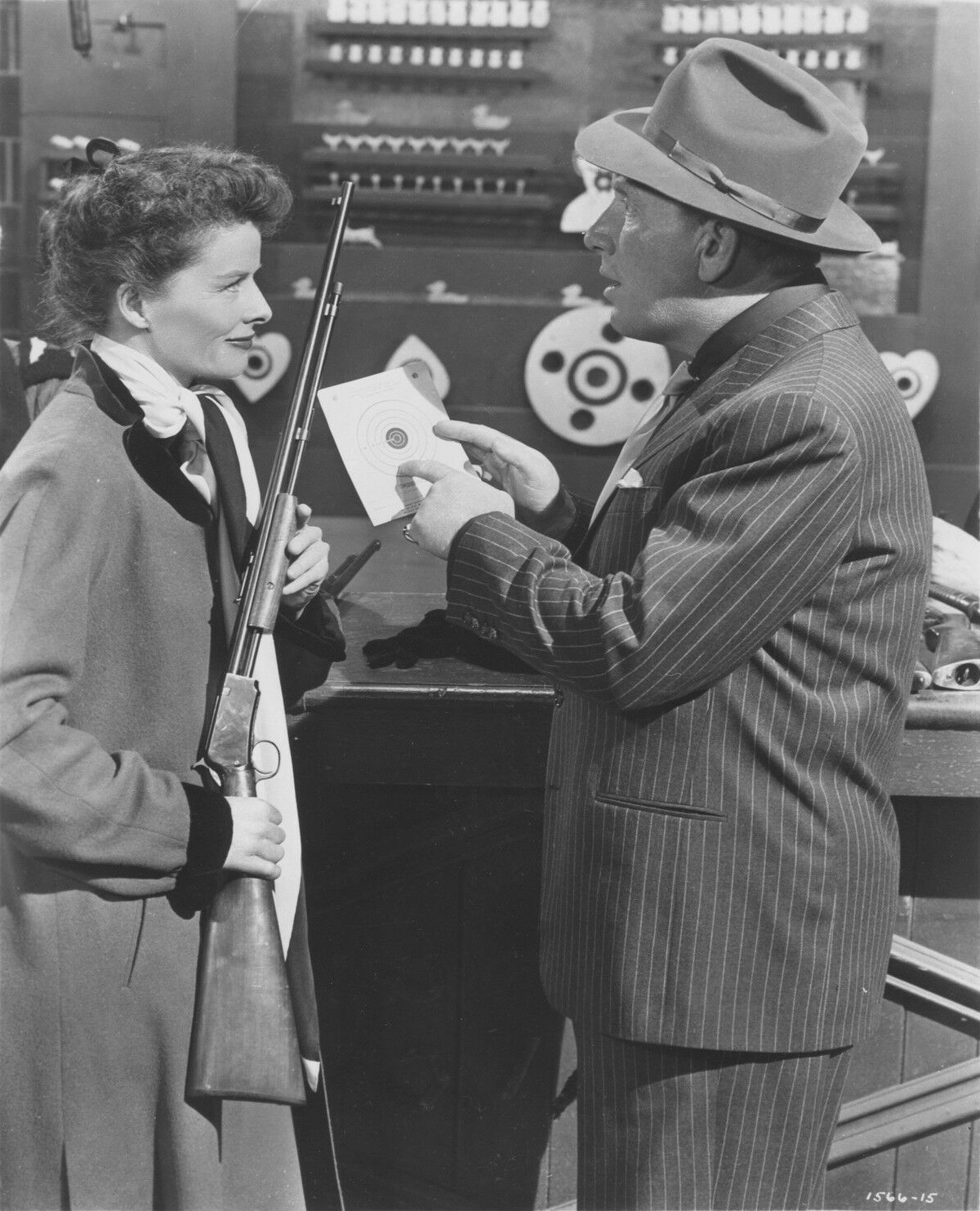 Katharine Hepburn with Spencer Tracy in a publicity still for Pat and Mike (1952).
Katharine Hepburn : Screwball Speed and Physical Comedy
Hepburn’s dramatic reputation can obscure how fearless she was in comedy. Bringing Up Baby (1938) initially disappointed at the box office, yet it became one of the defining screwball comedies. Opposite Cary Grant’s anxious paleontologist, Hepburn plays Susan Vance as a force of cheerful disruption. The performance requires speed, balance and an ability to make irrational behavior feel governed by its own perfect logic.
Holiday, another film with Grant and Cukor, uses her eccentricity more wistfully. Stage Door places her within an ensemble of ambitious women and allows privilege to collide with professional hardship. These performances are not simply versions of an off-screen personality. Their rhythms change according to the partner, director and emotional stakes.
The BFI’s selection of essential Hepburn films emphasizes how completely she moved between comedy and drama. Her comic characters often begin from certainty and discover dependence; her dramatic characters may begin under social restraint and find a language for defiance. In both modes, thought becomes visible through the body.
Katharine Hepburn : Spencer Tracy and the Art of Partnership
Woman of the Year (1942) began Hepburn’s nine-film partnership with Spencer Tracy. Their contrast was immediately useful: her long, tensile energy against his compact stillness; her precision against his conversational naturalism. The films often stage arguments about work, marriage, gender and authority, allowing both stars to challenge the other’s public identity.
Adam’s Rib (1949) is the most enduring comedy of the series. Hepburn and Tracy play married lawyers on opposite sides of an attempted-murder case, turning domestic intimacy into a debate about legal and social double standards. Pat and Mike (1952) places Hepburn’s athletic ability at the centre and lets Tracy’s character recognize rather than diminish it.
The off-screen relationship lasted until Tracy’s death in 1967, although he remained married to Louise Tracy. Because the relationship was protected from ordinary publicity and later became romantic legend, accounts can slide too easily into certainty about private arrangements and motives. The films provide firmer evidence: two performers listening closely, adjusting tempo and making combat feel like intimacy.
Guess Who’s Coming to Dinner was their final film together. Its liberal interracial-marriage drama now attracts justified criticism for making Sidney Poitier’s character almost impossibly accomplished and for centring white parental approval. Even within those limits, Hepburn’s emotion carries added force because Tracy was gravely ill during production and died soon after filming.
Katharine Hepburn : The African Queen and Mid-Career Reinvention
Hepburn’s career after the studio-era peak did not become a simple decline. The African Queen (1951) placed her opposite Humphrey Bogart in a demanding location production directed by John Huston. Rose Sayer begins as a rigid missionary and becomes an eager adventurer; Hepburn lets exhilaration break through discipline without losing the character’s moral intensity.
Summertime (1955), directed by David Lean, offers one of her most exposed performances. As an unmarried American tourist in Venice, she plays loneliness without sentimentality. The role depends on a mature woman’s desire being treated as both serious and socially precarious, and Hepburn allows the character’s self-protection to fail in small, painful increments.
Long Day’s Journey into Night, Suddenly, Last Summer and The Lion in Winter demanded very different forms of theatrical power. In The Lion in Winter, her Eleanor of Aquitaine turns language into strategy while revealing the injuries beneath royal performance. The role brought the third of her four Oscars; the Academy records that the 1969 award ended in a tie with Barbra Streisand.
Katharine Hepburn : Acting Style, Voice and Control
Imitation can reduce Hepburn to the upper-class New England voice, the lifted chin and the tremor that became more pronounced with age. Her actual technique was more flexible. She used consonants to sharpen thought, sudden movement to break social stillness and an alert listening style that made disagreement feel spontaneous.
Directors who understood her did not try to erase the recognisable manner. Cukor found emotional movement inside it. Howard Hawks accelerated it toward chaos. David Lean let it fail against solitude. John Huston placed it in physical discomfort, while Anthony Harvey used it as royal armour. The star persona remained visible, but the dramatic function changed.
Hepburn also understood the value of refusal. She avoided many rituals of Hollywood publicity, did not attend the Academy ceremonies for her competitive wins and protected areas of her private life. Distance made her appear unusually autonomous, though it should not be mistaken for complete freedom. She still worked within commercial systems and faced the unequal expectations placed on ageing actresses.
Katharine Hepburn : Clothes, Gender and a Modern Public Image
Hepburn’s preference for trousers became one of the most repeated details of her image. In the 1930s, clothing that now appears practical could be read as a challenge to prescribed femininity. The significance was not that she invented women wearing trousers, but that a major female star made comfort, mobility and self-definition central to glamour.
The image also interacted with her roles. Jo March, Susan Vance, Tracy Lord and Pat Pemberton are not identical women, but each tests the boundary between social expectation and individual appetite. Hepburn’s physical confidence allowed costume to become character information rather than mere decoration.
Modern discussions sometimes recruit her as a simple emblem for contemporary identities she did not publicly claim. It is more accurate to recognize that her style and performances created room for viewers who felt constrained by conventional gender presentation. The work can have meanings beyond biography without requiring speculative labels.
 Katharine Hepburn, at right in trousers, rehearsing a Bryn Mawr play in 1927.
Katharine Hepburn : Later Work and On Golden Pond
Television expanded Hepburn’s late career through projects including The Glass Menagerie, Love Among the Ruins and The Corn Is Green. She remained willing to take on demanding literary material at an age when the film industry offered women fewer central roles.
On Golden Pond (1981) paired her with Henry Fonda and Jane Fonda in a drama about ageing, family resentment and reconciliation. Hepburn’s Ethel Thayer balances brisk practicality with an awareness of mortality. The performance brought her fourth Academy Award, confirmed by the Academy’s 1982 ceremony record.
Her final screen appearances were selective rather than designed as grand farewells. By then the image of Hepburn as survivor could threaten to overwhelm individual roles, but she continued to look for intelligence and activity in older women rather than treating age as passive decline.
Katharine Hepburn : Private Life and Responsible Biography
Hepburn was married once, to Ludlow Ogden Smith, from 1928 until their divorce in 1941. Her later relationship with Tracy has dominated popular accounts, sometimes at the expense of friendships, family ties and the work itself. A responsible biography can acknowledge the relationship’s importance without converting guarded private lives into melodrama.
She also controlled her retrospective narrative through interviews and her 1991 memoir, Me: Stories of My Life. Autobiography is invaluable evidence but remains a performance shaped by memory, privacy and the wish to define one’s own legend. Hepburn’s version of Hepburn is part of the subject, not the final word on it.
She died in 2003 at the family home in Fenwick, Connecticut. The long life encouraged a satisfying story of absolute self-determination, but her career was more interesting than that. She experienced failure, dependence, compromise and grief. Her distinction was the ability to convert those pressures into renewed forms of authority.
Selected Katharine Hepburn Filmography
1932 – A Bill of Divorcement : Film debut opposite John Barrymore
1933 – Morning Glory : First Academy Award-winning performance
1933 – Little Women : Defining early role as Jo March
1937 – Stage Door : Ensemble drama-comedy with Ginger Rogers
1938 – Bringing Up Baby : Landmark screwball comedy with Cary Grant
1940 – The Philadelphia Story : Career-restoring comedy of manners
1942 – Woman of the Year : First film with Spencer Tracy
1949 – Adam’s Rib : Courtroom and marital comedy
1951 – The African Queen : Adventure romance with Humphrey Bogart
1955 – Summertime : David Lean’s Venice-set romantic drama
1962 – Long Day’s Journey into Night : Eugene O’Neill adaptation
1967 – Guess Who’s Coming to Dinner : Final film with Tracy
1968 – The Lion in Winter : Third Oscar-winning performance
1981 – On Golden Pond : Fourth Oscar-winning performance
Katharine Hepburn : Frequently Asked Questions
How many Oscars did Katharine Hepburn win?
She won four Academy Awards for Best Actress, for Morning Glory, Guess Who’s Coming to Dinner, The Lion in Winter and On Golden Pond. The total remains the acting record.
Were Katharine Hepburn and Audrey Hepburn related?
No. They shared a surname and became two of classic Hollywood’s most admired actresses, but they were not related. Their screen images and family backgrounds were also quite different.
How many films did Katharine Hepburn make with Spencer Tracy?
They made nine films together, beginning with Woman of the Year in 1942 and ending with Guess Who’s Coming to Dinner in 1967.
Why was Katharine Hepburn called “box-office poison”?
A 1938 trade advertisement used the label for several stars whose recent films had disappointed commercially. Hepburn’s subsequent Broadway and film success with The Philadelphia Story turned the phrase into the opening of a famous comeback story.
What is the best Katharine Hepburn film to watch first?
The Philadelphia Story is the broadest introduction because it combines comedy, romance, self-criticism and three major stars. Bringing Up Baby is ideal for screwball comedy, while The Lion in Winter displays her mature dramatic authority.
Related Articles
20 Classic Hollywood Actresses Everyone Should Know
20 Movie Stars Who Defined Old Hollywood Glamour
Top 20 Best Black-and-White Movies for New Classic Film Fans