Tony Curtis : Personal Info
Birth name : Bernard Schwartz
Born : 3 June 1925, New York City
Died : 29 September 2010, Henderson, Nevada
Nationality : American
Occupations : Actor, painter
Years active : 1948–2010
Known for : Sweet Smell of Success, The Defiant Ones, Some Like It Hot, Operation Petticoat, Spartacus, The Great Race, The Boston Strangler
Major honours : Academy Award nomination for Best Actor; BAFTA and Golden Globe nominations
Tony Curtis : Introduction
Tony Curtis spent much of his career trying to outrun the idea that a handsome contract player could not be a serious actor. The effort produced two very different peaks. In Sweet Smell of Success, he made charm look desperate and corrupt. In Some Like It Hot, he turned disguise, imitation and romantic dishonesty into effortless comedy.
The ease was deceptive. Curtis grew up speaking Hungarian before English, served in the Navy and entered Hollywood as Bernard Schwartz, a Jewish boy from the Bronx whose accent the studio wanted changed. Reinvention gave him access to stardom, but it also created a lifelong tension between public image and private insecurity.
 Tony Curtis in a 1958 studio publicity portrait.
Tony Curtis : Bronx Childhood and Navy Service
Bernard Schwartz was born to Hungarian Jewish immigrants Emanuel and Helen Schwartz. His father ran a tailor shop, and the family lived with limited money. Curtis later described an unstable childhood marked by parental conflict, antisemitism and periods when he and his brother were placed in an institution because the family could not support them.
He joined the US Navy in 1943 and served aboard the submarine tender USS Proteus in the Pacific. The National WWII Museum’s service history records his work around Guam and submarine relief operations. He witnessed the Japanese surrender in Tokyo Bay from a distance.
After the war, the GI Bill helped him study acting. He attended the Dramatic Workshop in New York, where fellow students included Walter Matthau. Talent scout Joyce Selznick helped bring him to Universal.
Tony Curtis : Becoming a Hollywood Star
Universal changed Bernard Schwartz into Anthony Curtis and then Tony Curtis. Early appearances were small, but audiences noticed him in Criss Cross and Winchester ’73. The studio exploited his looks through adventure films while he pushed for material with more dramatic weight.
Houdini (1953), with Janet Leigh, strengthened his popularity. Curtis and Leigh married in 1951 and became one of Hollywood’s most photographed couples. Their daughters Kelly and Jamie Lee Curtis later became actors.
The publicity could make the career look easier than it was. Curtis worked consciously on his voice and movement, sometimes overcorrecting the New York identity that later directors would use to better effect.
Tony Curtis : Sweet Smell of Success
Alexander Mackendrick’s Sweet Smell of Success (1957) gave Curtis his most corrosive role. Sidney Falco is a press agent who survives by flattering powerful columnist J. J. Hunsecker, played by Burt Lancaster. Sidney’s quickness is impressive because every calculation reveals dependence.
Curtis does not ask the audience to like him. He uses the speed and urban accent that conventional leading roles had suppressed, making Sidney’s intelligence inseparable from panic. The film failed commercially at first but became central to Curtis’s critical reputation.
Its view of publicity also speaks directly to his career. Sidney manufactures images for other people while losing control of his own moral identity. Curtis understood that bargain from inside the star system.
Tony Curtis : The Defiant Ones
In The Defiant Ones (1958), Curtis and Sidney Poitier play escaped prisoners chained together in the segregated American South. Both received Best Actor nominations. The Academy’s 1959 record confirms that Curtis’s performance brought his only Oscar nomination.
The film’s racial politics are shaped by liberal Hollywood of its period, but equal billing mattered. Curtis supported Poitier receiving the same prominence, a decision often cited as evidence that ambition did not exclude solidarity.
His character begins with open prejudice. Physical dependence gradually forces recognition without turning conflict into instant friendship. Curtis lets hostility, fear and reluctant respect change through action.
Tony Curtis : Some Like It Hot
Billy Wilder’s Some Like It Hot (1959) revealed the full range of Curtis’s comic technique. He and Jack Lemmon play musicians who witness a gangland murder and join an all-woman band in disguise. Curtis then adds another performance inside the disguise: a wealthy heir designed to attract Marilyn Monroe’s Sugar Kane.
His voice for “Junior” famously borrows from Cary Grant, though Curtis’s later accounts varied on how deliberate the imitation was. The joke works because the supposedly natural leading man is the most artificial identity in the film.
Curtis also gives Monroe room. Joe begins by treating her vulnerability as an opportunity, but the comedy gradually exposes his manipulation. The film’s ending refuses conventional certainty, allowing performance and desire to remain fluid.
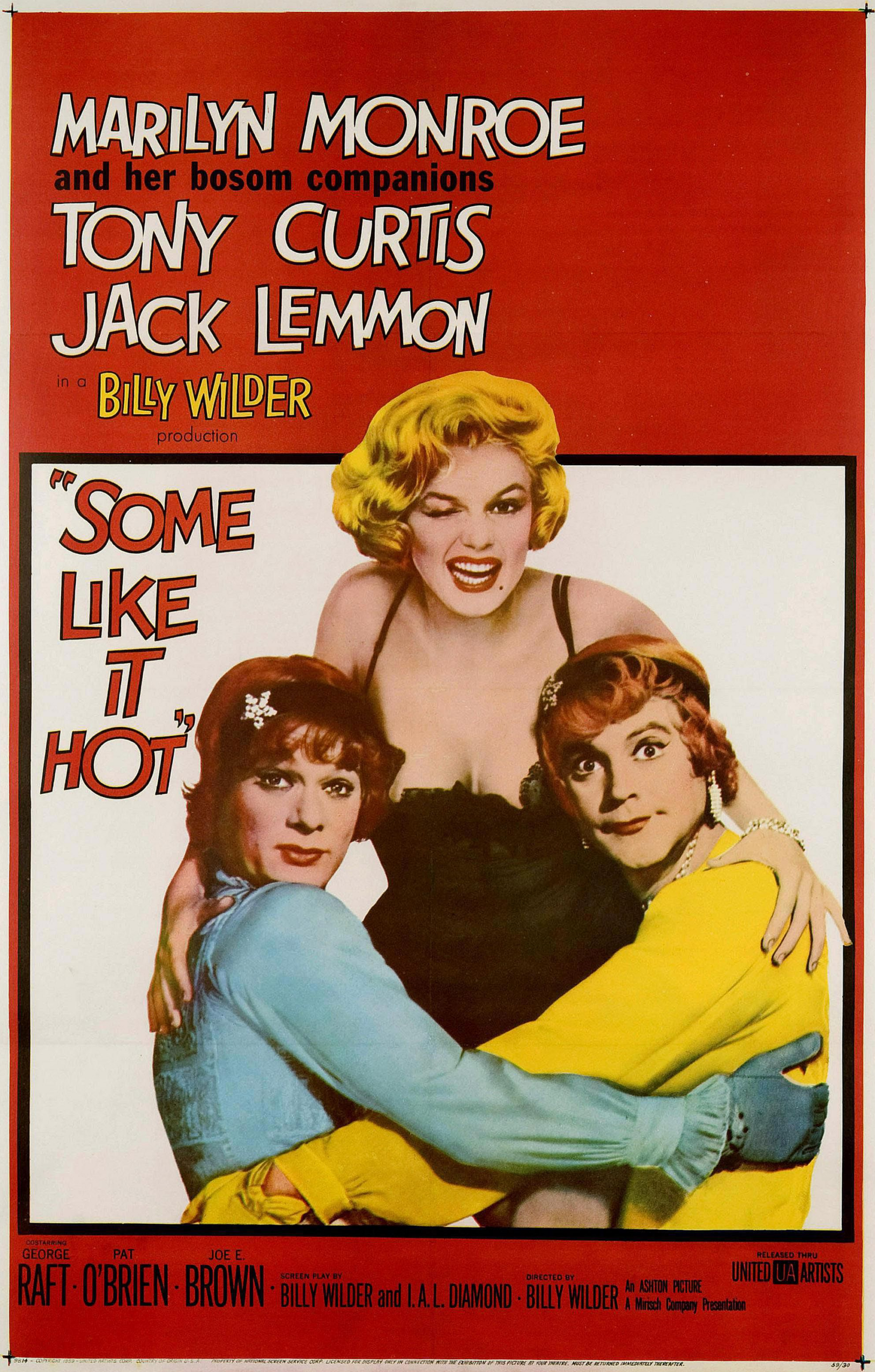 Original theatrical poster for Some Like It Hot (1959).
Tony Curtis : Spartacus and 1960s Range
Curtis played Antoninus in Stanley Kubrick’s Spartacus (1960). The restored “oysters and snails” scene with Laurence Olivier carries a discussion of sexual appetite that censors originally removed. His presence in the epic helped Dalton Trumbo’s script move openly back into credited Hollywood production.
Other films demonstrated restless range: naval comedy in Operation Petticoat, serial imposture in The Great Impostor, spectacle in Taras Bulba and extravagant parody in The Great Race. Not every project used him well, and changing 1960s tastes weakened his position as a leading man.
He answered with The Boston Strangler (1968), playing Albert DeSalvo without romantic glamour. The film’s claims about the case are disputed, but Curtis’s controlled, unsettling performance reminded critics that comedy and beauty had never been his limits.
Tony Curtis : Marriages, Addiction and Later Work
Curtis married six times. His marriages to Janet Leigh, Christine Kaufmann, Leslie Allen, Andrea Savio, Lisa Deutsch and Jill Vandenberg formed part of an eventful personal life that he discussed candidly and sometimes self-servingly in memoirs.
He struggled with alcohol and cocaine during periods of career decline and entered treatment in the 1980s. Relationships with some of his children were difficult. His son Nicholas died from a heroin overdose in 1994, a loss Curtis described as devastating.
Television gave him a popular partnership with Roger Moore in The Persuaders!. Later film roles were uneven, though he remained an engaging witness to studio Hollywood in interviews and documentaries. Painting became a serious second career, giving him a creative practice outside performance.
Curtis died in Nevada in 2010, aged 85.
Tony Curtis : Legacy
Curtis’s legacy rests on versatility achieved against type. Stardom first depended on appearance; the best performances reveal how hard he worked to make appearance unstable.
Sweet Smell of Success turns charm into moral compromise. The Defiant Ones uses physical conflict to challenge prejudice. Some Like It Hot makes identity a comic performance, while The Boston Strangler removes the reassurance audiences expected from his face.
He was neither the effortless lightweight nor the neglected tragedian of competing myths. He was a highly skilled star capable of inspired work when directors used his speed, insecurity and appetite rather than merely photographing him.
 Director Stanley Kubrick with Tony Curtis during production of Spartacus (1960).
Selected Tony Curtis Filmography
1953 – Houdini : Popular pairing with Janet Leigh
1957 – Sweet Smell of Success : Career-best dramatic role as Sidney Falco
1958 – The Defiant Ones : Academy Award-nominated performance
1959 – Some Like It Hot : Billy Wilder’s gender-disguise comedy
1959 – Operation Petticoat : Naval comedy with Cary Grant
1960 – Spartacus : Antoninus in Kubrick’s historical epic
1965 – The Great Race : Elaborate Blake Edwards comedy
1968 – The Boston Strangler : Dark dramatic transformation
1971–72 – The Persuaders! : Television partnership with Roger Moore
Tony Curtis : Frequently Asked Questions
What was Tony Curtis’s real name?
He was born Bernard Schwartz. Universal changed his professional name after signing him.
Did Tony Curtis win an Oscar?
No. He received one Best Actor nomination for The Defiant Ones.
Was Tony Curtis really in the Navy?
Yes. He served in the Pacific during the Second World War aboard the submarine tender USS Proteus.
What Tony Curtis film should a beginner watch first?
Some Like It Hot is the ideal introduction to his comic timing. Follow it with Sweet Smell of Success to see how effectively he could turn charm into something dangerous.
Related Articles
20 Classic Hollywood Comedies That Are Still Funny
Service history was checked against the National WWII Museum, and awards against the Academy’s 1959 ceremony record.