 Marilyn Monroe in a 1953 publicity portrait, at the moment her Hollywood image became unavoidable.
Marilyn Monroe : Personal Info
Full Name : Norma Jeane Mortenson, later baptized Norma Jeane Baker; professionally Marilyn Monroe
Date of Birth : June 1, 1926
Birthplace : Los Angeles, California, United States
Died : August 4, 1962, Los Angeles, California, United States
Occupations : Actress, model, singer, producer
Years Active : 1945-1962
Known For : Gentlemen Prefer Blondes, How to Marry a Millionaire, The Seven Year Itch, Bus Stop, Some Like It Hot, The Misfits
Major Honors : Golden Globe winner; Hollywood Walk of Fame star; AFI screen legend recognition
Marilyn Monroe : Introduction
Whether you remember her standing above a subway grate in The Seven Year Itch, singing Diamonds Are a Girl’s Best Friend in Gentlemen Prefer Blondes, or turning Some Like It Hot into a comedy with bruised romantic feeling, Marilyn Monroe remains one of the most recognizable movie stars who ever lived. Her image is so famous that it can seem almost detached from the woman who created it. That is the first difficulty in writing about her, and also the reason she still matters.
Marilyn was not simply a blonde bombshell manufactured by Hollywood. She was a foster child who learned self-invention as a survival skill, a model who studied light and angles, a contract player who wanted better parts, and an actress who fought to be taken seriously inside an industry that profited from underestimating her. The surface was dazzling, but the career was built on work.
It is easy to reduce Marilyn Monroe to tragedy, scandal, or costume. A better biography has to keep several truths in view at once. She was funny. She was ambitious. She was often treated carelessly. She could be difficult, but she was also operating under pressure that few performers of her era had to carry in public. Above all, she had a camera intelligence that still feels alive, which is why her best scenes have not become museum pieces.
Marilyn Monroe : Early Life as Norma Jeane
So where did it all begin? Marilyn Monroe was born Norma Jeane Mortenson in Los Angeles on June 1, 1926. Her mother, Gladys Pearl Baker, struggled with mental illness, and Norma Jeane’s childhood moved through foster homes, guardianships, and uncertainty. The PBS American Masters timeline traces the broad outline of these early years, including the instability that shaped her long before Hollywood entered the story.
This early instability is not just background color. It helps explain why belonging, security, and approval became such powerful themes in Marilyn’s life. She grew up learning that identity could be fragile and that adult promises could disappear. Later, when audiences saw a woman who seemed to need love and perform confidence at the same time, they were responding to something deeper than studio publicity.
At sixteen, Norma Jeane married James Dougherty, partly as a practical way to avoid returning to the foster-care system. During the Second World War she worked in a factory, where photographers noticed her. That discovery did not instantly make her a star, but it opened a door. Modeling gave her a first professional understanding of the camera, and she took the lesson seriously.
The young Norma Jeane was not yet Marilyn Monroe, but the transformation had begun. She learned posing, makeup, hair, and presentation not as decoration but as craft. Before she became a screen personality, she became a student of being seen. That distinction matters because Marilyn’s later image was not passive. It was constructed, refined, tested, and adjusted.
Marilyn Monroe : From Model to Studio Contract Player
By the mid-1940s, Norma Jeane had moved from factory work into modeling, and the camera liked her with unusual force. In 1946, she signed with Twentieth Century-Fox and began using the name Marilyn Monroe. The name sounded polished, but the woman behind it was still learning how to survive the studio system.
Those first contracts did not make her powerful. Like many young performers, she was tested, photographed, coached, dropped, rehired, and pushed toward a marketable type. Hollywood could be generous with illusion and stingy with control. Marilyn learned this early. Her beauty opened doors, but it also narrowed the kinds of rooms she was allowed to enter.
The early film roles were small, yet they were not meaningless. In The Asphalt Jungle and All About Eve, both released in 1950, she caught attention in limited screen time. She did not need much space to register. A line, a glance, a pause, or a particular stillness could make the camera organize itself around her.
That was one of Marilyn’s gifts: she could make a minor role feel like an interruption from another, more interesting film. She understood how to give the audience an invitation. The voice might be breathy, the posture soft, the smile slightly delayed, but behind those choices was a performer learning exactly how little she had to do to make people look.
Marilyn Monroe : 1953 and the Breakthrough Year
 Marilyn Monroe as Rose Loomis in Niagara, one of the films that changed her public profile in 1953.
If there is one year when Marilyn Monroe became impossible for Hollywood to ignore, it is 1953. Niagara gave her a darker, more dangerous screen presence. Gentlemen Prefer Blondes turned her into a musical-comedy phenomenon. How to Marry a Millionaire confirmed that audiences would buy a ticket for the Marilyn Monroe experience.
 Marilyn Monroe in Gentlemen Prefer Blondes, where her comic intelligence sharpened the Lorelei Lee image.
Niagara is important because it shows how forcefully Monroe could play threat and desire. Rose Loomis is not the innocent dream girl of later posters. She is restless, sexual, calculating, and trapped. The film uses color, movement, and landscape to amplify her presence, but Marilyn supplies the current underneath it. She makes the danger feel human.
 Marilyn Monroe in How to Marry a Millionaire, another 1953 success that confirmed her box-office power.
Gentlemen Prefer Blondes gave her the role of Lorelei Lee, and it could have flattened her into a joke. Instead, Marilyn made Lorelei smarter than people around her realized. Diamonds Are a Girl’s Best Friend became the number everyone remembers, but the performance works because Lorelei is not merely greedy. She understands how money, marriage, beauty, and power operate in a world that pretends not to be transactional.
How to Marry a Millionaire added another layer. As Pola Debevoise, Marilyn played a woman whose glamour is constantly undermined by bad eyesight and comic vulnerability. The joke is not simply that Pola is beautiful and foolish. The joke is that she is trying to maintain a polished fantasy while ordinary human awkwardness keeps breaking through. That mixture became one of Marilyn’s signatures.
Marilyn Monroe : Comedy, Timing and Screen Intelligence
Marilyn Monroe’s comedy is sometimes underrated because it looks so effortless. She did not deliver jokes like a nightclub comic. She let jokes happen to her, around her, and through her. Her timing often depended on a tiny delay, as if the character’s thought arrived half a beat after everyone else’s, but the delay was controlled.
That control is what separates Marilyn from many later imitations. The copied version is often just a whisper, a pout, and a walk. The real thing is more precise. She knew when to look away, when to widen her eyes, when to let a line fall softly, and when to make a character seem both aware and unaware of her effect on others.
Her singing works in a similar way. Marilyn was not built as a grand theatrical belter, but she had phrasing, breath, and personality. In musical numbers, she often makes the song feel conversational, as though the lyric is a private thought being dressed up for public performance. That intimacy helped make her musical scenes unusually replayable.
This is why Monroe’s best work survives even when the surrounding films show their age. She adds weather to the room. A scene can begin as a routine bit of studio comedy and suddenly become stranger, softer, or sadder because Marilyn lets the character’s self-protection slip for a second.
Marilyn Monroe : Music, Voice and the Art of Appearing Effortless
Marilyn Monroe’s voice is one of the most imitated sounds in movie history, which can make it easy to miss how carefully she used it. The breathiness was not simply a natural accident. It became part of a comic instrument: soft enough to invite attention, delayed enough to suggest private thought, and musical enough to make even ordinary dialogue feel staged for memory.
Her musical performances work because she rarely tries to overpower a number. In Gentlemen Prefer Blondes, she turns Diamonds Are a Girl’s Best Friend into a precise performance of worldly innocence. In Some Like It Hot, she makes I Wanna Be Loved by You feel both playful and exposed. The songs are not detachable from the character. They are little biographies inside the film.
This is also why Monroe’s apparent lightness can be misleading. Light comedy is hard because it gives the performer almost nowhere to hide. Marilyn had to make difficult choices look spontaneous while keeping the character readable at a glance. When she succeeds, the scene feels simple. That simplicity was the craft.
Marilyn Monroe : The Seven Year Itch and the Image Problem
 Marilyn Monroe in The Seven Year Itch, one of the most reproduced images in Hollywood publicity history.
The Seven Year Itch, released in 1955, gave Marilyn one of the most famous images in American film publicity: the white dress lifted by air from a subway grate. The image helped make her immortal, but it also created a problem. It turned a living actress into an endlessly reproduced symbol.
The film itself is lighter than the mythology around it. Marilyn plays The Girl, an upstairs neighbor who becomes the object of fantasy for a married man left alone in summer heat. The part is intentionally airy, but Monroe gives it warmth and comic innocence. She avoids making the character cruel or stupid. Instead, The Girl seems almost untouched by the fantasies projected onto her.
The problem was that the publicity image became bigger than the performance. A single still could travel further than the film, and in Marilyn’s case it often did. She became easier to consume as a pose than to consider as an actress. That tension between image and person would follow her for the rest of her life.
Marilyn Monroe : Photography, Pinups and Control of the Frame
Before Marilyn was fully established as a film star, she had already learned how photographs circulated. Pinups, magazine covers, publicity portraits, and calendar images shaped her career as much as dialogue scenes did. The camera did not merely record Marilyn Monroe. It helped manufacture her, and she learned to participate in that manufacturing process with unusual precision.
That experience gave her a rare kind of visual literacy. She understood how a still image could simplify a person, but she also understood its power. A photograph could get her attention from studio executives, bring audiences to a film, and fix a performance in the public imagination. The risk was that the photograph could also replace the person.
The best Monroe images usually contain some version of that tension. She appears available and unreachable at the same time. She can look like a fantasy while suggesting fatigue underneath the fantasy. This is why her photographs keep being reproduced by people who may not have seen the films. They promise glamour, but they also carry a flicker of unease.
Marilyn Monroe : New York, Marilyn Monroe Productions and the Fight for Respect
By the mid-1950s, Marilyn was tired of being treated as a studio property. She wanted better scripts, more control, and serious acting work. Her move to New York and association with the Actors Studio signaled a major shift. She was not trying to abandon glamour. She was trying to prove that glamour and acting did not have to cancel each other out.
The creation of Marilyn Monroe Productions was bold for its time. Female stars had challenged studios before, but Marilyn’s move struck directly against the assumption that she should be grateful for whatever roles the system gave her. She had become one of the industry’s most marketable images, and she wanted that market value to translate into creative leverage.
This fight for respect is one of the most important parts of the Monroe story. It shows an ambitious professional negotiating with a business that preferred her compliant. The easy version of Marilyn history treats her as drifting from one crisis to another. The fuller version shows a woman who repeatedly tried to shape her career, even when the effort was exhausting.
Marilyn Monroe : The Prince and the Showgirl
The Prince and the Showgirl, released in 1957, is not usually the first Marilyn Monroe film casual viewers reach for, but it is important to her career story. The film came out of the period when she was trying to use her star power more deliberately, and it placed her opposite Laurence Olivier, one of the most respected stage actors in the English-speaking world.
The production has often been remembered for tension between Monroe and Olivier, but the film itself shows why she wanted more demanding professional company. Her Elsie Marina is not simply a decorative showgirl. She is politically naive in some ways, but she has emotional instincts and social intelligence that the prince underestimates. Marilyn understood that kind of underestimated woman extremely well.
Seen in the larger arc of her career, The Prince and the Showgirl belongs with Bus Stop and The Misfits as evidence of Monroe pushing against the limits of her type. Even when the result is uneven, the ambition matters. She was trying to stretch the image without losing the audience that image had brought her.
Marilyn Monroe : Bus Stop and the Serious Actress
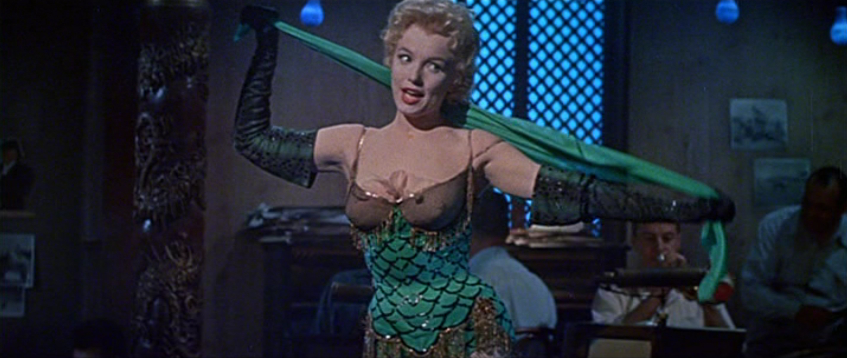 Marilyn Monroe in Bus Stop, a turning point in her effort to be recognized as a serious actress.
Bus Stop, released in 1956, gave Marilyn one of her clearest opportunities to show range. As Cherie, a saloon singer with a rough voice, tired dreams, and stubborn dignity, she stepped away from the polished blonde fantasy and leaned into vulnerability. The performance is not glamorous in the usual Monroe way. It is needy, funny, wounded, and hopeful.
Cherie wants escape, but she also wants to be loved without being possessed. That makes Bus Stop a useful Marilyn Monroe film because it places her persona under pressure. Instead of letting the camera worship her, the film asks what happens when a woman who is used to being looked at wants to be understood.
The result is not perfect, but it is revealing. Marilyn sometimes pushes the accent and mannerisms hard, yet the emotional intention is clear. She is trying to give Cherie a life beyond the joke. In a career often boxed in by fantasy, Bus Stop remains one of the strongest arguments that Monroe had more range than the industry usually allowed her to use.
Marilyn Monroe : Some Like It Hot and Late-Career Triumph
 Marilyn Monroe in Some Like It Hot, her late-career comic triumph.
Some Like It Hot, released in 1959, is often treated as Marilyn Monroe’s comic masterpiece, and for good reason. The Academy’s collection highlights the film’s place in Hollywood memory, and the movie still plays with startling speed. Billy Wilder’s direction, Tony Curtis and Jack Lemmon’s timing, and Monroe’s performance as Sugar Kane combine into one of the great American screen comedies.
Sugar Kane could easily have been only a fantasy: the singer, the blonde, the woman every man in the room wants. Marilyn makes her more complicated. Sugar is funny because she keeps choosing badly, but she is not stupid. She is tender, hopeful, bruised, and aware enough to know that her romantic instincts are a problem.
The role won Monroe a Golden Globe, and the Golden Globes record remains one of the cleanest ways to see how her comic work was recognized in her own time. That matters because Marilyn’s legend can make her achievements seem inevitable. They were not. She worked through delays, insecurity, illness, and pressure, and still produced a performance that feels loose and glowing on screen.
Some Like It Hot also shows why Monroe’s vulnerability was not a weakness as an actress. It gave the comedy emotional stakes. When Sugar sings, jokes, and hopes for a millionaire, the audience laughs but also feels the ache inside the fantasy. That is the Monroe balance: desire and disappointment in the same breath.
Marilyn Monroe : Personal Life and Public Pressure
Marilyn Monroe’s personal life has often been treated as if it explains everything about her. It does not. But it cannot be ignored either, because her marriages, friendships, illnesses, and public struggles shaped the conditions under which she worked. She married James Dougherty before fame, then baseball star Joe DiMaggio, and later playwright Arthur Miller. Each relationship became part of the public story, sometimes at the expense of the work.
The marriage to DiMaggio brought together two American icons, but it also exposed the strain between public glamour and private expectation. The marriage to Miller seemed to promise intellectual seriousness and artistic partnership, and The Misfits would eventually bring them together professionally under painful circumstances. Marilyn’s life was not separate from celebrity culture; it was consumed by it.
Her health struggles and working difficulties became famous, but they should not be used to erase her discipline. Marilyn could be late, anxious, and fragile, but she could also be exacting, ambitious, and deeply invested in performance. The contradiction is the point. She was not a simple cautionary tale. She was a talented performer trying to operate inside a machine that magnified every weakness and monetized every image.
Marilyn Monroe : Illness, Work and the Ethics of Biography
Any serious Marilyn Monroe biography has to decide how much weight to give illness, addiction, lateness, and professional difficulty. Those subjects are part of the story, but they should not be allowed to swallow it. Too often, Marilyn is written about as a problem to be solved rather than an artist to be understood.
A responsible account can acknowledge the difficulties without turning them into spectacle. Monroe struggled with anxiety, insomnia, medical treatment, and the intense pressures of fame. She also kept working, studying, negotiating, filming, rehearsing, and trying to improve. The difficulty and the discipline existed together.
That balance is especially important for a modern reader. Marilyn’s life invites sympathy, but sympathy should not become condescension. She was vulnerable, but she was not merely helpless. She was exploited, but she was not only a victim. She made choices, took risks, formed ambitions, and left behind performances that continue to reward close attention.
Marilyn Monroe : The Misfits and the Final Completed Film
 Marilyn Monroe in The Misfits, her final completed film.
The Misfits, released in 1961, was Marilyn Monroe’s final completed film. Written by Arthur Miller and directed by John Huston, it placed her alongside Clark Gable, Montgomery Clift, Eli Wallach, and Thelma Ritter in a story about damaged people trying to survive in a fading West.
Marilyn’s Roslyn Taber is not the cartoon version of Monroe. She is watchful, wounded, compassionate, and increasingly unable to tolerate cruelty. The film can feel heavy, but her performance has a moral clarity that cuts through the dust. Roslyn sees pain in animals and people, and she refuses to pretend that brutality is freedom.
The production was difficult and has often been surrounded by stories of illness, strain, and endings. Clark Gable died shortly after filming. Marilyn’s marriage to Miller was collapsing. Monroe herself would not complete another film. Yet The Misfits should not be remembered only as a haunted artifact. It is also evidence of the kind of adult dramatic work she wanted to do.
When Marilyn died in Los Angeles in August 1962, she was only thirty-six. Her death froze her in public memory as forever young, but it also interrupted a career that was still changing. The tragedy is not simply that she died young. It is that she was still fighting to become more than the image that had made her famous.
Marilyn Monroe : Awards, Recognition and Screen Legend Status
Marilyn Monroe was not an Academy Award winner, which sometimes leads people to underestimate her formal recognition. That is too narrow a way to measure her. She won Golden Globe recognition, became one of Hollywood’s most enduring box-office and publicity figures, and remains part of the official Hollywood Walk of Fame record.
The American Film Institute later ranked Marilyn among the greatest female screen legends of classic Hollywood. Rankings cannot explain the full force of a star, but this one captures something important: Monroe was not merely famous in the gossip-column sense. She helped define what twentieth-century movie stardom looked and felt like.
Her recognition also lives in imitation, quotation, fashion, photography, music, and advertising. That can be flattering, but it can also blur the original. The copied Marilyn is usually one note. The real Marilyn was musical, shrewd, vulnerable, frustrated, playful, ambitious, and often much more interesting than the icon printed on posters.
Marilyn Monroe : Why Her Legacy Still Works
Marilyn Monroe’s legacy survives because it contains glamour and critique at the same time. She represents Hollywood fantasy, but she also exposes the cost of being turned into fantasy. She is a symbol of beauty, yet her best work keeps asking whether being desired is the same as being valued.
For Movie Star Biographies, Marilyn is a cornerstone subject because her life connects so many evergreen interests: classic Hollywood, studio-system power, comedy, music, celebrity culture, fashion imagery, and the treatment of women in entertainment. Readers arrive for the famous face, but a strong biography should help them leave with a clearer sense of the worker behind the face.
The reason Marilyn still feels modern is not simply that she was beautiful. Many stars were beautiful. She still feels modern because she performed self-invention while letting the cracks show. She understood the camera, but she also showed how lonely it could be to live under its gaze. That tension is why the photographs keep circulating, but the performances keep breathing.
Selected Marilyn Monroe Filmography
1950 : The Asphalt Jungle – Small but attention-getting role as Angela Phinlay
1950 : All About Eve – Miss Casswell, an early example of her scene-stealing presence
1952 : Don’t Bother to Knock – Dramatic role that hinted at darker emotional range
1953 : Niagara – Rose Loomis; noir melodrama that sharpened her danger and glamour
1953 : Gentlemen Prefer Blondes – Lorelei Lee; musical-comedy breakthrough
1953 : How to Marry a Millionaire – Pola Debevoise; major CinemaScope ensemble hit
1955 : The Seven Year Itch – The Girl; one of Hollywood’s most famous publicity images
1956 : Bus Stop – Cherie; a more vulnerable, actorly performance
1957 : The Prince and the Showgirl – Elsie Marina; produced through Marilyn Monroe Productions
1959 : Some Like It Hot – Sugar Kane; Golden Globe-winning comic performance
1960 : Let’s Make Love – Amanda Dell; musical comedy opposite Yves Montand
1961 : The Misfits – Roslyn Taber; final completed film
Related Articles
20 Classic Hollywood Actresses Everyone Should Know
20 Movie Stars Who Defined Old Hollywood Glamour
Top 20 Best Black-and-White Movies for New Classic Film Fans
Top 10 Marilyn Monroe Movies Ranked
Where to Start with Marilyn Monroe Movies