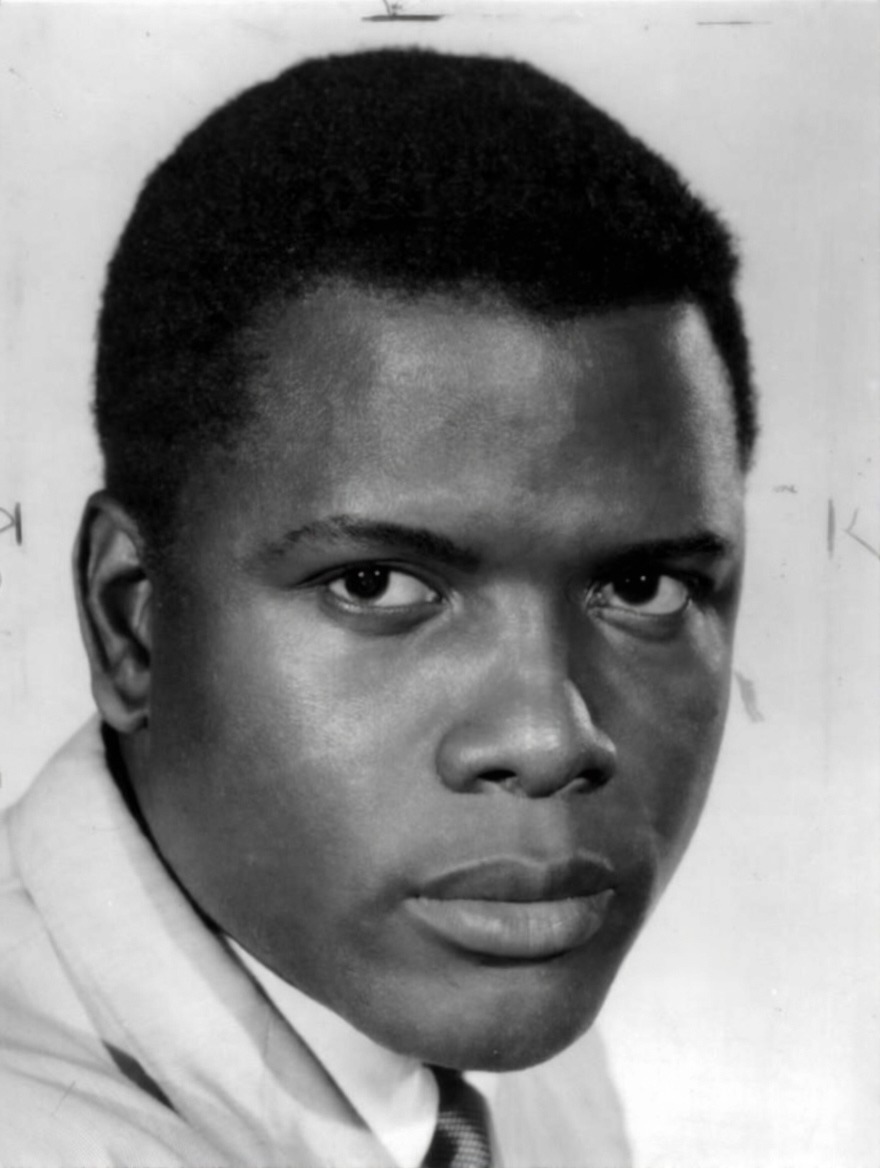
 Sidney Poitier in a 1967 CBS publicity portrait.
Sidney Poitier : Personal Info
Full name : Sidney Poitier
Born : February 20, 1927, Miami, Florida
Died : January 6, 2022, Beverly Hills, California
Nationality : Bahamian and American
Occupations : Actor, director, author, diplomat
Years active : 1946-2009 in performance and public creative work; later legacy appearances
Known for : No Way Out, Blackboard Jungle, The Defiant Ones, A Raisin in the Sun, Lilies of the Field, A Patch of Blue, In the Heat of the Night, To Sir, with Love, Guess Who’s Coming to Dinner
Major honors : First Black man and first Bahamian to win the Academy Award for Best Actor; Honorary Academy Award; Presidential Medal of Freedom; BAFTA Best Actor; Grammy; Kennedy Center Honor
Sidney Poitier : Introduction
Sidney Poitier carried more than the ordinary burden of stardom. In an American film industry structured by segregation and restrictive stereotypes, he became the first Black male star permitted sustained access to major dramatic leading roles. His characters were expected to be admirable enough to reassure white audiences, forceful enough to represent Black dignity and individual enough to remain human.
Poitier met that impossible assignment with voice, posture and moral concentration. He could play controlled intelligence, comic warmth and righteous anger, sometimes within the same scene. His success created opportunities, but it also exposed the limits of an industry that treated one performer as proof of progress.
The Academy’s collection profile records his Best Actor win for Lilies of the Field, Honorary Award and work as a director. The honours are historic, yet his greatest legacy is not a sequence of “firsts” detached from craft. It is the authority with which he made Black interior life central to films that often understood racial conflict less fully than he did.
Sidney Poitier : Miami Birth and Bahamian Childhood
Sidney Poitier was born unexpectedly in Miami while his Bahamian parents were visiting Florida to sell tomatoes. He arrived prematurely and remained in the United States long enough to acquire American citizenship, then grew up on Cat Island and later Nassau in the Bahamas.
His early childhood lacked electricity, automobiles and cinema as ordinary parts of life. Moving to Nassau exposed him to a larger, more stratified world. As a teenager he was sent to live with a brother in Miami, where the racial codes of the American South confronted him with an aggressively enforced identity he had not experienced in the same way on Cat Island.
He soon moved to New York. Poverty, restaurant work and limited formal education made survival difficult. Poitier later described buying access to a radio so he could imitate announcers and reduce a Bahamian accent that casting directors treated as an obstacle. The story reveals determination, but also the cultural gatekeeping that required transformation before talent could be heard.
Sidney Poitier : American Negro Theatre
Poitier initially failed an audition for the American Negro Theatre because he struggled with reading and pronunciation. He returned after months of work and gained experience through small roles, backstage labour and observation. The theatre connected him with other Black performers, including Harry Belafonte, who became friend, colleague and political ally.
An understudy opportunity led to a significant stage appearance and touring work. Broadway’s all-Black production of Lysistrata and other roles developed his command, but theatre did not provide an easy path. Black actors faced a narrow repertory shaped by white producers’ expectations and limited commercial investment.
Poitier’s early technique grew from disciplined speech and contained physicality. The control later read as innate dignity, yet it was also a professional strategy. In spaces ready to misread Black emotion as threat, precision became protection and power.
Sidney Poitier : No Way Out and Screen Arrival
Joseph L. Mankiewicz’s No Way Out (1950) gave Poitier his feature breakthrough as Dr. Luther Brooks, a young physician treating two white criminal brothers, one of whom responds with virulent racist abuse. Richard Widmark’s performance makes the hostility explicit, while Poitier must communicate anger within the character’s professional responsibility.
The film was unusually direct about racism for a major Hollywood production, but it also relied on the near-perfect restraint of its Black protagonist. That pattern would recur. Poitier’s characters often had to be more educated, ethical and controlled than everyone around them in order for the film to acknowledge their humanity.
Poitier was still in his early twenties, though publicity and casting sometimes presented him as older. The performance established a screen authority that did not depend on deference. He could remain composed without appearing submissive.
Sidney Poitier : Blackboard Jungle and Edge of the City
Blackboard Jungle cast Poitier as Gregory Miller, a gifted student confronting an idealistic white teacher in a troubled urban school. The film helped bring rock and roll into mainstream cinema through “Rock Around the Clock,” but Poitier gives its social conflict a centre of intelligence and scepticism.
Edge of the City paired him with John Cassavetes in a drama about friendship, labour corruption and racism on the New York waterfront. Poitier’s Tommy Tyler has humour, family warmth and an ease sometimes missing from the more symbolic roles Hollywood offered him.
The film also demonstrated his ability to support another actor without becoming merely supportive. Tommy’s fate exposes the story’s racial violence, while Poitier’s full characterization prevents the role from functioning only as a lesson for a white protagonist.
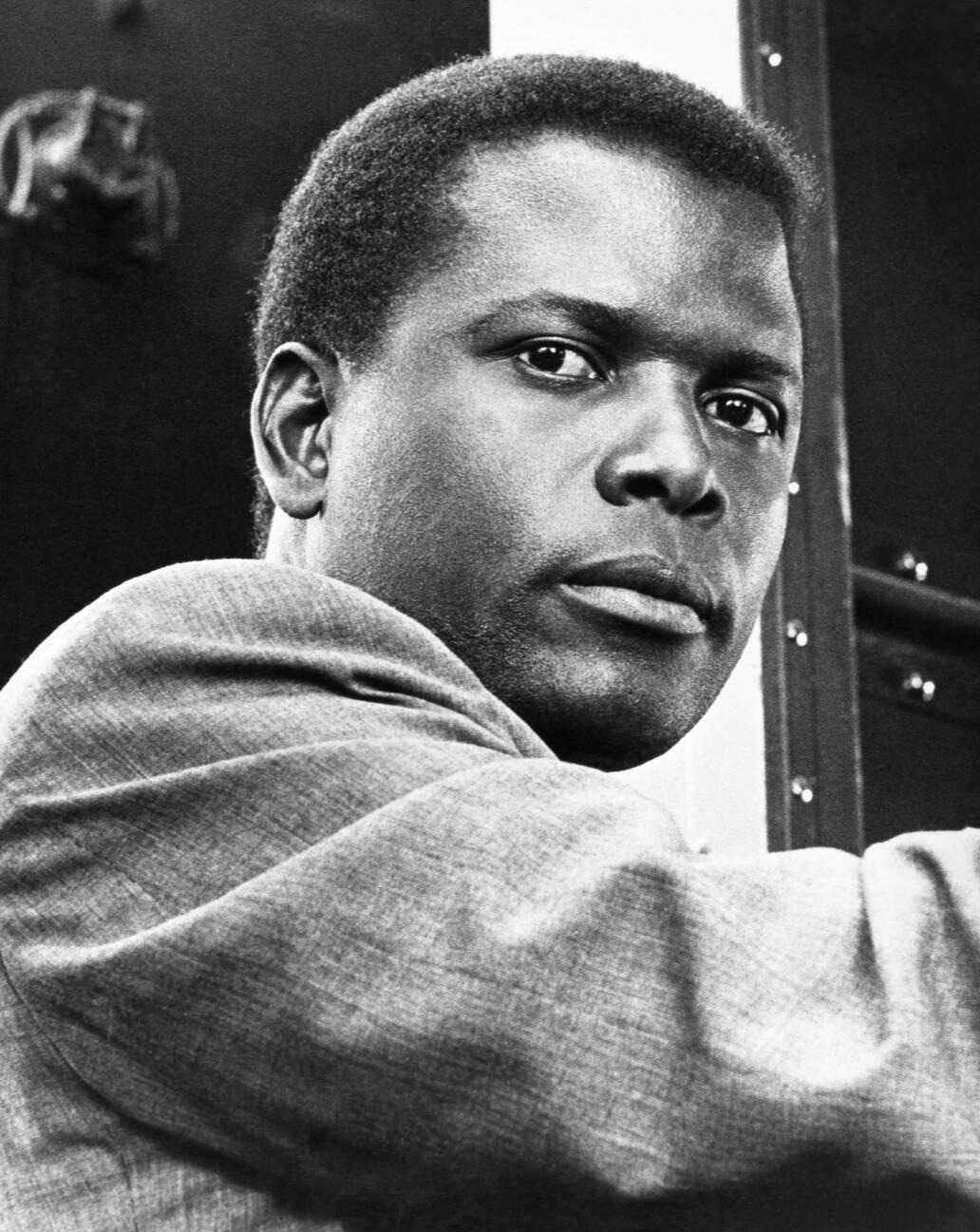 Sidney Poitier as Virgil Tibbs in In the Heat of the Night (1967).
Sidney Poitier : The Defiant Ones and a First Best Actor Nomination
In The Defiant Ones (1958), Poitier and Tony Curtis play escaped prisoners chained together, forced into cooperation despite racist hostility. Producer-director Stanley Kramer used the physical chain as an obvious symbol, but the performances give the allegory friction and personality.
Poitier’s Noah Cullen is proud, angry and unwilling to make easy peace for the audience’s comfort. The role made him the first Black man nominated for the Academy Award for Best Actor. He won the BAFTA for Best Foreign Actor, one of several signs that his importance extended beyond American reception.
The film’s resolution has been debated because Cullen’s final choice can be read as humane solidarity or as another example of a Black character sacrificing freedom for a white man. Poitier’s performance sustains both readings. Historical importance does not place a film beyond criticism.
Sidney Poitier : A Raisin in the Sun
Poitier originated Walter Lee Younger in Lorraine Hansberry’s A Raisin in the Sun on Broadway and returned for the 1961 film with much of the stage cast. Walter is not the composed Poitier ideal. He is restless, wounded, sexist, loving, ambitious and vulnerable to a disastrous financial decision.
The role matters because it centres conflict within a Black family rather than organising every scene around white prejudice. Housing discrimination shapes the story, but Walter’s dignity is not based on being flawless. He must confront the difference between economic aspiration and moral worth.
Poitier’s performance is physically expansive, sometimes almost too large for the camera because it carries the energy of the stage. That scale suits Walter’s hunger. The final refusal is moving because dignity has been fought for inside the character, not granted by an approving outsider.
Sidney Poitier : Lilies of the Field and an Historic Oscar
Lilies of the Field (1963) cast Poitier as Homer Smith, an itinerant handyman persuaded by a group of East German nuns to build a chapel in the Arizona desert. The film is modest in scale and avoids making race its explicit subject, allowing Poitier to display humour, irritation, generosity and practical competence.
He won the Academy Award for Best Actor, becoming the first Black man and first Bahamian to receive the competitive honour. The BFI’s Poitier film guide places the win within a career that had already expanded the possibilities of Black male stardom.
The milestone deserves celebration and context. Hattie McDaniel had become the first Black performer to win an Oscar in 1940, in the supporting category, while segregation and discrimination continued inside and outside Hollywood. Poitier’s win marked progress; it did not indicate an equal industry.
Sidney Poitier : A Patch of Blue and the Burden of Respectability
A Patch of Blue (1965) paired Poitier with Elizabeth Hartman as a blind white woman abused and isolated by her family. Their developing affection challenged the taboo against interracial romance, although the film approaches that challenge cautiously.
Poitier’s Gordon Ralfe is patient, educated and almost endlessly responsible. The characterization made a loving Black man visible to mainstream audiences, but it also reflects the burden placed on Poitier to embody unimpeachable respectability.
He understood the constraint. Roles could be socially meaningful and dramatically narrowing at once. To reject every idealised character would have surrendered rare screen space; to accept them risked becoming an emblem rather than a person.
Sidney Poitier : The Extraordinary Year of 1967
In 1967 Poitier starred in three major box-office successes: To Sir, with Love, In the Heat of the Night and Guess Who’s Coming to Dinner. Together they made him one of the most commercially powerful stars in American cinema.
To Sir, with Love moved him from the rebellious student of Blackboard Jungle to a teacher in an East London school. Mark Thackeray’s discipline and care reach working-class pupils through respect rather than sentimentality, even if the film simplifies educational transformation.
In the Heat of the Night gave Poitier his most forceful popular role as Philadelphia detective Virgil Tibbs. Wrongly arrested in Mississippi, Tibbs becomes essential to a murder investigation while confronting racist police and townspeople. His declaration of his own name and status became a cultural statement because Poitier fills professional authority with controlled anger.
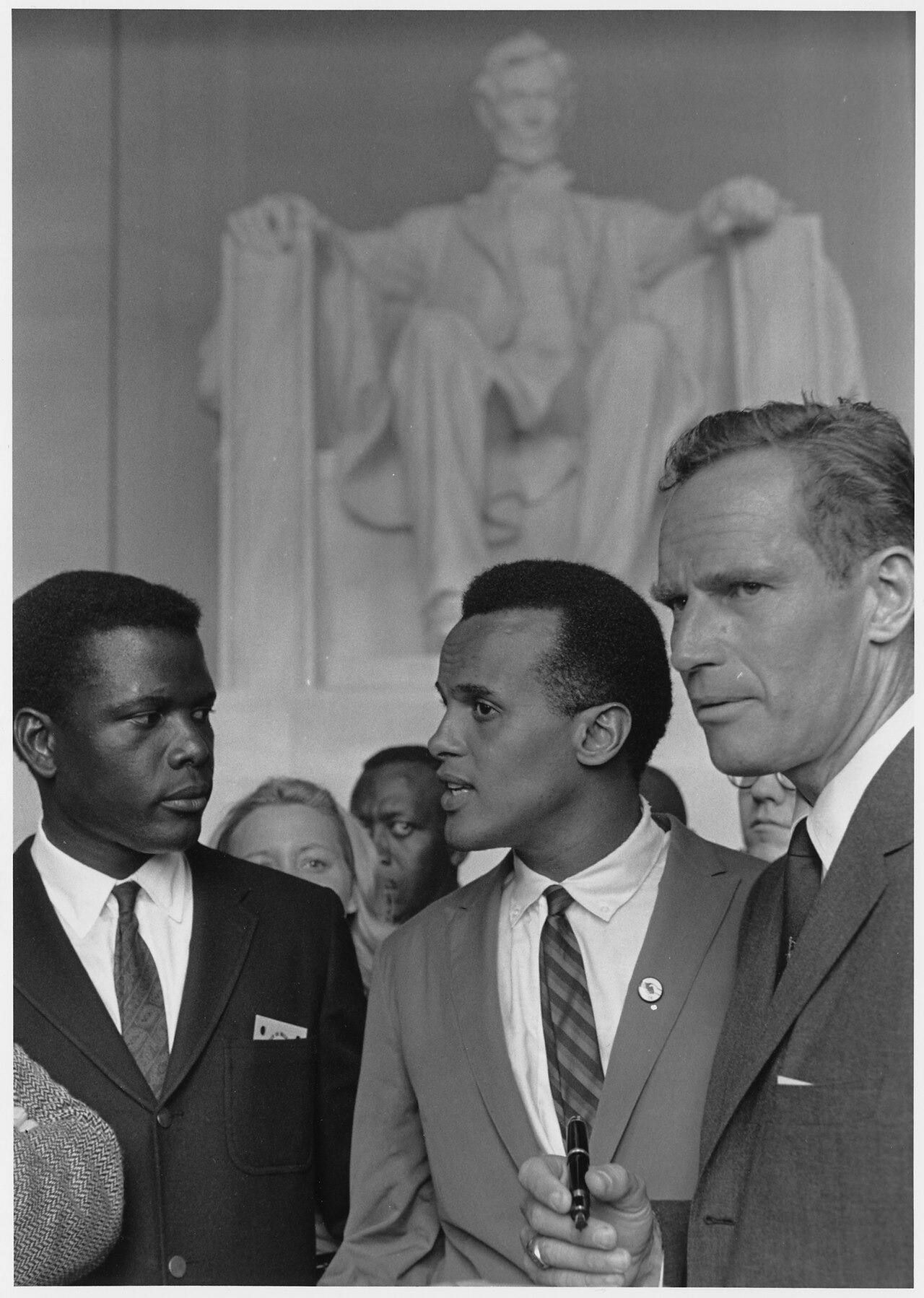 Sidney Poitier, Harry Belafonte and Charlton Heston at the March on Washington in 1963.
Sidney Poitier : In the Heat of the Night
The film’s central partnership places Tibbs opposite Rod Steiger’s police chief Bill Gillespie. Their cooperation does not dissolve racism; it exposes how competence and dependence can force recognition without producing equality.
The famous scene in which Tibbs returns a slap from a white plantation owner had enormous symbolic force. Poitier insisted the retaliation remain in versions shown in the American South, according to his later accounts. The moment refuses the expectation that the dignified Black hero must absorb humiliation to retain white sympathy.
Modern viewers can still question a narrative that makes progress depend on an exceptional outsider solving a white town’s problem. Poitier’s performance remains vital because he allows dignity to include anger. Composure is no longer the absence of resistance.
Sidney Poitier : Guess Who’s Coming to Dinner
Guess Who’s Coming to Dinner paired Poitier with Spencer Tracy and Katharine Hepburn. He plays Dr. John Prentice, an internationally respected physician engaged to a young white woman. Her liberal parents discover that abstract belief and family reality are not the same.
The film arrived when interracial marriage was still illegal in several states until the Supreme Court’s Loving v. Virginia decision in 1967. Its positive representation mattered. At the same time, Prentice is so accomplished, restrained and morally faultless that the romance seems designed to remove every possible objection except race.
Poitier later spoke about the pressure of embodying characters acceptable to both Black and white audiences. The film is a clear example of the bargain: extraordinary visibility purchased through extraordinary perfection.
Sidney Poitier : Criticism, Representation and a Changing Era
By the late 1960s, Black political and cultural movements were demanding images more varied than the Poitier ideal. Some critics saw his characters as too assimilated, desexualised or constructed for white reassurance. The criticism identified real limits, but it could unfairly make one actor responsible for an industry’s refusal to create enough roles.
Poitier was never the sole author of the films, yet he chose among imperfect opportunities and used his power to shape them. His career should not be defended by pretending every representation was sufficient. Nor should the breakthroughs be dismissed because later generations demanded more.
The tension is part of his importance. Poitier expanded the available image of Black masculinity so dramatically that the new space revealed how much remained excluded.
Sidney Poitier : Directing and Black Creative Control
Poitier moved behind the camera with Buck and the Preacher (1972), a western co-starring Harry Belafonte. The film centres formerly enslaved people travelling west and Black characters capable of defending their own community, a major shift from the passive suffering Hollywood often assigned them.
He directed A Warm December, Uptown Saturday Night, Let’s Do It Again and A Piece of the Action, building Black romantic and comic worlds with broader tonal range. Stir Crazy, starring Gene Wilder and Richard Pryor, became a major commercial success.
The directing career is essential because it moved beyond representation inside white-controlled prestige drama. Comedy, adventure and friendship allowed Black audiences pleasure as well as instruction. Poitier’s authority became industrial, not only symbolic.
Sidney Poitier : Activism and Harry Belafonte
Poitier and Harry Belafonte participated in civil-rights activism and supported the movement financially and publicly. They attended the 1963 March on Washington and undertook a dangerous 1964 trip to deliver funds to civil-rights workers in Mississippi.
Their friendship included political disagreements and periods of distance. Belafonte favoured more openly confrontational activism, while Poitier often worked through a public image whose access depended on negotiation. Reducing one to radical and the other to accommodation misses the risks and contributions of both.
The two men reunited artistically in films Poitier directed. Their partnership shows that different strategies could coexist within a long struggle over representation, power and responsibility.
Sidney Poitier : Diplomacy, Writing and Later Honors
Poitier served as the Bahamas’ ambassador to Japan and as a diplomatic representative connected with UNESCO. The appointments reflected his international stature and enduring Bahamian identity.
His memoirs, including The Measure of a Man, presented moral reflection rather than a conventional celebrity chronology. The books helped shape his later image as elder statesman, but they also preserved the perspective of someone who understood that public symbolism had repeatedly overtaken private complexity.
The Academy presented Poitier with an Honorary Award in 2002 for his achievements and presence in cinema. He later received the Presidential Medal of Freedom. Such honours recognised both craft and the institutional barriers his career had exposed.
Sidney Poitier : Family and Private Life
Poitier was married to Juanita Hardy from 1950 to 1965, and they had four daughters. He later married actor Joanna Shimkus in 1976, and they had two daughters, including actor and filmmaker Sydney Tamiia Poitier.
His relationship history included an affair with Diahann Carroll during his first marriage, described in accounts by the people involved. The subject belongs in a complete biography but should not be used to turn moral screen roles into accusations of personal hypocrisy. Public characters are performances, not promises of private perfection.
Poitier guarded family life while living under unusual representational pressure. The distinction between the dignified public figure and the complicated individual is necessary if biography is to treat him as fully human rather than preserve another idealised symbol.
Sidney Poitier : Death and Legacy
Poitier died in 2022 at the age of ninety-four. The BFI obituary emphasised how profoundly he changed prospects for Black performers and public perceptions of Black men.
His legacy is visible in every debate about representation, respectability and who is allowed to occupy the centre of a mainstream film. Later actors inherited a wider field partly because Poitier had demonstrated commercial and artistic authority within narrower limits.
The performances remain the strongest evidence. Walter Lee Younger is not a symbol of calm. Virgil Tibbs is not passive. Homer Smith is funny and stubborn. The full filmography corrects the simplified image of flawless dignity by revealing an actor capable of volatility, sensuality, disappointment and play.
Selected Sidney Poitier Filmography
1950 – No Way Out : Feature breakthrough as Dr. Luther Brooks
1955 – Blackboard Jungle : Rebellious student Gregory Miller
1957 – Edge of the City : Waterfront friendship drama
1958 – The Defiant Ones : First Best Actor Oscar nomination
1959 – Porgy and Bess : Major musical adaptation
1961 – A Raisin in the Sun : Walter Lee Younger
1961 – Paris Blues : Jazz drama with Paul Newman
1963 – Lilies of the Field : Historic Academy Award-winning role
1965 – A Patch of Blue : Interracial romantic drama
1967 – To Sir, with Love : London classroom drama
1967 – In the Heat of the Night : Defining role as Virgil Tibbs
1967 – Guess Who’s Coming to Dinner : Interracial-marriage drama
1972 – Buck and the Preacher : Feature directorial debut
1974 – Uptown Saturday Night : Directed and starred with Bill Cosby
1980 – Stir Crazy : Major directing success
1992 – Sneakers : Ensemble thriller
Sidney Poitier : Frequently Asked Questions
What was Sidney Poitier the first to achieve?
He became the first Black man and first Bahamian to win the Academy Award for Best Actor, for Lilies of the Field.
Was Sidney Poitier Bahamian or American?
Both. He was born in Miami during his Bahamian parents’ visit, giving him American citizenship, and grew up in the Bahamas. He later served as a Bahamian diplomat.
What three hit films did Sidney Poitier make in 1967?
To Sir, with Love, In the Heat of the Night and Guess Who’s Coming to Dinner.
Did Sidney Poitier direct movies?
Yes. He directed nine features, including Buck and the Preacher, Uptown Saturday Night and Stir Crazy.
What is the best Sidney Poitier film to watch first?
In the Heat of the Night is the strongest popular introduction. A Raisin in the Sun shows greater emotional range, while Lilies of the Field captures the performance that made Oscar history.
Related Articles
20 Classic Hollywood Actors Everyone Should Know
Top 20 Best Black-and-White Movies for New Classic Film Fans