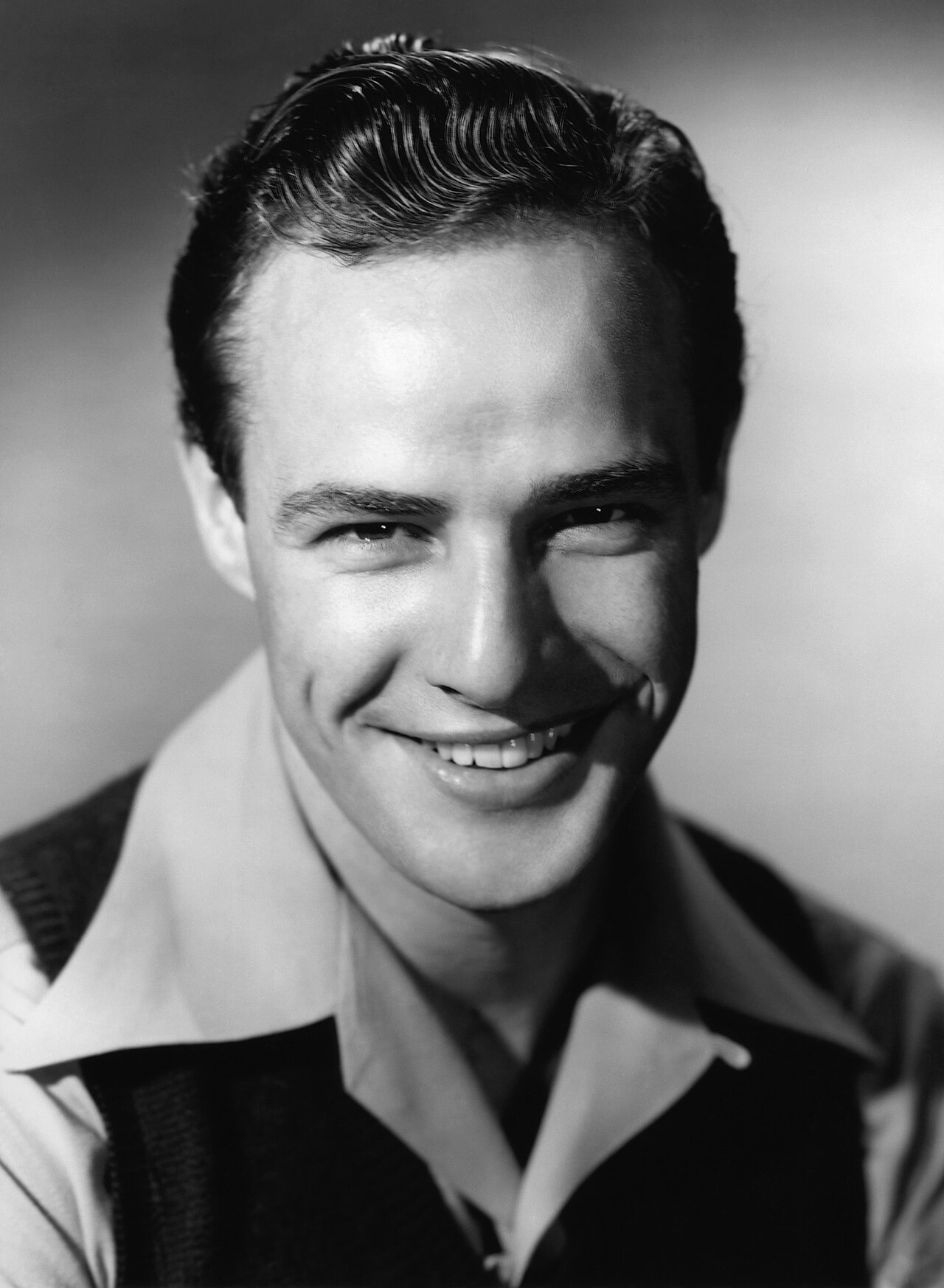
 Marlon Brando in a publicity portrait for The Men (1950).
Marlon Brando : Personal Info
Full name : Marlon Brando Jr.
Born : April 3, 1924, Omaha, Nebraska
Died : July 1, 2004, Los Angeles, California
Nationality : American
Occupations : Actor, director, activist
Years active : 1944-2001 in major stage and screen work
Known for : A Streetcar Named Desire, The Wild One, Julius Caesar, On the Waterfront, One-Eyed Jacks, The Godfather, Last Tango in Paris, Apocalypse Now
Major honors : Two Academy Awards for Best Actor from eight acting nominations; Cannes Best Actor; multiple BAFTA and Golden Globe honors
Marlon Brando : Introduction
Marlon Brando changed what American screen acting could sound and look like. The broken phrasing, physical restlessness and sense that thought continued beneath dialogue brought a new intimacy to post-war film. He did not invent modern acting, and the popular label “Method actor” can flatten the distinct teachings he encountered, but his fame carried a more behaviourally alive performance style into the cultural mainstream.
At his best, Brando made contradiction immediate. Stanley Kowalski could be magnetic and brutal; Terry Malloy ashamed and defiant; Vito Corleone tender within a system of violence. He could command a scene through explosive movement or by lowering his voice until everyone leaned toward him.
The career is also a story of resistance, privilege and waste. Brando challenged some studio expectations, supported civil-rights and Indigenous-rights causes, and used his celebrity for protest. He could also be unprepared, obstructive and protected by an industry that tolerated conduct it would not have accepted from less powerful performers. Greatness does not require the biography to excuse damage.
Marlon Brando : Nebraska, Illinois and a Difficult Home
Marlon Brando Jr. was born in Omaha and grew up partly in Illinois. His father worked in sales and manufacturing; his mother, Dorothy Pennebaker Brando, had theatrical interests and struggled with alcohol. Brando later described a home marked by emotional instability and parental drinking.
He was expelled from military school and resisted conventional authority, a pattern that later became central to both his screen image and professional reputation. After family pressure and uncertain work, he followed his older sister Jocelyn to New York and pursued acting seriously.
Later memoir and biography include painful claims about family relationships. These accounts help explain how Brando narrated himself, but psychological conclusions should remain cautious. Childhood difficulty can provide context without becoming a universal key for adult behaviour.
Marlon Brando : Stella Adler and the New York Stage
In New York, Brando studied with Stella Adler, whose teaching drew on Konstantin Stanislavski while rejecting the idea that actors should depend narrowly on personal emotional recall. Adler emphasized imagination, circumstances and close observation of behaviour. Brando absorbed those principles in ways that could look instinctive because the preparation disappeared into action.
Stage roles quickly attracted attention. Truckline Cafe and Maxwell Anderson’s Truckline Cafe brought early critical notice, but Tennessee Williams’s A Streetcar Named Desire created the phenomenon. Directed by Elia Kazan, the Broadway production placed Brando’s Stanley Kowalski against Jessica Tandy’s Blanche DuBois.
Audiences encountered a performer whose body, clothes and speech did not observe established theatrical decorum. Stanley’s sensuality and violence were inseparable, a fact later publicity sometimes romanticised. The performance was revolutionary in technique, not morally admirable in character.
Marlon Brando : The Men and Screen Preparation
Brando’s film debut, The Men (1950), cast him as a paraplegic veteran adjusting to life after wartime injury. He spent time in a veterans’ hospital and used a wheelchair during preparation, pursuing physical credibility rather than a decorative transformation.
The film belongs to a post-war cycle concerned with veterans’ reintegration, marriage and masculine identity. Some language and assumptions reflect the period, but Brando’s attention to frustration and bodily autonomy remains powerful.
The performance established that his stage intensity could survive the camera. Film rewarded his ability to behave in the spaces between lines: a hand adjusting, a face refusing eye contact, a sentence allowed to trail into thought.
Marlon Brando : A Streetcar Named Desire
The 1951 film of A Streetcar Named Desire reunited Brando with Kazan and most of the principal Broadway cast, while Vivien Leigh played Blanche. The difference between Leigh’s more classically shaped performance and Brando’s physical immediacy creates part of the film’s tension.
Stanley Kowalski became an icon of post-war masculinity: T-shirt, sweat, appetite and aggressive territoriality. The image has often been detached from the story’s violence, especially the rape of Blanche. Any appreciation of Brando’s force must keep the character’s abuse in view rather than turning brutality into uncomplicated sex appeal.
Brando received his first Academy Award nomination. The Academy’s 1952 ceremony record lists him alongside the nominated performances and confirms the film’s major acting recognition. The role made him a star without making him comfortable with stardom.
 James Baldwin, Marlon Brando and Charlton Heston at the March on Washington in 1963.
Marlon Brando : The Wild One and Youth Rebellion
In The Wild One (1953), Brando’s motorcycle-gang leader Johnny Strabler became another cultural image larger than the film. Leather jacket, cap and machine produced a shorthand for rebellion copied in fashion, music and youth culture.
Johnny is less powerful than the icon suggests. He is watchful, inarticulate and unsure what to do with attention. The famous answer to what he is rebelling against—essentially, “what have you got?”—expresses posture and emptiness at once.
The film’s representation of motorcycles and juvenile threat alarmed censors in some markets. Brando’s achievement was to make defiance look like both social danger and emotional defence, a contradiction that influenced later screen rebels.
Marlon Brando : Julius Caesar and Range
Critics who dismissed Brando as a mumbling naturalist faced Julius Caesar (1953), in which he played Mark Antony opposite John Gielgud and James Mason. The funeral oration required formal verse, rhetorical architecture and public command.
Brando worked on the language and delivered a performance that respected Shakespearean shape without surrendering behavioural urgency. The role earned another Oscar nomination and demonstrated that the apparent informality of his acting was a choice rather than a technical limit.
The film remains important to understanding his range. Brando could bring modern psychology to classical material without treating the text as an obstacle. He was capable of discipline even though later productions sometimes found him resistant to conventional preparation.
Marlon Brando : On the Waterfront and an Oscar
On the Waterfront (1954) reunited Brando with Kazan. Terry Malloy is a former boxer entangled with a corrupt longshoremen’s union and forced to decide whether informing is cowardice or moral responsibility. The politics are inseparable from Kazan’s testimony before the House Un-American Activities Committee, which made the film a defence of speaking names for some viewers and an act of self-justification for others.
Brando’s performance exceeds a single allegorical reading. Terry’s intelligence is bodily and incomplete; he understands betrayal before he can explain it. In the taxi scene with Rod Steiger, disappointment moves through affection, shame and accusation. The famous “contender” speech is powerful because Terry is speaking to a brother he still loves.
Brando won his first Academy Award for Best Actor. The role established a standard for wounded masculinity that actors have imitated ever since, often reproducing surface mumbling without the precision underneath.
Marlon Brando : One-Eyed Jacks and Directing
After a sequence of major performances and increasingly difficult productions, Brando directed One-Eyed Jacks (1961). Stanley Kubrick had previously been attached, and the project’s long development contributed to cost and schedule problems.
Brando plays Rio, an outlaw seeking revenge on a former partner played by Karl Malden. The film combines betrayal, romantic hesitation and unusually sensuous coastal imagery for a western. Its pacing is expansive, sometimes to a fault, but the emotional attention gives it a distinct identity.
One-Eyed Jacks was his only credited feature as director. The experience reinforced the industry view of Brando as both gifted and undisciplined, yet later restoration and reappraisal have made its visual and psychological ambition easier to appreciate.
 Marlon Brando in a publicity portrait for One-Eyed Jacks (1961).
Marlon Brando : Decline, Excess and Uneven Work
Mutiny on the Bounty (1962) became a symbol of runaway production and Brando’s disruptive power. His accent, script interventions and conflicts attracted more attention than the finished performance. The film’s cost helped turn him from artistic rebel into an industry warning.
The 1960s and early 1970s included strong work—The Chase, Reflections in a Golden Eye, Burn!—alongside commercial failures and performances that appeared disengaged. The distinction matters. Brando was not simply “bad until The Godfather”; he remained capable of startling choices in projects audiences overlooked.
His use of cue cards became legendary. Brando argued that not fully memorising lines preserved spontaneity, but collaborators sometimes experienced the practice as burdensome. Both can be true: a technique may produce immediacy while shifting labour and inconvenience onto others.
Marlon Brando : The Godfather and a Second Transformation
Francis Ford Coppola fought to cast Brando as Vito Corleone in The Godfather (1972) when Paramount considered him unreliable. Brando’s screen test used darkened hair, a quiet voice and padding in the cheeks; makeup artist Dick Smith completed the transformation.
At forty-seven, Brando created the impression of an older patriarch without reducing him to weight and rasp. Vito’s tenderness toward family exists within organised violence. The performance does not excuse the system; it shows how authority can make brutality appear domestic.
The film restored Brando’s commercial position and brought a second Academy Award for Best Actor. The Academy’s Godfather collection preserves production and awards materials that place the performance within the film’s larger achievement.
Marlon Brando, Sacheen Littlefeather and the 1973 Oscars
Brando declined the Oscar. Sacheen Littlefeather appeared at the ceremony on his behalf and delivered a brief statement referring to the film industry’s treatment of Native Americans and the occupation at Wounded Knee. The Academy’s 1973 ceremony archive records her appearance for Brando.
The event has been retold through conflicting claims about Brando’s motives, Littlefeather’s identity and the industry’s response. The secure public facts should lead: Brando refused the award, Littlefeather delivered the message, and parts of the audience booed while others applauded. Later debate does not erase the protest or justify presenting disputed biographical claims as settled.
Brando’s action brought attention to issues he had supported, but it also placed Littlefeather in the direct path of hostility while he remained absent. Responsible assessment can recognize the visibility of the protest and question the distribution of its consequences.
Marlon Brando : Last Tango in Paris and Ethical Reckoning
Last Tango in Paris (1972) brought one of Brando’s most exposed performances and one of the most troubling production histories in major 1970s cinema. As Paul, a widower entering an anonymous sexual relationship, Brando used elements of personal experience to create grief, cruelty and emotional collapse.
The film includes a sexual-assault scene involving Maria Schneider. Later statements from Schneider and director Bernardo Bertolucci established that aspects of the scene were withheld from her before filming in order to obtain a reaction, although accounts differ over exactly what was scripted and physically enacted. The ethical violation lies in removing meaningful informed consent from an actor in a vulnerable scene.
Any account that treats the result as evidence of artistic daring without centring Schneider’s testimony repeats the production’s imbalance. Brando’s performance can be historically important and the method used around his co-star unacceptable. Those judgements are not mutually exclusive.
Marlon Brando : Apocalypse Now
In Apocalypse Now (1979), Brando played Colonel Kurtz, the renegade officer at the end of an American journey into the Vietnam War. He arrived heavier than director Francis Ford Coppola expected and without the production’s preferred preparation, forcing rapid changes in lighting, costume and staging.
The difficulties have become comic legend, but the finished performance uses opacity productively. Kurtz emerges from shadow, speaking in fragments that suggest intelligence severed from restraint. Brando’s physical scale and cultural mythology become part of the character’s terrifying authority.
The role is not a model of collaborative professionalism. It is evidence that Coppola, cinematographer Vittorio Storaro, editor Walter Murch and Brando could convert crisis into a coherent cinematic effect. Authorship belongs to the collaboration, not the star alone.
Marlon Brando : Activism
Brando participated in the 1963 March on Washington and supported the civil-rights movement. He also became involved in advocacy around Native American rights and donated time, attention and money to political causes. His activism was sustained enough to be more than a single awards-season gesture.
At the same time, political commitment does not cancel harmful personal behaviour or professional power. Celebrity activism deserves assessment by actions and outcomes rather than moral halo. Brando’s willingness to risk industry approval was meaningful; his fame also insulated him from costs others bore more directly.
The contradiction belongs to the legacy. He distrusted Hollywood’s moral claims while benefiting enormously from its fascination with difficult male genius.
Marlon Brando : Family, Relationships and Tragedy
Brando had numerous relationships and acknowledged many children. Accounts of the exact number vary because family status, adoption and paternity have been reported differently. A careful biography should avoid turning children and partners into a tally or treating private lives as extensions of the star.
Family tragedy became public in 1990 when Brando’s son Christian shot and killed Dag Drollet, the partner of Brando’s daughter Cheyenne. Christian pleaded guilty to voluntary manslaughter and served prison time. Cheyenne died by suicide in 1995.
These events caused profound suffering and attracted sensational coverage. They should be stated accurately without speculative claims that assign simple responsibility for complex lives. Brando’s grief is part of the record; it does not erase the victims or settle questions about family dynamics.
Marlon Brando : Final Work, Death and Legacy
Later films ranged from the playful Don Juan DeMarco to the troubled The Island of Dr. Moreau and the heist drama The Score. Brando could still create memorable moments, but the late career often depended on audiences watching the legend as much as the character.
He died in Los Angeles in 2004 from respiratory failure associated with pulmonary fibrosis and other health problems. Obituaries confronted the same division that had followed him for decades: transformative artist, exasperating colleague, activist, self-indulgent celebrity.
The BFI’s essential-film survey makes the influence visible across roles rather than slogans. Brando helped move screen performance toward unfinished speech, unpredictable gesture and morally unstable presence. The achievement remains immense. So does the need to discuss power and harm without allowing “genius” to end the conversation.
Selected Marlon Brando Filmography
1950 – The Men : Screen debut as a disabled veteran
1951 – A Streetcar Named Desire : Breakthrough film performance
1953 – The Wild One : Defining youth-rebellion image
1953 – Julius Caesar : Oscar-nominated Shakespeare performance
1954 – On the Waterfront : First Academy Award-winning role
1955 – Guys and Dolls : Musical performance as Sky Masterson
1961 – One-Eyed Jacks : Only credited feature as director
1966 – The Chase : Arthur Penn social drama
1967 – Reflections in a Golden Eye : Carson McCullers adaptation
1969 – Burn! : Political drama directed by Gillo Pontecorvo
1972 – The Godfather : Second Academy Award-winning role
1972 – Last Tango in Paris : Acclaimed performance, ethically disputed production
1979 – Apocalypse Now : Colonel Kurtz in Coppola’s Vietnam epic
1989 – A Dry White Season : Anti-apartheid drama
2001 – The Score : Final feature-film role
Marlon Brando : Frequently Asked Questions
How many Oscars did Marlon Brando win?
He won two Academy Awards for Best Actor, for On the Waterfront and The Godfather, from eight acting nominations.
Did Marlon Brando invent Method acting?
No. His training with Stella Adler drew on Stanislavski, and many teachers and actors developed related approaches. Brando’s fame made a more behaviourally naturalistic style highly influential in mainstream film.
Why did Brando refuse the Oscar for The Godfather?
He declined the award to protest the film industry’s treatment of Native Americans and draw attention to events at Wounded Knee. Sacheen Littlefeather appeared at the ceremony on his behalf.
Did Marlon Brando direct a film?
Yes. He directed and starred in the 1961 western One-Eyed Jacks.
What is the best Marlon Brando film to watch first?
On the Waterfront is the clearest introduction to his early technique. The Godfather shows his mature reinvention, while A Streetcar Named Desire demonstrates the disruptive force of his arrival.
Related Articles
20 Classic Hollywood Actors Everyone Should Know
Top 20 Best Black-and-White Movies for New Classic Film Fans
10 Best Oscar-Winning Performances by Classic Movie Stars