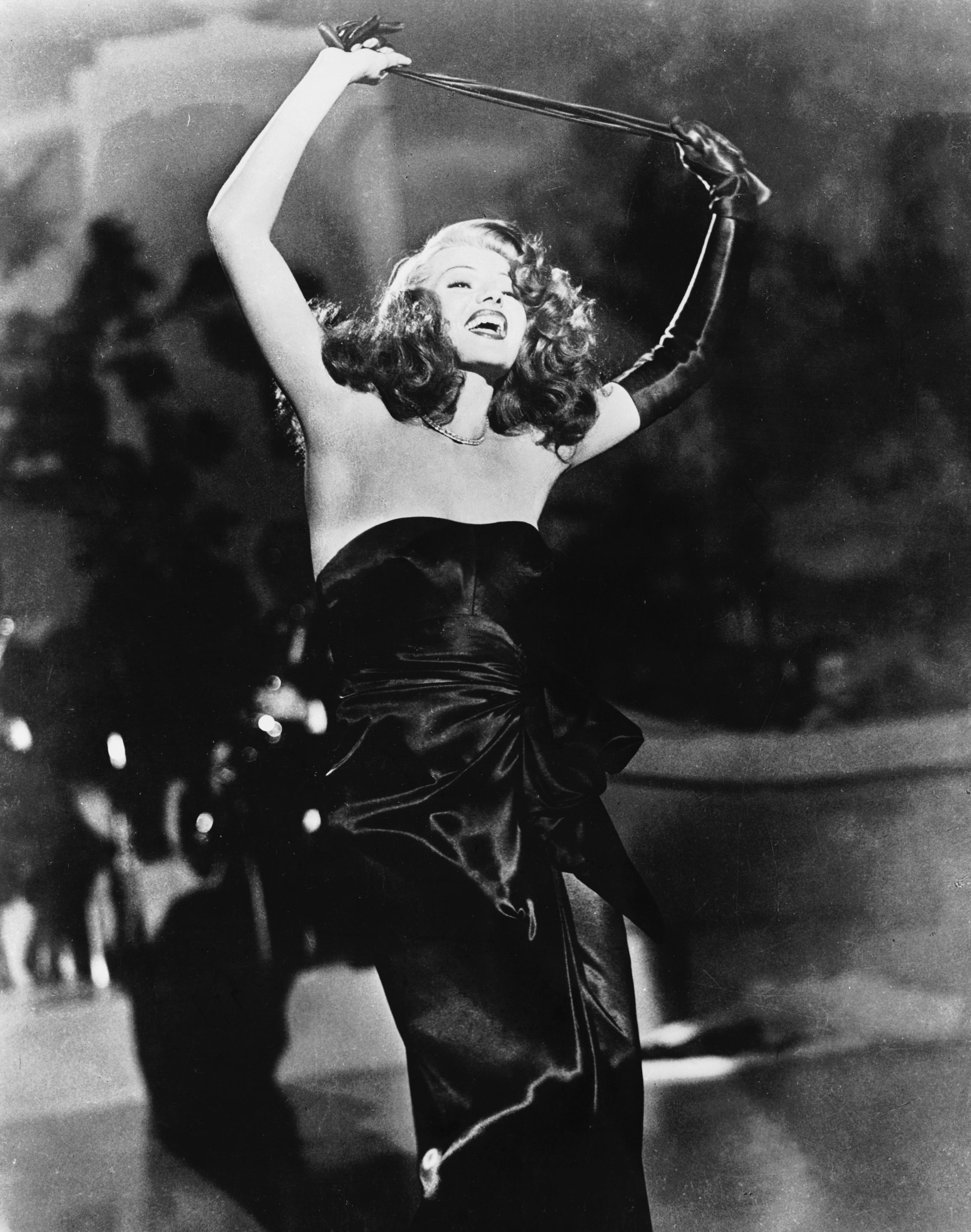
 Rita Hayworth performing in the black dress associated with Gilda (1946).
Rita Hayworth : Personal Info
Full name : Margarita Carmen Cansino, professionally Rita Hayworth
Born : October 17, 1918, New York City
Died : May 14, 1987, New York City
Nationality : American
Occupations : Actress, dancer, producer
Years active : 1926; 1934-1972
Known for : Only Angels Have Wings, The Strawberry Blonde, Blood and Sand, You’ll Never Get Rich, Cover Girl, Gilda, The Lady from Shanghai, The Loves of Carmen, Miss Sadie Thompson, Pal Joey, Separate Tables
Major honors : Golden Globe nomination; National Board of Review recognition as part of the Separate Tables ensemble; enduring cultural and charitable legacy through Alzheimer’s awareness
Rita Hayworth : Introduction
Rita Hayworth’s entrance in Gilda lasts only a moment: Glenn Ford asks whether she is decent, she throws back her hair and looks up into the frame. The movement created one of classic Hollywood’s defining star images. It also completed a transformation that had taken years of dancing, physical alteration, publicity and studio discipline.
Hayworth was promoted as a “Love Goddess,” a wartime pin-up and the embodiment of effortless glamour. The effort was hidden by design. She had performed professionally since childhood, learned exact musical timing from her dancer father, remade her name and appearance for an industry that treated her Spanish heritage as an obstacle, and worked under Columbia chief Harry Cohn, whose determination to control her career became a continuing source of conflict.
The private woman was repeatedly described as shy, a contrast that can become too convenient if it is used to turn every film into tragedy. Hayworth was not simply a victim trapped inside Gilda. She was a skilled dancer, an intelligent camera performer and, for a period, an independent producer. Yet the distance between the public image and her sense of self was real, and it shaped marriages, career decisions and the way later illness was misunderstood.
Her biography therefore belongs to more than Hollywood glamour. It is a story about ethnicity and reinvention, the labour concealed inside beauty, the ownership of a star’s body and the way one family’s openness about Alzheimer’s disease changed public understanding.
Rita Hayworth : The Cansino Family and Childhood Performance
Rita Hayworth was born Margarita Carmen Cansino in New York City. Her father, Eduardo Cansino, was a Spanish-born dancer from a well-known theatrical family. Her American mother, Volga Hayworth, had performed as a dancer and was of Irish and English ancestry.
Performance began before Margarita could make an adult choice about it. She appeared as a child dancer and, after the family moved to California, trained intensively with her father. By adolescence she had become his partner in the “Dancing Cansinos,” appearing in clubs and venues where her youth was sometimes obscured.
The BFI’s survey of Hayworth’s essential films traces her professional screen work to childhood and notes that she initially performed under the name Rita Cansino. The experience gave her exceptional control of rhythm, line and movement. It also meant that work, parental authority and personal identity were entangled unusually early.
Later biographies have made serious claims about mistreatment within the family. Hayworth did not leave a public account that allows every allegation to be independently verified, so those claims should not be repeated as settled fact. What the documented record does show is a child carrying adult professional responsibilities and entering film through an industry that categorised her appearance before it considered her range.
Rita Hayworth : Rita Cansino and Early Hollywood
As Rita Cansino, she received a contract with Fox while still in her teens. Her early roles often relied upon an “exotic” identity, casting her as dancers or women marked as Latin, foreign or racially ambiguous. The parts offered exposure but little opportunity to define a complex screen character.
After Fox dropped her contract, she married Edward Judson in 1937. Judson became involved in managing and promoting her career. She secured a contract at Columbia Pictures, where studio chief Harry Cohn saw the possibility of a major star.
That possibility came with transformation. Rita Cansino became Rita Hayworth, using her mother’s family name. Her dark hair became auburn, and electrolysis altered her hairline. Publicity reframed her as an all-American glamour figure while reducing visible markers that casting departments associated with her Spanish heritage.
The process should not be described as a simple personal makeover. Adrienne L. McLean’s scholarly study, indexed by the ERIC education research archive, examines how ethnicity, labour and authenticity shaped the construction of “Rita Hayworth.” Her stardom demonstrates that classic Hollywood did not merely discover beauty; it classified and rebuilt it according to racialised commercial expectations.
Rita Hayworth : Breakthrough in Only Angels Have Wings
Howard Hawks’s Only Angels Have Wings (1939) gave Hayworth her first important dramatic opportunity. She plays Judy MacPherson, a woman whose arrival at a dangerous South American air base reopens an old wound. Cary Grant and Jean Arthur carry the central romance, but Hayworth makes Judy more than a beautiful complication.
Her relative inexperience is visible, yet so is the camera’s interest. Hayworth listens carefully and lets discomfort enter through posture before dialogue explains it. The role also introduced a pattern: the films often knew exactly how to photograph her entrance but were less certain what to do with the woman after the entrance had changed the room.
The Strawberry Blonde and Blood and Sand, both released in 1941, expanded her reputation. In Blood and Sand, Technicolor intensified the auburn-haired image while casting her as a sophisticated temptress opposite Tyrone Power. The contrast with her early “exotic” parts shows how thoroughly the studio had recoded her appearance without ending its reliance on stereotype.
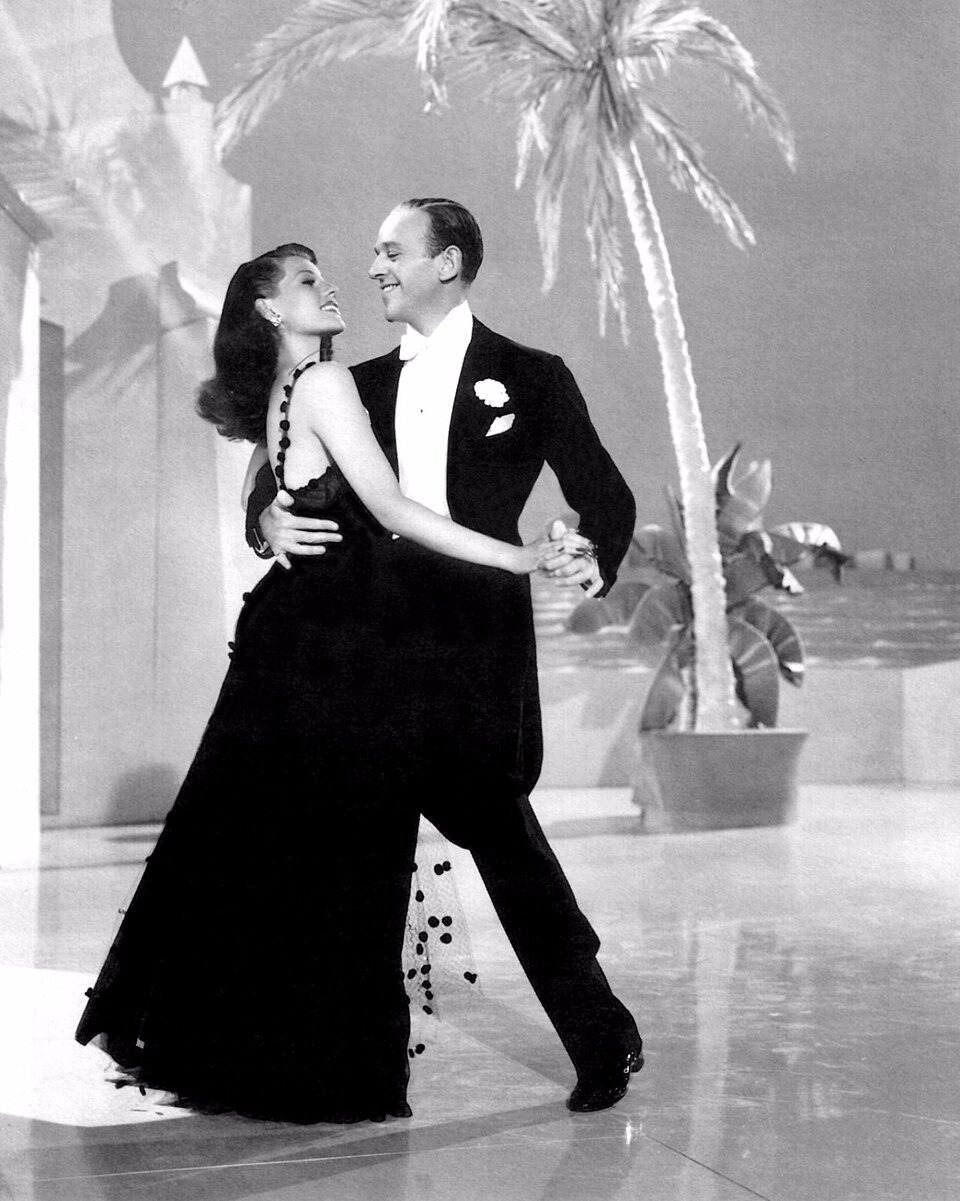 Rita Hayworth dancing with Fred Astaire in You’ll Never Get Rich (1941).
Rita Hayworth : Dancing with Fred Astaire
Hayworth’s dance training became central in You’ll Never Get Rich (1941) and You Were Never Lovelier (1942), both with Fred Astaire. She was not presented as a technical novelty or comic beginner. Her long experience allowed her to meet Astaire’s precision while bringing a distinct warmth and grounded sensuality.
The partnership is important because it corrects the tendency to treat Hayworth’s fame as primarily photographic. Dance requires memory, stamina, timing, spatial intelligence and trust. The glamour works because the technique is secure enough to disappear.
Her musical performances also reveal the collaborative machinery of studio production. Hayworth’s singing was frequently dubbed, a common practice that should not be used to dismiss her contribution. The physical phrasing, expression and integration of song into character remain hers. She knew how to let the camera see movement without breaking its flow into visible effort.
Rita Hayworth : Cover Girl and Wartime Stardom
Cover Girl (1944), with Gene Kelly, became one of Hayworth’s biggest musicals and one of Columbia’s major Technicolor productions. She plays Rusty Parker, a nightclub dancer whose sudden modelling success threatens her relationship and sense of belonging. Hayworth also plays Rusty’s grandmother in the film’s parallel romantic history.
The plot reflects the machinery creating Hayworth herself: a working dancer becomes a mass-produced image, then discovers that visibility does not guarantee control. The film celebrates glamour while allowing loneliness to appear within it. Kelly’s innovative dancing gives the male character an interior world, but Hayworth’s quieter conflict keeps the story emotionally balanced.
During the Second World War she became one of the most popular pin-up stars among American servicemen. A famous 1941 photograph reproduced by Life contributed to that status. Life’s retrospective describes the enormous reach of the image and Hayworth’s wartime popularity.
Pin-up fame increased her commercial power but further separated public possession from private identity. Millions of viewers felt they knew Rita Hayworth through a photograph designed for circulation. The person beneath the image had little control over the meanings attached to it.
Rita Hayworth : Gilda and the Love Goddess
Gilda (1946) made Hayworth immortal. Set largely in a Buenos Aires casino, the film reunites Gilda with former lover Johnny Farrell, played by Glenn Ford, after she marries his powerful employer. Desire, resentment and male loyalty turn the triangle into an atmosphere of suspicion.
Gilda is often called a femme fatale, but the label only partly fits. The men imagine her as sexually destructive and punish her for that imagined power. Hayworth’s performance repeatedly shows Gilda acting out the reputation imposed upon her. The glove dance to “Put the Blame on Mame” is provocative, yet its emotional force comes from anger and humiliation as much as seduction.
The BFI’s discussion of the film identifies Gilda as the defining expression of her star image. What keeps the role alive is the friction between image and feeling. Hayworth can make a room believe Gilda controls it, then reveal that the performance is an attempt to survive other people’s control.
The film’s enormous success fixed the “Love Goddess” identity. Hayworth later struggled with the expectation that the woman in private should behave like Gilda. The exact wording of remarks attributed to her varies across sources, but the recurring point is well supported: audiences and partners often confused the screen fantasy with the person.
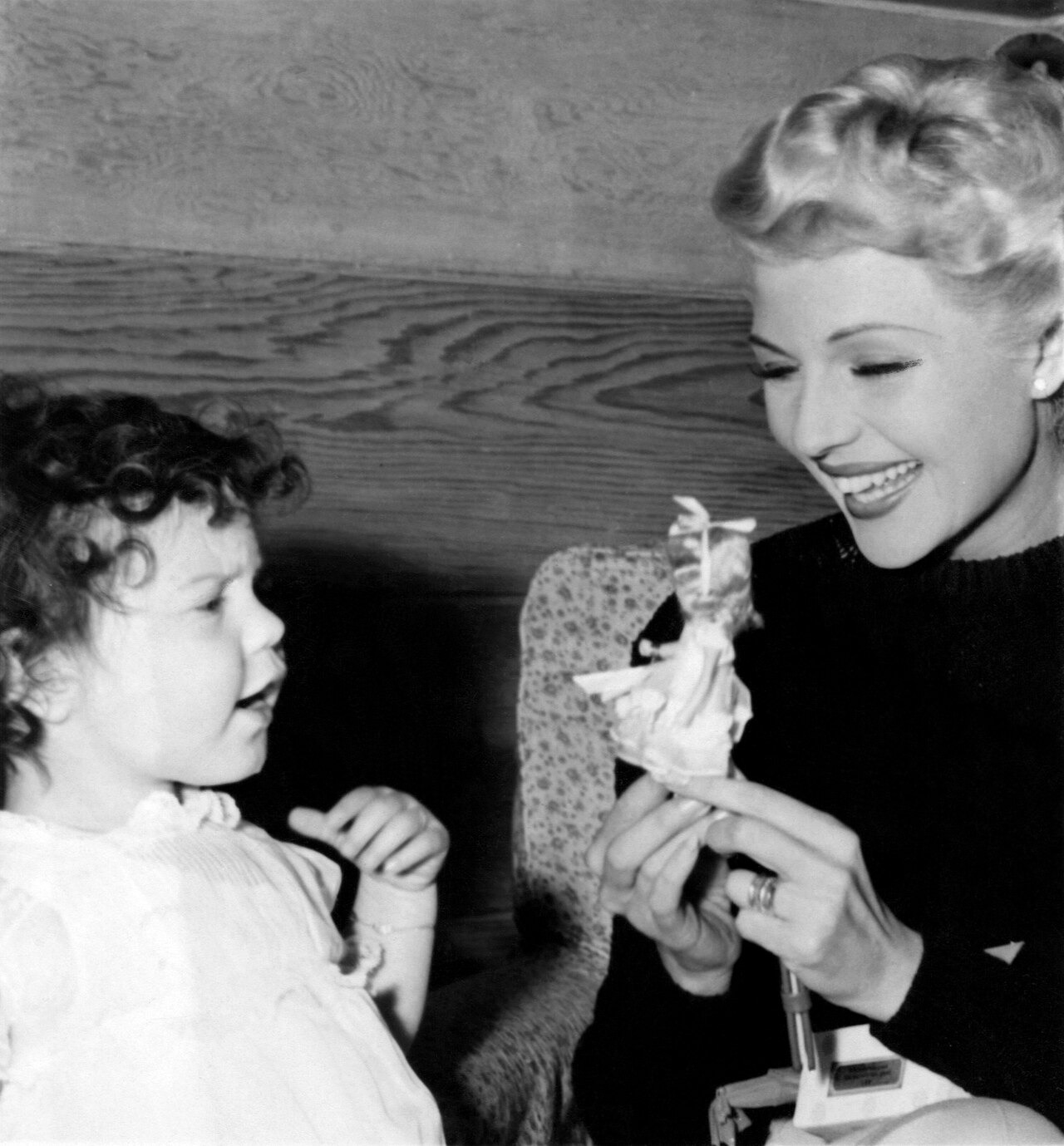 Rita Hayworth with her young daughter Rebecca Welles in 1946.
Rita Hayworth : Orson Welles and The Lady from Shanghai
Hayworth married Orson Welles in 1943. Their daughter Rebecca was born in 1944. The marriage joined one of Hollywood’s most photographed stars with one of its most ambitious filmmaker-performers, but their temperaments and careers did not create a stable domestic life. They separated before The Lady from Shanghai was released and divorced in 1948.
Welles directed and co-starred with Hayworth in the film, transforming her familiar appearance with shorter blonde hair. Popular accounts often present the haircut as an act of hostility toward Columbia or a deliberate destruction of her image. The evidence supports a creative decision and studio conflict, but not every dramatic motive later attached to it.
As Elsa Bannister, Hayworth gives one of her most controlled dramatic performances. The character’s beauty is neither innocent nor fully explanatory; Elsa is trapped within legal, marital and criminal arrangements she is trying to manipulate. The hall-of-mirrors climax multiplies her image until glamour becomes fragmentation.
The film was not a straightforward commercial success on release, but its reputation grew. It now provides essential evidence that Hayworth could use mystery and restraint beyond the emotional directness of Gilda.
Rita Hayworth : Independence and The Loves of Carmen
Hayworth’s conflict with Harry Cohn was not merely personal dislike. It concerned contracts, surveillance, role selection and who possessed the economic value of “Rita Hayworth.” She sought greater independence and formed the Beckworth Corporation, through which she produced The Loves of Carmen (1948).
The production made her one of the comparatively small number of female stars exercising formal producing power during the studio era. As Carmen, she returned to material associated with Spanish identity, but now through the fully established Hayworth image.
Independence remained incomplete. Distribution, financing and publicity still depended upon powerful institutions, and Cohn’s Columbia retained leverage. Even so, the step complicates the common portrait of Hayworth as entirely passive. She understood that control over production was one route toward control over the image.
Rita Hayworth : Aly Khan and Leaving Hollywood
In 1949 Hayworth married Prince Aly Khan, a son of Aga Khan III. Their daughter, Yasmin, was born that year. The marriage produced international press attention and temporarily moved Hayworth away from Hollywood production.
Publicity treated the relationship as a fairy tale in which a movie star became a princess. The reality involved different cultures, relentless photographers, infidelity allegations and later disputes over their daughter’s upbringing. Hayworth returned to the United States, and the marriage ended in divorce in 1953.
It is easy to read the episode as another attempt to escape Gilda, but motives within a marriage cannot be reduced to a single symbolic explanation. What can be said is that leaving Hollywood did not release Hayworth from the demands of public image. Royal celebrity intensified them in a different form.
Rita Hayworth : Return to Columbia
Hayworth returned to the screen in Affair in Trinidad (1952), again opposite Glenn Ford. Columbia promoted the reunion through echoes of Gilda, demonstrating how strongly the studio preferred a proven identity. Salome and Miss Sadie Thompson followed, both in colour and both organised around sexual reputation.
In Miss Sadie Thompson (1953), Hayworth plays a nightclub entertainer confronted by a moralising preacher on a rain-soaked Pacific island. The material has limitations, but she brings defiance and exhaustion to a woman judged by men who refuse to examine themselves.
Hayworth married singer Dick Haymes in 1953. Their turbulent relationship ended in divorce in 1955. She married producer James Hill in 1958; they divorced in 1961. Across five marriages, popular coverage often turned disappointment into proof that the “Love Goddess” could not find love. That formulation repeats the publicity trap. The relationships involved distinct people and circumstances, not a curse created by a film role.
Rita Hayworth : Pal Joey and Mature Performances
Pal Joey (1957) placed Hayworth opposite Frank Sinatra and Kim Novak. She received top billing, though Sinatra plays the title character. As Vera Simpson, a wealthy widow drawn to an opportunistic nightclub singer, Hayworth uses maturity as part of the role rather than pretending to be the younger woman in the triangle.
The casting contains a deliberate echo of her earlier glamour, but Vera is allowed pride, sexual desire and the possibility of change. Hayworth’s performance suggests someone accustomed to being watched who is no longer certain watching confers power.
She also appeared in Separate Tables (1958), an ensemble drama set in a British hotel. The role strips away some of the ornamental protection associated with her stardom. They Came to Cordura (1959), opposite Gary Cooper, offered another serious part. These films did not restore the commercial dominance of the 1940s, but they demonstrate that her later work cannot be dismissed as decline.
Rita Hayworth : Illness and Misunderstanding
During the later part of her career, Hayworth experienced memory loss, confusion and difficulty performing. At a time when Alzheimer’s disease was poorly understood, behaviour associated with illness was often attributed to alcohol, temperament or professional unreliability.
She made her final film, The Wrath of God, in 1972. By 1981 a court placed her under the care of her daughter Yasmin, who became a prominent advocate for Alzheimer’s awareness. Hayworth’s illness transformed public discussion because a globally recognised star gave families a visible reference for symptoms that had often been hidden or misdiagnosed.
The Alzheimer’s Association states that Yasmin Aga Khan founded the Rita Hayworth Gala in her mother’s honour. The organisation’s current history of the event records that the galas have raised more than $90 million for the cause. This charitable legacy belongs primarily to Yasmin’s advocacy, but it grew from a decision to make Hayworth’s condition public rather than allowing shame and misinformation to dominate.
Hayworth died in New York on May 14, 1987, aged sixty-eight. The Los Angeles Times obituary described both the manufactured glamour of her career and the disease that had taken memory and speech during her final years.
Rita Hayworth : Acting Style and Legacy
Hayworth’s acting begins with dance. Even in still scenes she understands weight, balance and the expressive value of turning toward or away from another person. Her entrances are famous because movement creates character before dialogue arrives.
The face and hair were deliberately constructed as commercial signs, but the performances often question the construction. Rusty in Cover Girl discovers that becoming an image can estrange her from work and love. Gilda exaggerates sexual availability because other people have already judged her. Elsa in The Lady from Shanghai moves through multiplying reflections she cannot finally control.
Her legacy also requires acknowledging how Hollywood altered ethnicity. Rita Hayworth became more marketable as visible signs of Margarita Cansino were reduced. That transformation opened roles while teaching audiences not to see the heritage and labour that produced the star.
Popular culture continued to use her image after her career ended, most famously through Stephen King’s novella Rita Hayworth and Shawshank Redemption and the poster concealed in the film adaptation. The reference depends upon instant recognition: Hayworth as glamour, escape and a surface hiding another life.
The greater achievement lies behind the poster. She was a gifted dancer, an underrated dramatic performer and a star whose apparent effortlessness concealed extraordinary work. Understanding the machinery does not diminish the magic. It allows the person who helped create it to come back into view.
Selected Rita Hayworth Filmography
1939 – Only Angels Have Wings : First major dramatic breakthrough
1941 – The Strawberry Blonde : Popular period romance
1941 – Blood and Sand : Important Technicolor glamour role
1941 – You’ll Never Get Rich : First musical with Fred Astaire
1942 – You Were Never Lovelier : Second Astaire partnership
1944 – Cover Girl : Major Technicolor musical with Gene Kelly
1946 – Gilda : Defining star performance opposite Glenn Ford
1947 – The Lady from Shanghai : Film noir directed by Orson Welles
1948 – The Loves of Carmen : Hayworth’s independent production
1952 – Affair in Trinidad : Screen return with Glenn Ford
1953 – Miss Sadie Thompson : Dramatic musical adaptation
1957 – Pal Joey : Mature musical role with Frank Sinatra
1958 – Separate Tables : Acclaimed ensemble drama
1959 – They Came to Cordura : Serious western drama
1972 – The Wrath of God : Final film
Rita Hayworth : Frequently Asked Questions
What was Rita Hayworth’s real name?
She was born Margarita Carmen Cansino. She adopted the surname Hayworth from her mother’s family as her Hollywood image was being rebuilt.
What was Rita Hayworth’s ethnicity?
Her father was a Spanish-born dancer, and her American mother had Irish and English ancestry. Hollywood deliberately reduced visible markers of her Spanish heritage while constructing her mainstream star image.
What is Rita Hayworth’s most famous film?
Gilda is her most famous film and created her defining screen image. Cover Girl best displays her musical ability, while The Lady from Shanghai offers one of her strongest dramatic roles.
Did Rita Hayworth sing in her movies?
Her singing was frequently dubbed, which was common in studio-era musicals. The dance performance, screen expression and physical interpretation remained her own.
Did Rita Hayworth win an Oscar?
No. She was never nominated for a competitive Academy Award, despite becoming one of the most recognisable stars of the 1940s.
How many times was Rita Hayworth married?
She married five times: Edward Judson, Orson Welles, Prince Aly Khan, Dick Haymes and James Hill.
What illness did Rita Hayworth have?
She had Alzheimer’s disease. Her daughter Yasmin Aga Khan’s public advocacy and fundraising helped increase awareness of the condition.
Related Articles
20 Classic Hollywood Actresses Everyone Should Know
20 Movie Stars Who Defined Old Hollywood Glamour
20 Best Film Noir Movies Starring Hollywood Legends