James Cagney is remembered as the man who pushed a grapefruit into Mae Clarke’s face, fired a machine gun and shouted from the top of a burning industrial tank. Yet the same actor could dance across a table, imitate George M. Cohan’s stiff-legged style and turn a short scene with Bob Hope into a contest between two veteran performers who knew exactly what they were doing.
So was Cagney really a gangster actor who happened to dance, or a dancer who became trapped inside the gangster films that made him famous? The answer is that both descriptions are too simple.
In this biography, we will follow Cagney from a working-class New York childhood through vaudeville, Broadway and Warner Bros. We will look closely at The Public Enemy, Footlight Parade, Angels with Dirty Faces, Yankee Doodle Dandy and White Heat, as well as the contract battles that repeatedly took him away from the studio. We will also consider the quieter part of his life: a marriage lasting more than sixty years, a serious interest in farming and painting, and several attempts to retire from a profession he never seemed to trust completely.
Cagney’s screen energy came from rhythm. He moved forward on the balls of his feet, clipped the ends of sentences and changed direction before another actor had time to settle. Violence in his films can arrive like an unexpected beat in a dance routine. Once you notice that connection, the gangsters and musicals no longer look like opposite halves of the career.
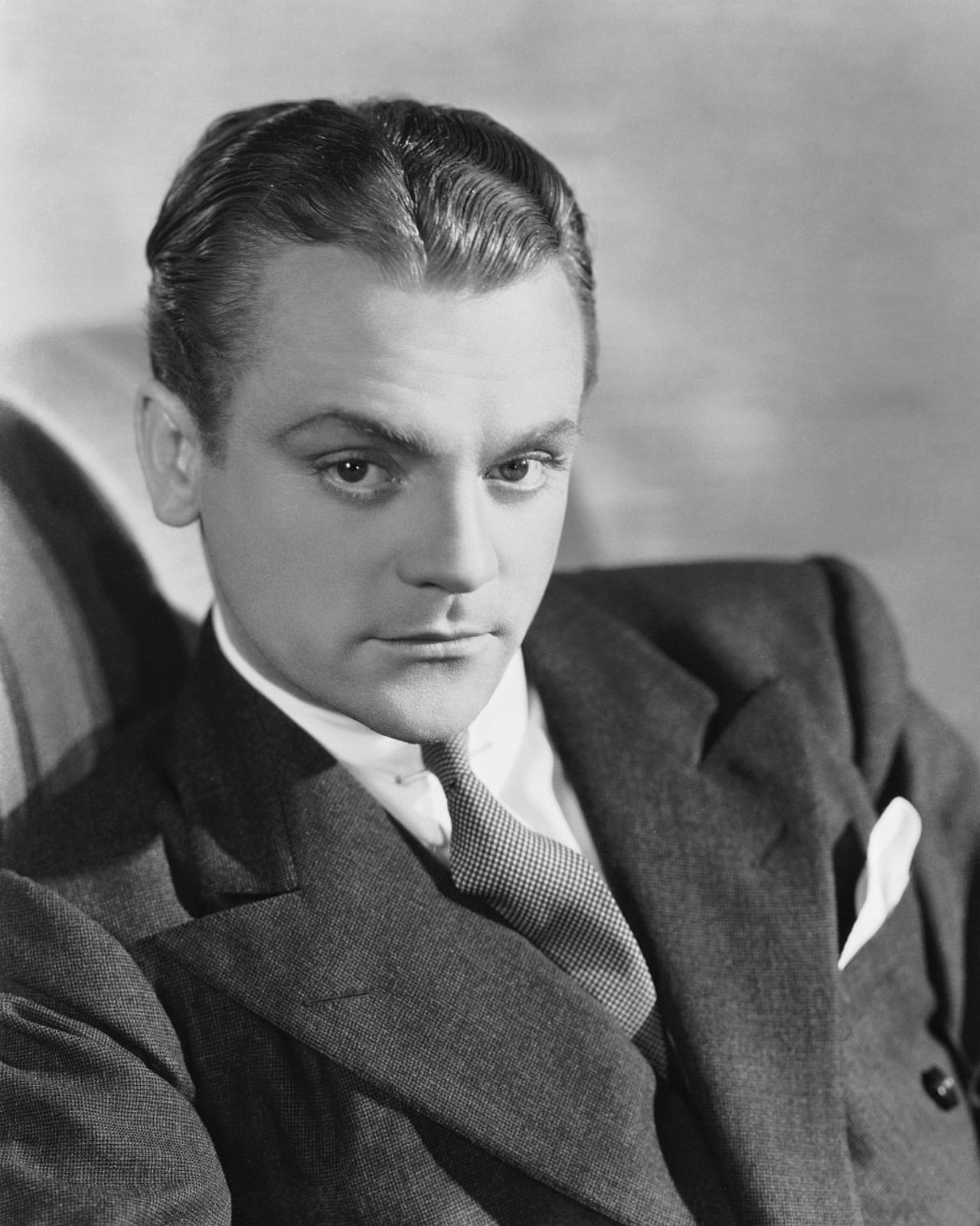 James Cagney in a 1930s studio portrait, during the decade that established his screen image.
James Cagney at a glance
- Full name: James Francis Cagney Jr.
- Born: 17 July 1899 in New York City
- Died: 30 March 1986 in Stanfordville, New York
- Occupations: Actor, dancer, stage performer and producer
- Years active: 1919 to 1984, with a twenty-year screen retirement after 1961
- Best-known films: The Public Enemy, Footlight Parade, Angels with Dirty Faces, The Roaring Twenties, Yankee Doodle Dandy and White Heat
- Major honours: Academy Award for Yankee Doodle Dandy, AFI Life Achievement Award, Kennedy Center Honor and Presidential Medal of Freedom
- Screen Actors Guild service: President from 1942 to 1944
New York taught him to move quickly
Cagney was born in Manhattan to James Francis Cagney Sr. and Carolyn Nelson Cagney. His father was of Irish descent and worked in several jobs, including tending bar, while his mother came from a Norwegian-American family. Money was often short, and illness affected the household. The family moved within New York, with Cagney closely associated with the Yorkville neighbourhood where he spent much of his youth.
The later film image encouraged publicity writers to present his childhood as preparation for gangster roles. There were street fights and Cagney boxed as a young man, but we should not turn ordinary working-class hardship into a criminal apprenticeship. He was studious enough to attend Stuyvesant High School and briefly Columbia College, leaving when his father’s death increased the family’s financial pressure.
He took whatever work was available, including jobs as a copy boy, doorman and package wrapper. The variety matters because performance did not begin as a grand ambition. Cagney was interested in drawing, physical activity and the possibility of further education. Show business offered wages before it offered a vocation.
Dance had been part of family life, and Cagney could imitate steps quickly. He also had a compact body built for sharp movement rather than the long, floating line associated with later film dancers such as Fred Astaire. His style stayed close to the floor. The knees bent, the shoulders joined the rhythm and the feet looked as if they were pushing against the stage.
An accidental chorus job became a career
One of the best-known stories in Cagney’s life concerns his first professional stage work in the 1919 revue Every Sailor. He auditioned for a chorus in which male performers appeared dressed as women. The job sounds like an unlikely beginning for Hollywood’s future tough guy, which is exactly why publicity repeated it. More importantly, the experience gave him professional discipline and proved he could learn choreography under pressure.
Vaudeville followed. Cagney performed comedy, dance and sketches, sometimes touring with his brother Harry. He met Frances Willard Vernon, known as Billie, while working on the stage. They married in 1922 and remained together until his death in 1986. Hollywood biographies often praise a long marriage as if duration tells us everything about it. In this case, the public evidence does at least show a partnership that survived touring, studio conflict, retirement and poor health.
Cagney’s Internet Broadway Database record shows how varied his stage apprenticeship became. He appeared in Pitter Patter, Outside Looking In, Women Go On Forever, the Grand Street Follies, Maggie the Magnificent and finally Penny Arcade. These were not all dance shows. By the late 1920s he was combining movement with character acting and the direct speech that sound cinema wanted.
Penny Arcade also starred Joan Blondell. Al Jolson purchased the screen rights and sold them to Warner Bros., leading to Sinners’ Holiday in 1930. Cagney and Blondell both repeated their stage roles. Neither was initially treated as a future star, but the studio had found two performers who could make fast dialogue feel like conversation rather than recitation.
The Public Enemy made him famous almost immediately
Cagney’s fifth film was The Public Enemy (1931). He plays Tom Powers, a Chicago bootlegger whose childhood mischief develops into organised crime during Prohibition. The film moves with the speed of a newspaper headline. It gives us criminal success, but it never allows that success to become secure or romantic.
A familiar story claims that Cagney began filming as Tom’s friend Matt Doyle before director William Wellman switched his role with Edward Woods. The AFI Catalog specifically warns that the often-repeated account is not correct. This is a useful example of why Hollywood anecdotes need checking even when they have appeared in print for decades.
What is not disputed is the effect of the performance. Cagney’s Tom seems to make decisions physically. He leans into rooms, reacts before politeness can intervene and treats stillness as a temporary pause. The voice is high and hard rather than conventionally imposing. That contrast makes the aggression less predictable.
The grapefruit scene became the film’s most famous moment. During breakfast, Tom pushes half a grapefruit into the face of Kitty, played by Mae Clarke. Different accounts assign the idea to Wellman, producer Darryl Zanuck or an improvised joke that remained in the film. Whatever its precise origin, the scene is disturbing because it is casual. Tom does not build towards a grand explosion. He silences a woman who irritates him and continues with his morning.
The ending is harsher. Tom’s body is returned to his family after he has been abducted and killed, collapsing through the front door while a cheerful record plays inside. Warner Bros. had made a star by showing exactly where his character’s energy led.
The Library of Congress later selected the film for the National Film Registry, describing Cagney’s performance as incendiary and star-making. That description is fair, but we should add that the performance works because speed does not become charm alone. Tom is exciting to watch and appalling to know.
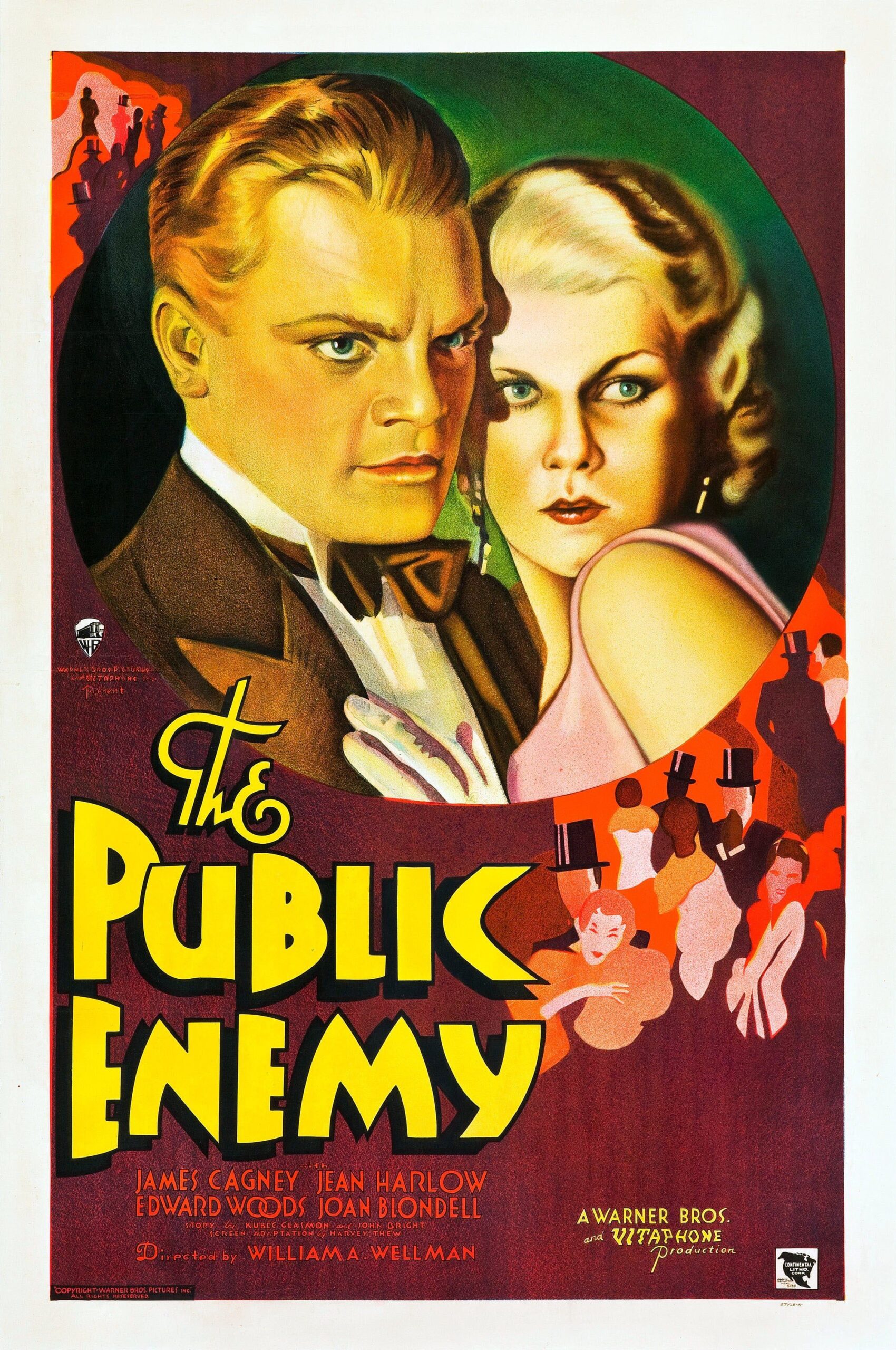 The 1931 release poster for The Public Enemy, featuring James Cagney and Jean Harlow.
Warner Bros. knew what it had, then used it repeatedly
Warner Bros. specialised in urban stories with quick production schedules, crowded casts and dialogue that sounded as though it had been torn from the morning paper. Cagney suited the house style perfectly. The studio consequently kept him working.
In Smart Money he appeared with Edward G. Robinson, giving audiences the unusual sight of the decade’s two defining screen gangsters in the same film. Blonde Crazy reunited him with Joan Blondell for a comedy about small-time swindlers. Taxi! gave him a working man ready to fight an entire city, while Picture Snatcher, Lady Killer and Hard to Handle kept adjusting the same basic mixture of nerve, ambition and speed.
Not every assignment deserved him. Cagney disliked repetition and objected when the studio required more films than he believed his contract allowed. He also knew that a successful star generated far more money than the weekly salary suggested. The conflict was financial, but it was also about control over roles and working pace.
We can see why the studio resisted. Cagney could make a thin scene feel active simply by listening impatiently. He was also valuable opposite other performers because he created pressure. Pat O’Brien’s steadier manner, Joan Blondell’s warmth and Humphrey Bogart’s colder aggression all became clearer when placed beside him.
Footlight Parade revealed the dancer Hollywood had hidden
Footlight Parade (1933) gave audiences a fuller view of Cagney’s stage experience. He plays Chester Kent, a producer creating short musical “prologues” for cinemas. The role still contains the familiar drive. Chester talks rapidly, distrusts competitors and pushes exhausted colleagues towards impossible deadlines. The difference is that the energy now produces shows instead of crimes.
Busby Berkeley designed the large-scale numbers, including “By a Waterfall” and “Shanghai Lil”. Berkeley’s camera turns dancers into patterns that could never be reproduced from a theatre seat. Cagney’s own dancing has a different appeal. He is compact, direct and slightly mischievous, appearing to throw steps into the air rather than polish them for display.
The Library of Congress essay on Footlight Parade argues that audiences who knew him mainly as a tough guy were surprised by his grace, and that the film helped make Yankee Doodle Dandy possible. That connection is important. Hollywood did not suddenly discover in 1942 that Cagney could dance. The evidence had been available for years, but the gangster films were easier to sell.
Joan Blondell is again essential. Her character Nan understands Chester’s business, protects him from other people’s schemes and waits for him to notice what the audience already knows. Cagney’s screen partnerships often work best with actors who refuse to be hurried by him. Blondell can match the pace without copying it.
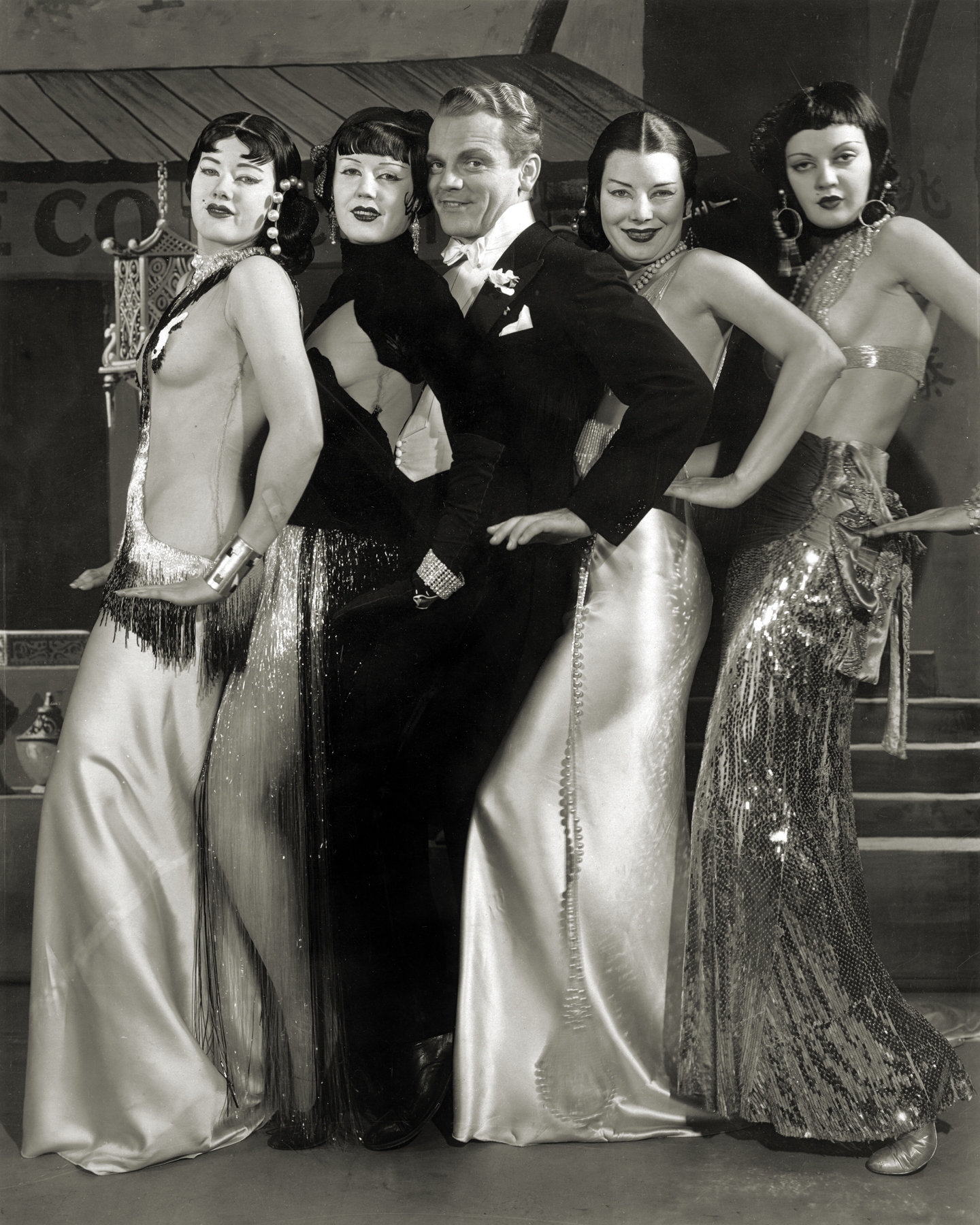 James Cagney in Footlight Parade (1933), surrounded by performers from the Shanghai Lil number.
G-Men changed sides without changing the energy
By the middle of the decade, censorship and public pressure had made the unpunished screen gangster harder to sustain. G-Men (1935) placed Cagney on the side of federal law enforcement. His character becomes an agent, but the performance keeps the urgency audiences associated with the criminal roles.
The shift is revealing because Cagney never needed elaborate villainy. His basic screen quality was resistance to being controlled. A gangster could direct that resistance against society, while an agent could direct it against criminals or bureaucracy. The same clipped speech and forward movement served both.
That flexibility did not solve his problems with Warner Bros. Cagney had already walked out once during contract negotiations. In 1935 he sued the studio for breach of contract, objecting to the number and quality of assignments as well as billing. He eventually left and worked for the smaller Grand National company.
The victory is sometimes described as if Cagney single-handedly broke the studio system. He did not. Studios retained enormous power, and other actors, including Bette Davis and later Olivia de Havilland, fought their own legal battles under different circumstances. Cagney did demonstrate that a profitable star could use suspension, publicity and the courts to challenge a contract rather than simply accept every assignment.
Leaving Warner Bros. proved freedom was not enough
At Grand National, Cagney made Great Guy and Something to Sing About. The second film let him dance and play a Hollywood performer, material he clearly wanted. It also suffered from the limited resources and distribution available to a small company.
Creative control does not guarantee an audience. Warner Bros. could be restrictive, but it also supplied strong supporting casts, efficient crews and cinemas ready to show the finished film. Cagney’s independent period made the trade-off visible.
He returned to Warner with better terms and better material. Angels with Dirty Faces (1938) casts him as Rocky Sullivan, a criminal whose childhood friend Jerry Connolly, played by Pat O’Brien, has become a priest. The Dead End Kids worship Rocky, so Jerry eventually asks his friend to die pretending to be a coward and destroy the glamour surrounding him.
The ending refuses to tell us whether Rocky’s terror is real or performed for the boys. Cagney reportedly preferred the ambiguity, and the performance supports both readings. Rocky fights on the way to the chair, but acting and fear are impossible to separate once the door closes.
The film earned Cagney his first Academy Award nomination. The AFI production history also records awards from the New York Film Critics and National Board of Review. More importantly, the role widened the gangster image. Rocky remains dangerous, but he is capable of loyalty and perhaps sacrifice.
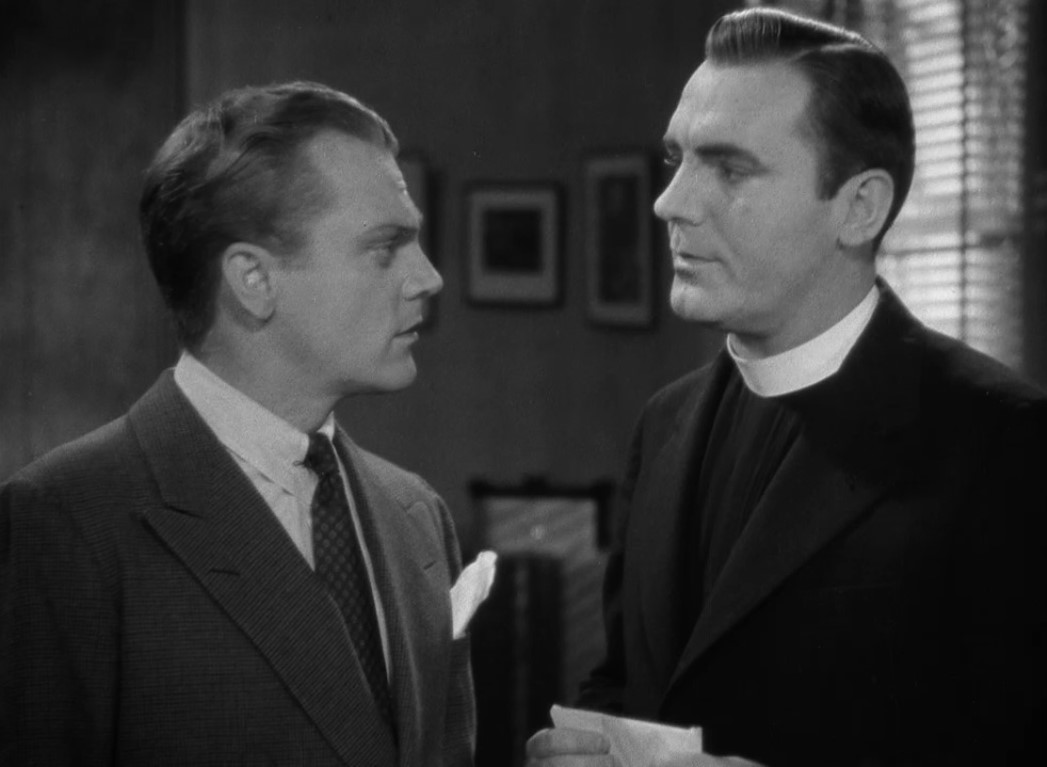 James Cagney as Rocky Sullivan and Pat O’Brien as Father Jerry in Angels with Dirty Faces (1938).
The Roaring Twenties looked back at the gangster cycle
Raoul Walsh’s The Roaring Twenties (1939) pairs Cagney with Humphrey Bogart and Jeffrey Lynn as former soldiers trying to find places in civilian America. Cagney’s Eddie Bartlett becomes a bootlegger after legitimate work fails him. Bogart’s George Hally treats crime with fewer illusions.
The film arrived after the first great cycle of gangster pictures had begun to fade. It consequently looks backwards, using newsreel material and narration to connect Eddie’s rise and fall with Prohibition. The approach can feel like a summary of the genre, but Cagney prevents Eddie from becoming an example in a history lesson.
Eddie wants success, friendship and romantic recognition, and he repeatedly confuses them. His feelings for Jean, played by Priscilla Lane, are sincere but also built around an image she never promised to fulfil. When his business collapses, Cagney slows the body that once seemed impossible to stop.
The film’s final line asks what Eddie did, and Gladys George’s Panama replies that he “used to be a big shot”. Cagney’s career could have ended inside that epitaph. Instead, he was about to make the film that reminded everyone he had been a dancer first.
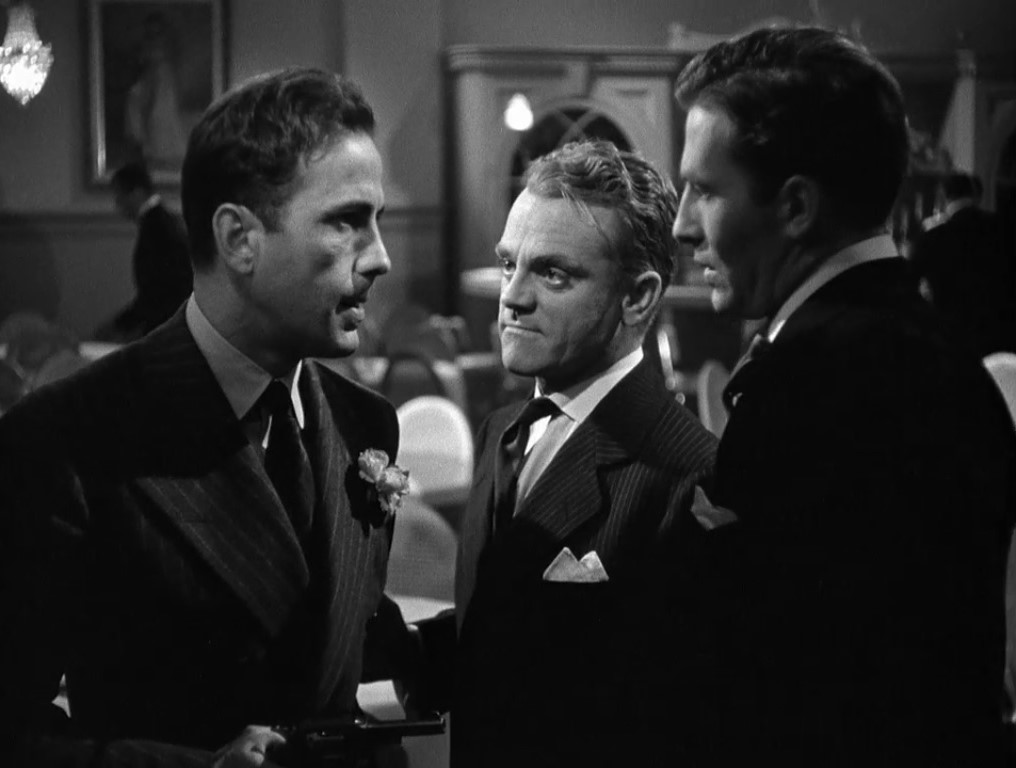 Humphrey Bogart, James Cagney and Jeffrey Lynn in a trailer frame from The Roaring Twenties (1939).
Yankee Doodle Dandy earned the Oscar
Yankee Doodle Dandy (1942) tells the life of Broadway performer, writer and producer George M. Cohan. It is patriotic, heavily shaped by studio storytelling and far from a complete account of Cohan’s life. It is also the clearest record of Cagney’s ability to build character through dance.
According to the AFI Catalog, Cohan wanted Cagney to play him. John Boyle worked on Cagney’s dances, while LeRoy Prinz and Seymour Felix staged the larger numbers. Cagney did not try to transform the material into elegant ballet. He copied the stiff-legged, forward-driving quality associated with Cohan and let age alter it across the film.
The performance therefore does more than reproduce famous songs. Young Cohan seems to attack the stage. Older Cohan uses some of the same gestures, but experience has changed their weight. Cagney’s control is particularly clear in the quieter White House framing scenes, where the showman tells his story to President Franklin D. Roosevelt.
The timing also mattered. The United States had entered the Second World War while the film was in production. At the New York premiere, Warner Bros. sold war bonds instead of conventional tickets, raising millions of dollars according to contemporary trade reports collected by AFI. Songs such as “Over There” consequently arrived with an immediate wartime charge.
Cagney won the Academy Award for Best Actor at the 1943 ceremony. It was his only Oscar, and the official Academy record confirms a field that included Gary Cooper, Ronald Colman, Walter Pidgeon and Monty Woolley.
If you watch only the gangster films, the award can look like Hollywood rewarding an actor for proving he possessed unexpected range. That understates the point. Dancing was not a departure from Cagney’s technique. It was the foundation of it.
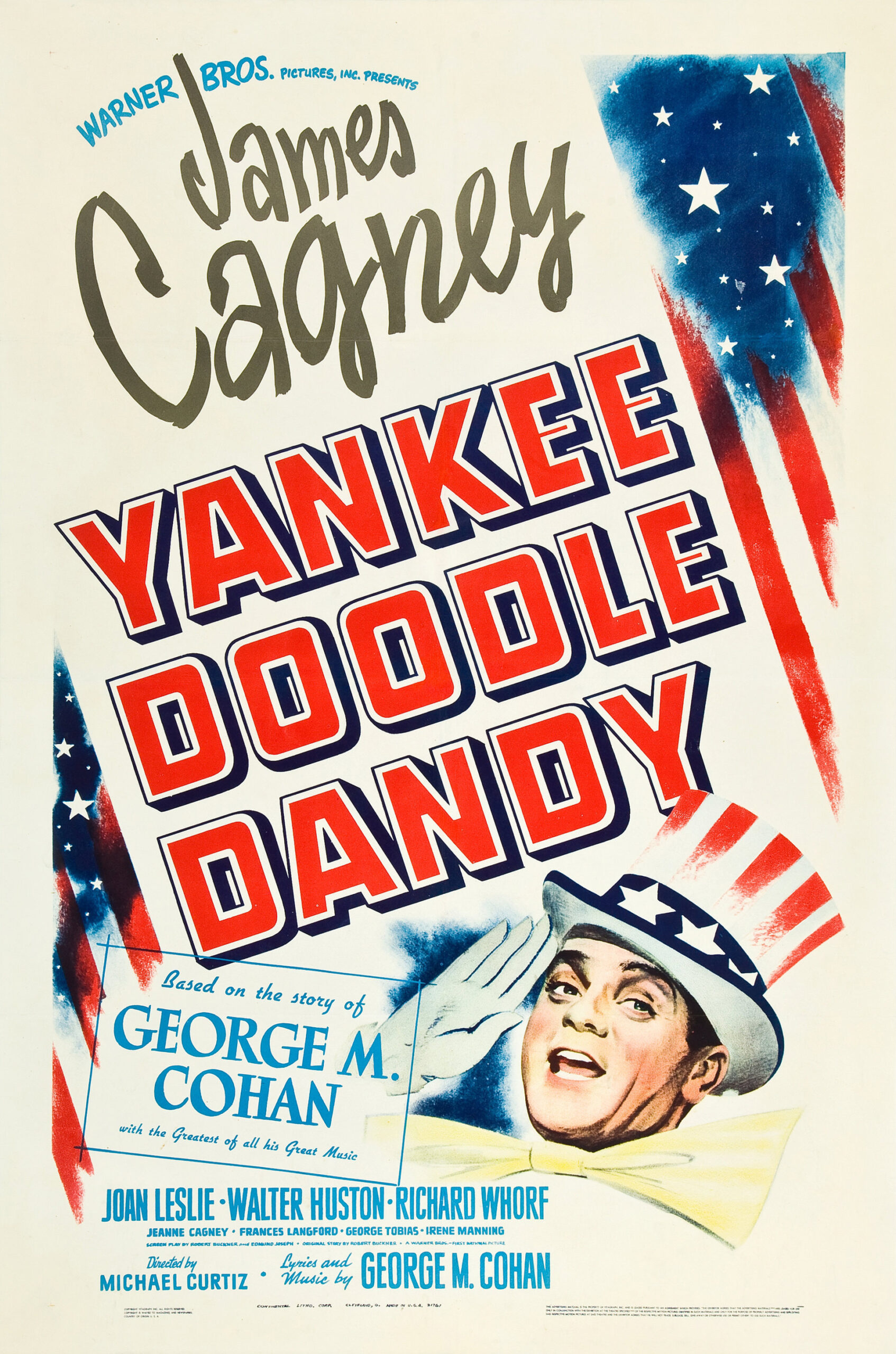 The 1942 release poster for Yankee Doodle Dandy, the musical that won Cagney his Academy Award.
He also worked for actors when he reached the top
In September 1942, Cagney became president of the Screen Actors Guild. The role placed him inside wartime disputes over salary restrictions and the representation of background performers. SAG-AFTRA’s official history records his 1942 to 1944 presidency, his trip to Washington during wage-stabilisation discussions and the difficult argument over whether extras should remain within the Guild.
This part of the career complicates the simple story of a star fighting only for himself. Cagney’s Warner disputes concerned his own contract, but he had joined the Guild early and served on its board. At the same time, Guild politics involved competing interests, and the extras issue was not solved during his presidency. His farewell address called it one of the organisation’s most serious problems.
Cagney’s politics changed over a long lifetime. In the 1930s he was associated with labour and anti-fascist causes. He later moved towards conservative politics and supported Ronald Reagan. Rather than forcing those positions into a perfectly consistent journey, it is more honest to recognise that the political world around him changed and so did he.
Cagney Productions offered control and new problems
Cagney and his brother William formed Cagney Productions. The company made films including Johnny Come Lately, Blood on the Sun and The Time of Your Life. William Cagney handled much of the producing work, making the enterprise a family business as well as a bid for independence.
Blood on the Sun allowed James to use judo in a wartime thriller. The Time of Your Life, adapted from William Saroyan’s play, gave him an unusually observant and restrained character. The film respects Saroyan’s collection of people drifting through a waterfront bar, but audiences did not respond strongly enough to support the company’s ambitions.
Again, independence proved expensive. Distribution, production costs and legal complications reduced the freedom the company was supposed to provide. By the late 1940s, Cagney returned to Warner Bros. for the kind of role he had spent years avoiding.
White Heat made the old gangster frightening again
White Heat (1949) was Cagney’s first gangster film since The Roaring Twenties. It did not ask him to repeat Tom Powers. Cody Jarrett is a gang leader with severe headaches, an intense dependence on his mother and sudden eruptions of violence. The character belongs to a postwar crime film in which police technology, prison surveillance and psychological explanation have changed the genre.
Raoul Walsh directs with little wasted movement. The famous prison mess-hall scene begins with Cody receiving news of his mother’s death while seated among hundreds of inmates. Grief travels through the room before he explodes across the tables. According to the AFI production history, Walsh protected the scene when Jack Warner worried about its cost and completed it quickly.
Cagney’s performance is large, but it is not uncontrolled. He knows exactly when Cody’s stillness has become dangerous. The affection for Ma Jarrett, played by Margaret Wycherly, does not make him sympathetic in a conventional sense. It reveals the one relationship through which he imagines himself important.
The climax takes Cody to the top of a chemical storage tank as police close in. His final declaration that he has reached the top of the world turns triumph into self-destruction. The Library of Congress selected White Heat for the National Film Registry in 2003, and the image has become inseparable from Cagney’s screen identity.
There is an irony here. Returning to the gangster role refreshed his career because he and Walsh refused to behave as if 1931 had never ended. Cody is not Tom Powers grown older. He is the nightmare produced when the old speed loses every remaining social connection.
 The 1949 release poster for White Heat, Cagney’s frightening return to the gangster film.
The 1950s contained some of his most interesting acting
Cagney continued to work across genres. Kiss Tomorrow Goodbye returned to crime, while Come Fill the Cup cast him as an alcoholic newspaper reporter trying to rebuild his life. The latter role uses weariness and restraint rather than the forward charge of the early films.
In Love Me or Leave Me (1955), he plays Martin Snyder opposite Doris Day’s singer Ruth Etting. Snyder is controlling, violent and physically insecure. Cagney does not ask us to admire him, but he shows how resentment and dependence feed one another. The performance brought his third Academy Award nomination, following Angels with Dirty Faces and Yankee Doodle Dandy.
The same year, Mister Roberts placed him on a naval cargo ship as Captain Morton, a small-minded officer using authority to punish men who despise him. Cagney and director John Ford clashed during production, and Ford was later replaced after illness. The role is deliberately unpleasant, but Cagney understands how Morton uses procedure as a substitute for respect.
Man of a Thousand Faces (1957) gave him another performer to interpret, silent-film star Lon Chaney. The biography simplifies parts of Chaney’s life, as studio biographies often did, but Cagney handles the performance scenes without turning imitation into a collection of tricks.
Billy Wilder’s One, Two, Three (1961) pushed his speed almost to exhaustion. Cagney plays a Coca-Cola executive in West Berlin trying to solve a political and corporate crisis before his superior arrives. The dialogue rarely stops. Cagney later suggested that the experience contributed to his decision to retire, and after its release he left the screen for twenty years.
Retirement was real, even when it was not permanent
Cagney had purchased farms and country properties long before retirement. He bred animals, painted and valued work that did not require publicity. Newspaper profiles sometimes treated this as a charming hobby, but the repeated retreats from Hollywood suggest it answered a genuine need for independence.
He and Billie adopted two children, James Cagney Jr. and Cathleen Cagney. As with many famous families, later accounts include tensions that cannot be settled fairly in a short article. The marriage remained intact, while the public version of the Cagney household was kept comparatively private.
Honours drew him back into view. The American Film Institute chose Cagney as the second recipient of its Life Achievement Award in 1974, after John Ford. He received a Kennedy Center Honor in 1980.
Then, after two decades away from films, he accepted the role of Police Commissioner Rhinelander Waldo in Miloš Forman’s Ragtime (1981). The performance is quieter than audiences expecting the old Cagney may have anticipated. Age and a stroke had changed his movement, but his attention remained sharp. He made one final television film, Terrible Joe Moran, broadcast in 1984.
President Ronald Reagan presented Cagney with the Presidential Medal of Freedom in 1984. The event brought together two former Screen Actors Guild presidents whose political paths had overlapped and diverged across half a century.
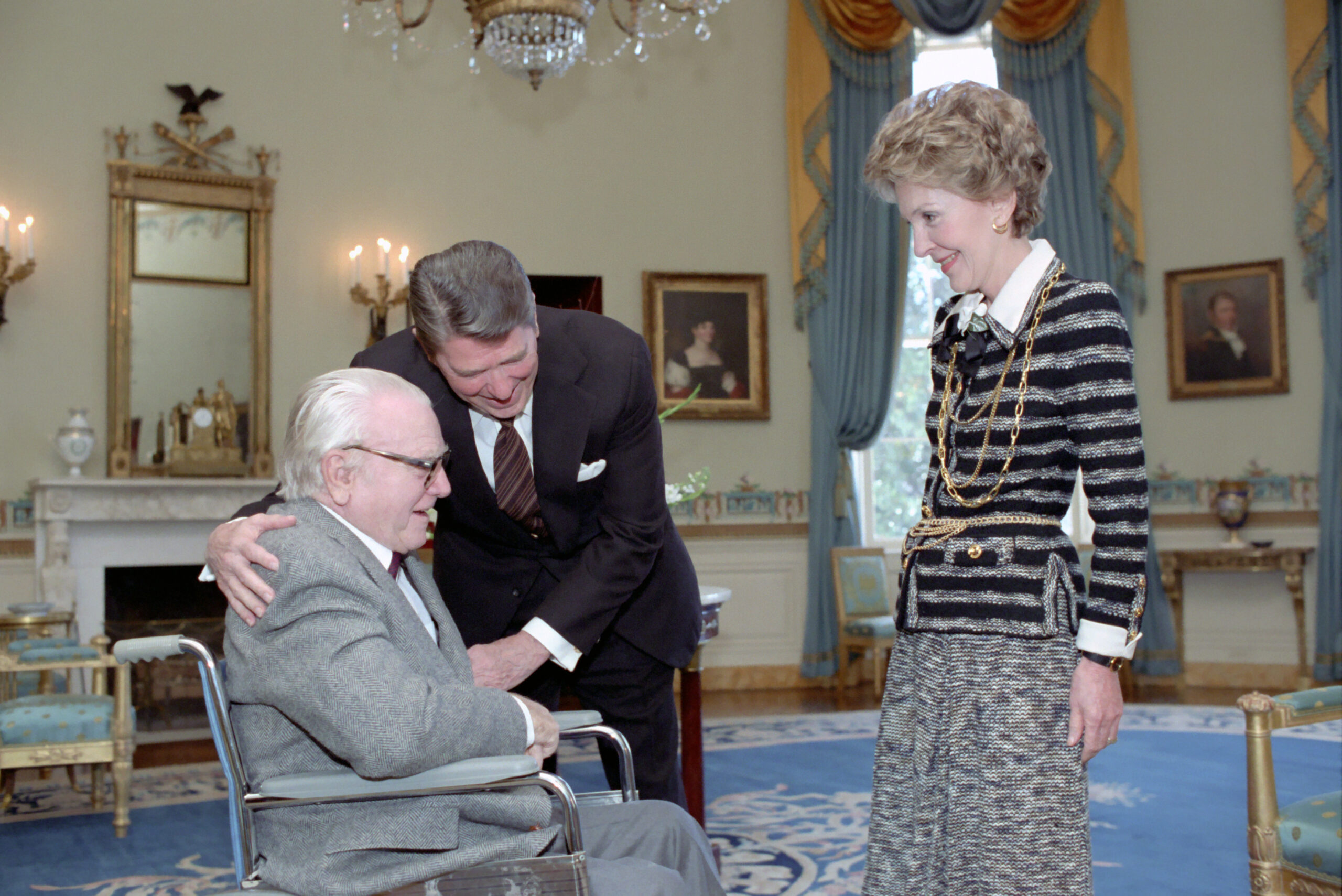 President Ronald Reagan and Nancy Reagan with James Cagney after the actor received the Presidential Medal of Freedom in 1984.
Death and the reputation he left behind
Cagney died at his farm in Stanfordville, New York, on 30 March 1986. He was eighty-six and had experienced declining health following strokes and other medical problems. Billie Cagney lived until 1994.
His reputation rests on a paradox. Few actors were more immediately recognisable, yet the recognisable manner contained more variety than the imitation suggests. Comedians copied the clipped voice. Cartoons borrowed the stance. People attributed “You dirty rat” to him even though he never delivered that exact line on screen.
The imitation usually misses the listening, the timing and the dance training. Cagney did not simply bark at other actors. He measured them. A pause from Bogart, a dry answer from Blondell or a calm refusal from O’Brien changed what he did next.
This is also why the violence remains unsettling. The body looks organised even when the character is not. Tom Powers, Rocky Sullivan and Cody Jarrett can lose control, but Cagney never does.
Which James Cagney films should you watch first?
If you want to understand the whole career, we suggest alternating the gangsters with the musicals rather than watching one group first.
- The Public Enemy (1931): Begin with the breakthrough and notice how quickly Cagney alters the rhythm of early sound acting.
- Footlight Parade (1933): Follow it with the dancer and comic performer Warner Bros. rarely allowed to lead a musical.
- Angels with Dirty Faces (1938): This is the best bridge between the gangster image and more complicated dramatic acting.
- The Roaring Twenties (1939): Watch Cagney and Humphrey Bogart use very different kinds of threat inside the same film.
- Yankee Doodle Dandy (1942): The Oscar-winning performance shows how dance, age and character can be built from the same physical vocabulary.
- White Heat (1949): Finish the essential group with a gangster performance that consciously destroys the old one.
After those six, try Love Me or Leave Me, Mister Roberts and One, Two, Three. They show Cagney playing insecurity, petty authority and corporate panic without relying on the heroic star image.
Our Humphrey Bogart biography provides a useful companion to The Roaring Twenties, while the Bette Davis biography follows another Warner Bros. star who fought the studio over roles and contracts.
Gangsters, musicals and the actor behind both
James Cagney’s career makes more sense when we stop separating movement from acting. The feet that attack the floor in Yankee Doodle Dandy belong to the same performer whose shoulders tell us Tom Powers is about to strike. The difference lies in what the character wants the rhythm to achieve.
He also understood the business surrounding the performance. Cagney fought Warner Bros., worked independently, served the Screen Actors Guild and walked away when he believed the work had taken enough from him. Not every fight produced a better film, and independence sometimes exposed the value of the studio resources he had rejected. That makes the story more interesting than a simple victory over Hollywood.
If you only remember the grapefruit or the burning tank, start again with Footlight Parade. Then return to The Public Enemy. The dancer will be visible in the gangster, and the gangster’s impatience will still be present in the dance. That connection is the key to Cagney’s screen acting.
Questions readers often ask
Did James Cagney say “You dirty rat”?
No. The phrase became attached to Cagney through impressions and popular culture, but he did not say those exact words in a film.
Was James Cagney a trained dancer?
He learned through family dancing, chorus work, vaudeville and years on stage rather than through the type of formal ballet training associated with some later stars. Dance was part of his professional career before films made him a gangster.
Which film won James Cagney his Oscar?
He won Best Actor for playing George M. Cohan in Yankee Doodle Dandy. He was also nominated for Angels with Dirty Faces and Love Me or Leave Me.
Why did James Cagney leave Warner Bros.?
He objected to salary, billing, the number of films required and the repetition of roles. Cagney challenged the studio more than once, worked for Grand National and later formed Cagney Productions with his brother William.
When did James Cagney retire?
He retired from films after One, Two, Three in 1961. He returned for Ragtime in 1981 and made the television film Terrible Joe Moran before ending his acting career.