 Bette Davis in a 1935 studio publicity portrait.
Bette Davis : Personal Info
Full name : Ruth Elizabeth Davis
Born : April 5, 1908, Lowell, Massachusetts
Died : October 6, 1989, Neuilly-sur-Seine, France
Nationality : American
Occupations : Actress, stage performer, producer
Years active : 1929-1989
Known for : Of Human Bondage, Dangerous, Jezebel, Dark Victory, The Letter, The Little Foxes, Now, Voyager, All About Eve, What Ever Happened to Baby Jane?
Major honors : Two Academy Awards for Best Actress; ten competitive acting nominations; first woman to receive the American Film Institute Life Achievement Award; Kennedy Center Honor
Bette Davis : Introduction
Bette Davis made ambition visible. Her best characters want power, love, freedom or professional survival with an intensity Hollywood did not always permit women to display attractively. She accepted roles that risked vanity, sympathy and conventional glamour, then used voice, eyes and physical precision to make difficult women impossible to ignore.
The public legend is full of combat: Davis against Warner Bros., Davis against directors, Davis against Joan Crawford, Davis against age and illness. Conflict was real, but it can become a lazy substitute for examining the work. She was a disciplined actor with stage training, strong script instincts and a detailed understanding of how gesture changed under the camera.
The Academy’s centennial tribute notes her two wins, ten nominations and unprecedented run of five consecutive Best Actress nominations for work released from 1938 through 1942. The record reflects both performance quality and a period when Warner Bros. finally supplied roles large enough for her appetite.
Bette Davis : New England Childhood and Stage Training
Ruth Elizabeth Davis was born in Lowell, Massachusetts. After her parents separated, she and her sister Barbara were raised largely by their mother, Ruthie. Financial uncertainty and repeated moves made self-reliance important early, while school productions gave Davis a direction.
She studied at John Murray Anderson’s dramatic school in New York, where classmates included Lucille Ball, and worked in stock theatre. Broadway appearances in Broken Dishes and Solid South helped lead to Hollywood tests. The transition was not immediately flattering. Universal struggled to see what to do with a young actor whose intensity did not fit its preferred ingénue mould.
Davis later repeated the story that a studio representative failed to recognise her at the train because nobody who looked like an actress had arrived. Like many perfect Hollywood anecdotes, it serves a mythic function whether every detail is literal or polished by memory. The larger truth is secure: her initial film period was uncertain, and success required moving beyond the studio that first signed her.
Bette Davis : Warner Bros. and Of Human Bondage
At Warner Bros., Davis found stronger opportunities, though the relationship would remain contentious. The breakthrough came through RKO’s Of Human Bondage (1934), in which she played Mildred Rogers, a cruel and self-destructive waitress who humiliates Leslie Howard’s obsessive medical student.
The role rejected prettiness as protection. Davis altered her speech and appearance, allowing illness and degradation to register without sentimental softening. Her failure to receive a conventional Academy nomination led to a write-in campaign and helped expose dissatisfaction with the nomination process.
Dangerous brought her first official Academy Award for Best Actress. Davis herself sometimes treated the win as compensation for Of Human Bondage, but the honour increased her leverage. Jezebel (1938), directed by William Wyler, brought the second Oscar and established the mature Davis image: commanding, emotionally excessive, capable of cruelty and devastating self-knowledge.
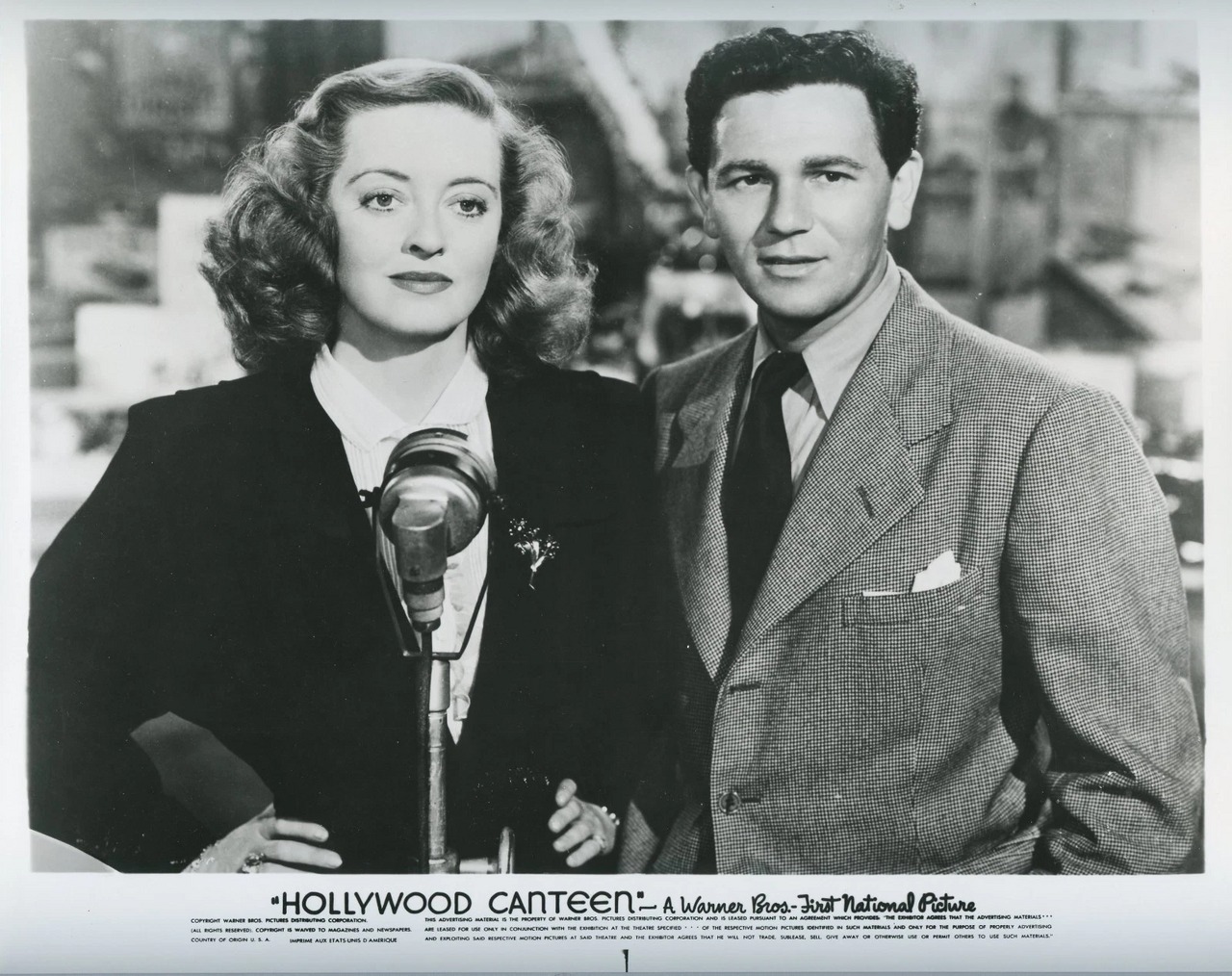 Bette Davis and John Garfield promoting the Hollywood Canteen in 1944.
Bette Davis : The Warner Bros. Lawsuit
In 1936 Davis went to Britain in an attempt to escape her Warner Bros. contract and accept better roles. The studio sued, and the English court ruled against her. The legal defeat cost money and returned her to the contract, but it also made her dissatisfaction public.
The episode is sometimes narrated as a complete victory of principle because better parts followed. The reality is more complicated. Davis did not overturn the contract system, and Warner Bros. retained enormous power. Yet her willingness to challenge it strengthened her identity as an actor who believed quality and career control were worth open conflict.
The BFI’s introduction to Davis places this struggle within her larger pursuit of substantial, sometimes unsympathetic characters. That pursuit shaped both the best films and the reputation for difficulty. Professional resistance was often described differently when exercised by women.
Bette Davis : The Great Warner Bros. Run
From Jezebel through Now, Voyager, Davis built one of the richest sequences of female star vehicles in studio-era Hollywood. Dark Victory casts her as a socialite confronting terminal illness; the performance moves from denial and panic toward a controlled final act that avoids easy sainthood.
In The Private Lives of Elizabeth and Essex, Davis played Queen Elizabeth I opposite Errol Flynn. The Letter opens with one of the great Davis images: Leslie Crosbie emptying a revolver into a man, then arranging a story of self-defence. William Wyler’s direction and Davis’s restraint make the gradual exposure of deception more powerful than overt confession.
The Little Foxes gave her Regina Giddens, a woman whose desire for economic power has been sharpened by a patriarchal family and has not made her morally innocent. Davis and Wyler fought over interpretation, contributing to the end of a major collaboration. The performance remains formidable because Regina’s stillness can feel more violent than movement.
Now, Voyager transformed Davis into a romantic heroine without requiring innocence. Charlotte Vale begins under her mother’s domination and discovers a self through therapy, travel, clothes and forbidden love. The famous makeover matters because Davis shows the psychological labour beneath it.
Bette Davis : Acting Style, Eyes and Voice
Davis understood that film acting required concentration rather than mere reduction. Her eyes could hold attention, but they were never the whole technique. She used the angle of her head, clipped breath, cigarette handling and sudden changes of vocal weight to organise a scene.
Her voice became more mannered with age and imitation, yet at its best it carried contradictory intentions. A line could sound courteous, wounded and threatening at once. She was willing to make emotion unattractive: grief might distort the face, desire might appear as hunger and authority might become cruelty.
Costume and makeup were tools rather than guarantees of glamour. She shaved her hairline for historical roles, accepted ageing effects and argued for appearances that supported character. The willingness should not be romanticised as total disregard for image—Davis understood publicity acutely—but she repeatedly chose dramatic force over decorative consistency.
Bette Davis : Hollywood Canteen and Wartime Service
During the Second World War, Davis and actor John Garfield helped establish the Hollywood Canteen, where servicemen could eat, dance and encounter volunteer entertainers. The project depended on extensive industry labour, but Davis’s organisational energy and visibility were central.
The film Hollywood Canteen turned the institution into wartime entertainment and publicity. Modern accounts should recognize both genuine service and the studio system’s skill at converting service into morale-building spectacle. Davis’s contribution was practical as well as symbolic.
Her public role during the war complicates the stereotype of the isolated combatant. She could mobilise colleagues, work administratively and place star power in service of a collective project. The same forcefulness that caused studio disputes could become effective leadership.
 Bette Davis in a publicity portrait for Jezebel (1938).
Bette Davis : Leaving Warner Bros. and All About Eve
By the late 1940s, Davis’s relationship with Warner Bros. had deteriorated. Beyond the Forest became an unhappy final obligation, and she left the studio after nearly two decades. The transition could have ended her central importance just as Hollywood’s treatment of middle-aged actresses was narrowing.
All About Eve (1950) reversed the decline. As Margo Channing, Davis found a character whose professional authority, fear of ageing and theatrical wit could absorb her own public history. Margo is not merely jealous of a younger woman. She understands that an industry equates female value with youth and that experience does not protect against replacement.
Joseph L. Mankiewicz’s dialogue gave Davis famous lines, but the performance’s power lies in the quieter passages: Margo without an audience, aware that theatrical command cannot organise private life. The role brought another Oscar nomination and created the template for the Davis comeback—an older star using age as material.
Bette Davis and Joan Crawford : Rivalry, Myth and Baby Jane
Bette Davis and Joan Crawford had different backgrounds, screen styles and approaches to self-presentation. Industry competition and personal hostility existed, but later retellings often turn every interaction into camp warfare. The myth can obscure how both women survived a system with limited space for ageing female stars.
What Ever Happened to Baby Jane? (1962) used the rivalry commercially. Davis plays a former child star caring for and tormenting her disabled sister, played by Crawford. Her makeup is grotesque, the performance deliberately theatrical and the film poised between psychological horror and black comedy.
Davis received her tenth competitive Oscar nomination. The production stories are entertaining, but the film matters because it allowed two older actresses to dominate a major commercial success without pretending to be young. It also helped create the “psycho-biddy” cycle, whose opportunities were mixed with cruel ideas about ageing women.
Bette Davis : Private Life and Family Conflict
Davis married four times: to Harmon Nelson, Arthur Farnsworth, William Grant Sherry and Gary Merrill. She had three children, including a biological daughter, B. D. Hyman, and two adopted children. Her domestic life was shaped by work, repeated marital breakdown and painful family conflict.
In 1985 Hyman published a memoir portraying Davis as an abusive and damaging mother. Davis responded through her own writing and public statements. The dispute should not be resolved by adopting either participant’s account as complete. Hyman’s testimony deserves acknowledgement; Davis’s perspective and the limits of public evidence also matter.
Responsible biography does not need to convert artistic greatness into personal innocence. Nor should private accusation be used as a key that explains every performance. The family history belongs in the record because it affected real people, but it must be handled without sensational certainty.
Bette Davis : Television, Late Films and Survival
Davis worked steadily across film and television, sometimes in material beneath her ability and sometimes with remarkable force. The Nanny, The Anniversary and The Whales of August offered very different uses of the late Davis image. Television roles and guest appearances kept her visible to audiences beyond the studio-era generation.
In 1983 she underwent surgery for breast cancer and then suffered a stroke. Recovery was difficult, yet she returned to work. The survival narrative became part of her final public image, reinforced by an unsentimental willingness to appear physically changed.
The Whales of August paired her with Lillian Gish in a quiet film about ageing sisters. Davis’s character is blind, bitter and dependent, a role that refuses triumphant comeback conventions. The performance is valuable because it lets frailty coexist with the old edge rather than pretending time has been defeated.
Bette Davis : Awards and Institutional Leadership
Davis’s Academy history includes two wins and ten competitive nominations. She also served as the first female president of the Academy of Motion Picture Arts and Sciences, although her 1941 tenure was brief and contentious. The position reflected ambition beyond individual performance.
The American Film Institute gave Davis its Life Achievement Award in 1977, making her the first woman to receive the honour. A Kennedy Center Honor followed, along with festival and lifetime tributes that recognised the scale of the filmography.
Awards do not resolve debates about individual roles, but the pattern is clear: peers repeatedly valued her willingness to carry difficult material. Her career helped expand what a female star could look like when desire, authority and age were not softened for approval.
Bette Davis : Death and Legacy
Davis continued travelling and appearing publicly during her final year. She died of breast cancer in France on October 6, 1989, after leaving a film festival in Spain. She was eighty-one.
Her legacy lives in performances, but also in a model of female professional authorship. Davis read scripts closely, argued about characterization and insisted that star power could be used to obtain better material. She did not always win, and forcefulness could wound collaborators and family, but the work changed expectations.
The face and voice remain instantly recognisable. More important is the range behind them: Mildred Rogers’s destructiveness, Judith Traherne’s fear, Regina Giddens’s stillness, Charlotte Vale’s emergence, Margo Channing’s self-knowledge and Baby Jane Hudson’s ruined performance of stardom. Davis made women’s ambition dramatically central, then refused to disappear when Hollywood considered ambition in older women inconvenient.
Selected Bette Davis Filmography
1934 – Of Human Bondage : Breakthrough as Mildred Rogers
1935 – Dangerous : First Academy Award-winning performance
1938 – Jezebel : Second Academy Award-winning performance
1939 – Dark Victory : Oscar-nominated terminal-illness drama
1939 – The Private Lives of Elizabeth and Essex : Historical drama
1940 – The Letter : William Wyler crime melodrama
1941 – The Little Foxes : Lillian Hellman adaptation
1942 – Now, Voyager : Defining romantic transformation story
1950 – All About Eve : Career-renewing role as Margo Channing
1952 – The Star : Self-referential Hollywood drama
1962 – What Ever Happened to Baby Jane? : Final Oscar-nominated role
1964 – Hush…Hush, Sweet Charlotte : Southern Gothic thriller
1965 – The Nanny : Psychological horror
1987 – The Whales of August : Late-career drama with Lillian Gish
Bette Davis : Frequently Asked Questions
How many Oscars did Bette Davis win?
She won two Academy Awards for Best Actress, for Dangerous and Jezebel, and received ten competitive nominations.
Why did Bette Davis sue Warner Bros.?
She believed the studio was damaging her career with inferior roles and tried to work elsewhere. Warner Bros. enforced her exclusive contract in an English court, and Davis lost the case.
Did Bette Davis and Joan Crawford hate each other?
They had genuine professional rivalry and personal conflict, but later publicity magnified the feud into a simplified legend. Their only feature together was What Ever Happened to Baby Jane?
What made Bette Davis’s acting distinctive?
She combined vocal precision, concentrated eye movement, expressive physical choices and a willingness to play ambition, cruelty and emotional need without protecting conventional glamour.
What is the best Bette Davis film to watch first?
All About Eve is the most accessible introduction to her wit and mature authority. Now, Voyager reveals her romantic range, while The Letter displays her control in darker material.
Related Articles
20 Classic Hollywood Actresses Everyone Should Know
20 Movie Stars Who Defined Old Hollywood Glamour
20 Best Film Noir Movies Starring Hollywood Legends
Top 20 Best Black-and-White Movies for New Classic Film Fans