Fred Astaire and Ginger Rogers made ten films together, but the familiar image—top hat, white tie, feathers and effortless romance—can hide how much variety sits inside them. They danced in a ship’s engine room, on roller skates, through snow, across polished Art Deco floors and, in their final reunion, in Technicolor.
In this countdown we will rank all ten Astaire and Rogers movies from their supporting roles in Flying Down to Rio to The Barkleys of Broadway. We have judged the whole films, not only the dances. A masterpiece of movement can therefore rank below a film whose comedy, music, romance and supporting cast all work together.
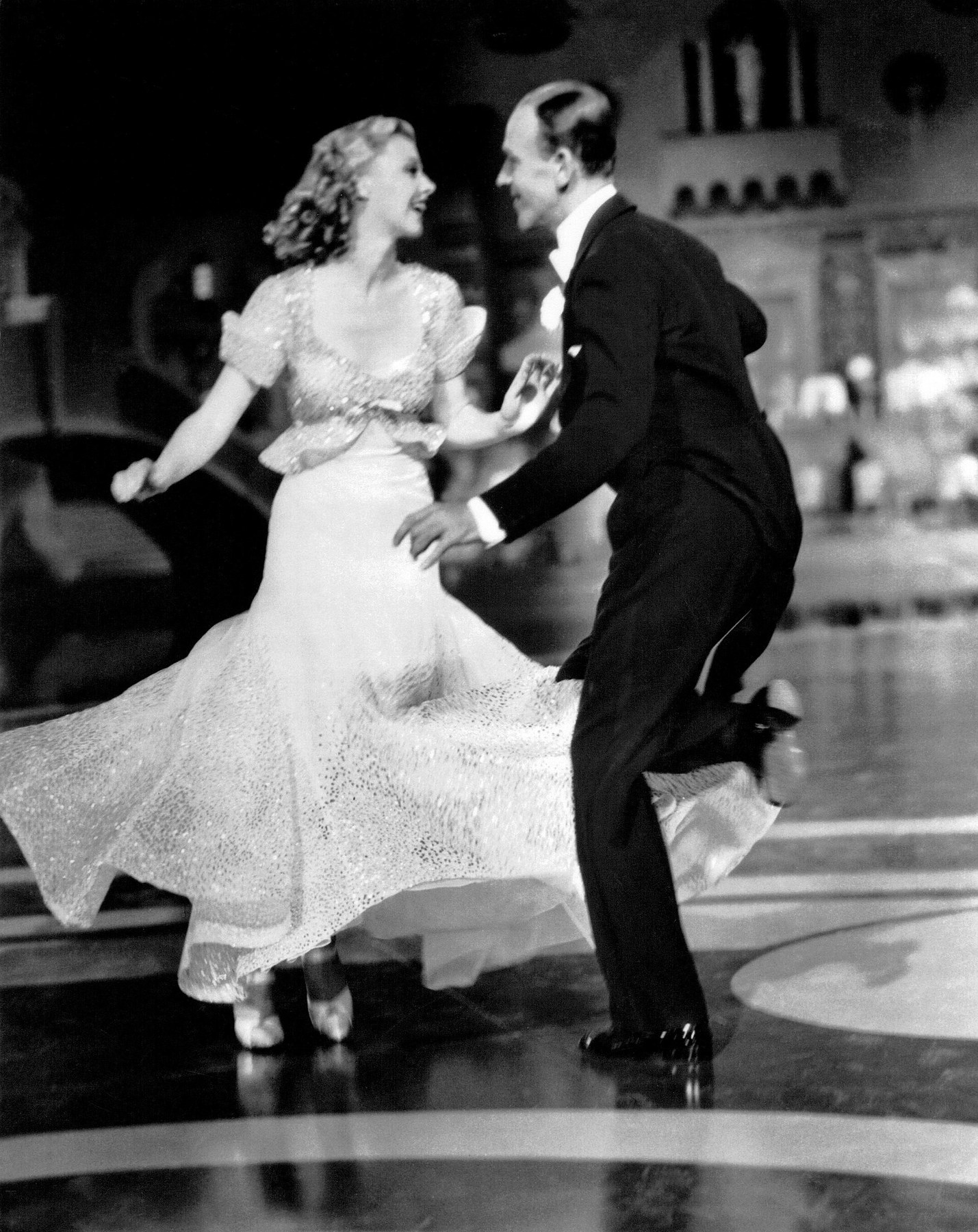 Fred Astaire and Ginger Rogers in Top Hat (1935). Image credit: RKO Radio Pictures / Public domain, via Wikimedia Commons.
How many films did Fred Astaire and Ginger Rogers make together?
They appeared together in ten features. Nine were made at RKO between 1933 and 1939. Ten years after The Story of Vernon and Irene Castle, they reunited at MGM for The Barkleys of Broadway.
How we ranked the films
We considered the dances, songs, chemistry, comedy, story and value to a first-time viewer. Astaire and Rogers can rescue a weak plot for several minutes at a time, but the highest positions go to films that continue working when they are not dancing.
We have also tried to distinguish “most important” from “best place to start”. Flying Down to Rio matters because it introduced the pairing. That does not make it their most satisfying film.
Every Astaire and Rogers movie ranked
10. The Barkleys of Broadway (1949)
Their only colour film and only MGM feature together casts them as Josh and Dinah Barkley, a married musical-comedy team whose partnership is threatened when Dinah wants to become a serious dramatic actress. Oscar Levant supplies dry commentary, and the songs include a lovely reunion with “They Can’t Take That Away from Me”.
There is pleasure in seeing the pair together again, older and playing professionals who know exactly how to irritate one another. The problem is that the film sometimes turns their maturity into mere nostalgia. The central marriage quarrel is useful, but the supporting machinery lacks the fizz of RKO at its best.
 Fred Astaire & Ginger Rogers in The Barkleys of Broadway – trailer (cropped screenshot) Image credit: film trailer screenshot (MGM) / Public domain, via Wikimedia Commons.
The reunion gains interest from the fact that Astaire and Rogers are no longer playing young strangers who need a plot to bring them together. Josh and Dinah Barkley are an established theatrical team, and the conflict grows from the imbalance hidden inside successful collaboration. A serious playwright convinces Dinah that musical comedy has limited her talent; Josh reacts as though her independence were a rejection of their whole shared history.
Technicolor and Charles Walters’s MGM polish distinguish the film from the RKO series, while Oscar Levant supplies musical wit at the edge of the marriage. The reprise of “They Can’t Take That Away from Me” carries memories the characters do not literally share but the audience does. “Shoes with Wings On” gives Astaire a clever solo with animated footwear, yet the emotional centre remains the reunion of two performers testing whether partnership can survive ambition. The film is uneven, but its maturity is not merely a matter of age.
Best for: watching last, when the reunion carries emotional meaning.
9. Flying Down to Rio (1933)
Dolores del Río and Gene Raymond are the romantic leads, while Astaire and Rogers appear in support as bandleader Fred Ayres and singer Honey Hales. Their “Carioca” number, danced forehead to forehead, transformed the film’s future: audiences and RKO noticed the supporting couple.
As history, it is essential. As an Astaire–Rogers film, it is only the beginning. They do not yet control the tone, and the aviation spectacle around them is a curious mixture of pre-Code energy and elaborate fantasy. Watch the pairing come into focus, then move quickly to the films designed around it.
 Theatrical poster for Flying Down to Rio (1933). Image credit: Harold Seroy (d. 1999) / Public domain, via Wikimedia Commons.
Dolores del Río and Gene Raymond are the official romantic leads, and the plot travels through aviation, Brazilian nightlife and spectacular chorus formations. Then Astaire and Rogers dance “The Carioca,” touch foreheads and reorganise the audience’s attention. Their screen time is limited, but the ease already looks complete. Rogers meets Astaire’s precision with a relaxed, teasing confidence that prevents the number from becoming a demonstration.
The famous chorus staged on aeroplane wings belongs to the film’s delight in impossible spectacle rather than to the pair themselves. It is also an image that requires us to accept studio fantasy on its own fearless terms. The Brazilian setting is filtered through Hollywood exoticism, so the film is best approached with historical awareness as well as enjoyment. We ranked it ninth because it offers only the beginning of the partnership. That beginning, however, is one of those rare supporting turns that makes a studio realise the real event has happened slightly off-centre.
Best for: seeing the moment Hollywood discovered the team.
8. The Story of Vernon and Irene Castle (1939)
The last of their original RKO run is a biographical drama about the married dance team who helped popularise social dances before the First World War. Astaire and Rogers play real people, which changes the familiar contract. Misunderstanding and fantasy give way to partnership, work and loss.
The film is sincere and beautifully danced, but viewers looking for champagne comedy may be startled by its seriousness. Rogers is especially strong when Irene’s public composure has to contain private grief. We rank it low for beginners, not because it lacks quality, but because it is deliberately unlike the films that made the team famous.
The Castles were celebrities who helped popularise social dances before the First World War, and the film treats their career with more biographical gravity than the pair’s usual invented romances. Astaire’s Vernon is enthusiastic, awkward and increasingly disciplined; Rogers’s Irene supplies steadiness without losing the pleasure of discovery. Their success emerges from work as much as inspiration.
Period dances and costumes replace the sleek modernity associated with the series, while the story’s movement towards war changes what performance means. The final passages ask Rogers to carry grief with unusual restraint, and she refuses to turn Irene into a monument. The film’s sentiment can become heavy, but the weight is intentional. After years of plots in which mistaken identities delayed a dance, Astaire and Rogers made a picture in which history itself interrupts the partnership. It is not the first recommendation for pure musical joy, but it reveals how much dramatic trust had developed between them.
Best for: viewers ready for the pair’s most dramatic and historically grounded film.
7. Carefree (1938)
Astaire plays psychiatrist Tony Flagg, asked to discover why Rogers’s Amanda Cooper will not marry his friend. Hypnosis, dreams and professional ethics become the route to romance. Irving Berlin’s score includes “Change Partners”, and the film lets Astaire play a character slightly less polished than usual.
The psychoanalytic farce is uneasy in places, and the story does not give Rogers enough control once hypnosis takes over. Yet the dream ballet has an unusual floating beauty, while the golf routine expands Astaire’s movement into open space. The film is a fascinating experiment even when the experiment does not completely work.
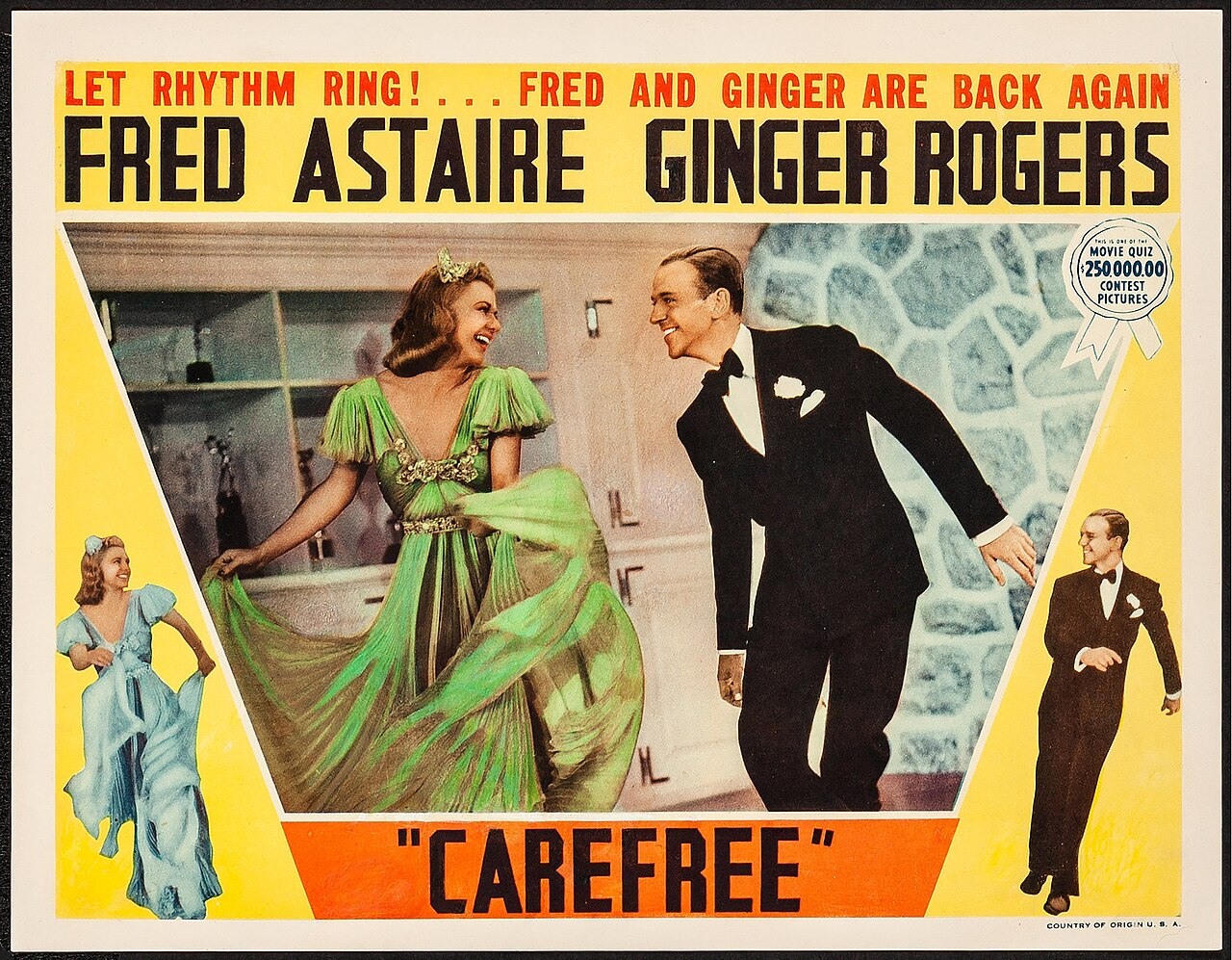 Lobby card for Carefree (1938). Image credit: RKO Radio Pictures / Public domain, via Wikimedia Commons.
Astaire plays psychiatrist Tony Flagg, asked to analyse Rogers’s Amanda Cooper because she cannot commit to marrying his friend, played by Ralph Bellamy. The premise gives Rogers permission to be emotionally direct and Astaire permission to appear professionally ridiculous. Tony’s methods are absurd, and Amanda’s resistance gradually looks more sensible than his expertise.
The dream sequence for “I Used to Be Color Blind” uses slow motion to turn movement into romantic suspension, while “The Yam” lets Rogers drive the social energy. At just over 80 minutes, the film is shorter and less musically abundant than their great RKO pictures. That relative sparseness makes the character comedy easier to notice. Rogers is especially good when hypnosis frees Amanda to say and do exactly what polite courtship has concealed. We ranked it seventh because the story’s psychology is nonsense, but the performers use that nonsense to reverse their usual balance of control.
Best for: devoted fans interested in the duo trying a stranger comic premise.
6. Roberta (1935)
Irene Dunne and Randolph Scott technically lead this adaptation of the stage musical, but Astaire’s bandleader Huck Haines and Rogers’s singer Lizzie Gatz supply much of its personality. Rogers performs comedy, romance and a playful imitation of Polish sophistication, while the Jerome Kern score gives the film lasting musical strength.
Because Astaire and Rogers are not solely responsible for the plot, the film sometimes asks us to wait for their return. The reward is substantial. “I’ll Be Hard to Handle” has the relaxed intimacy of two performers amusing each other, and “Smoke Gets in Your Eyes” gives Dunne one of the film’s finest moments.
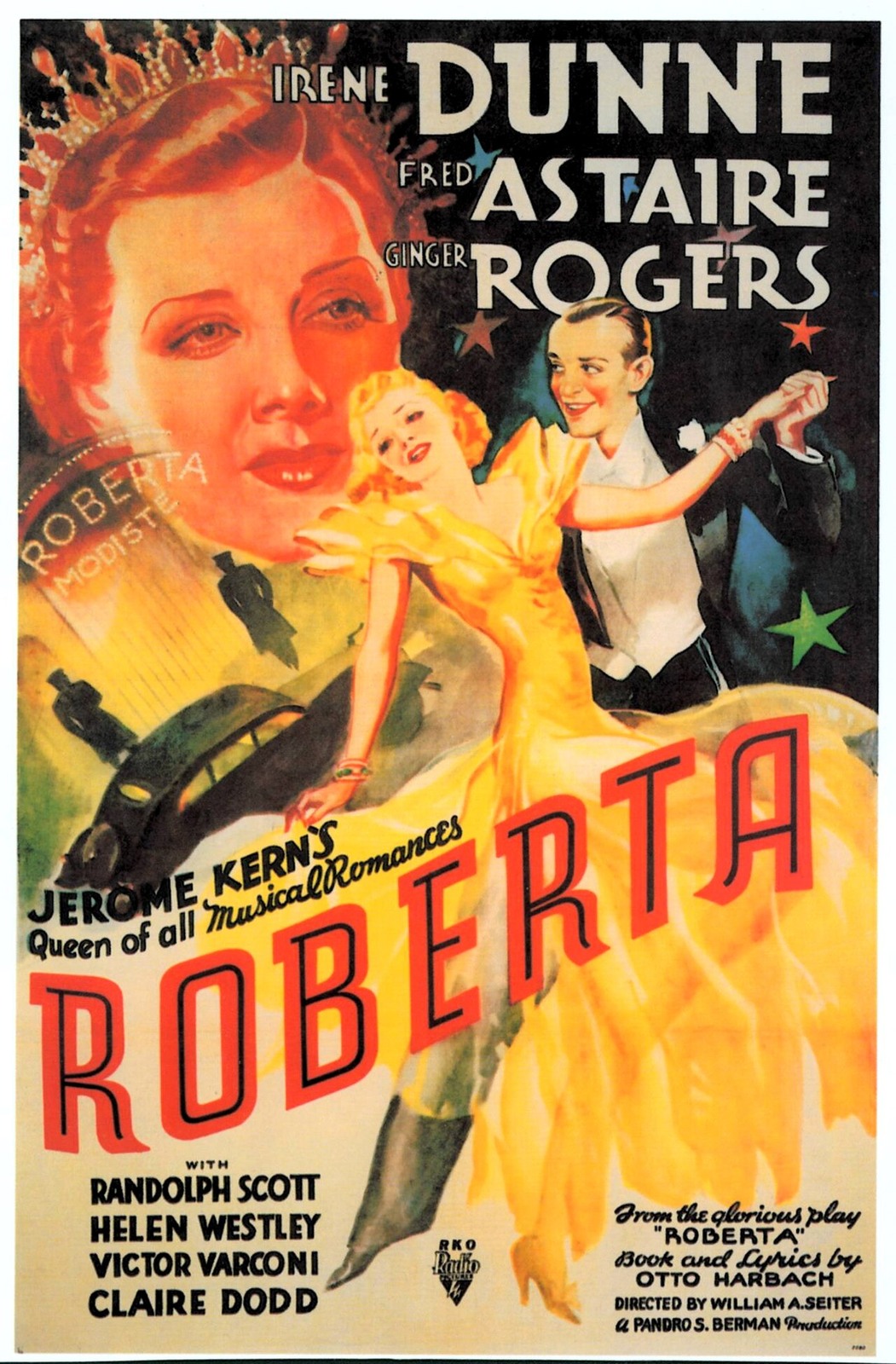 Theatrical poster for Roberta (1935). Image credit: RKO / Public domain, via Wikimedia Commons.
The film belongs partly to Irene Dunne and Randolph Scott, whose romance and Jerome Kern songs provide a more traditional operetta centre. Astaire’s Huck and Rogers’s Countess Scharwenka—actually his old friend Lizzie—enter with a looser, more American rhythm. Their informality cuts through the Paris fashion-house setting and keeps elegance from becoming stiffness.
“I’ll Be Hard to Handle” is the essential number. It begins like playful rehearsal, with both dancers appearing to invent challenges for the other, and develops into one of their most joyful conversations. Rogers’s comic performance outside the dances is equally valuable; Lizzie’s manufactured aristocratic persona gives her accents, attitude and a secret she enjoys controlling. The plot has more threads than it needs, but the supporting status works in the pair’s favour. They can arrive, energise the film and leave before the operetta machinery demands another misunderstanding.
Best for: an ensemble musical in which the supporting couple repeatedly steals the picture.
5. Follow the Fleet (1936)
Astaire is sailor Bake Baker; Rogers is his former partner Sherry Martin, now trying to build a performing career. Randolph Scott and Harriet Hilliard carry a second romance, while Irving Berlin provides the score.
The naval comedy around the dances is variable, but the best numbers are major. “Let Yourself Go” gives Rogers force and swing, and “Let’s Face the Music and Dance” turns a dark theatrical scenario into controlled romantic motion. The film also lets Sherry have professional ambition rather than functioning only as somebody to be pursued.
 Ginger Rogers and Fred Astaire in Follow the Fleet publicity still Image credit: Unknown author / Public domain, via Wikimedia Commons.
Astaire’s Bake Baker is a sailor and former dance partner who wants another chance with Rogers’s Sherry Martin. Their reunion is not built on aristocratic mistaken identity but on bruised professional history. Sherry is working, hoping for a break and wary of trusting a man whose charm previously proved unreliable. Rogers gives the romantic hesitation more practical weight than the naval comedy around it.
The film alternates between bustling ensemble numbers and the extraordinary restraint of “Let’s Face the Music and Dance.” Dressed in black, the pair move through a story of despair, rescue and temporary escape without needing the dialogue to explain it. “Let Yourself Go” shows Rogers commanding a different kind of public energy, while Harriet Hilliard and Randolph Scott carry the secondary romance. The plot wanders and some service comedy has dated, but the best numbers reveal how readily Astaire and Rogers could create emotional atmosphere inside a film that rarely sustains one elsewhere.
Best for: viewers who value Rogers as a singer and actor as much as a dance partner.
4. Shall We Dance (1937)
George Gershwin’s music, Ira Gershwin’s lyrics and a story about ballet dancer Peter Peters falling for musical-comedy star Linda Keene produce a film full of excellent individual pleasures. Astaire taps in a ship’s engine room; the pair dance on roller skates to “Let’s Call the Whole Thing Off”; “They Can’t Take That Away from Me” becomes one of their defining songs.
The mistaken-marriage plot is overcomplicated, and the film withholds a conventional dance duet from that last great song. Still, the combination of industrial settings, modern transport and Gershwin sophistication makes this one of their most varied pictures.
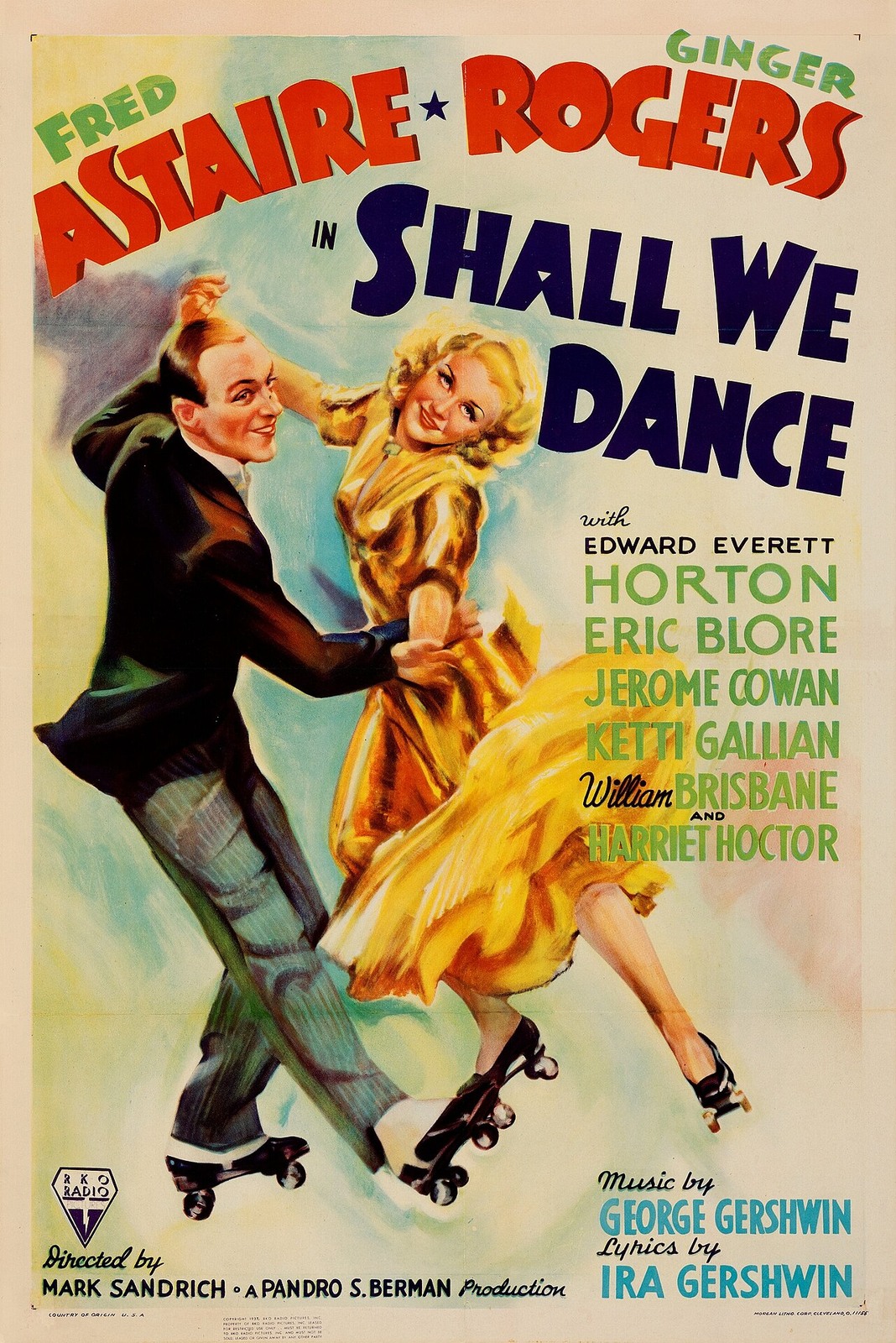 Theatrical poster for Shall We Dance (1937). Image credit: “©1937 RKO Radio Pictures, Inc. .” / Public domain, via Wikimedia Commons.
The ballet-versus-tap premise makes Astaire’s style part of the story. Peter Peters is an American dancer presented to Europe as a Russian ballet star, while Rogers’s Linda Keene wants to escape the publicity machinery surrounding her. Rumours of a secret marriage then become so persistent that the couple must consider whether reality can catch up with the headline.
George and Ira Gershwin’s score gives the film an embarrassment of riches. “They All Laughed” turns disbelief into flirtation, “Let’s Call the Whole Thing Off” puts the argument on roller skates and “They Can’t Take That Away from Me” pauses the machinery for quiet regret. The ocean-liner setting and mechanical engine-room rhythm encourage experiments in sound and movement. The plot eventually ties itself into exhausting knots, but the musical ideas keep opening clear spaces. Astaire and Rogers are never more appealing than when the screenplay stops explaining why they should dance.
Best for: Gershwin songs, roller skates and a team confident enough to change its settings.
3. The Gay Divorcee (1934)
This was the first film built as an Astaire–Rogers starring vehicle. Astaire’s Guy Holden falls for Rogers’s Mimi, who is trying to arrange a staged act of adultery so that she can obtain a divorce. Mistaken identity ensures that Guy is confused with the hired correspondent.
The plot has the happy irresponsibility of screwball comedy, and the supporting players—Edward Everett Horton, Alice Brady, Erik Rhodes and Eric Blore—help create the world the series would refine. “Night and Day” establishes dance as romantic conversation; the huge “Continental” finale turns private attraction into public spectacle.
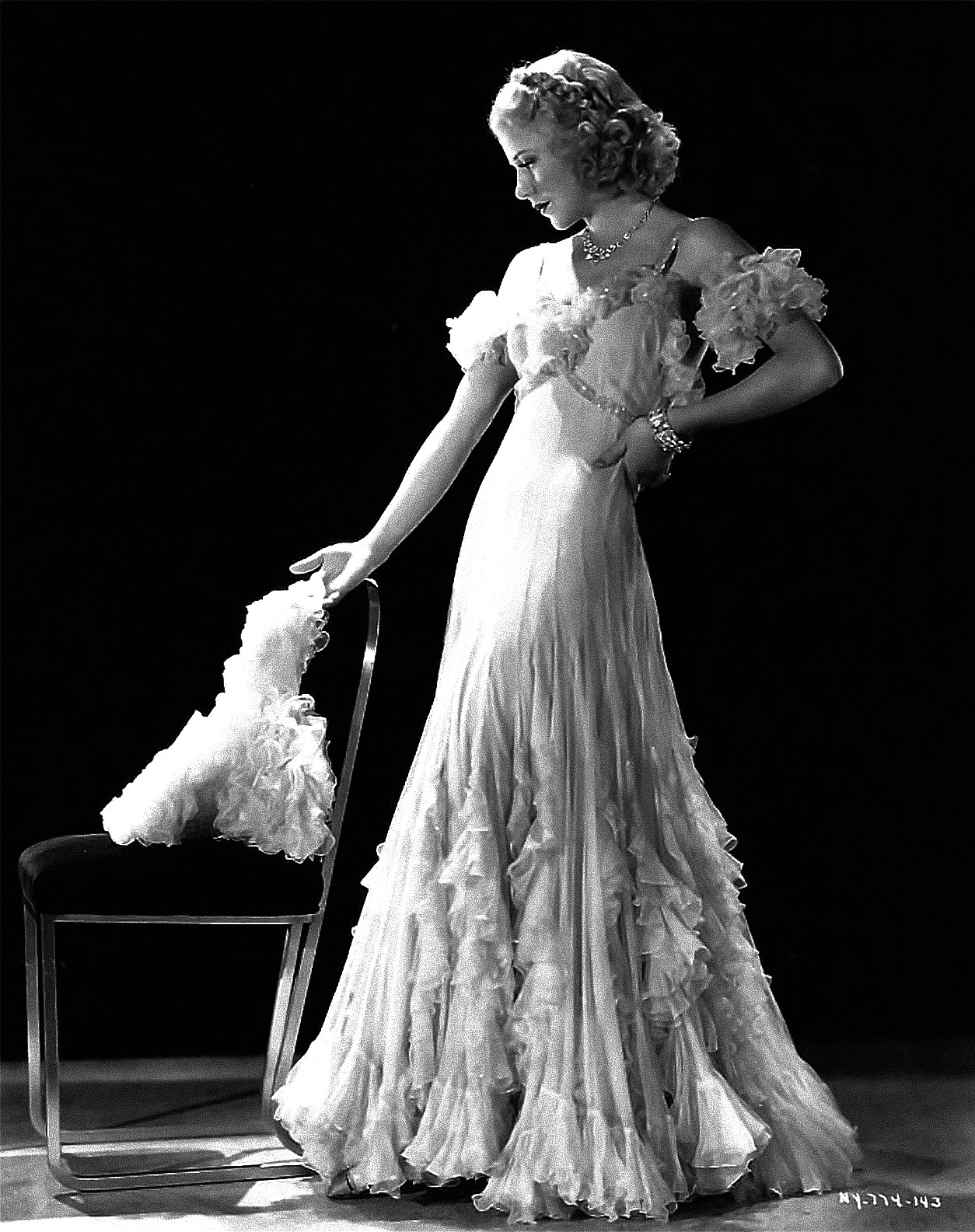 Ginger Rogers in a Walter Plunkett dress during filming of The Gay Divorcee (1934). Image credit: Unknown. / Public domain, via Wikimedia Commons.
Hollywood altered the title of Astaire’s stage hit Gay Divorce because censors could accept a divorcee more readily than the idea that divorce itself might be cheerful. The absurdity is perfectly matched by a plot involving co-respondents, hotel rooms and a series of people confidently mistaking one arrangement for another. Edward Everett Horton, Alice Brady and Eric Blore turn confusion into an ensemble profession.
“Night and Day” establishes the romantic method the later films would refine. Astaire pursues through dance, Rogers resists without withdrawing and the number becomes a negotiation in which physical agreement arrives before verbal trust. “The Continental” expands that intimacy into a large-scale production number. Rogers’s comic authority is already crucial: she does not simply receive Astaire’s elegance but tests whether it deserves her attention. The film runs longer than its plot can comfortably support, yet it is the first feature built around the partnership and still feels thrilled by the discovery.
Best for: the moment the partnership becomes a complete screen formula.
2. Top Hat (1935)
If somebody asked for the most recognisable Astaire–Rogers film, this would be the answer. Astaire is Jerry Travers, Rogers is Dale Tremont, and a mistaken identity convinces her that the man pursuing her is married to her friend. The misunderstanding is prolonged with such elegance that logic becomes beside the point.
Irving Berlin’s score includes “No Strings”, “Isn’t This a Lovely Day?”, “Top Hat, White Tie and Tails” and “Cheek to Cheek”. The white gown, black tails and gleaming fantasy of Venice have become the visual shorthand for the pair. Rogers also makes Dale’s anger funny without allowing the character to seem foolish; from her information, the outrage is entirely reasonable.
We rank it second by the smallest margin. Top Hat is the polished ideal. Swing Time lets a little more human feeling disturb the polish.
 Lobby card for Top Hat (1935). Image credit: RKO / Public domain, via Wikimedia Commons.
The opening hotel sequence tells us almost everything about Astaire’s Jerry Travers. Unable to sleep, he dances in the room above Rogers’s Dale Tremont and treats the disturbance as a charming introduction. Dale’s anger is entirely reasonable; Jerry’s confidence is impossible; their rhythm begins in the argument between those facts. Mark Sandrich directs the luxury world around them like a perfectly polished toy.
Irving Berlin’s score then keeps finding new forms for personality. “Top Hat, White Tie and Tails” lets Astaire turn formalwear into attack, while “Cheek to Cheek” gives Rogers’s feathered gown and yielding movement an almost dreamlike softness. The mistaken-identity plot is foolish even by the series’ standards, but Horton, Blore and Helen Broderick make foolishness elegant. What matters is the visual confidence: white sets, black clothes, rain, canals and movement organised so clearly that romance seems to have designed the architecture.
Best for: the definitive Art Deco Astaire–Rogers fantasy.
1. Swing Time (1936)
Astaire plays Lucky Garnett, a dancer and gambler sent to New York to earn enough money to marry his fiancée. He meets Rogers’s dance instructor Penny Carroll and immediately complicates every promise he has made. George Stevens directs, Jerome Kern supplies the music and Dorothy Fields the lyrics.
“Pick Yourself Up” allows attraction to emerge through teaching and pretence. “A Fine Romance” lets the pair sing frustration at each other. “Never Gonna Dance” turns romantic loss into a climb, fall and return across one vast set. Rogers is funny, wounded and completely present inside the dancing; Astaire’s virtuosity never turns her into decoration.
The film includes Astaire’s “Bojangles of Harlem” number in blackface, which modern viewers should approach with historical context rather than pretending it is not there. That serious flaw prevents an uncomplicated recommendation. We still rank the film first because the central partnership reaches its richest emotional and musical expression. Top Hat presents the dream. Swing Time lets us feel what the dream costs.
 Lobby card for Swing Time (1936). Image credit: RKO / Public domain, via Wikimedia Commons.
George Stevens gives the film a slightly more grounded emotional texture than the brightest RKO fantasies. Lucky Garnett arrives in New York after gambling and delay have complicated his engagement; Penny Carroll meets him through irritation, work and gradually undeniable partnership. Rogers makes Penny’s professional pride central. She does not exist simply to redirect Lucky’s romantic destiny.
Jerome Kern and Dorothy Fields provide songs that understand mixed feeling. “A Fine Romance” turns frustration into duet, “Pick Yourself Up” makes teaching become courtship and “Never Gonna Dance” builds romantic defeat into a soaring ascent through the set. The “Bojangles of Harlem” number contains blackface and must be viewed within the racist performance history it invokes, even while its choreography and shadow effects remain formally ambitious. That contradiction belongs in any honest appreciation. We rank Swing Time first because the dances do not decorate the relationship; they reveal every stage of it.
Best for: the most complete mixture of dance, romance, music and feeling in the series.
The best order for first-time viewers
Start with Top Hat. Its plot, design and Irving Berlin songs offer the cleanest introduction to the team’s public image. Then watch Swing Time to see the partnership deepen, followed by The Gay Divorcee to understand how the starring formula began.
After that, choose by taste. Try Shall We Dance for Gershwin, Follow the Fleet for a slightly less rarefied world or The Story of Vernon and Irene Castle for drama.
Why did Astaire and Rogers work so well together?
Astaire’s screen characters often pursue control. Rogers’s characters make him earn it. She could look amused, sceptical or angry while keeping the dance perfectly balanced, which gives the romance resistance. We do not merely watch two people perform the same steps. We watch a negotiation.
The supporting casts matter too. Edward Everett Horton, Eric Blore, Helen Broderick, Victor Moore and others create comic spaces in which the central couple can separate and return. The RKO design teams then place that human rhythm inside worlds that seem built from white curves, black floors and impossible amounts of room.
Final thoughts
Ranking these ten films means separating works designed to feel inseparable. Songs migrate in memory, dresses and sets blend together, and a gesture from one film seems to answer a step from another. That continuity is part of their achievement.
Begin with Top Hat or Swing Time, but do not reduce the partnership to two titles. Even the uneven films contain minutes when movement becomes conversation and a studio fantasy suddenly feels personal.
Frequently asked questions
What is the best Fred Astaire and Ginger Rogers movie?
We rank Swing Time first, with Top Hat an extremely close second. Beginners may find Top Hat the easier introduction.
What was the first Astaire and Rogers film?
They first appeared together in Flying Down to Rio (1933), although Dolores del Río and Gene Raymond were the leading romantic couple.
What was their final movie together?
The Barkleys of Broadway (1949) was their tenth and last film together, as well as their only feature in colour.