Ginger Rogers : Personal Info
Birth name : Virginia Katherine McMath
Born : 16 July 1911, Independence, Missouri
Died : 25 April 1995, Rancho Mirage, California
Nationality : American
Occupations : Actress, dancer, singer
Years active : 1925–1987
Known for : 42nd Street, Top Hat, Swing Time, Stage Door, Bachelor Mother, Kitty Foyle
Major honours : Academy Award for Best Actress for Kitty Foyle; Kennedy Center Honor
Ginger Rogers : Introduction
Ginger Rogers is permanently linked with Fred Astaire, but she was never simply the other half of a dance team. She was a sharp comedian, an assured singer and an Oscar-winning dramatic actress who made more than seventy films.
What Rogers brought to the Astaire partnership was not just the ability to follow intricate choreography. She gave the dances a story. A glance could turn technical perfection into flirtation, resistance or reconciliation.
Her larger career confirms the point. Rogers could move from backstage musicals to working-woman dramas and sophisticated comedy without losing the directness that made audiences trust her.
 Ginger Rogers in a 1930s studio portrait.
Ginger Rogers : Childhood and Early Performance
Virginia Katherine McMath was born in Independence, Missouri, and raised largely in Texas. “Ginger” grew from a childhood attempt to pronounce Virginia.
Her mother, Lela, became a powerful presence in her life and career. Rogers entered a Charleston contest as a teenager, won, and toured with an act billed as Ginger and the Redheads.
Vaudeville taught her to make an impression quickly. Broadway followed. In 1930 she appeared in the Gershwins’ Girl Crazy, a success that placed her among the promising young musical performers heading towards film.
Early Hollywood and 42nd Street
Rogers worked rapidly after arriving in Hollywood, often in supporting parts. Her brassy “Anytime Annie” in 42nd Street and wisecracking singer in Gold Diggers of 1933 showed how much character she could establish with a few lines.
She was modern without seeming brittle. Even when playing chorus girls who understood the economics of show business, Rogers kept humour and optimism in view.
Then RKO paired her with Fred Astaire in Flying Down to Rio. They were not the nominal stars, but “The Carioca” made their chemistry the film’s discovery.
Ginger Rogers and Fred Astaire
Rogers and Astaire made nine films together at RKO between 1933 and 1939, followed by a reunion in The Barkleys of Broadway a decade later. The plots changed less than the settings: attraction met misunderstanding, and dancing expressed what dialogue delayed.
In Top Hat, “Cheek to Cheek” begins as persuasion and becomes surrender. In Swing Time, “Never Gonna Dance” carries the sadness of a relationship that appears to be ending. Rogers’s acting gives each number its emotional temperature.
The labour was severe. Rehearsals were long, and shoes and elaborate gowns created practical difficulties invisible in the finished films. Yet Rogers made precision look like an immediate response to her partner.
The familiar claim that she did everything Astaire did “backwards and in high heels” was not coined by Rogers, and it simplifies how dance partnerships work. Her real contribution was more interesting: she made virtuosity feel human.
 Ginger Rogers in a publicity portrait for Tender Comrade (1943).
Beyond the Partnership
Rogers worked hard to keep the Astaire films from defining her limits. Stage Door placed her among a superb female ensemble, trading fast dialogue with Katharine Hepburn while revealing the anxiety beneath a performer’s confidence.
In Vivacious Lady, she and James Stewart made impulsive marriage feel both romantic and practically inconvenient. Bachelor Mother used her comic realism to ground an increasingly absurd misunderstanding about an abandoned baby.
These films show a performer who listened. Rogers did not wait decoratively for the next joke; she reacted, challenged and changed the rhythm of a scene.
Kitty Foyle and an Academy Award
Kitty Foyle offered Rogers a dramatic role as a working woman caught between love, class and independence. The film’s treatment of social choice now reflects its period, but Rogers’s emotional clarity still carries it.
She won the 1941 Academy Award for Best Actress, ahead of a formidable field that included Bette Davis and Katharine Hepburn. The award confirmed that Hollywood recognised a range audiences had already seen.
Rogers followed it with films including Tom, Dick and Harry, The Major and the Minor and I’ll Be Seeing You. Billy Wilder’s The Major and the Minor required a far-fetched disguise, but her alert comic intelligence kept the film moving.
Marriage and Private Life
Rogers married five times. Her husbands included actor Lew Ayres and Jacques Bergerac; none of the marriages produced children.
She remained especially close to her mother, whose business involvement and political views sometimes attracted controversy. Rogers herself became identified with conservative causes later in life.
Her private history did not fit the romantic resolution of her musicals. That contrast may have sharpened the practicality she brought to screen romance: her heroines usually knew that charm alone would not organise a life.
Later Career and the Stage
Changing audience tastes reduced the quality of Rogers’s film opportunities during the 1950s. She nevertheless found notable roles, including the older actress targeted by a younger admirer in Black Widow.
In 1965 she succeeded Carol Channing in the Broadway production of Hello, Dolly! and later toured extensively. She also appeared in the London musical Mame.
Television, theatre and public appearances kept her connected to audiences. Her last screen acting role came in the 1980s, and she received a Kennedy Center Honor in 1992.
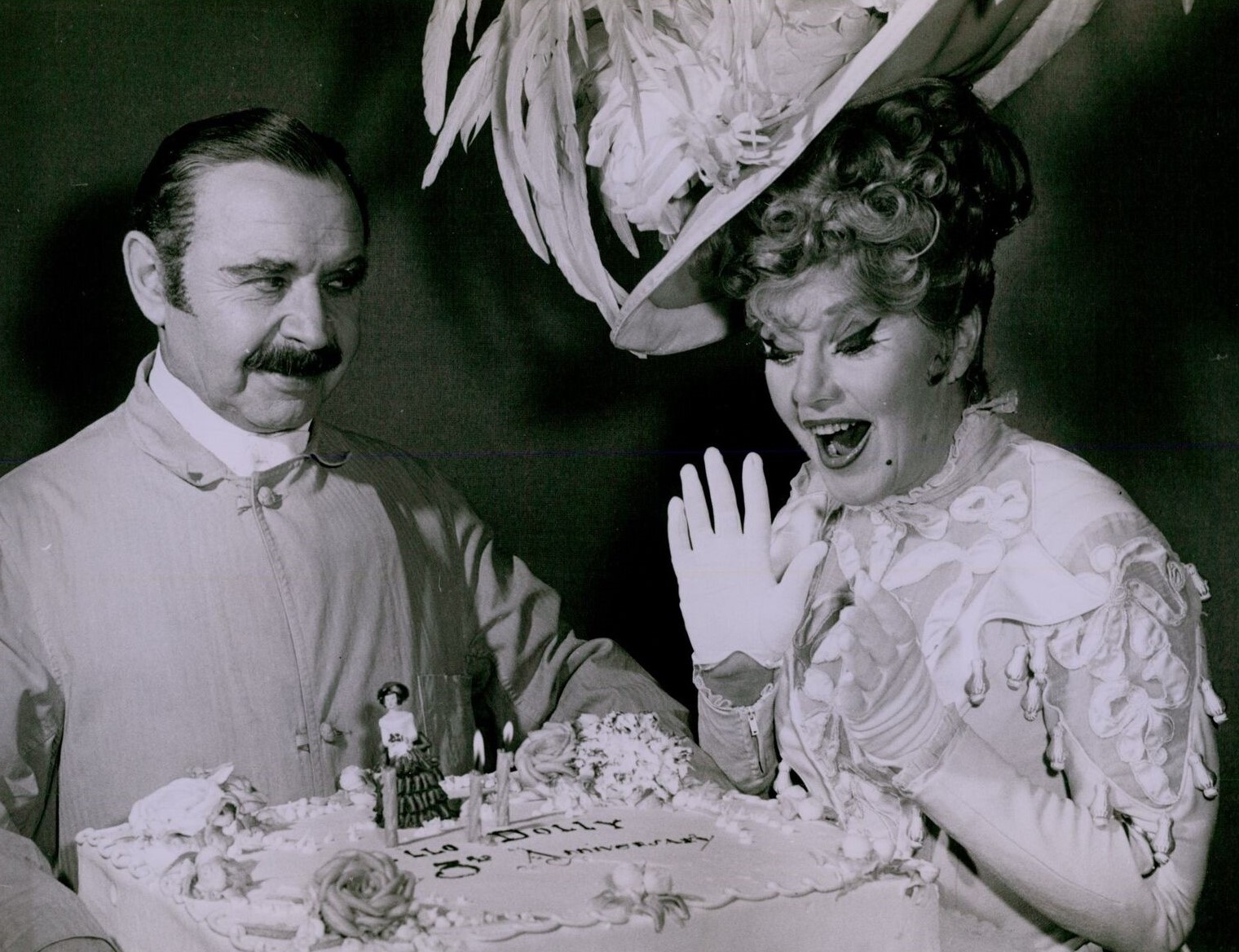 Ginger Rogers with David Burns during the Broadway run of Hello, Dolly!
Ginger Rogers : Death and Legacy
Rogers died in 1995 at the age of 83. By then the Astaire-Rogers films had become central texts in the history of the Hollywood musical.
Their partnership deserves its fame, but viewing Rogers only through it diminishes both artists. Astaire needed a partner who could match the steps and create a believable emotional exchange. Rogers did that while carrying an independent career in comedy and drama.
Her best performances share a quality that dance training intensified: exact timing that never feels mechanical. Whether crossing a ballroom or delivering a skeptical reply, she knows precisely when to hold back and when to move.
Selected Ginger Rogers Filmography
1933 – 42nd Street : Memorable early musical supporting role
1933 – Flying Down to Rio : First screen pairing with Fred Astaire
1935 – Top Hat : Elegant peak of the RKO partnership
1936 – Swing Time : Romantic musical with exceptional dance storytelling
1937 – Stage Door : Strong ensemble comedy-drama performance
1938 – Vivacious Lady : Fast romantic comedy with James Stewart
1939 – Bachelor Mother : Warm mistaken-identity comedy
1940 – Kitty Foyle : Academy Award-winning dramatic role
1942 – The Major and the Minor : Billy Wilder comedy
1949 – The Barkleys of Broadway : Final film with Astaire
Ginger Rogers : Frequently Asked Questions
How many films did Ginger Rogers make with Fred Astaire?
They made ten films together: nine at RKO in the 1930s and the MGM reunion The Barkleys of Broadway in 1949.
Did Ginger Rogers win an Oscar?
Yes. She won Best Actress for Kitty Foyle, a dramatic performance unrelated to her films with Astaire.
What Ginger Rogers film should a beginner watch first?
Top Hat is the clearest introduction to the Astaire partnership. Bachelor Mother is an excellent choice for seeing her comic ability on its own.
Related Articles
Fred Astaire Biography
15 Essential Hollywood Musicals for Beginners
Career details and the scale of Rogers’s film work were checked against the Smithsonian’s biographical feature and the Academy’s collections record relating to her Kitty Foyle Oscar.