Barbara Stanwyck could make a line sound dangerous, wounded or extremely funny without changing her volume. That control is one reason her comedies remain such a pleasure. She did not abandon intelligence when a film asked her to be romantic, and she never treated comedy as an excuse to make a character foolish.
In this countdown we will rank ten Barbara Stanwyck comedies, moving from pleasant lesser-known films to two performances that belong near the top of any classic Hollywood watchlist. We are using “comedy” broadly enough to include romantic comedy, screwball farce, satire and comedy-drama. The question is not whether every scene tries to make us laugh. It is whether the film gives Stanwyck’s wit, timing and appetite for play somewhere to live.
 Barbara Stanwyck in a George Hurrell portrait published by Photoplay in June 1938. Image credit: George Hurrell / Photoplay, public domain.
How we chose and ranked the films
We considered the quality of the film, the importance of Stanwyck’s performance, how well the comedy has aged and how confidently we would recommend it to somebody watching her for the first time. A famous title does not automatically win, and a film with comic passages does not qualify if its real identity lies elsewhere.
That is why you will not find Double Indemnity smuggled onto the list because Phyllis Dietrichson occasionally has a dry line. These are films in which comedy shapes the experience.
The best Barbara Stanwyck comedies
10. The Bride Wore Boots (1946)
Stanwyck plays Sally Warren, a horse-loving wife whose husband Jeff, played by Robert Cummings, prefers writing books about the Civil War. Their incompatible enthusiasms create the marital problem; an old admirer and a glamorous book illustrator make it worse.
The film is lighter than its stars deserve and never finds the irresistible rhythm of the best remarriage comedies. Even so, Stanwyck gives Sally more sense than the plot. She understands that irritation and affection can occupy the same sentence, and the horse-country setting lets her bring an unforced physical confidence to the part.
The central joke has more bite than the finished film quite knows how to use. Sally understands horses instinctively, while Jeff studies heroic cavalry charges from the safety of a desk. She lives the physical confidence that his books turn into romance. Stanwyck makes that imbalance visible whenever Sally enters a stable or takes practical charge: this is her country, whatever the marriage contract may suggest.
Robert Cummings gives Jeff an appealingly distracted quality, and Diana Lynn adds pressure as the admiring illustrator who treats him like the great man he sometimes imagines himself to be. The screenplay repeatedly chooses contrivance when a sharper comedy might have explored two capable people speaking incompatible languages. Stanwyck supplies that missing sharpness in her reactions. She can show Sally’s jealousy, amusement and exasperated loyalty within a single exchange. The picture remains minor, but her performance suggests the better marital comedy hiding inside it.
Why watch it: a minor but agreeable example of Stanwyck making thin material feel inhabited.
9. You Belong to Me (1941)
Stanwyck is Dr Helen Hunt, a successful physician who marries wealthy playboy Peter Kirk, played by Henry Fonda. He soon discovers that being the idle husband of a busy doctor is not as comfortable as he expected. Jealousy follows, especially when Helen’s patients require attention at inconvenient hours.
The gender reversal gives the film its best idea. Stanwyck’s competence is never the joke; Peter’s inability to imagine a useful life becomes the problem. Some of the resolution retreats towards convention, but Stanwyck and Fonda make the negotiation warm and funny. Their chemistry is gentler here than in The Lady Eve, which makes the double bill revealing.
What keeps the film interesting is Helen’s refusal to apologise for competence. She can handle a medical emergency, speak frankly to male patients and return to work after marriage without behaving as though professional purpose were a temporary eccentricity. Stanwyck makes the doctor credible not through equipment or speeches but through attention: Helen looks directly at whoever needs her and expects the rest of the room to adjust.
Fonda has the harder comic task. Peter’s jealousy could make him merely tiresome, so Fonda leans into the helplessness of a wealthy man who has never had to invent a useful day. His attempts at independence are funny because they reveal how little the world has demanded of him. The film ultimately reassures its period more than a modern viewer may want, but the argument along the way remains lively. Pair it with The Lady Eve and you can watch Stanwyck and Fonda reverse the balance of power without losing their ease together.
Why watch it: a marriage comedy built around a woman whose work genuinely matters.
8. Breakfast for Two (1937)
This brisk RKO comedy casts Stanwyck as Valentine Ransome, an heiress who decides that irresponsible playboy Jonathan Blair, played by Herbert Marshall, is the man she intends to marry. Unfortunately, he is broke, distracted and not yet aware that he has entered a campaign.
The plot borrows familiar screwball machinery: money trouble, strategic jealousy, social embarrassment and a heroine who moves faster than everybody around her. Stanwyck makes Valentine’s confidence attractive because she also lets us see the calculation. She is not waiting to be chosen. She is directing the comedy, even when the screenplay becomes more frantic than sharp.
Valentine’s pursuit is comic because she approaches romance like a hostile takeover conducted with perfect manners. She has money, a plan and the ability to recognise that Jonathan’s charm will not survive indefinitely without discipline. Stanwyck never asks us to mistake determination for desperation. Valentine wants this particular man, but she is also fascinated by the project of making him worthy of the choice.
Herbert Marshall’s dry reserve prevents the battle from becoming shrill, while Eric Blore and Glenda Farrell bring the sort of professional comic detail that can make a thin screwball plot feel densely inhabited. The film moves quickly enough to disguise some arbitrary turns, and its ideas about “reforming” a playboy are hardly unique. What distinguishes it is the pleasure Stanwyck takes in command. Long before the romantic resolution, she has already won the more important contest: the story belongs to the woman doing the choosing.
Why watch it: Stanwyck as the active force in a compact, underseen romantic farce.
7. Lady of Burlesque (1943)
Based on Gypsy Rose Lee’s mystery novel The G-String Murders, this unusual mixture of backstage comedy, musical performance and murder mystery lets Stanwyck play burlesque star Dixie Daisy. When performers begin turning up dead, the dressing-room rivalries acquire a darker edge.
The tones do not always fit neatly together, but that is part of the fascination. Stanwyck had danced on stage before Hollywood, and the film lets her use the directness and physical assurance of a performer who knows how an audience works. She is funny with the company, convincing in the musical numbers and alert enough to keep the mystery moving.
 Screenshot of Barbara Stanwyck from the film Lady of Burlesque . Image credit: Film screenshot / Public domain, via Wikimedia Commons.
The backstage setting gives the film a texture few studio mysteries possess. Performers tease one another, protect their territory, endure uncomfortable costumes and keep a show moving while resentment travels through the dressing rooms. Stanwyck understands that working atmosphere. She had been a chorus girl before films, and Dixie handles the theatre like somebody who knows that glamour is produced by labour, timing and a willingness to carry on when conditions are ridiculous.
Director William A. Wellman lets comedy arise from professional friction rather than treating the burlesque company as an exotic display. When the murders intrude, the same rivalries become possible motives, which is why the tonal mixture works better than its description suggests. Stanwyck’s dance numbers are energetic, but her best moments may be the practical ones: sizing up a colleague, resisting Michael O’Shea’s good-natured pressure or turning fear into another problem to solve. The film is not a polished whodunit, yet it gives her an unusually complete working woman.
Why watch it: the most eccentric genre blend on this list and a reminder of Stanwyck’s stage roots.
6. The Mad Miss Manton (1938)
Stanwyck’s wealthy socialite Melsa Manton discovers a body, reports it and then finds that the evidence has disappeared. When the police dismiss her, she recruits her circle of debutante friends to investigate. Henry Fonda plays the newspaper editor who ridicules Melsa before becoming fascinated by her.
The mystery is deliberately breathless, and the group of amateur detectives creates a cheerful form of organised chaos. Stanwyck is very good at treating Melsa’s certainty as both comic and justified. The film is not as elegant as the great screwballs, but it gives her a heroine who acts first, argues well and refuses to become embarrassed merely because men think she should.
Melsa’s friends are not passive society ornaments. Once the police decide wealthy young women cannot possibly understand evidence, the group turns its freedom, cars and social access into investigative tools. The results are chaotic, but the premise gives Stanwyck a comic army and makes the authorities’ condescension part of the joke. She leads by moving first and trusting everybody else to catch up.
This was Stanwyck’s first film with Henry Fonda, and their contrast is already useful. His Peter Ames relies on scepticism and a newspaper editor’s superior pose; her Melsa keeps producing facts that force him to revise the story. Their romance grows from argumentative curiosity rather than instant softness. The mystery does not withstand much logical inspection, but director Leigh Jason keeps scenes moving before the machinery can stall. For viewers who love amateur-detective comedies, it offers the unusual pleasure of a whole female friendship group refusing to leave the danger to professionals.
Why watch it: a lively mystery-comedy with Stanwyck leading her own investigative team.
5. Meet John Doe (1941)
Frank Capra’s film begins as a newspaper satire. Stanwyck plays reporter Ann Mitchell, who invents a letter from a fictional “John Doe” threatening to protest a corrupt society. When the story catches public imagination, unemployed ballplayer Long John Willoughby, played by Gary Cooper, is hired to embody the invented man.
The film grows darker and more earnest as a cynical publicity stunt becomes a political movement. Stanwyck moves with it. Ann is funny when she is improvising faster than her editors, moving when she begins to believe what she has helped create and painfully clear-eyed when power takes control. It sits at the edge of our comedy definition, but leaving it out would ignore one of her richest performances.
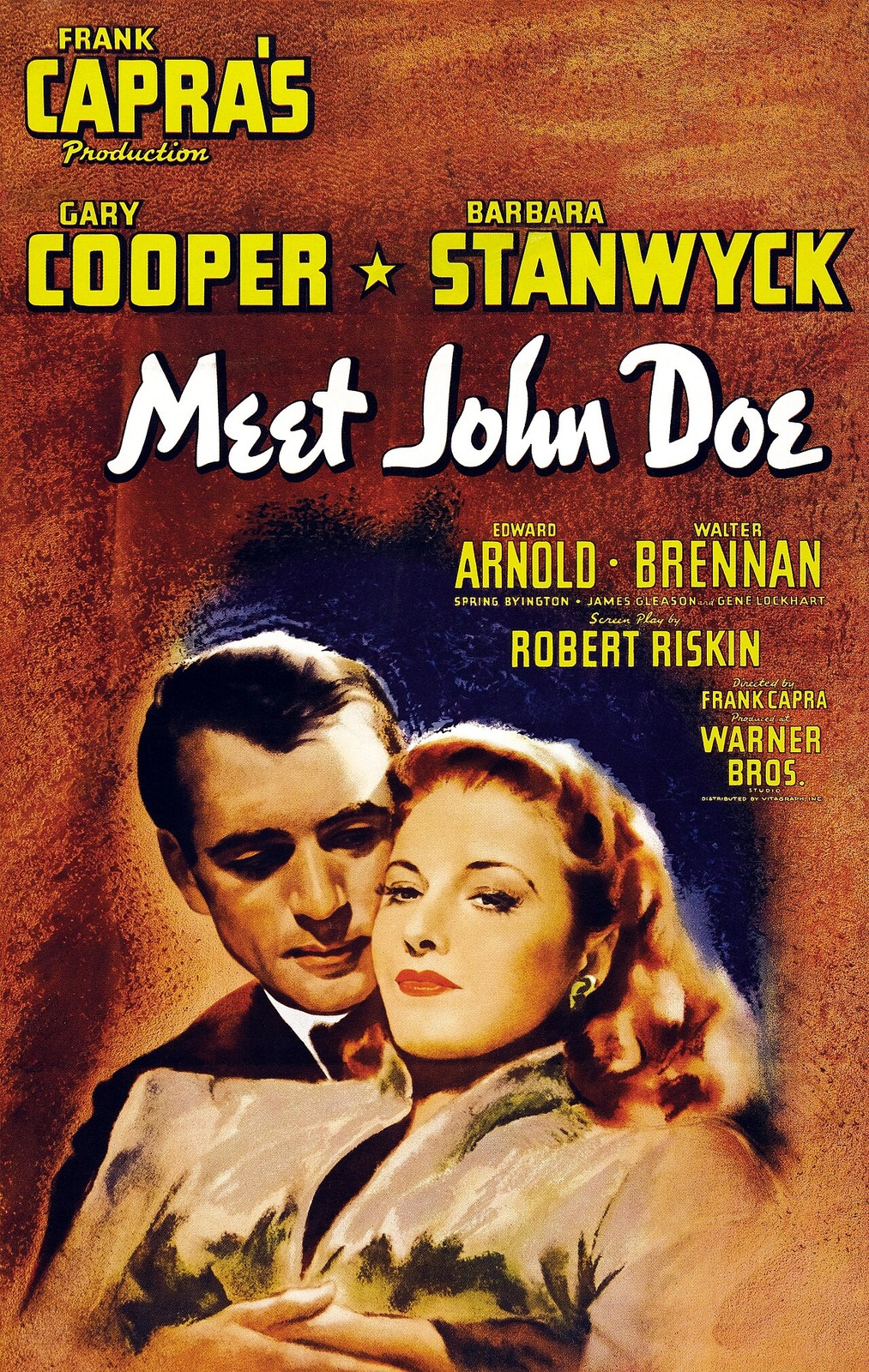 Theatrical poster for Meet John Doe (1941). Image credit: Employee(s) of Warner Bros. / Public domain, via Wikimedia Commons.
Ann Mitchell is one of Stanwyck’s most complicated fast talkers because the improvisation has consequences. At first, inventing John Doe is a survival tactic by a reporter who has just lost her job. Success then rewards every compromise. Stanwyck lets us see Ann’s professional excitement before moral alarm catches up with it; the character does not become innocent merely because the movement grows larger than her scheme.
Gary Cooper’s stillness gives the film a necessary centre, while Walter Brennan’s distrustful outsider keeps puncturing the pageantry. Edward Arnold, as the wealthy political operator who sees how the John Doe clubs might be used, introduces a chill that gradually changes the genre. Capra’s mixture of comedy, populist feeling and nightmare can be uneven, but the unevenness is part of its urgency. Stanwyck holds it together because Ann can speak the language of every world in the film: newsroom cynicism, advertising spectacle, private remorse and a belief she is almost afraid to admit.
Why watch it: social comedy with an increasingly serious moral argument.
4. Remember the Night (1940)
Stanwyck plays Lee Leander, a shoplifter being prosecuted by Fred MacMurray’s assistant district attorney John Sargent. When the trial is delayed over Christmas, John arranges her bail and, through a series of practical decisions, takes her home to Indiana with him.
The first section has the snap of a Preston Sturges script; the middle becomes one of classic Hollywood’s warmest Christmas stories; the ending acknowledges that affection cannot simply cancel responsibility. Stanwyck is the bridge between those tones. Her comedy comes from Lee’s intelligence and defensive speed, while her quieter reactions show what kindness costs somebody who has learnt not to expect it.
 Screenshot of Fred MacMurray and Barbara Stanwyck from the trailer for the film Remember the Night (1940). Image credit: Trailer screenshot / Public domain, via Wikimedia Commons.
The journey from New York to Indiana changes Lee and John because it removes them from the courtroom roles in which they first understand one another. At home, John becomes a son and neighbour rather than a prosecutor. Lee experiences a family whose kindness is not a bargain. Stanwyck’s most affecting reactions are often silent: she watches Beulah Bondi’s generous mother and understands both the invitation and the life she has missed.
Mitchell Leisen’s direction gives the Christmas section room to breathe, while Preston Sturges’s screenplay keeps a hard edge beneath the warmth. Lee has committed a crime; John has professional power over her; neither fact disappears because they fall in love. Fred MacMurray is excellent at allowing duty to complicate decency without turning John cold. The comedy therefore matters. It lets the couple discover ease together before the ending asks what that ease can honestly survive. Few holiday films earn their tenderness with such clear eyes.
Why watch it: a funny, tender and bittersweet Christmas film for viewers who dislike forced cheer.
3. Christmas in Connecticut (1945)
Elizabeth Lane is a celebrated magazine writer whose readers believe she lives on a farm, cooks beautifully and raises a baby. In reality, Stanwyck’s Elizabeth is a single New Yorker who cannot cook. When her publisher invites a returning war hero to spend Christmas at the fictional farm, she has to manufacture the entire domestic fantasy.
The premise gives Stanwyck an excellent comic problem: Elizabeth is capable at her actual job but hopeless at the role she sells to the public. She lies because the professional world rewards the lie, then keeps lying because the weekend will collapse if she stops. Sydney Greenstreet, S. Z. Sakall and Dennis Morgan help turn the deception into a generous ensemble comedy.
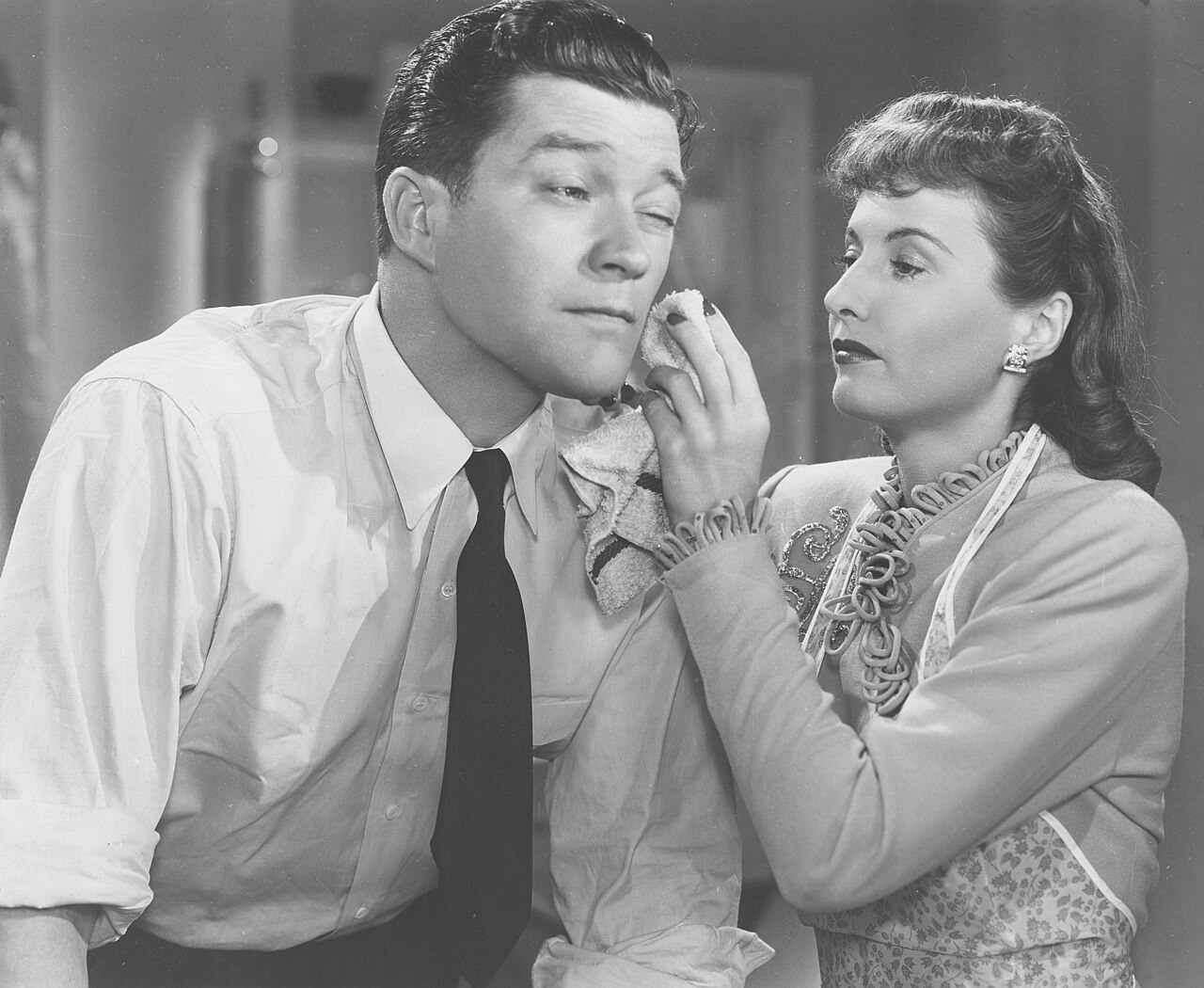 Image credit: Warner Brothers Pictures Distributing Corporation / Public domain, via Wikimedia Commons.
Elizabeth’s fraud is more than a useful farce premise. She has constructed a commercially successful version of domestic womanhood because the magazine industry values that persona more than her real urban intelligence. The supposedly authentic farm, baby and recipes are a brand campaign long before anybody used the term that way. Stanwyck makes Elizabeth good at the lie and increasingly exhausted by having to live inside it.
The supporting cast keeps the deception buoyant. S. Z. Sakall’s Felix supplies the cooking knowledge behind Elizabeth’s byline, Sydney Greenstreet’s publisher treats hospitality as an order and Dennis Morgan’s returning sailor is sincere enough to make the performance uncomfortable. The baby-swapping and kitchen disasters are funny, but Stanwyck’s attraction to the film lies in the collision between public expertise and private improvisation. Every time Elizabeth is asked to demonstrate “her” perfect life, we can see her calculating which part of the set might collapse next.
Why watch it: festive comfort, romantic confusion and a heroine trapped inside her own successful brand.
2. Ball of Fire (1941)
Howard Hawks places Stanwyck’s nightclub singer Sugarpuss O’Shea inside a house occupied by eight sheltered professors who are compiling an encyclopaedia. Gary Cooper’s Bertram Potts needs her knowledge of contemporary slang. She needs somewhere to hide from the police and her gangster boyfriend. Education immediately starts moving in both directions.
Stanwyck makes Sugarpuss quick, funny and socially fearless, but never reduces her to the colourful intruder who teaches dull men how to live. She watches the professors, recognises their decency and gradually confronts the limits of her own arrangement. Cooper’s reserve gives her energy something to play against. Their romantic scenes work because language itself becomes flirtation.
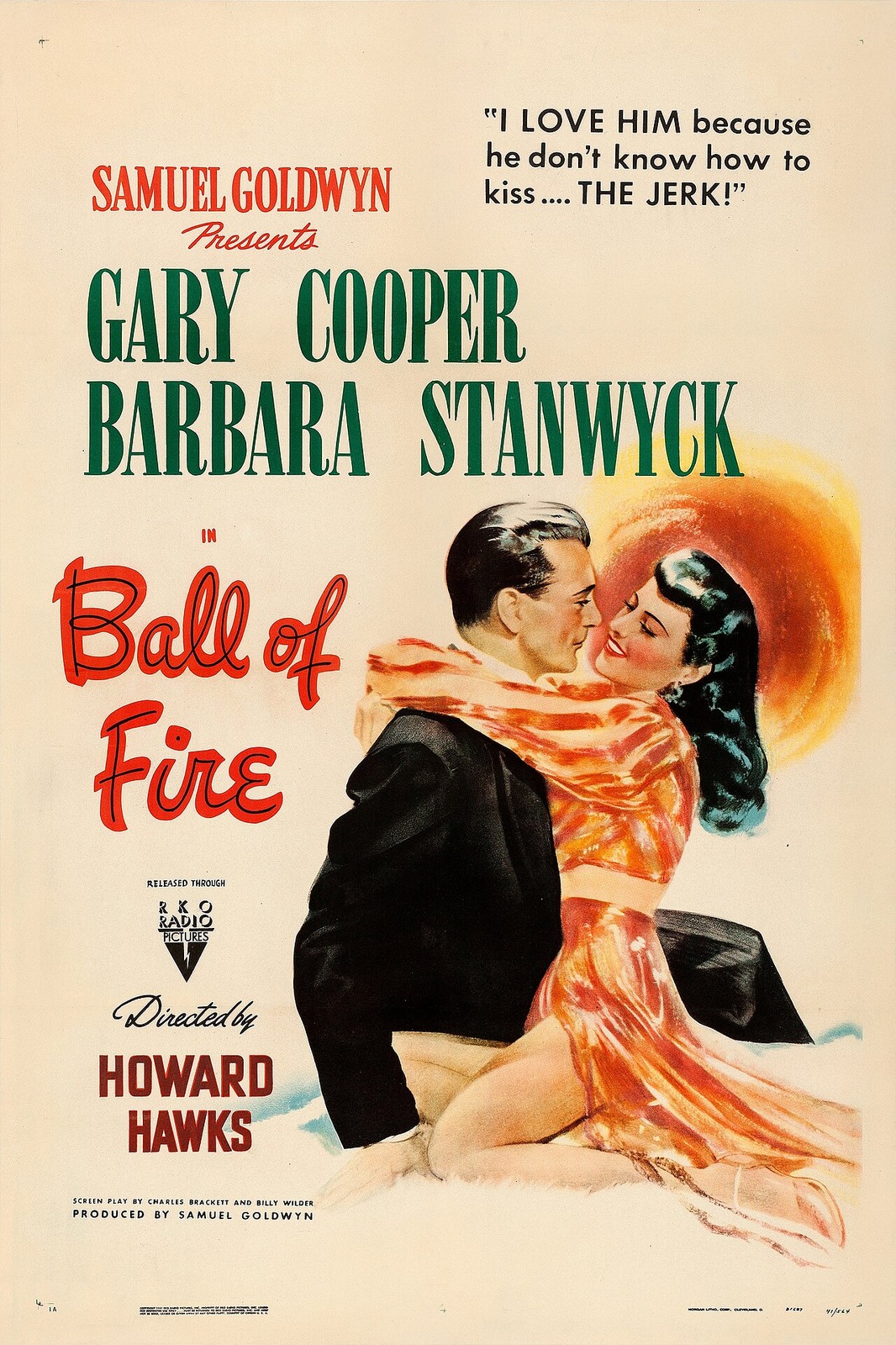 Theatrical poster for Ball of Fire (1941). Image credit: “Copyright 1941 RKO Radio Pictures, Inc. ” / Public domain, via Wikimedia Commons.
Billy Wilder and Charles Brackett’s screenplay turns slang into a record of living culture. Professor Potts believes language can be collected and defined; Sugarpuss knows it changes in clubs, jokes, flirtations and arguments before an academic can write it down. Stanwyck relishes the words, but she also shows how Sugarpuss uses them to control distance. A joke can charm the professors, hide fear from the police or prevent Potts from noticing that she is moved.
Howard Hawks surrounds the romance with a magnificent ensemble. Each professor has a recognisable rhythm, and the household gradually becomes a community without losing its comic precision. Gary Cooper wisely refuses to compete with Stanwyck’s speed. Potts’s literal seriousness makes her improvisation brighter, then gives the later emotional scenes their tenderness. Gene Krupa’s appearance and the nightclub energy expand the film beyond the study. What begins as a collision between knowledge and experience becomes an argument that each is incomplete without the other.
Why watch it: Stanwyck’s most generous comic performance and one of the finest examples of Hawksian ensemble rhythm.
1. The Lady Eve (1941)
Preston Sturges gives Stanwyck two identities and lets her dominate both. As card sharp Jean Harrington, she targets Henry Fonda’s shy brewery heir Charles Pike aboard an ocean liner. She falls for him, he discovers the con, and she returns as the aristocratic Lady Eve Sidwich to deliver an exquisitely complicated revenge.
The film understands that Jean is almost always the smartest person in the room. Stanwyck can make her seductive, bruised, furious and hilarious within the same sequence. Fonda’s gift for falling over furniture matters, but the deeper comedy comes from watching Jean direct Charles’s emotions while losing command of her own.
We ranked The Lady Eve above Ball of Fire because it uses even more of what Stanwyck could do. She controls the pace, changes character without losing emotional continuity and makes a farcical ending feel like a genuine romantic solution. For first-time viewers, this is the clearest answer to the claim that Barbara Stanwyck was “mainly” a dramatic actress.
 Theatrical poster for The Lady Eve (1941). Image credit: “Copyright 1941 by Paramount Pictures Inc. ” / Public domain, via Wikimedia Commons.
Preston Sturges builds the first half around looking. Jean studies Charles in a compact mirror while other women compete for his attention; he thinks he is entering a romance, but she has already edited the scene. Stanwyck makes observation seductive. We enjoy Jean’s professional control even as the performance begins to expose the genuine feeling that will make the con impossible to complete cleanly.
The second identity is not merely a disguise. Lady Eve is Jean’s anger transformed into theatre: an accent, a history and a campaign of exquisite humiliation. Fonda’s repeated falls are funny because Charles is emotionally off balance long before his body hits the furniture. Charles Coburn and Eric Blore understand the game and keep it moving with conspiratorial pleasure. The final train sequence returns every contradiction at once—revenge, desire, lies and recognition—then races towards a resolution too outrageous to be logical and too emotionally exact to resist. Stanwyck does not simply star in the comedy; she controls its weather.
Why watch it: one of the great screwball performances, full stop.
Where should a beginner start?
Start with The Lady Eve if you want the funniest and most complete display of Stanwyck’s comic skill. Choose Ball of Fire if you prefer a warmer ensemble and a slower romance. Save Remember the Night or Christmas in Connecticut for December, although neither needs the season to work.
For a three-film route, we would watch The Lady Eve, Ball of Fire and Christmas in Connecticut. They show the strategist, the romantic and the professional woman caught in a very funny lie.
What makes Barbara Stanwyck funny?
Stanwyck rarely asks us to laugh because her character lacks sense. She is funny because she has sense and the world keeps presenting her with people who do not. Her reactions arrive quickly, but they do not feel rehearsed. She can pause before a line, measure the person opposite her and make the response sound like it has just occurred to her.
She is also unusually good at protecting the emotional stakes inside farce. Jean Harrington’s revenge matters because Jean has been hurt. Sugarpuss’s slang matters because language is how she maintains control. Elizabeth Lane’s domestic disaster matters because her career depends on the performance. Stanwyck never forgets the reason behind the joke.
Final thoughts
If you know Barbara Stanwyck from Double Indemnity, Stella Dallas or The Bitter Tea of General Yen, her comedies may feel like the discovery of another actor. They are not. The nerve, speed and emotional precision were always there; comedy simply lets us see them from a brighter angle.
Begin with the two films she made in 1941 and then move outward. The top of this ranking contains recognised classics, but the lower half shows why directors trusted Stanwyck with so many different kinds of stories. She did not visit comedy as a guest. She knew exactly how it worked.
Frequently asked questions
What is Barbara Stanwyck’s funniest movie?
Our choice is The Lady Eve. Ball of Fire is a very close second and may be the better introduction for viewers who prefer warmth to romantic combat.
Did Barbara Stanwyck make screwball comedies?
Yes. The Lady Eve, Ball of Fire, The Mad Miss Manton, Breakfast for Two and Christmas in Connecticut all connect with screwball rhythms to different degrees.
Which Barbara Stanwyck comedy is best for Christmas?
Choose Christmas in Connecticut for a full festive farce. Choose Remember the Night for something quieter, more romantic and bittersweet.