Gary Cooper made silence look like a decision. At six feet three, with a voice that seemed to arrive only after a thought had been tested, he could hold the centre of a film without appearing to demand it. Directors learned that a pause, a lowered glance or an awkward shift of weight could say more for Cooper than a page of heroic dialogue.
That screen manner became so familiar that it is easy to mistake it for the man himself. Cooper was described as natural, modest and unmistakably American, as though he had simply walked out of Montana and into the camera. In this biography, we will look at the work behind that apparent ease. We will follow him from silent westerns and stunt riding to Mr. Deeds Goes to Town, Sergeant York, The Pride of the Yankees and High Noon, while also examining the political and personal contradictions that the public image usually smoothed away.
Cooper did not play one type of hero for thirty-five years. The shyness of his early lovers, the moral uncertainty of his Capra characters and the exhausted courage of Marshal Will Kane are related, but they are not identical. What joins them is the feeling that thought is taking place before speech. Cooper gave audiences time to meet a character rather than simply receive a star.
 Portrait of Gary Cooper from the August 1927 issue of Screenland magazine. Image credit: Unknown author Unknown author / Public domain, via Wikimedia Commons.
Gary Cooper at a glance
- Full name: Frank James Cooper
- Born: 7 May 1901 in Helena, Montana
- Died: 13 May 1961 in Los Angeles, California
- Occupation: Actor
- Years active: 1925 to 1961
- Best-known films: Morocco, Mr. Deeds Goes to Town, Sergeant York, The Pride of the Yankees, For Whom the Bell Tolls, The Fountainhead, High Noon and Friendly Persuasion
- Major recognition: Academy Awards for Sergeant York and High Noon, plus an honorary Academy Award
- Marriage: Veronica Balfe, known professionally as Sandra Shaw
- Screen speciality: Men whose moral strength is revealed through hesitation, pressure and action rather than speeches
Montana gave Hollywood a story it could sell
Frank Cooper was born in Helena, the younger son of Alice and Charles Henry Cooper. His parents were English immigrants, and his father became a lawyer, rancher and Montana Supreme Court justice. The family spent time at the Seven-Bar-Nine ranch near Craig, giving Cooper practical experience with horses and outdoor work long before westerns became his profession.
The ranch background was real, but it should not be turned into proof that the screen cowboy arrived fully formed. Cooper was also sent to school in England with his brother Arthur. From 1910 to 1912 he attended Dunstable Grammar School in Bedfordshire, where the discipline, accent and social codes were very different from Montana. Returning home, he attended Helena High School and later Grinnell College in Iowa, studying art without completing a degree.
He hoped to work as a newspaper cartoonist. After college he sold a small number of drawings, worked in Yellowstone National Park and joined his parents when they moved to Los Angeles. The film business entered the story as a way of earning money rather than fulfilling a childhood ambition.
Friends from Montana were working as film riders, supplying the horsemanship that silent westerns required. Cooper knew how to ride and began taking jobs as an extra and stunt rider. The work could be dangerous, repetitive and anonymous. A fall was not more artistic because it happened in front of a camera. Cooper quickly decided that speaking roles offered a safer and more sustainable route.
He changed his professional name because another actor was already registered as Frank Cooper. His agent Nan Collins suggested Gary, reportedly after her Indiana hometown. The new name sounded compact and western, although it had no connection to his family or Montana. Even before stardom, the apparently natural American identity contained a practical piece of professional construction.
 Gary Cooper in 1930s. Image credit: Unknown author / Monovisions, Black and White Photography Magazine, Vintage: 1930s American Hollywood Actors Portraits / Public domain, via Wikimedia Commons.
Silent film taught him to do less
Cooper appeared in shorts and westerns before gaining attention in The Winning of Barbara Worth (1926). His part was not large, but audiences and reviewers noticed the tall young actor. Paramount signed him, and Children of Divorce and Wings followed.
Silent acting is often caricatured as large gesture and rolling eyes. Cooper’s early value came from moving in the opposite direction. His face registered well without constant emphasis, and his height gave him presence before he did anything. He could make uncertainty visible through the delay before a movement. That economy would become even more useful when sound arrived.
The transition to talking pictures ended many careers because voices, accents and new production methods altered what audiences accepted. Cooper’s voice deepened the existing image. He spoke slowly, with pauses that sounded unplanned, and sometimes appeared to discover the sentence while saying it. The result could suggest honesty because the character did not seem to have prepared an effect.
That impression was carefully managed. Cooper learned scripts, marks and camera positions like any other professional. Directors and editors shaped the pauses. His technique depended on knowing exactly how little the scene could tolerate. When it worked, audiences felt they were watching behaviour instead of performance. When the material was weak, the same reserve could look blank. The distinction helps explain why his best films place moral pressure around the character rather than relying on charm alone.
Morocco made restraint erotic
Josef von Sternberg’s Morocco (1930) paired Cooper with Marlene Dietrich in her first American film. Dietrich plays the nightclub singer Amy Jolly, while Cooper is Legionnaire Tom Brown. The film surrounds her with mirrors, smoke, costume and calculated display. Cooper seems at first to provide the simpler half of the attraction, a uniform, a long body and an amused refusal to become impressed.
The performance is more intelligent than that description suggests. Tom’s confidence depends on not revealing what Amy can do to him. Cooper lets interest appear in quick changes of attention, then restores the relaxed surface. Dietrich controls the room theatrically. Cooper creates the sense of a private reaction that the room cannot fully see.
Their contrast made the romance modern. Amy wears a tuxedo, kisses a woman in the audience and directs desire rather than waiting for it. Tom is masculine without needing to defeat that authority. In the final movement, when Amy follows him into the desert, the image can be read as romantic surrender, yet Dietrich’s decision remains the action driving the scene.
Morocco made Cooper an international romantic star and earned him no Academy nomination, despite later accounts sometimes implying otherwise. Its importance lies in the screen partnership. Cooper learned that stillness could carry sexual uncertainty as effectively as moral seriousness. The quiet hero and the romantic leading man grew from the same skill.
 Gary Cooper publicity photo for the film Morocco, 1936. Image credit: Paramount Pictures / eBay / Public domain, via Wikimedia Commons.
Frank Capra found the argument inside the ordinary man
By the mid-1930s, Cooper had worked across westerns, war films and melodramas. Frank Capra’s Mr. Deeds Goes to Town (1936) gave his simplicity a new dramatic purpose. Longfellow Deeds inherits a fortune and travels from Mandrake Falls to New York, where lawyers, journalists and opportunists assume that innocence is another word for stupidity.
Cooper makes Deeds awkward without making him foolish. He listens longer than the city characters expect, accepts ridicule until a line has been crossed and then acts with surprising force. The famous tuba playing and sudden punches belong to the same personality. Deeds does not understand why sophistication should require dishonesty, and Cooper never winks at the audience to show that the actor is cleverer than the character.
Capra’s film can be sentimental, particularly when ordinary people become a moral chorus. Cooper prevents the sentiment from floating away because embarrassment remains present. Deeds does not enjoy public speaking or know how to package goodness. The character’s decency has to survive humiliation before it can become heroic.
Cooper received his first Academy Award nomination. He reunited with Capra for Meet John Doe (1941), another story in which institutions build a public symbol around an ordinary man. John Willoughby agrees to impersonate a fictional protester created by a newspaper, then discovers that the invented movement has become real to its followers. Cooper’s discomfort is central. We watch a man become trapped inside a version of himself that other people find useful.
This is where the supposedly simple Cooper persona becomes politically interesting. His characters often represent American individualism, but the films repeatedly ask who owns that image. Newspapers, corporations, political movements and crowds try to speak through the quiet man. Cooper’s resistance is not based on having the best argument. It comes from refusing to say words he can no longer live with.
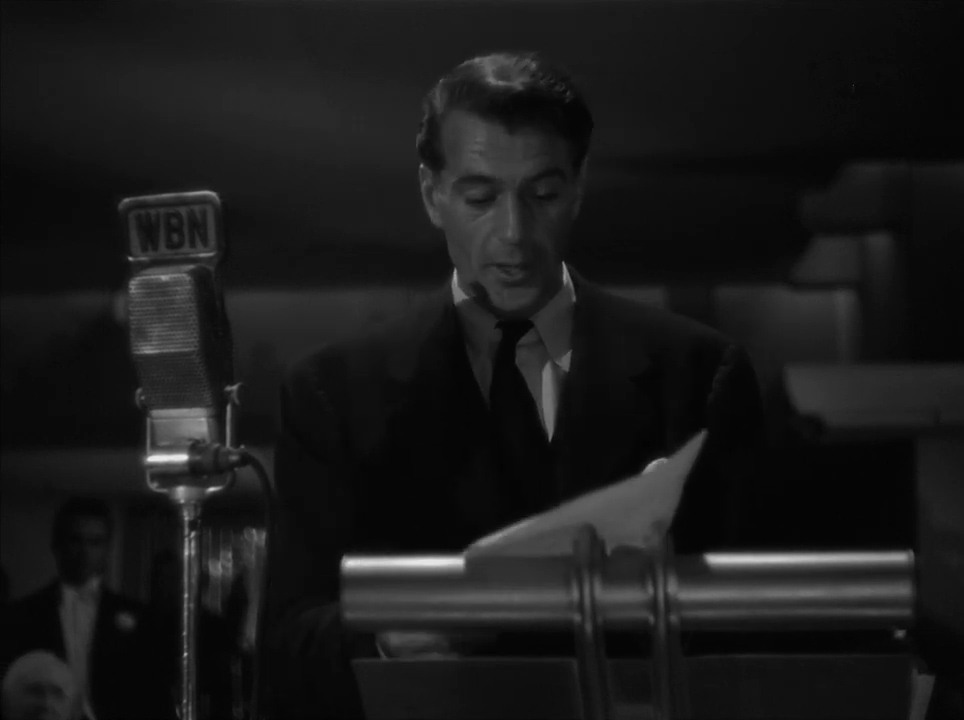 Gary Cooper in the film trailer for Meet John Doe, 1941. Image credit: Warner Bros. / YouTube / Public domain, via Wikimedia Commons.
Sergeant York turned hesitation into patriotic certainty
Howard Hawks’s Sergeant York (1941) was based on the life of Alvin C. York, a Tennessee farmer and Christian who struggled with military service before becoming one of the most decorated American soldiers of the First World War. York initially objected to a film of his life and later agreed under conditions that included the choice of Cooper.
The role suited Cooper’s screen manner because the story depends on conscience developing in stages. York is not introduced as a ready-made national hero. He drinks, fights, experiences a religious conversion and then faces a conflict between his reading of Christian teaching and the state’s demand for military service. Cooper makes the argument personal rather than abstract. The pauses feel like a man testing whether duty and belief can occupy the same life.
Once York enters combat, the film converts rural marksmanship into military achievement. The sequence in which he captures German soldiers is efficient and deliberately unshowy. Cooper does not celebrate killing. His concentration makes the action impressive while the earlier moral conflict prevents it from becoming a simple adventure.
The timing mattered. Sergeant York opened months before the United States entered the Second World War and became both a major commercial success and an argument about reluctant participation. Cooper won his first Academy Award for best actor. The performance fixed his public identity as the decent American who acts only after conscience has been satisfied.
The image could conceal contradictions. Film patriotism, personal politics and a character’s beliefs are not interchangeable. Cooper was a conservative Republican, but he was not Alvin York. The star’s authority came partly from audiences carrying one role into the next. Hollywood found that the man who looked reluctant could make commitment appear especially trustworthy.
 Colonial Theater advertisement for the American drama film Sergeant York (1941) – 19 Oct. 1941 Morning Call, Allentown PA. Image credit: Warner Bros. / Unknown photographer / Public domain, via Wikimedia Commons.
The Pride of the Yankees made a public farewell feel private
In The Pride of the Yankees (1942), Cooper played the baseball player Lou Gehrig, whose career ended after he developed amyotrophic lateral sclerosis. Cooper was right-handed while Gehrig had batted left-handed, and the production used coaching, reversed images and editing to create the baseball performance. The physical mismatch is a useful reminder that screen naturalism often depends on elaborate practical work.
The film is less interested in technical baseball than in public character. Gehrig becomes famous without becoming comfortable with fame. That allowed Cooper to use awkwardness as affection. Opposite Teresa Wright as Eleanor, he makes courtship funny because Gehrig’s emotional directness is strongest when language fails him.
The closing speech at Yankee Stadium is one of the most famous scenes in American sports cinema. Cooper does not imitate every detail of Gehrig’s surviving address. He creates the impression of a man trying to steady a crowd while his own future has disappeared. The emotion comes from restraint under public observation. A larger performance would have made the speech about an actor demanding tears. Cooper lets the listeners complete it.
He received another Academy Award nomination. The film also strengthened a pattern that could become limiting: suffering appeared nobler when Gary Cooper refused to complain. His best later work would examine what that expectation cost a man who did not feel certain.
 Boyd Theater advertisement for the American film The Pride of the Yankees (1942) – 2 Oct. 1942 Morning Call, Allentown PA. Image credit: RKO Radio Pictures / Public domain, via Wikimedia Commons.
War work and politics complicated the uncomplicated American
Cooper was beyond the usual age for military service during the Second World War and had health problems, including the lasting effects of injuries. He supported the war effort through bond drives, hospital visits and extensive tours entertaining troops in the South Pacific. The travel was demanding and exposed him to conditions far removed from studio publicity.
His politics became more visible after the war. Cooper joined the Motion Picture Alliance for the Preservation of American Ideals, a conservative organisation concerned about communist influence in Hollywood. In 1947 he appeared as a friendly witness before the House Un-American Activities Committee.
Cooper testified that he had encountered ideas he considered communistic, but he did not name colleagues as Communist Party members. That distinction matters, although it does not remove him from the political climate in which careers were damaged through suspicion, testimony and blacklisting. His presence lent the committee the moral authority of his screen image whether or not his evidence was dramatic.
The episode resists a tidy heroic reading. Cooper’s anti-communism was sincere. The committee’s methods and the blacklist caused lasting injustice. High Noon, made five years later from a screenplay by Carl Foreman, would be widely read as a response to the abandonment experienced by people under political pressure. Foreman was blacklisted after appearing before the committee. Cooper admired the script and remained in the film, even though his political position differed from Foreman’s.
This does not turn Cooper into a secret opponent of the blacklist, nor does it make High Noon an apology. It shows that work, friendship, politics and public identity do not always align cleanly. The actor whose image promised moral clarity lived through a period designed to punish ambiguity.
For Whom the Bell Tolls and the challenge of romantic idealism
Cooper had wanted to play Robert Jordan in an adaptation of Ernest Hemingway’s For Whom the Bell Tolls. The 1943 film paired him with Ingrid Bergman and placed the American volunteer inside the Spanish Civil War. Hemingway’s friendship with Cooper gave the project additional publicity, although friendship did not guarantee that an adaptation could preserve the novel’s political and emotional complexity.
Cooper’s Jordan is a technical man facing a mission that may require his life. Bergman’s Maria brings trauma, hope and sudden intimacy into the limited time before the bridge operation. Cooper is effective because he does not make idealism loud. Jordan’s commitment is visible in preparation, attention and the refusal to convert fear into performance.
The film’s politics were softened by studio caution, and its casting now invites questions about Hollywood using American stars to represent a Spanish conflict. Even with those limitations, the romance showed how Cooper’s reserve could make accelerated feeling credible. The characters know that time is short. His unwillingness to oversell the emotion gives their promises weight.
Cooper received another Oscar nomination. The role also joined him permanently to Hemingway’s world of capable men, physical danger and feelings expressed indirectly. That association suited the star, but it could make the labour of performance disappear again. Cooper was not simply being himself in a mountain landscape. He was organising a complicated part around the limited means that the camera trusted most.
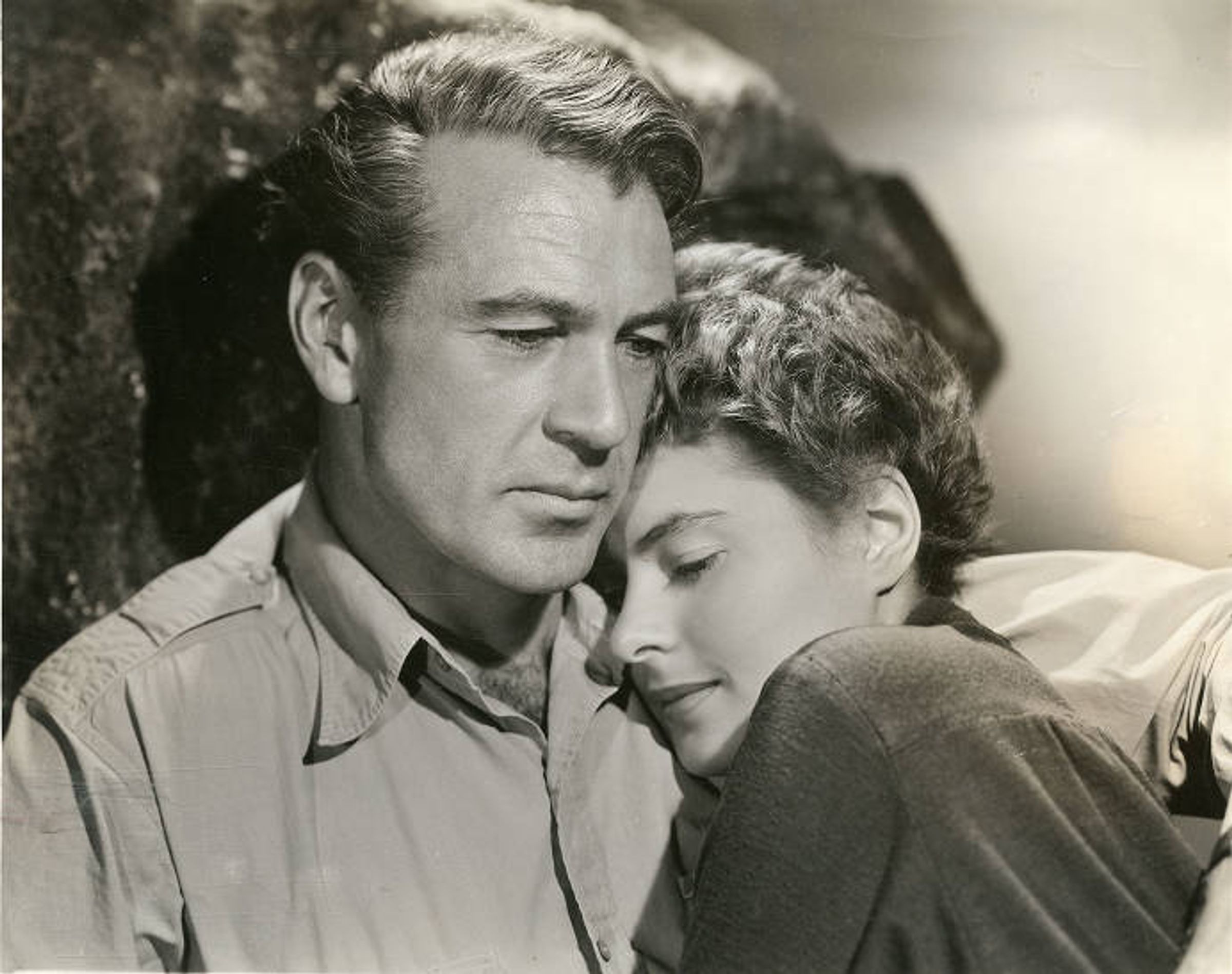 Gary Cooper and Ingrid Bergman in American epic war film For Whom the Bell Tolls (1943). Image credit: Whitey Schafer / J. Willis Sayre Collection of Theatrical Photographs / Public domain.
Marriage, affairs and the private cost of a dependable image
Cooper married Veronica Balfe in 1933. She had acted briefly under the name Sandra Shaw and came from a wealthy New York family. Their daughter Maria was born in 1937. Rocky, as Veronica was known, provided a home life that Hollywood publicity could present as stable, cultured and properly removed from scandal.
The marriage was more complicated. Cooper had relationships with several women before and during the marriage, and later biographers have discussed affairs with co-stars and other public figures. We should not turn the biography into an inventory of conquests. The recurring pattern is relevant because it affected his wife, his daughter and the distance between private conduct and the upright screen image.
His relationship with Patricia Neal began during the production of The Fountainhead (1949). Neal later wrote about the affair and a pregnancy she ended. The subject requires care because it involves her body and later recollection, not an episode designed to prove something glamorous about Cooper. The relationship contributed to a separation between Cooper and Veronica.
Cooper and his wife reconciled in the 1950s. He converted to Catholicism near the end of his life, a decision connected with the family’s faith and his own developing religious commitment. Reconciliation should not be used to tidy away the damage. It is one part of a long marriage that included affection, betrayal, distance and return.
The public had been encouraged to see Cooper as reliable even when his characters failed. That image made private contradiction particularly marketable. A responsible biography can acknowledge the affairs without pretending to know the complete emotional truth of every relationship. The people around a star are not supporting characters in a film organised to explain him.
High Noon made an ageing body part of the argument
Fred Zinnemann’s High Noon (1952) begins on Marshal Will Kane’s wedding day. Kane is about to leave town when he learns that the outlaw Frank Miller will arrive on the noon train. He seeks help from the community he has protected and discovers that fear, self-interest and resentment are stronger than public gratitude.
Cooper was fifty when he made the film, and illness and a painful ulcer contributed to his drawn appearance. That physical weariness became part of the performance. Kane is not a young gunfighter eager to prove himself. He is frightened, newly married and increasingly aware that every attempt to do the responsible thing makes him more alone.
The film’s near real-time structure turns waiting into action. Clocks, empty streets and repeated requests for help place pressure around Cooper’s reserve. He does not need to announce disappointment because the town keeps supplying new reasons for it. When Kane writes his will, the heroism lies in accepting fear rather than rising above it.
Carl Foreman’s screenplay was shaped by the blacklist climate, and the town’s refusal to stand with Kane became an obvious political metaphor. Producer Stanley Kramer and others later contested how centrally that allegory should be understood. The film supports several readings, but Foreman’s experience cannot be removed from its history.
Cooper’s own conservative politics make the casting richer, not simpler. He helped Foreman during a difficult period and embodied a blacklisted writer’s abandoned man without renouncing his political identity. John Wayne later condemned the film’s vision of a marshal asking for help, yet accepted Cooper’s Oscar on his behalf. Hollywood contradiction could hardly be staged more neatly.
Cooper won his second Academy Award. The performance remains the clearest demonstration of his technique because every familiar quality changes under pressure. Silence becomes worry. Slowness becomes time running out. Physical height no longer guarantees command. Will Kane is heroic because he continues after the image of the hero has stopped protecting him.
 Gary Cooper in the film trailer for High Noon, 1952. Image credit: United Artists / YouTube screenshot from the film trailer / Public domain, via Wikimedia Commons.
Later films let the hero age, even when scripts resisted it
Cooper remained a major star through the 1950s, but the quality of the films varied. Vera Cruz gave him a harder, more amused western role opposite Burt Lancaster. In Friendly Persuasion, directed by William Wyler, he played a Quaker farmer whose pacifist beliefs are tested by the American Civil War. The conflict returned him to the territory of Sergeant York, but with age and family responsibility replacing youthful conversion.
Billy Wilder’s Love in the Afternoon paired Cooper with Audrey Hepburn. The age difference between the stars is difficult to ignore, and the film works partly by turning Cooper’s visible age into the weariness of an experienced playboy. His guardedness has consequences. Hepburn’s character invents a romantic history to protect herself, and Cooper’s man discovers that detachment is less comfortable when someone else performs it back to him.
Anthony Mann’s Man of the West (1958) offered one of Cooper’s strongest late performances. He plays Link Jones, a former outlaw forced back among the gang he escaped. Cooper’s age, stiff movement and familiar decency create tension with the violent past the character has concealed. The western landscape no longer confirms identity. It exposes the work required to leave an old self behind.
By this stage Cooper’s health was deteriorating. He continued to work, completing The Naked Edge, but cancer spread through his body. At the 1961 Academy Awards, James Stewart accepted an honorary Oscar for him and, visibly emotional, signalled to the audience that Cooper was seriously ill. Cooper died on 13 May 1961, six days after his sixtieth birthday.
 Anthony Perkins (left) and Gary Cooper (right) filming Friendly Persuasion (1956). Image credit: Uncredited / Dr. Macro / Public domain, via Wikimedia Commons.
The Fountainhead turned architectural argument into star conflict
King Vidor’s The Fountainhead (1949), adapted by Ayn Rand from her novel, cast Cooper as architect Howard Roark. The character defends individual creative vision against clients, committees and public pressure, eventually delivering a courtroom speech explaining his actions.
Cooper’s natural understatement sits uneasily beside Rand’s declarative philosophy. That tension is part of the film’s interest. Roark must embody absolute certainty, while Cooper’s best work usually allows doubt to remain visible.
The actor later expressed reservations about how fully he understood or delivered the speech. We do not need the anecdote to see the problem. The language asks the star to state what his face would normally leave for us to consider.
Patricia Neal’s Dominique gives the film a romantic and sexual force complicated by a scene modern viewers frequently read as assault. The production presents power and desire through ideas that require critical attention rather than nostalgic acceptance.
The Fountainhead is not the easiest Cooper film, but it reveals the limit of the quiet-man image. Restraint works best when a story trusts silence. When ideology requires constant certainty, even one of Hollywood’s most natural stars can appear trapped inside the argument.
Vera Cruz and Man of the West allowed danger to return
In Vera Cruz (1954), Cooper plays an American veteran working in Mexico alongside Burt Lancaster’s flamboyant mercenary. Their different styles become the film’s moral weather. Lancaster smiles as a threat; Cooper appears trustworthy while calculating how long trust can survive.
The western’s cynical alliances anticipate later genre revisions. Cooper does not discard the dependable image. He makes us wonder how much experience and violence were always hidden inside it.
Man of the West goes further. His character has built a respectable life after leaving an outlaw family, then finds himself forced back among them. Age makes the return physically and morally painful.
The film understands that a reformed man may still possess the habits he rejects. Cooper’s slowness is no longer youthful modesty. It becomes the calculation of someone who knows exactly what violence will awaken.
These late performances are essential because they prevent High Noon from becoming a final summary. Cooper continued questioning the hero after Will Kane left the badge in the dust.
Where should you begin with Gary Cooper’s films?
Begin with High Noon. It is the famous choice because it gathers the whole Cooper image and then tests every part of it. Follow it with Mr. Deeds Goes to Town to see how embarrassment, humour and moral stubbornness worked before age added fatigue.
Then watch Morocco. The film reveals a romantic and erotic uncertainty that disappears when Cooper is discussed only as a western hero. Sergeant York is essential for understanding how his screen image became attached to national conscience, while The Pride of the Yankees shows his control in public emotion.
For the late work, choose Man of the West. It is less comforting than the best-known films and more honest about what an ageing body does to a heroic type. Add Design for Living if you want to see Cooper inside Ernst Lubitsch’s sophisticated comedy, where apparent innocence becomes part of a much less conventional romantic arrangement.
Gary Cooper was not Hollywood’s quietest leading man because he had nothing to say. He understood that a camera notices the moment before speech and the effort after it. At his best, he allowed uncertainty to remain visible inside courage. That is why Will Kane waiting for the noon train still feels human after the western hero around him has become history.