Hedy Lamarr was one of the most photographed women in Hollywood and the co-inventor of a wartime communication system. Those facts belong to the same life, yet they are often presented as if one must cancel the other. The usual story asks us to be astonished that a beautiful actor could also think seriously about engineering.
In this biography, we will follow Lamarr from Vienna and the controversy surrounding Ecstasy to Algiers, MGM stardom, independent production and Samson and Delilah. We will also examine the “secret communication system” she developed with composer George Antheil, what their patent actually proposed and why calling it the invention of Wi-Fi creates a new myth while trying to correct an old one.
The films deserve the same care. Lamarr was sometimes restricted by roles that treated her appearance as a complete character, but it would be too easy to blame every disappointment on Hollywood and declare every performance misunderstood. Her screen work was uneven. At its best, her stillness became authority, secrecy or comic control. At its weakest, a production simply placed her in beautiful clothes and waited for the camera to agree.
So we will not divide the story into “movie star” and “real genius”. Lamarr was an ambitious actor, an intelligent amateur inventor, a producer, a celebrity and a private person who sometimes contributed to her own legend. The interesting life is the one that contains all of them.
 Hedy Lamarr in 1939, shortly after Algiers established the screen image Hollywood would repeatedly reproduce.
Hedy Lamarr at a glance
- Birth name: Hedwig Eva Maria Kiesler
- Born: 9 November 1914 in Vienna, Austria-Hungary
- Died: 19 January 2000 in Casselberry, Florida
- Occupations: Actor, film producer and inventor
- Years active in films: 1930 to 1958
- Best-known films: Ecstasy, Algiers, Comrade X, Ziegfeld Girl, Experiment Perilous, The Strange Woman and Samson and Delilah
- Patent: US Patent 2,292,387, “Secret Communication System”, developed with George Antheil
- Later recognition: Electronic Frontier Foundation Pioneer Award and posthumous induction into the National Inventors Hall of Fame
Vienna gave her two kinds of curiosity
Hedwig Kiesler grew up in a comfortable Viennese household. Her father, Emil, was a bank director who encouraged her interest in how machines worked. Her mother, Gertrud, was a pianist. Music, technology and performance consequently appeared in her life long before publicity separated them into incompatible subjects.
Lamarr later remembered walks with her father during which he explained machinery and city systems. As with many childhood recollections, the exact conversations cannot be checked. The broader picture is credible. She was interested in mechanisms, enjoyed taking things apart and lived in a city where music and engineering were visible parts of modern culture.
Her parents were of Jewish background, although the family’s religious practice and later accounts of conversion require more detail than a simple label provides. That ancestry became dangerous as fascism grew in Austria and Germany. Lamarr rarely allowed Hollywood publicity to define her through it, but European politics shaped the choices that eventually took her away from Vienna.
Acting arrived first as a profession. She found work in Austrian and German film production while still in her teens, learning on sets rather than through one long formal course. Small roles led to the film that would follow her across the Atlantic.
Ecstasy made her famous for what censors saw
Gustav Machatý’s Ecstasy (1933) tells the story of a young woman trapped in an emotionally empty marriage who experiences desire outside it. Lamarr appears briefly nude and, more unusually for the period, the film presents female sexual pleasure through her face rather than treating the woman as a passive object in a man’s adventure.
Censors and exhibitors concentrated on the nudity. The film was cut, banned or delayed in different countries, while its artistic ambitions became harder to discuss than its scandal. Lamarr spent years being introduced as the woman from Ecstasy, regardless of whether the next interviewer had seen it.
We should not turn that notoriety into proof that the performance was a modern declaration of personal liberation. Lamarr later expressed anger about how the film was made and promoted, and accounts of her understanding of the nude scenes vary. What we can see is a serious European film whose treatment of a woman’s desire was provocative enough to overwhelm the rest of her early work.
The episode taught her something Hollywood would confirm repeatedly: an image could travel farther than the performance that created it.
Her first marriage has attracted too many perfect stories
In 1933, Lamarr married Friedrich Mandl, a wealthy Austrian arms manufacturer. She later described the marriage as controlling and oppressive. Mandl attempted to suppress Ecstasy, and Lamarr’s movement and acting career were restricted.
Her ghost-written memoir, Ecstasy and Me, tells a dramatic story of escaping in disguise. Lamarr challenged the book’s accuracy and tried to prevent its publication, so we cannot use its most colourful scenes as if they were sworn testimony. Biographers agree that she left Mandl and Austria; they differ over exactly how the departure happened.
Another popular account has Lamarr learning the complete science of weapon guidance by listening at Mandl’s dinner table. It sounds satisfying because it joins the marriage directly to the later patent. The evidence is not strong enough for that neat chain. She may have heard discussion of military technology and already had a practical interest in machines. That does not make the dinners a documented engineering apprenticeship.
By 1937, she had reached London. There she came to the attention of MGM chief Louis B. Mayer, who was recruiting European talent. Their negotiations continued during a transatlantic journey to New York. Hedwig Kiesler arrived in the United States with a new contract and soon received a new name.
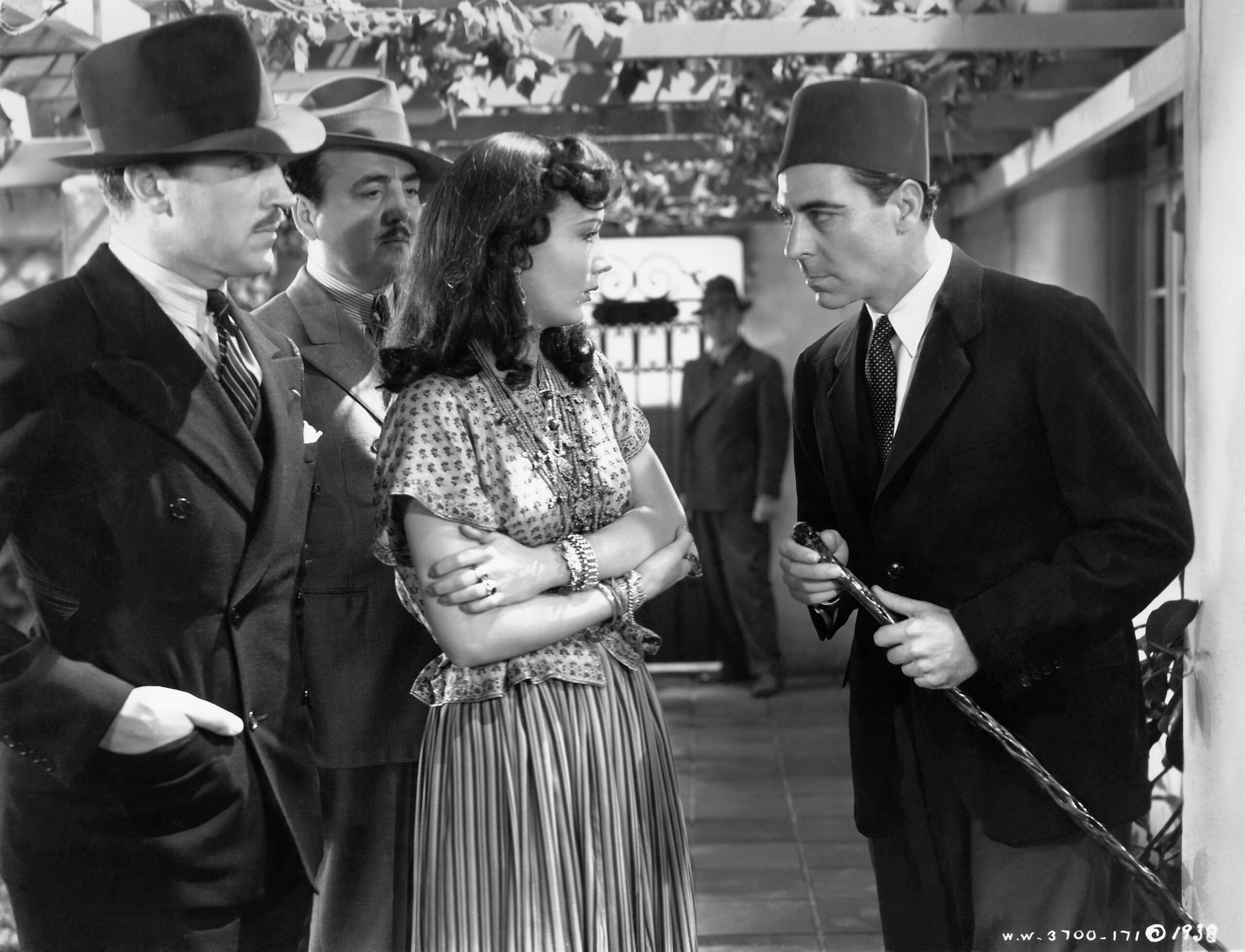 Lamarr as Gaby with Charles Boyer as Pepe le Moko in Algiers, the American film that made her a Hollywood star.
MGM manufactured Hedy Lamarr carefully
Mayer renamed her Hedy Lamarr, drawing on the memory of silent-film actor Barbara La Marr. The change separated the new MGM star from Ecstasy without allowing the studio to stop exploiting the aura of European sophistication that the film had created.
Her American debut came not at MGM but in producer Walter Wanger’s Algiers (1938), opposite Charles Boyer. The film introduces her with the kind of close-up that tells an audience a star has arrived before the character has done anything. Her face, dark centre-parted hair and measured movement were copied in fashion and publicity photographs.
Algiers is a romantic crime drama set inside a Hollywood construction of the Casbah. Lamarr plays Gaby, a visitor from Paris whose presence reminds trapped thief Pepe le Moko of the world beyond the district. She does not need to pursue him aggressively. The possibility of escape has been attached to her appearance before she speaks.
The effect made her famous, but it also established the problem. Producers could use Lamarr as a destination, mystery or expensive object without giving the character enough independent life. Her reserve worked when the film wanted uncertainty. It became blankness when the writing supplied nothing behind it.
Hollywood repeatedly confused beauty with character
MGM placed Lamarr in a succession of prominent productions. Lady of the Tropics cast her as a woman of mixed European and Asian heritage, using a white European actor inside the period’s racist casting practices. Boom Town put her among Clark Gable, Spencer Tracy and Claudette Colbert in a large story about oil, competition and marriage.
In Comrade X (1940), she had a better opportunity to use comedy. She plays Theodore, a Soviet tram conductor whose name and clothing initially allow Gable’s American reporter to mistake her for a young man. The politics are broad and the disguises unconvincing, but Lamarr handles changes of language, romantic argument and comic pride more lightly than the “most beautiful woman” image usually permitted.
Gable’s speed helps. Lamarr often worked well opposite performers who supplied obvious movement because her pause could then become a response rather than an absence. She looks as though Theodore is deciding how much foolishness to tolerate, which gives the comedy a point of view.
Ziegfeld Girl (1941) offered another kind of contrast. Judy Garland, Lana Turner and Lamarr play three women whose lives take different directions around a Broadway revue. Garland has musical warmth, Turner restless vulnerability and Lamarr an almost architectural glamour. The film uses those differences deliberately, even though its enormous production numbers leave limited space for psychological depth.
 Clark Gable and Hedy Lamarr in Comrade X. The comedy allowed Lamarr to use a lighter, more deliberately controlled screen manner.
Ziegfeld Girl showed the power and limits of the image
As Sandra Kolter in Ziegfeld Girl, Lamarr appears in costumes and settings designed to make her look less like an ordinary person than a figure inside a display. That is not automatically a criticism. Spectacle depends on performers who understand how stillness, posture and costume work together.
The limitation arrives when publicity treats the resulting image as Lamarr’s natural state. Hours of lighting, makeup, photography, fitting and direction disappear, leaving the claim that the camera merely recorded a perfectly beautiful woman. The labour of constructing Hollywood glamour becomes invisible at the same time as the actor’s other abilities.
Lamarr understood the image well enough to reproduce it, resist it and sometimes use it as a business asset. She also complained that studios gave her too few challenging roles. Both can be true. A star may dislike the cage while recognising that it is made of valuable material.
During the early 1940s, she appeared in H. M. Pulham, Esq., Tortilla Flat, Crossroads, White Cargo and The Heavenly Body. The films varied widely. White Cargo pushed her into an exoticised seductress role that repeated some of Hollywood’s worst instincts. The Heavenly Body placed her in a marital comedy shaped around astrology, giving her moments of deliberate silliness that the solemn portraits rarely suggested.
The face did not act by itself
Lamarr’s acting is difficult to assess fairly because the publicity has trained us to watch the wrong thing. A studio portrait asks us to admire a face held perfectly still. A dramatic performance requires us to notice why the character is still, what she is withholding and whether another actor has changed her attention.
In weaker films, Lamarr can appear remote because the role gives her no playable decision. The director lights her, another character describes her beauty and the scene assumes the work is finished. Repeating that limitation as praise does not help. “Mysterious” becomes a polite word for writing that has failed to imagine a woman beyond her entrance.
The stronger performances give the reserve a purpose. In Comrade X, the pause allows Theodore to judge Gable’s latest argument before answering it. In Experiment Perilous, it suggests fear inside a household where candour is unsafe. In The Strange Woman, the same composure becomes social calculation. Lamarr was not transforming beyond recognition in each film, but she could redirect a familiar quality when the part provided somewhere for it to go.
Her voice also matters. Lamarr’s European accent marked her as foreign within American films, and studios often used that difference as shorthand for sophistication or danger. She could slow a line until another performer seemed impatient, then regain control of the scene by refusing to match their speed. Comedy benefited when the film allowed her to know that she was creating the delay.
This is why we should not make the corrective claim that Lamarr was secretly one of Hollywood’s greatest actors. Her work was inconsistent, and some roles exposed her limitations. The more interesting judgement is that Hollywood identified a real screen quality, marketed it brilliantly and then used it too narrowly. When a director attached her stillness to thought, secrecy or power, the image became a performance again.
 Lamarr in Ziegfeld Girl, where costume, lighting and stillness turned her into the centre of an elaborate visual design.
George Antheil was a collaborator, not an assistant
Lamarr met George Antheil in Hollywood. Antheil was an American composer known for experimental music, player pianos and an earlier reputation for artistic provocation. Their friendship developed around conversation and shared problem-solving rather than a formal research laboratory.
During the Second World War, radio-controlled torpedoes presented an obvious difficulty. A guidance signal transmitted on one frequency could be detected and jammed. Lamarr and Antheil considered whether transmitter and receiver could move together through a sequence of frequencies, making the signal harder to interrupt.
The names on the patent are Hedy Kiesler Markey, the legal name Lamarr used during her marriage to screenwriter Gene Markey, and George Antheil. Modern summaries sometimes turn Antheil into the man who helped a brilliant actor put her idea on paper. That is not fair to the collaboration. Lamarr brought the central concern, technical imagination and persistence. Antheil brought practical knowledge of synchronised player-piano mechanisms. The resulting system belonged to both inventors.
The collaboration also tells us something useful about Lamarr’s mind. She was not pursuing a professional engineering qualification or building a company around a product. She was an inventive amateur working with another inventive outsider on a military problem. Calling her an amateur is not an insult. It describes the conditions under which the work occurred and makes the achievement easier to understand accurately.
The patent proposed frequency hopping for torpedo control
Lamarr and Antheil filed their application in June 1941. US Patent 2,292,387, titled “Secret Communication System”, was granted on 11 August 1942. Its stated purpose concerned secret radio communication, particularly the remote control of torpedoes.
The proposal linked a transmitter and receiver so that both would change frequency according to the same pattern. An enemy attempting to jam one frequency would consequently disrupt only a small part of the sequence. The patent described eighty-eight possible frequencies, matching the number of keys on a piano, and used synchronised perforated rolls as part of the control mechanism.
That player-piano element has sometimes made the invention sound eccentric. Mechanical synchronisation was central to Antheil’s musical experience, and a patent must explain how an idea could be implemented with the technology available at the time. The rolls were not an attempt to place a piano inside a torpedo. They were a model for keeping two changing systems together.
The design was not adopted in its patented wartime form. The US Navy did not install the Lamarr-Antheil mechanism in wartime torpedoes, and the inventors received no financial reward. Lamarr instead made public appearances supporting war-bond sales, a more conventional contribution for a female film star.
 US Patent 2,292,387 records Hedy Kiesler Markey and George Antheil’s frequency-changing secret communication system.
The invention did not simply become Wi-Fi
This is the point where a corrective story often becomes another exaggeration. Frequency hopping and other spread-spectrum techniques later became important in military communication and wireless technology. Modern systems including Bluetooth use frequency-hopping principles, while Wi-Fi standards have used different forms of spread-spectrum and multicarrier communication.
That does not mean a direct production line runs from Lamarr’s piano-roll mechanism to the router in a modern home. Later engineers developed electronic systems under different conditions, and the exact influence of the 1942 patent on particular military programmes is debated. The patent expired before Lamarr and Antheil received recognition.
The accurate claim is already impressive. They patented an early frequency-hopping communication proposal intended to resist jamming. Their work belongs to the history of spread-spectrum thinking. It anticipated a problem and a general solution that became increasingly important as electronics made rapid frequency changes practical.
We do not need to say Lamarr invented Wi-Fi, Bluetooth or the mobile phone. Those claims make her sound more famous while making the technical history less true. They also repeat the publicity habit of reducing a complicated person to one startling sentence.
Experiment Perilous used reserve as part of the mystery
Jacques Tourneur’s Experiment Perilous (1944) casts Lamarr as Allida Bederaux, a woman living inside an elegant New York household dominated by her controlling husband. A psychiatrist gradually suspects that the apparently unstable wife is in danger rather than simply ill.
The film surrounds Lamarr with paintings, staircases, curtains and reflective surfaces. Her beauty is not offered as uncomplicated pleasure. It has been framed and possessed by the husband who controls the house. Lamarr’s reserve consequently becomes useful. Allida appears distant because the character has learned that observation is dangerous.
There are limits to the film’s psychology, and its medical assumptions belong to melodrama rather than modern practice. Even so, Tourneur understands that Lamarr does not need to explain every feeling immediately. A look held slightly too long can make the room feel less secure.
This is a better use of her screen manner than roles that expected the audience to accept mystery without giving it a dramatic cause.
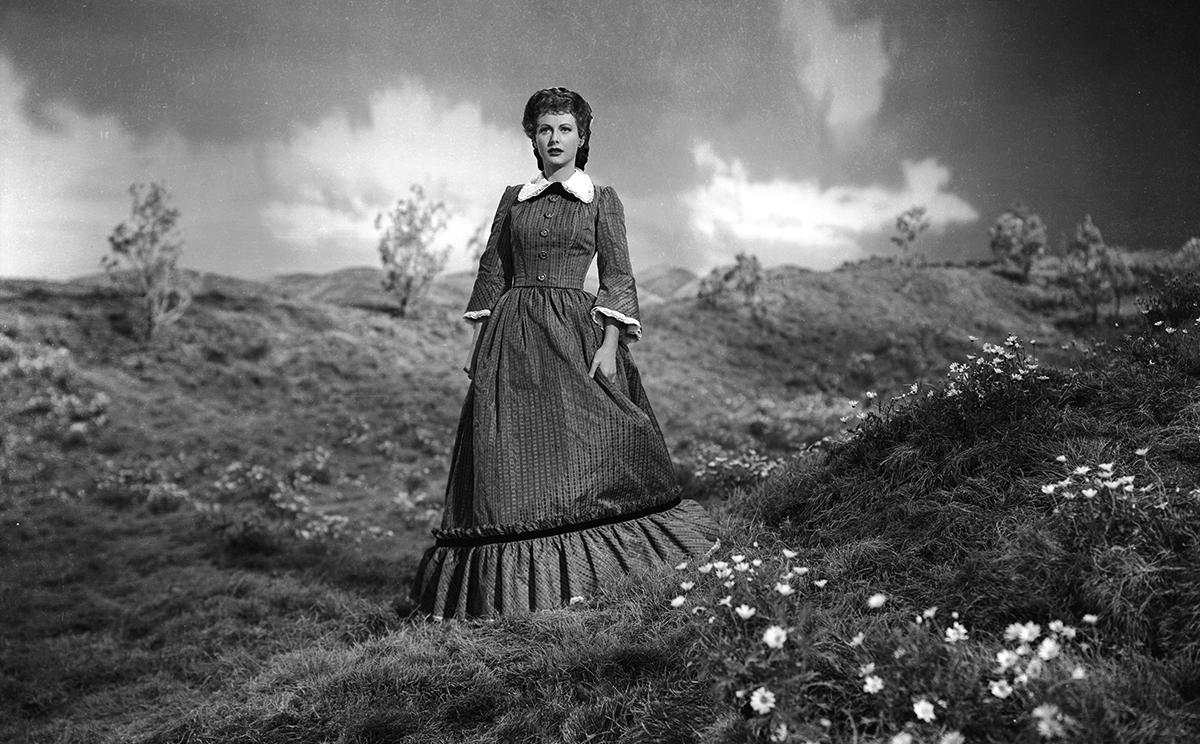 Lamarr as Allida Bederaux in Experiment Perilous, a psychological melodrama that makes productive use of her reserve and ambiguity.
Leaving MGM allowed her to produce
Lamarr’s MGM contract ended in the mid-1940s. Greater independence did not guarantee stronger films, but it gave her an opportunity to shape them. She formed a production company and starred in The Strange Woman (1946), directed by Edgar G. Ulmer.
As Jenny Hager, Lamarr plays an ambitious woman in nineteenth-century Maine who uses desire, charity and social expectation to gain power. Jenny is not secretly innocent, and the film does not require Lamarr to protect a respectable star image. Her stillness becomes calculation, while sudden emotional changes suggest how closely Jenny watches the effect she is producing.
The production experienced financial and distribution difficulties, reminding us that independence involves invoices as well as artistic choice. Dishonored Lady (1947) followed with Lamarr as a fashion editor whose public success has left her exhausted and unstable. The film attempts a serious account of psychological crisis, romance and reinvention, although its solutions are conventional and its treatment should not be read as medical guidance.
Both films are valuable because they show Lamarr seeking characters whose lives are not defined entirely by a man’s first look at them. Neither transformed her career. They did, however, prove that her dissatisfaction was accompanied by an attempt to produce different work.
 Lamarr as fashion editor and artist Madeleine Damien in Dishonored Lady, one of the films made during her move towards independent production.
Samson and Delilah became the greatest commercial success
Cecil B. DeMille’s Samson and Delilah (1949) returned Lamarr to a vast studio spectacle. Victor Mature plays Samson, while Lamarr’s Delilah seeks revenge before becoming trapped by the attachment she meant to exploit.
DeMille fills the film with colour, jewels, monumental sets and the promise of destruction. Lamarr’s established image is not incidental decoration. Delilah understands the political and sexual value of being watched. Her costumes and entrances announce shifts in power before the dialogue confirms them.
The performance works because Lamarr does not treat seduction as a continuous smile. Delilah observes Samson, tests him and adjusts. When the scheme develops emotional consequences, the same composure begins to look like effort.
The film became the largest box-office success associated with Lamarr and won Academy Awards for art direction and costume design. Its biblical world is filtered through 1940s Hollywood ideas about gender, race and spectacle, so a modern viewer will find plenty to question. It nevertheless shows how effectively Lamarr could command a production designed around display.
The irony is clear. After years of wanting roles that moved beyond beauty, her greatest commercial success arrived in one of the most lavishly visual films of the period. The image was still a cage, but DeMille understood its scale.
 Lamarr as Delilah in Cecil B. DeMille’s Samson and Delilah, the greatest commercial success of her film career.
Six marriages should not become the whole private life
Lamarr married six times. Her husbands included Friedrich Mandl, screenwriter and producer Gene Markey, actor John Loder, bandleader Teddy Stauffer, oilman W. Howard Lee and lawyer Lewis J. Boies. She had three children, James, Denise and Anthony.
The number of marriages became an easy way for magazines to frame the life as romantic instability. Some relationships were clearly painful, and court records provide facts about divorce and custody. They do not give us permission to invent private motives for every decision.
Her memoir made the problem worse. Published in 1966, Ecstasy and Me offered sensational accounts of sex, escape and celebrity. Lamarr said that ghost-writers had invented or distorted material and pursued legal action. The book remains part of her public history because readers encountered it under her name, but its anecdotes require independent confirmation.
There is a useful parallel with her films. Publicity repeatedly converted a complicated woman into a glamorous story that could be sold quickly. Lamarr sometimes participated in that manufacture and sometimes fought it. Biography becomes misleading when it assumes only one of those positions was real.
Later films and withdrawal from public view
After Samson and Delilah, Lamarr appeared in films including Copper Canyon, A Lady Without Passport, My Favorite Spy and the independently produced Loves of Three Queens. Her final screen role came in The Female Animal in 1958.
The later career did not provide a major reinvention. Changing audience tastes, personal finances and the reduced range of roles available to middle-aged actresses all mattered. Lamarr also invested in business ideas, not all of them successful. The same willingness to experiment that produced the patent did not guarantee commercial judgement.
Shoplifting arrests in 1966 and 1991 received disproportionate attention because they contradicted the image of luxury attached to her. The legal outcomes differed, and the incidents should not be used as a diagnosis or as the conclusion to her life.
Lamarr increasingly avoided cameras while remaining socially connected by telephone. She challenged unauthorised commercial use of her image and reached settlements in some cases. It is not difficult to understand why control over that image mattered. Studios had profited from it, imitators had copied it and later accounts treated her changing appearance as public property.
She died from heart disease in Casselberry, Florida, on 19 January 2000. She was eighty-five.
Recognition arrived after the patent had expired
George Antheil died in 1959, long before the partnership received wide public recognition. Lamarr and Antheil were honoured with the Electronic Frontier Foundation’s Pioneer Award in 1997. Lamarr did not attend, but the recognition reached her during her lifetime.
The National Inventors Hall of Fame inducted both inventors in 2014. Museums, documentaries and educational projects have since helped move the patent from a surprising footnote to a central part of her reputation.
That correction was necessary. It has also created a new imbalance. Some accounts now hurry through twenty-five years of film work so they can reveal that the beautiful actor was “really” an inventor. Lamarr did not need to stop being an actor for the patent to matter. Nor does one patent mean that every technical claim made on her behalf becomes true.
Her later reputation is strongest when it allows acting, invention and self-fashioning to remain connected but distinct. She knew how systems created an effect, whether that system involved a camera, a studio publicity department or two radio devices changing frequency together.
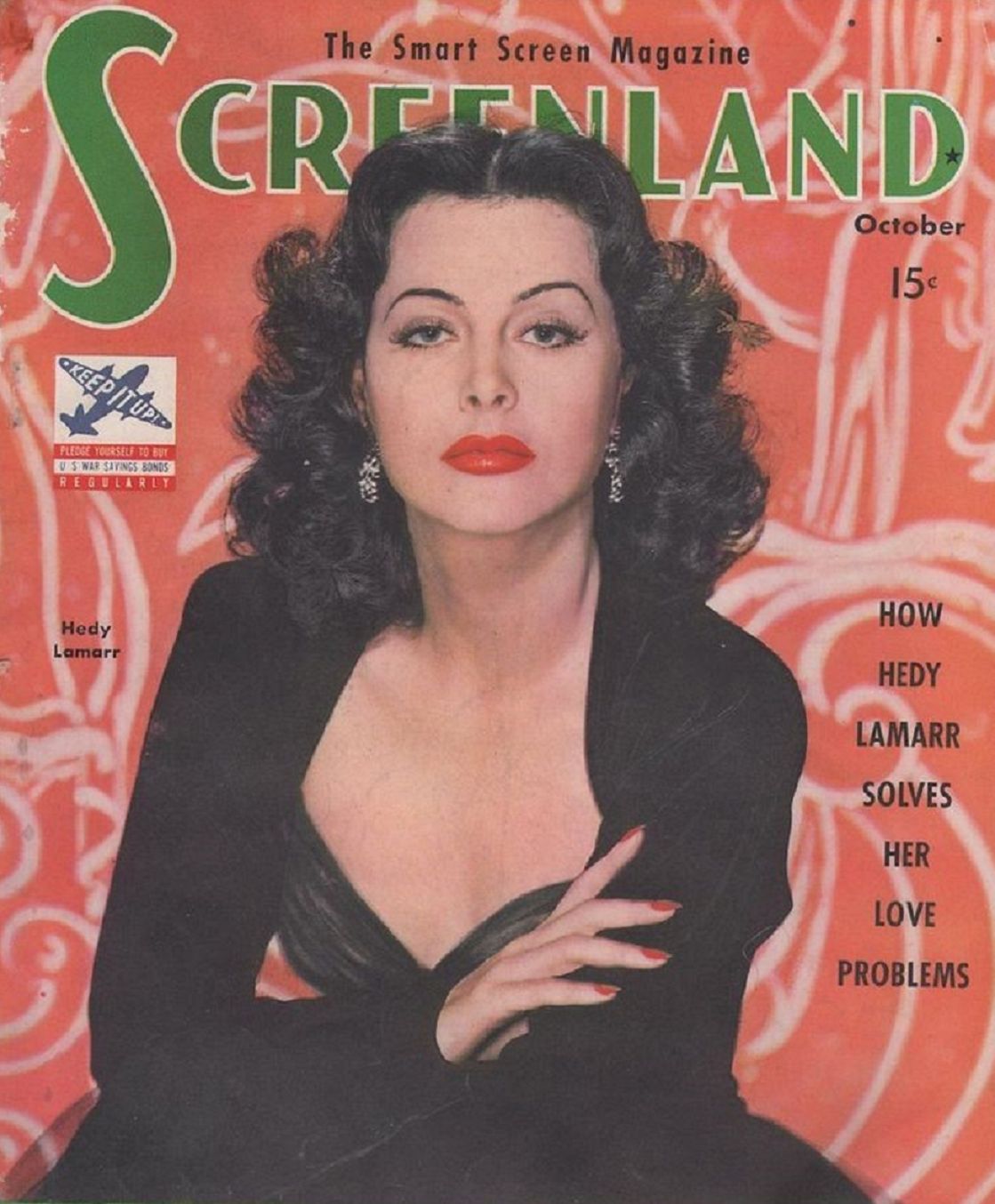 A 1942 Screenland cover shows the star image visible to wartime audiences while Lamarr’s technical work remained largely private.
Which Hedy Lamarr films should you watch first?
We suggest choosing films that use her screen image in different ways rather than simply starting with the biggest productions.
- Algiers (1938): Begin with the American debut and watch how lighting, costume and other characters’ reactions manufacture a star entrance.
- Comrade X (1940): The broad comedy gives Lamarr more movement and allows her to argue with Clark Gable instead of remaining an object of fascination.
- Ziegfeld Girl (1941): Compare her constructed glamour with the very different screen qualities of Judy Garland and Lana Turner.
- Experiment Perilous (1944): This is one of the best examples of a director turning her reserve into dramatic uncertainty.
- The Strange Woman (1946): Lamarr’s independent production gives her a morally difficult character with genuine control over the story.
- Samson and Delilah (1949): Finish the essential group with the spectacle that made the fullest commercial use of her image.
After those six, try Dishonored Lady and The Heavenly Body. They are imperfect films, but together they reveal psychological melodrama and comedy missing from the standard collection of glamour photographs.
Our Clark Gable biography provides more context for Comrade X and Boom Town. The Rita Hayworth biography offers a useful comparison with another star whose carefully manufactured beauty could obscure the work involved in sustaining it.
Hollywood stardom and the invention beyond the screen
Hedy Lamarr’s story does not need a surprise ending. The patent was not a secret proof that the movies had mistaken a scientist for a decorative woman. It was one serious achievement inside a life already shaped by curiosity, ambition, performance and the desire for control.
Hollywood certainly underestimated her. It also made her internationally famous, supplied opportunities she sometimes used well and created an image she could later turn towards independent production. Lamarr resisted that image without ever becoming separate from it.
If you want to understand the whole person, watch Experiment Perilous, then read the patent. In the film, a woman’s appearance has been turned into part of the structure confining her. In the patent, two collaborators design a structure that keeps a signal moving beyond interference. The connection is not that one work secretly explains the other. It is that Lamarr understood how much depends on the system around what we see.
Questions readers often ask
Did Hedy Lamarr invent Wi-Fi?
No. Lamarr and George Antheil patented an early frequency-hopping communication system intended to make radio-controlled torpedoes harder to jam. Their idea belongs to the wider history of spread-spectrum communication, but modern Wi-Fi developed through later technologies and many other inventors.
What exactly did Hedy Lamarr and George Antheil patent?
US Patent 2,292,387 described a transmitter and receiver changing together through a sequence of radio frequencies. The patent proposed synchronised perforated rolls and eighty-eight possible frequencies for secret communication and torpedo control.
Was the invention used during the Second World War?
Not in its patented form. The Navy did not deploy their player-piano-based system in wartime torpedoes. Later electronic frequency-hopping systems became important, but claims about a direct path from this patent to a particular military deployment require caution.
Why did Hedy Lamarr change her name?
She was born Hedwig Kiesler. MGM chief Louis B. Mayer renamed her Hedy Lamarr when bringing her to Hollywood, partly separating the new star from the controversy surrounding Ecstasy and invoking silent-film actor Barbara La Marr.
What was Hedy Lamarr’s most successful film?
Samson and Delilah was the greatest commercial success of her film career. Cecil B. DeMille’s biblical spectacle paired her with Victor Mature and won Academy Awards for art direction and costume design.
Did Hedy Lamarr receive recognition for the patent?
Recognition arrived very late. Lamarr and Antheil received the Electronic Frontier Foundation Pioneer Award in 1997, and both were inducted into the National Inventors Hall of Fame in 2014.