Robert Mitchum made difficult acting look suspiciously easy. He could enter a scene with heavy eyes, a low voice and no visible desire to impress anybody, then leave us with the feeling that he had understood more than every other character in the room. Hollywood sold that manner as indifference. Mitchum helped the story along by joking about his profession and presenting himself as a man who had wandered into stardom without taking it seriously.
In this biography, we will test that image against the films. We will follow Mitchum through a restless childhood, wartime factory work, rapid training in low-budget westerns and the performance in The Story of G.I. Joe that brought his only Academy Award nomination. We will look closely at film noir, the 1948 arrest that strengthened his rebel reputation and the extraordinary range from The Night of the Hunter to The Friends of Eddie Coyle.
Mitchum did not always choose carefully, and he sometimes seemed to enjoy telling interviewers that none of it mattered. The evidence on screen says something else. An actor cannot produce that many distinct variations on calm, fear, tenderness, exhaustion and menace by accident. The apparent lack of effort was not the absence of technique. It was the technique.
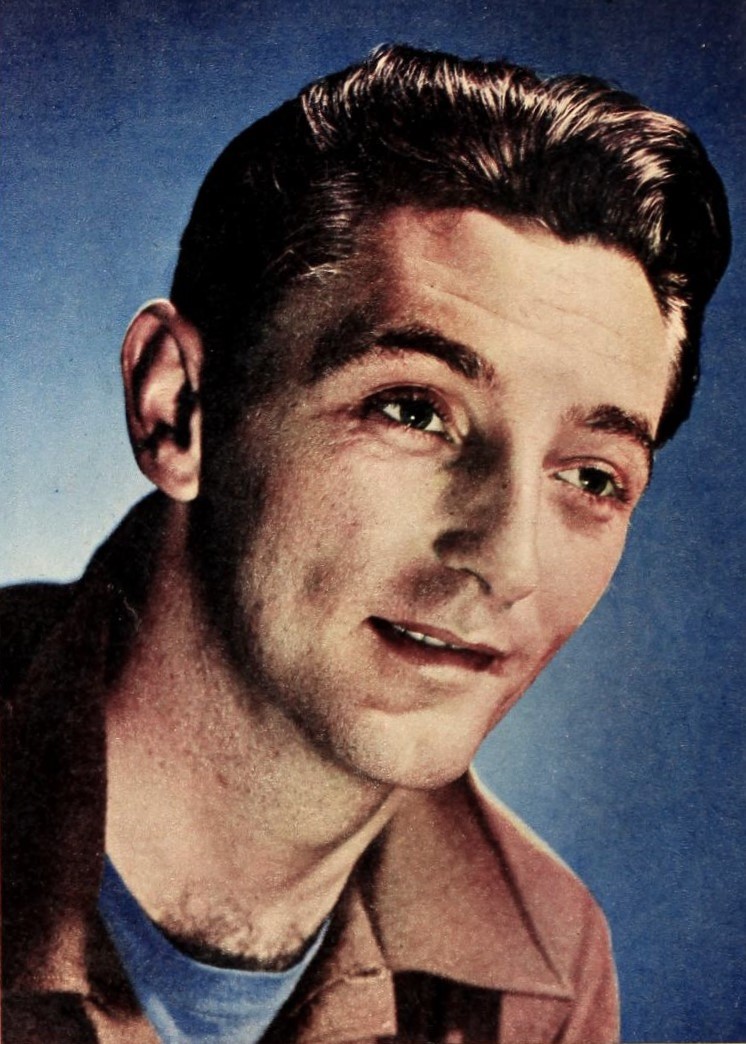 Robert Mitchum in 1946, after The Story of G.I. Joe had revealed the control behind a screen manner publicity would soon call effortless.
Robert Mitchum at a glance
- Full name: Robert Charles Durman Mitchum
- Born: 6 August 1917 in Bridgeport, Connecticut
- Died: 1 July 1997 in Santa Barbara, California
- Occupations: Actor, singer, writer and occasional producer
- Years active: 1942 to 1997
- Best-known films: The Story of G.I. Joe, Crossfire, Out of the Past, The Night of the Hunter, Heaven Knows, Mr. Allison, Cape Fear, El Dorado and The Friends of Eddie Coyle
- Major recognition: Academy Award nomination for The Story of G.I. Joe and later lifetime-achievement honours
- Spouse: Dorothy Spence, married from 1940 until his death
- Children: James, Christopher and Petrine Mitchum
A childhood that became part of the sales pitch
Mitchum was born in Bridgeport to Ann Gunderson Mitchum and James Thomas Mitchum. His father, a railway worker, died in an accident when Robert was very young. Ann later remarried, and the family moved between Connecticut, New York and Delaware. Money was limited, and Robert developed a reputation for resisting school discipline.
He left formal education early and travelled around the country during the Depression. Later accounts include freight trains, temporary jobs, boxing and a Georgia chain gang after an arrest for vagrancy. Some elements are supported by biographical research, while the details vary and Mitchum himself was capable of improving a story for an audience. We should not treat every colourful anecdote as a court transcript.
What we can say is that his adolescence did not follow a protected route into acting. He knew precarious work and movement long before a studio publicity department discovered that these experiences could make a star seem authentically tough. The press eventually joined the wandering youth, battered face and sleepy eyes into a single explanation: Mitchum was not performing hard men; he simply was one.
That idea was useful because it made craft disappear. It also flattened a curious young man who wrote verse, later created material for the stage and had a strong feeling for music. The future actor’s education was irregular, not nonexistent. He absorbed speech, rhythm and behaviour from people he met outside the institutions that usually supplied Hollywood with polished leading men.
California, Dorothy and work before the movies
Mitchum reached California during the 1930s, where his sister Julie was working as a performer. Through the Players Guild of Long Beach, he helped backstage, acted and wrote material. Community theatre gave him practical experience without requiring him to announce a grand ambition to become an actor.
He married Dorothy Spence in 1940. They had known one another since their teens, and the marriage lasted until his death fifty-seven years later. That endurance does not mean the relationship was simple; Mitchum’s long absences and reported affairs belong to the record. It does, however, complicate the lone-wolf image. His family life had a continuity that his public persona rarely advertised.
With a child to support and wartime industry expanding, Mitchum took work at Lockheed. Accounts describe sheet-metal or machine work, exhausting shifts, damaged hearing and a stress-related health collapse that included temporary loss of sight. The details differ, but the central point is secure: factory employment was difficult, and film extra work offered an alternative rather than a glamorous fantasy.
An agent helped him find jobs in the Hopalong Cassidy western series. In 1943 he appeared in a remarkable number of small roles, often as a villain. Low-budget filmmaking became his real screen school. He learned to hit a mark, handle horses and weapons, make a moment register quickly and avoid wasting film. By the time prestige productions noticed him, Mitchum had accumulated the kind of technical repetition that publicity later erased.
 A Holiday Affair advertisement featuring Robert Mitchum and Janet Leigh. Romantic comedy gave the familiar reserve a warmer, more embarrassed meaning.
The Story of G.I. Joe discovered the stillness
William A. Wellman’s The Story of G.I. Joe follows war correspondent Ernie Pyle, played by Burgess Meredith, among American infantrymen in Italy. Mitchum plays Lieutenant Bill Walker, a fictionalised officer shaped partly by Captain Henry T. Waskow, whose death Pyle had described in a celebrated column.
The role changed Mitchum’s career because the film did not need conventional heroics. Walker is tired, responsible and aware of the cost behind every order. Mitchum’s face looks as though sleep has become a distant memory. He does not perform command by raising his voice. Authority comes from the attention he gives the men and the weight that settles after each loss.
Wellman reportedly had doubts before seeing what Mitchum could do in a test. The finished performance makes clear why the director changed his mind. Mitchum’s restraint suits a film interested in ordinary infantry rather than triumphant spectacle. The character’s courage is not presented as immunity from fear or grief. It is the ability to continue while carrying both.
The Academy nominated Mitchum for best supporting actor. It remained his only competitive Oscar nomination, a surprisingly small awards record for such a long career. The nomination is valuable not because it proves that this was his single best performance, but because it appeared before the rebel publicity had fully formed. Audiences and industry voters responded to the control before they were taught to call it laziness.
 The Gremlin Movie Theatre on Attu Island advertises The Story of G.I. Joe. The contemporary setting connects the film’s infantry story with wartime exhibition.
RKO turned reserve into a star identity
RKO placed Mitchum under contract and used him across westerns, melodramas and thrillers. The volume of work could be punishing, but it allowed him to test the same physical presence in different moral settings. A lowered head might suggest shyness in one film, calculation in another and exhaustion in a third.
In Thirty Seconds Over Tokyo he had already shown that a supporting actor could make ordinary behaviour memorable. Undercurrent placed him opposite Katharine Hepburn in a glossy psychological melodrama. Pursued used him in a western shaped by the shadows and damaged memory associated with film noir. Blood on the Moon gave him another morally divided western role.
The studio liked the heavy-lidded gaze, deep voice and broad frame because they could be marketed immediately. Mitchum appeared masculine without seeming polished, romantic without becoming eager and dangerous without needing elaborate makeup. The risk was repetition. RKO could keep changing the plot while asking him to reproduce the same promise.
He responded by adjusting the balance inside the image. Sometimes the calm belongs to a man who knows he can win. Sometimes it belongs to a man who already expects defeat. The distinction is small enough to miss if we watch only the costume and cigarette, but it is the difference between a durable actor and a brand.
Crossfire used the noir hero as a witness
Edward Dmytryk’s Crossfire in 1947 places a murder investigation inside the tensions of recently demobilised servicemen. The victim has been killed because he is Jewish, and the film confronts antisemitism directly within a noir framework. Mitchum plays Sergeant Peter Keeley, who tries to protect a vulnerable fellow soldier while helping expose the real killer.
Keeley is not the tormented centre of the film in the way Jeff Bailey will be in Out of the Past. Mitchum instead gives the story a stable intelligence. He watches, questions and refuses the easiest explanation. Robert Ryan’s violent Montgomery supplies the hatred; Mitchum’s reserve becomes a moral counterweight rather than romantic fatalism.
The film was made during a politically charged moment, and director Dmytryk and producer Adrian Scott soon became members of the Hollywood Ten. Knowing that history changes the way Crossfire feels. A film condemning prejudice was released just before the industry’s blacklist punished political association and testimony.
Mitchum’s performance also challenges the belief that he needed ambiguity to be interesting. Keeley is fundamentally decent. The actor avoids making decency bland by showing the effort of attention. He does not merely wait for the plot to identify evil; he notices how frightened men behave and chooses where to place trust.
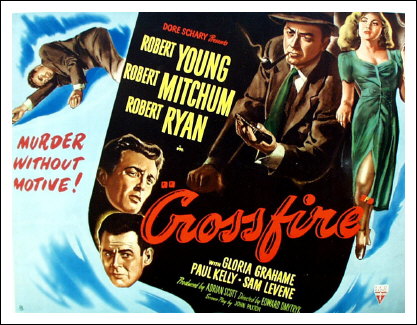 An original poster for Crossfire, the noir drama in which Mitchum’s watchful decency counters Robert Ryan’s violent antisemitism.
Out of the Past made fatalism look intelligent
If we choose one film to explain Robert Mitchum’s place in film noir, it has to be Jacques Tourneur’s Out of the Past. Mitchum plays Jeff Bailey, formerly Jeff Markham, a private detective who has tried to build a quiet new life after betraying a dangerous employer and becoming involved with Jane Greer’s Kathie Moffat.
Jeff is not surprised when the past returns. That is the foundation of the performance. Mitchum does not play fatalism as passivity or stupidity. Jeff sees the traps, often before the audience does, but knowledge does not provide a clean route out. His calm is the behaviour of someone calculating inside a situation whose basic terms have already been set.
Opposite Greer and Kirk Douglas, Mitchum makes listening competitive. Douglas’s Whit Sterling speaks with polished control; Greer’s Kathie shifts between vulnerability and calculation. Jeff rarely tries to overpower either of them. A slight pause or downward glance tells us that he has registered a lie and is deciding whether exposing it would help.
The romance works because scepticism and desire exist at the same time. Jeff does not believe Kathie completely, yet he wants the world she offers to be possible. Mitchum’s half-guarded face allows both truths to remain visible. Cinematographer Nicholas Musuraca and Tourneur’s low-key direction turn that uncertainty into the film’s atmosphere.
Out of the Past did more than fit Mitchum to a genre. It established a form of male vulnerability that does not ask for sympathy directly. Jeff can fight, lie and make decisions, but he cannot control the meaning of his own desire. The relaxed body and doubtful eyes show a man losing an argument with himself.
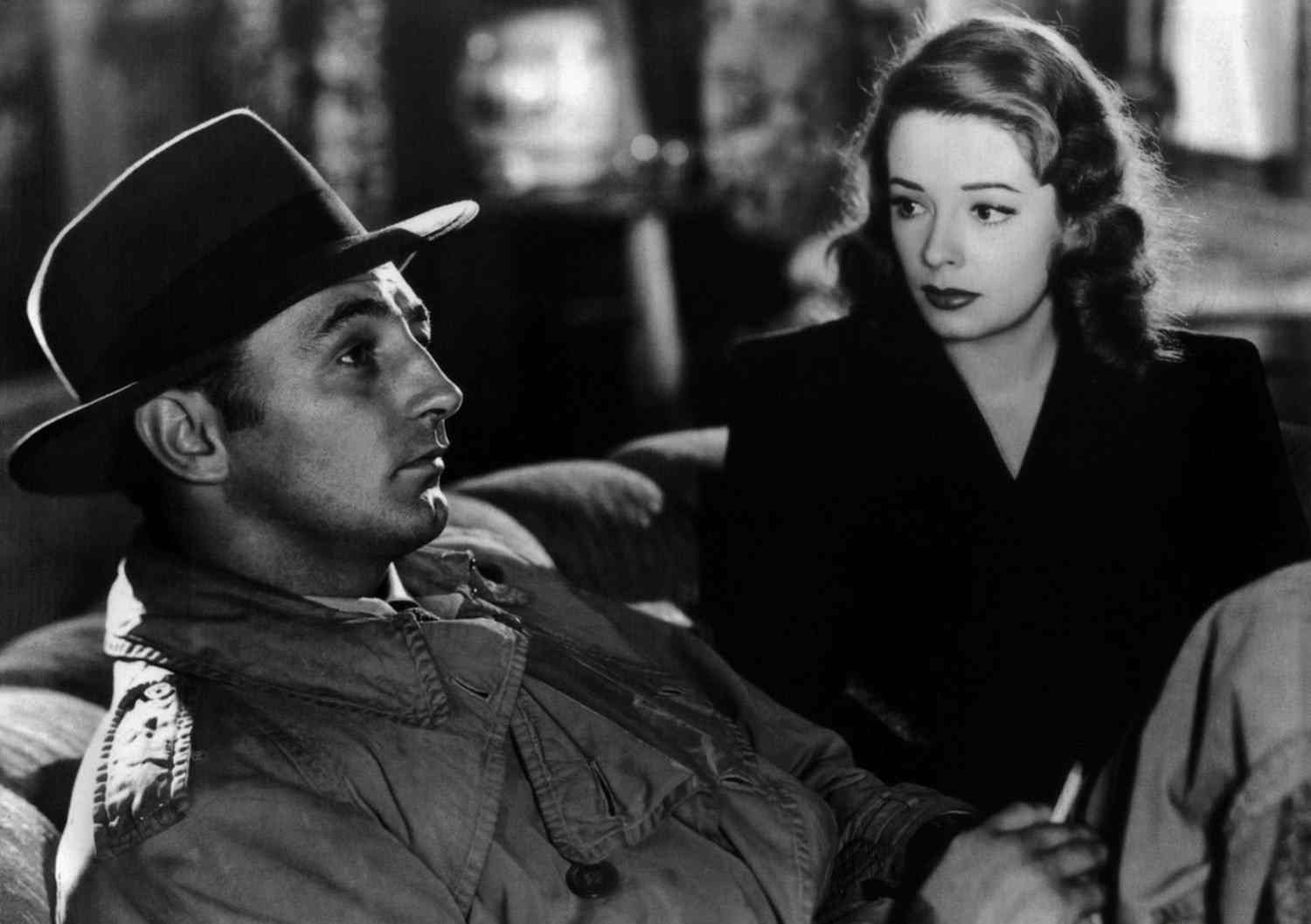 Robert Mitchum and Jane Greer in Out of the Past. Their performances keep scepticism, attraction and betrayal alive at the same time.
The 1948 arrest became profitable rebellion
In September 1948 police arrested Mitchum at the home of actor Lila Leeds during a marijuana raid. He entered a no-contest plea to a conspiracy charge, received a jail sentence with most of it suspended and served time in Los Angeles County custody and at a prison farm in Castaic.
The legal context matters. Marijuana enforcement in the period was tied to sensational publicity and unequal punishment, and a drug arrest could destroy a performer’s career. Mitchum’s conviction was set aside and the charge dismissed in 1951 with the approval of the Los Angeles district attorney’s office after further investigation. The later court action should be included whenever the arrest is described.
RKO decided not to abandon him. Photographs of Mitchum in custody circulated widely, and upcoming films benefited from public curiosity. Instead of contradicting his screen identity, the arrest seemed to confirm it. The studio and the press could now sell rebellion as biography.
That outcome should not be romanticised. Mitchum lost liberty and faced a real threat to his livelihood. At the same time, his race, gender, studio value and existing popularity helped him survive a scandal that might have ended another career. The incident became a marketable badge of authenticity rather than permanent exclusion.
From then on, interviews could treat every performance as an extension of the arrest, the wandering youth and the refusal to behave. Mitchum sometimes encouraged the game with jokes. Yet the films made before 1948 already contain the technique. The scandal did not create the actor. It made a simplified explanation easier to sell.
Comedy and romance complicate the tough-guy story
Mitchum’s chemistry with Jane Russell in His Kind of Woman and Macao shows a performer enjoying himself inside studio nonsense. Russell could meet his relaxed manner without becoming decorative, and the two developed an easy rhythm of challenge and amusement.
In His Kind of Woman, production troubles and Vincent Price’s flamboyant supporting performance create a strange mixture of noir, comedy and adventure. Mitchum remains the still point without becoming humourless. His reactions help Price’s theatricality land, and his scenes with Russell depend on both actors understanding that attraction can include mockery.
Holiday Affair with Janet Leigh offers another correction. Mitchum plays a man who loses his job after recognising Leigh’s character as a comparison shopper and becomes involved with her family during Christmas. The romantic comedy uses his apparent toughness gently. He can be warm with a child without turning sentimental and can make generosity seem private rather than performed for approval.
These films matter because range is not always a matter of radical physical transformation. Mitchum remains recognisably Mitchum, but the emotional pressure changes. The same pause that signals danger in noir can become embarrassment in a romance. The same deep voice that threatens in a thriller can make a joke feel confidential.
 Mitchum and Jane Russell in His Kind of Woman. Their relaxed challenge and shared humour complicate the idea that he could play only weary tough men.
 The Night of the Hunter turned charm into terror
Charles Laughton directed only one feature, The Night of the Hunter, and gave Mitchum his most frightening role. Harry Powell is a murderer posing as a preacher, with “LOVE” and “HATE” tattooed across his fingers. He marries Shelley Winters’s Willa Harper while searching for money hidden by her children.
Powell is terrifying because Mitchum does not begin with obvious madness. The voice that made weary heroes attractive becomes a tool of religious authority. Singing allows him to announce his presence across distance, while the slow body suggests that escape is temporary. When the mask slips, Mitchum can become abruptly comic, animal and violent.
Laughton and cinematographer Stanley Cortez built the film as a dark American fable. Expressionist shadows, storybook landscapes and Lillian Gish’s protective Rachel Cooper place Powell between a real predator and a nightmare invented by children. Mitchum understands both levels. He is credible enough to deceive adults and exaggerated enough to become the wolf at the door.
The film disappointed commercially on release, and its failure helped prevent Laughton from directing another feature. Its reputation grew through revival, television, criticism and preservation. Mitchum later regarded Powell as one of his best parts, and it is difficult to disagree.
What makes the performance especially important is the way it weaponises the star image. Audiences were accustomed to Mitchum’s authority, sexuality and apparent self-possession. Powell uses all three to conceal emptiness. The actor behind the rebel image understood exactly how that image could be trusted, and how frightening betrayal of that trust could become.
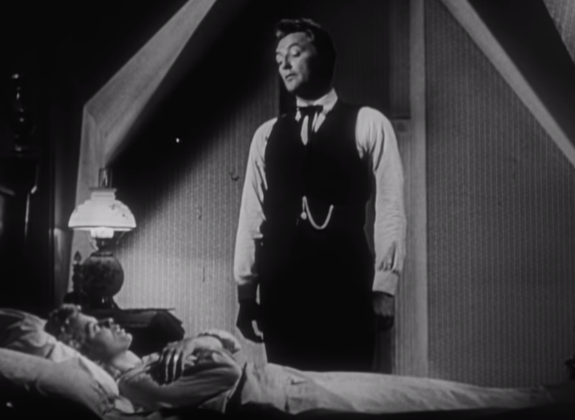 Mitchum as false preacher Harry Powell with Shelley Winters as Willa Harper in The Night of the Hunter, where reassuring authority becomes a weapon.
 Heaven Knows, Mr. Allison found gentleness without softness
John Huston’s Heaven Knows, Mr. Allison places Mitchum’s Marine Corporal Allison and Deborah Kerr’s Sister Angela alone on a Pacific island during the Second World War. The premise encourages romance, but the film depends on restraint. Their affection develops inside commitments neither character can simply abandon.
Mitchum makes Allison direct, physically capable and sometimes socially clumsy. The performance never treats him as stupid. His respect for Sister Angela grows alongside desire, and the tension matters because he understands that her religious vocation is not an obstacle invented for the plot.
Kerr and Mitchum work through differences in rhythm. Her precision meets his apparent looseness, and both actors show how attention can become intimacy. When Allison drinks and speaks too openly, Mitchum allows embarrassment to remain after the immediate scene. The character’s strength does not protect him from loneliness.
The film demonstrates that Mitchum’s masculinity could create safety as effectively as threat. He does not have to become gentle by losing size, voice or authority. Instead, those qualities are placed in service of another person’s survival. Their later reunion in The Sundowners developed a different but equally persuasive partnership, this time inside a marriage tested by movement and conflicting ideas of home.
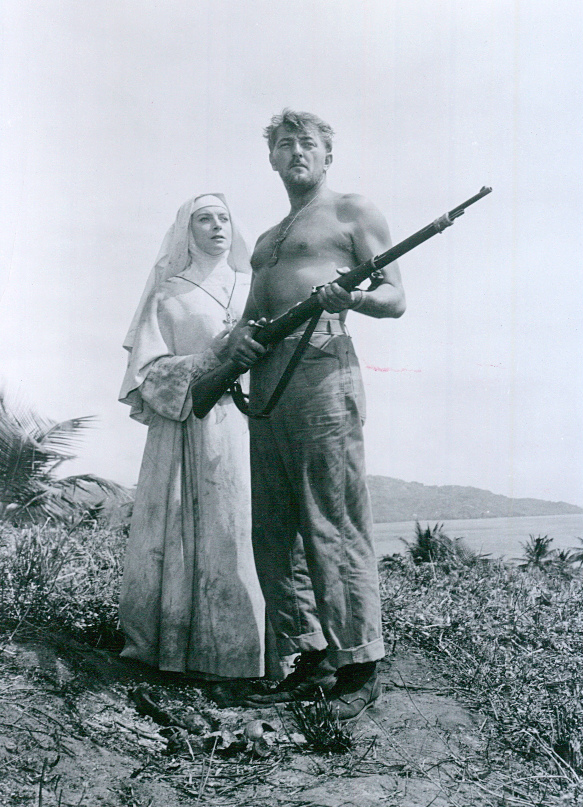 Robert Mitchum and Deborah Kerr in Heaven Knows, Mr. Allison. The partnership finds gentleness in physical strength without making either character sentimental.
Thunder Road joined acting, producing, writing and music
Mitchum was more involved in Thunder Road than a standard acting credit suggests. Released in 1958, the film follows moonshine driver Lucas Doolin as he faces federal agents and organised criminals. Mitchum helped develop the story, served as producer and recorded “The Ballad of Thunder Road”, which became a charting single.
The film draws on folk stories and economic realities surrounding illegal liquor in the American South. It also fits Mitchum’s public identity perfectly: an independent driver resists both government authority and criminal control. That fit could have produced pure self-mythology. Instead, Lucas feels increasingly trapped by the skills that once gave him freedom.
Mitchum’s musical work is not a footnote. He recorded the calypso album Calypso Is Like So… after filming in the Caribbean and later released country material. Modern listeners may debate the cultural framing of a Hollywood star adopting calypso, but the recordings confirm his strong feeling for phrasing. The low, unhurried vocal line works for the same reason his screen dialogue does: rhythm arrives before display.
Thunder Road became a durable regional favourite and an important part of car culture. It also reveals an actor more engaged with production than the lazy-professional story allows. Mitchum may have mocked Hollywood’s seriousness, but here he helped construct the vehicle, in every sense, around a subject and sound he understood.
Cape Fear removed every trace of safety
In J. Lee Thompson’s Cape Fear, Mitchum plays Max Cady, a convicted sexual offender seeking revenge on lawyer Sam Bowden, played by Gregory Peck. Peck’s familiar moral authority makes an ideal target. Mitchum turns the relaxed body that once suggested reassurance into a constant invasion of space.
Cady does not need to shout continually. He appears in public places where Bowden cannot easily act, smiles as though the two men share an understanding and uses the law’s limits against the lawyer. Mitchum’s voice becomes oily rather than weary. The character enjoys forcing respectable people to reveal how quickly their principles change when the threat becomes personal.
The film is disturbing not only because Cady is violent, but because sexual threat is used to terrorise the women around Bowden. Modern viewers should recognise where the story gives its female characters too little independent perspective. Mitchum’s performance remains effective because he does not turn Cady into abstract evil. He shows a man calculating precisely how fear moves through a family.
Martin Scorsese’s 1991 remake cast Robert De Niro as Cady and gave Mitchum a different role as police lieutenant Elgart. That return acknowledges the authority of the original while refusing simple repetition. By then Mitchum no longer needed to play the monster to remind us whose shadow covered the story.
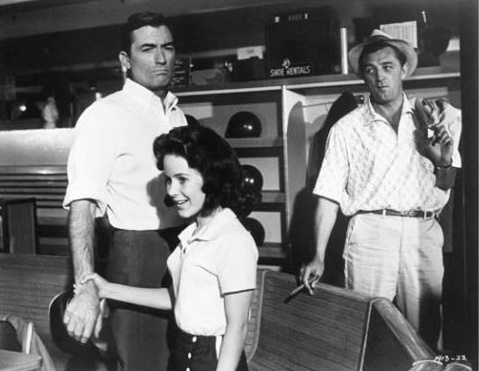 Gregory Peck, Lori Martin and Robert Mitchum in a Cape Fear publicity photograph. Mitchum turns relaxed physical confidence into Max Cady’s calculated threat.
 Westerns revealed loyalty, failure and dry humour
Mitchum’s westerns run throughout his career, from the Hopalong Cassidy apprenticeship to Pursued, Blood on the Moon, The Lusty Men, Track of the Cat and El Dorado. The genre suited his physical confidence, but the best examples do not present uncomplicated frontier mastery.
Nicholas Ray’s The Lusty Men casts him as a damaged rodeo rider whose experience is both valuable and dangerous. William Wellman’s Track of the Cat uses colour so sparingly that Mitchum’s red coat becomes part of the family conflict cutting across a snowbound landscape. These men carry knowledge that does not guarantee wisdom.
Howard Hawks’s El Dorado in 1966 pairs Mitchum with John Wayne. Mitchum plays Sheriff J.P. Harrah, an able lawman who has collapsed into alcoholism after romantic humiliation. Wayne’s Cole Thornton and a younger group help him recover before the final confrontation.
The pleasure lies in the friendship. Wayne’s direct authority meets Mitchum’s rueful humour, and Hawks allows professional competence to return through companionship rather than a miraculous declaration. Mitchum is funny during Harrah’s humiliation but never asks us to treat addiction as a harmless joke. The performance understands how pride can make help difficult to receive.
Ryan’s Daughter survived a famous critical beating
David Lean’s Ryan’s Daughter in 1970 cast Mitchum as Charles Shaughnessy, a quiet Irish schoolteacher married to Sarah Miles’s restless Rosy. The film’s large-scale landscapes and romantic tragedy divided audiences and drew severe criticism. At a well-known National Society of Film Critics gathering, Lean faced a hostile questioning that affected his willingness to direct again for years.
Mitchum’s work is easy to lose inside that production history. Charles is not a conventional romantic hero. He recognises that his wife wants an intensity he cannot provide, and Mitchum makes the recognition painful without turning it into self-pity. The stillness here does not signal superior knowledge. It belongs to a man whose decency cannot solve an emotional mismatch.
The casting also shows directors using the history of Mitchum’s image. A performer associated with sexual confidence plays a husband who feels inadequate and watches desire move elsewhere. The audience’s expectation becomes part of the character’s humiliation.
The film remains debatable. Its Irish setting, scale and treatment of politics invite serious criticism, and no single reappraisal has to reverse the original verdict. Mitchum’s performance can be valued without declaring every element a misunderstood masterpiece.
The Friends of Eddie Coyle let age enter the image
Peter Yates’s The Friends of Eddie Coyle in 1973 gives Mitchum one of his finest late roles. Eddie is a low-level Boston criminal facing prison and trying to trade information without being killed by the people around him. There is no romantic noir lighting to make defeat beautiful. Meetings happen in car parks, bars, kitchens and ordinary cars.
Mitchum allows age to change the familiar calm. Eddie is still observant, but observation no longer gives him an advantage. He talks because silence will not solve the sentence hanging over him, then discovers that information has less value than he hoped. His body looks heavy with consequences rather than powerful with withheld violence.
The performance is detailed without advertising detail. Eddie’s complaints, small negotiations and attempts at friendliness create the sense of a man who has spent years near important criminals without becoming important himself. Mitchum does not ask us to confuse criminal failure with innocence. He shows the fear inside a limited man running out of choices.
After decades of stars playing gangsters as dangerous individualists, Eddie’s world is almost bureaucratic. Guns move through supply chains, informants are managed and loyalty lasts only while useful. The rebel image reaches its bleakest correction: independence is not available, and the system barely notices the man trying to escape it.
Marlowe, television and the long late career
Mitchum played Philip Marlowe in Farewell, My Lovely in 1975 and again in The Big Sleep in 1978. He was older than Raymond Chandler’s detective is usually imagined, which became the point. This Marlowe has seen corruption repeat itself and continues less from optimism than professional habit.
Farewell, My Lovely uses period recreation and neo-noir nostalgia, while Mitchum prevents the exercise from becoming fancy dress. The voice sounds as if it has carried too many explanations. He can still handle violence, but the performance knows recovery takes longer.
Television introduced him to audiences who may not have known the RKO films. As Victor “Pug” Henry in The Winds of War and War and Remembrance, Mitchum anchored a huge historical narrative with the same ability to make authority conversational. The scale was enormous, but he did not inflate himself to match it.
Later films included That Championship Season, The Yakuza, Mr. North, Jim Jarmusch’s Dead Man and the Cape Fear remake. Not every role was worthy of him, and he rarely behaved as though career curation were a sacred duty. The accumulation still matters. Across more than half a century, the face changed while the actor kept finding new uses for what audiences thought they already knew.
The public rebel and the private professional
Mitchum repeatedly gave interviewers lines that made acting sound simple. He mocked prestige, claimed not to watch many of his films and encouraged the belief that he arrived, spoke and went home. Those remarks are entertaining, but a performer can be both genuinely irreverent and strategically protective.
Downplaying effort prevented failure from looking like earnest failure. It also allowed Mitchum to resist an industry that demanded public gratitude while treating actors as replaceable property. If a film was poor, he could imply that he had never mistaken it for art. If it was excellent, the performance appeared miraculous.
Colleagues often described a different working reality: lines learned, marks hit, technical problems understood and other actors helped. His methods did not require visible preparation on set, which made discipline easy to miss. In The Night of the Hunter, he could support child performers; in large television productions, he could hold complicated material steady.
The image also had costs. Rebellion could excuse bad choices, heavy drinking and behaviour that affected other people. A balanced biography should neither punish him for failing to behave like a modern publicity subject nor celebrate every excess as proof of authenticity. The useful distinction is between persona and evidence. The persona says he did not care. The body of work says he cared selectively, privately and sometimes very deeply.
Family, health and death
Robert and Dorothy Mitchum remained married throughout his adult career and raised three children. James and Christopher became actors, while Petrine became a writer. The family sometimes travelled with him, and Dorothy managed a marriage shaped by long productions and a husband whose public legend included infidelity.
Mitchum smoked heavily for decades. In later life he experienced emphysema and was diagnosed with lung cancer. He continued appearing on screen almost to the end, by which time age had made the once-heavy eyelids and slow movement look less like cultivated detachment than physical history.
He died on 1 July 1997 at his home in Santa Barbara, five weeks before his eightieth birthday. James Stewart died the following day, and the closeness of their deaths encouraged reflections on the passing of a Hollywood generation. The comparison was striking: Stewart had often represented earnest civic decency, while Mitchum represented doubt, appetite and refusal. Both images were more complicated than the labels.
Mitchum’s ashes were scattered at sea, and Dorothy died in 2014. The long marriage, children and private routines never displaced the wandering rebel in popular memory. They should at least remind us that no star persona contains an entire life.
How Robert Mitchum acted
Mitchum’s technique begins with divided signals. The body may appear relaxed while the eyes remain alert. The voice may be calm while a pause tells us that anger has arrived. He rarely explains the contradiction because the camera can hold both pieces at once.
In Out of the Past, that division creates fatalism: Jeff knows more than he can use. In The Night of the Hunter, it creates horror: Powell’s reassuring voice and murderous purpose occupy the same frame. In Heaven Knows, Mr. Allison, physical strength and emotional delicacy support one another. In The Friends of Eddie Coyle, calm becomes the exhausted habit of a man without leverage.
Mitchum also understood scale. A low-budget western required immediate clarity. Noir allowed smaller reactions. Epic filmmaking needed presence that could survive landscape without constant enlargement, while television required steadiness across many hours. He adjusted without replacing his recognisable manner.
The mistake is to ask whether Mitchum “played himself” as though the answer settled the question. Screen acting always uses available body, voice, history and expectation. The achievement lies in variation. Mitchum took an image that appeared narrow, a tired and dangerous man who would not explain himself, and found decency, comedy, evil, romance, failure and old age inside it.
Where to begin with Robert Mitchum’s films
We suggest a route that keeps changing the moral meaning of his calm.
- The Story of G.I. Joe (1945): Begin before the rebel legend. The performance shows responsibility and grief with extraordinary economy.
- Out of the Past (1947): This is the essential noir role, where intelligence does not provide escape from desire or consequence.
- Holiday Affair (1949): The romantic comedy demonstrates warmth, humour and his ease with a child performer.
- The Night of the Hunter (1955): Watch the trusted voice and body become instruments of terror in Charles Laughton’s dark fable.
- Heaven Knows, Mr. Allison (1957): The partnership with Deborah Kerr reveals gentleness that never feels imposed from outside the character.
- Cape Fear (1962): Compare Harry Powell’s theatrical evil with Max Cady’s calculated, physically immediate threat.
- El Dorado (1966): Mitchum and John Wayne turn male friendship, failure and recovery into the film’s real story.
- The Friends of Eddie Coyle (1973): Finish with age, limitation and a criminal world too ordinary to support romantic rebellion.
After these, try Crossfire, The Lusty Men, Thunder Road, The Sundowners, Ryan’s Daughter and Farewell, My Lovely. The route does not prove that every Mitchum film is good. It proves that the familiar manner could contain far more than one character.
Film noir, rebellion and the actor behind the image
Film noir gave Robert Mitchum his perfect landscape because it allowed knowledge and helplessness to coexist. His characters could recognise corruption without standing outside it. The voice remained calm because outrage would not change the terms. The body remained loose because tension had already moved inward.
Rebellion then gave the industry a way to explain the effect. The wandering youth, arrest, jail photographs, jokes and refusal to flatter Hollywood all became evidence that the screen persona was simply the man. That story helped Mitchum protect himself and helped studios sell him.
The actor behind the image is visible whenever the meaning changes. Compare Jeff Bailey’s reluctant surrender with Harry Powell’s predatory confidence. Compare Max Cady’s invasion of space with Corporal Allison’s protective strength. Compare the young Lieutenant Walker’s exhaustion with Eddie Coyle’s late-life defeat. The surface remains recognisable, but the moral and emotional structures are entirely different.
Mitchum was not careless enough to be accidental or solemn enough to advertise mastery. He found a third position: work so exact that it could pass for doing nothing. That is why the performances survive the legend that once threatened to explain them away.
Questions readers often ask
What was Robert Mitchum’s real name?
His full name was Robert Charles Durman Mitchum. He was born in Bridgeport, Connecticut, on 6 August 1917.
Was Robert Mitchum really on a chain gang?
Mitchum described being arrested for vagrancy as a teenager and serving on a Georgia chain gang before escaping. Biographers have treated the broad episode as part of his youth, but details vary and Mitchum was a gifted storyteller. It is safest to avoid presenting every repeated anecdote as independently verified fact.
Why was Robert Mitchum arrested in 1948?
He was arrested during a marijuana raid at actor Lila Leeds’s home and later entered a no-contest plea to a conspiracy charge. He served time in county custody and at a prison farm. In 1951 the conviction was set aside and the charge dismissed with the approval of the Los Angeles district attorney’s office.
Did the marijuana arrest ruin Robert Mitchum’s career?
No. RKO supported him, his films continued to draw audiences and the publicity strengthened his established rebel image. His ability to survive should not be treated as proof that the arrest was harmless; studio backing and his position as a popular white male star materially affected the outcome.
What was Robert Mitchum’s only Oscar nomination?
He was nominated for best supporting actor for The Story of G.I. Joe, released in 1945. Despite later acclaimed performances, he never received another competitive Academy Award nomination.
Did Robert Mitchum sing?
Yes. He recorded Calypso Is Like So…, country material and “The Ballad of Thunder Road”. His musical phrasing and baritone voice are closely related to the unhurried vocal control heard in his acting.
Was Robert Mitchum married?
He married Dorothy Spence in 1940, and they remained married until his death in 1997. They had three children: James, Christopher and Petrine. The marriage endured despite long separations and reports of Mitchum’s affairs.
What is Robert Mitchum’s best film?
There is no objective single answer. Out of the Past is the best introduction to his film-noir persona, The Night of the Hunter contains his most celebrated villain and The Friends of Eddie Coyle is often considered his great late performance. The Story of G.I. Joe is essential for understanding the actor before the legend.