Gregory Peck : Personal Info
Full name : Eldred Gregory Peck
Born : 5 April 1916, La Jolla, California
Died : 12 June 2003, Los Angeles, California
Nationality : American
Occupations : Actor, producer
Years active : 1941–2000
Known for : Spellbound, The Yearling, Gentleman’s Agreement, Roman Holiday, Moby Dick, The Guns of Navarone, Cape Fear, To Kill a Mockingbird
Major honours : Academy Award for Best Actor; Jean Hersholt Humanitarian Award; Presidential Medal of Freedom; Kennedy Center Honor
Gregory Peck : Introduction
Gregory Peck’s deep voice and upright bearing made him a natural choice for men expected to carry responsibility. Hollywood repeatedly cast him as doctors, soldiers, lawyers, diplomats and fathers. The danger was respectability without friction. Peck’s best work avoids it by showing the cost of being treated as the moral centre.
Atticus Finch became the defining role, but Peck’s range was wider than that reputation suggests. He played a dangerously unstable patient in Spellbound, a reckless cattle baron in Duel in the Sun, the obsessive Captain Ahab in Moby Dick and a frightened father in Cape Fear. Even his romantic comedy in Roman Holiday depends on a journalist recognising that professional advantage has become a moral test.
 Gregory Peck in a black-and-white publicity photograph.
Gregory Peck : Early Life and Training
Peck was born in La Jolla, California. His parents separated when he was young, and he spent part of his childhood with his maternal grandmother. He attended a Catholic military school and later studied at the University of California, Berkeley, where rowing and theatre helped replace an earlier intention to study medicine.
After graduation he moved to New York and trained at the Neighborhood Playhouse under Sanford Meisner. The years before success included temporary jobs and limited money. Stage work finally brought him to Broadway in the early 1940s.
Peck did not serve during the Second World War because of a spinal injury. An old account that blamed rowing was later corrected by Peck, who said the damage came from movement during a dance lesson. The exemption left him available when Hollywood needed new leading men, but his theatre preparation prevented him from seeming merely convenient.
Gregory Peck : Rapid Hollywood Breakthrough
Peck’s film rise was unusually fast. Days of Glory appeared in 1944, followed by The Keys of the Kingdom, which brought his first Academy Award nomination. Within several years he received further nominations for The Yearling, Gentleman’s Agreement and Twelve O’Clock High.
Alfred Hitchcock used Peck’s composure as a mystery in Spellbound. Ingrid Bergman’s psychiatrist believes in the frightened man behind his assumed identity, while Peck’s stiffness becomes evidence of repression rather than limited technique. The Academy’s Gregory Peck collection places the film among the works that established his unusually durable early reputation.
Duel in the Sun moved in the opposite direction. Peck’s Lewt McCanles is selfish, violent and sexually possessive. The performance is broader than his later work, but it shows that the “noble Peck” image was never the whole career.
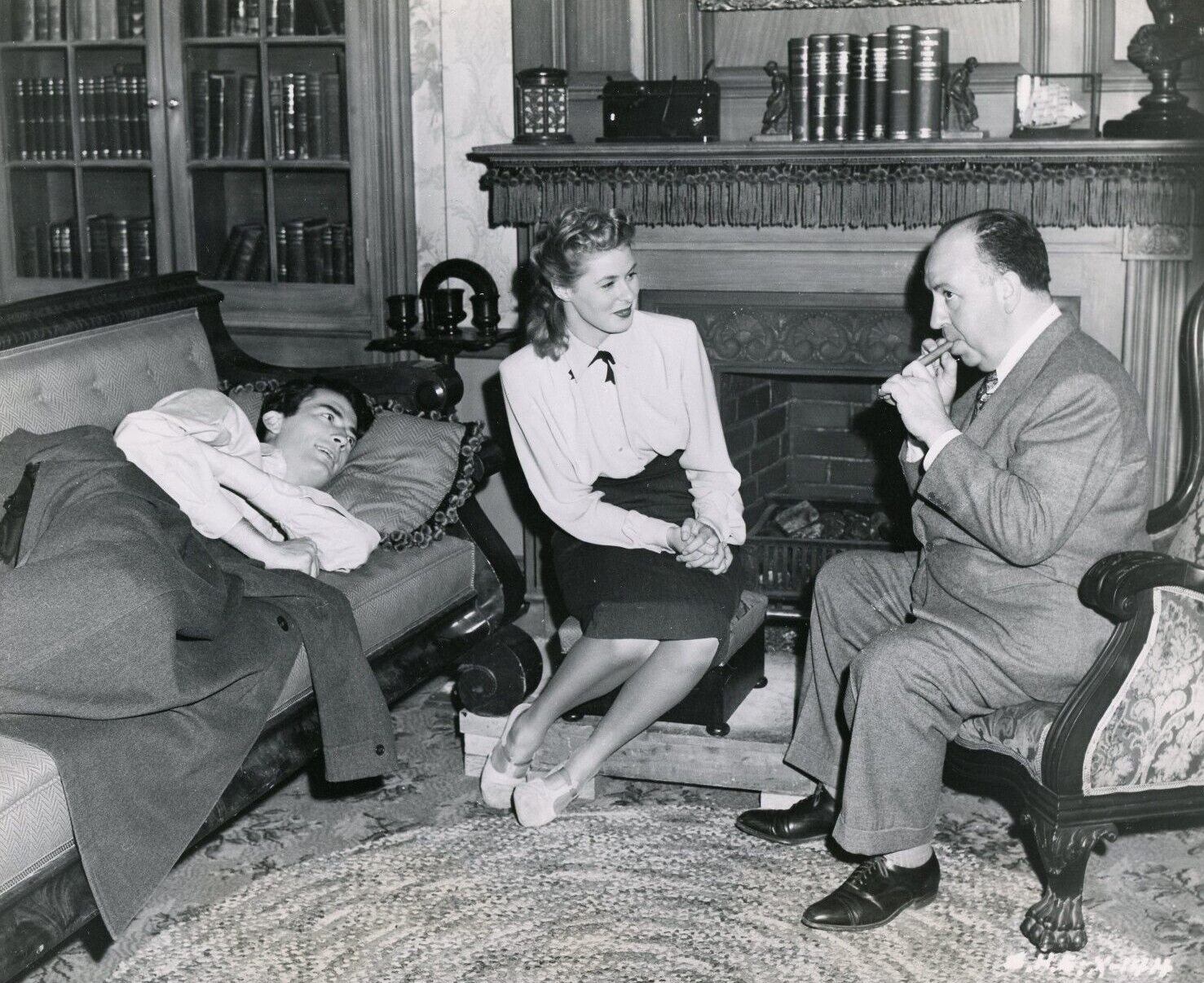 Gregory Peck, Ingrid Bergman and Alfred Hitchcock during production of Spellbound (1945).
Gregory Peck : Gentleman’s Agreement and Public Responsibility
In Gentleman’s Agreement (1947), Peck plays a journalist who pretends to be Jewish to investigate antisemitism. The film won Best Picture and brought another acting nomination. Its method can feel didactic, and the Jewish characters sometimes receive less dramatic space than the gentile hero’s awakening.
Yet the picture was unusually direct for a major Hollywood production of its period. Peck’s restrained anger suits a story about prejudice expressed through clubs, housing, jokes and polite evasions rather than only open violence.
The role also fitted his developing public identity. Peck supported liberal causes, civil rights and industry institutions. He later served as president of the Academy and chairman of the American Film Institute’s board. His politics were not identical to every role, but audiences increasingly linked the actor with civic seriousness.
Gregory Peck : Roman Holiday
Roman Holiday (1953) gave Peck one of his lightest and most generous performances. Joe Bradley initially sees Audrey Hepburn’s runaway princess as an exclusive story. Their day in Rome gradually makes the deception impossible to sustain.
Peck recognised Hepburn’s impact and insisted that her name receive equal prominence in the billing. She won the Academy Award, but his contribution is essential: he allows Joe’s calculation to soften without turning the change into a speech.
The final press-conference sequence depends on control. Joe and Princess Ann speak formally while acknowledging privately that the relationship cannot continue. Peck’s stillness gives the farewell its weight.
Gregory Peck : Moby Dick and The Big Country
John Huston’s Moby Dick cast Peck as Captain Ahab. Peck later felt he was too young, but the performance is fascinating precisely because physical authority has become fanaticism. Ahab’s voice binds the crew to a private revenge that he presents as destiny.
In William Wyler’s The Big Country, Peck’s James McKay refuses to perform masculinity for spectators. He will fight when necessary but rejects public displays meant to prove courage. The role is a quiet correction to Western heroes who confuse violence with character.
Peck also produced the film. His willingness to support large, serious projects did not always lead to easy productions, but it gave him more influence over the values attached to his star image.
Gregory Peck : To Kill a Mockingbird
Atticus Finch in To Kill a Mockingbird (1962) brought Peck his Academy Award. Harper Lee’s novel places the story largely through a child’s memory, and Peck understood that Atticus needed domestic warmth as well as courtroom authority.
He met Lee and her father, who had helped inspire the character. Lee gave Peck her father’s pocket watch, an object he wore when accepting the Oscar. The personal connection strengthened the mythology, although the performance succeeds through craft: lowered voice, patient attention to the children and flashes of controlled fear.
The film’s treatment of racism now draws necessary criticism. Tom Robinson remains the victim around whom a white family’s moral education is organised, and Atticus’s liberalism has limits. Even so, Peck makes defeat visible without confusing it with futility. The American Film Institute later named Atticus Finch its leading American screen hero.
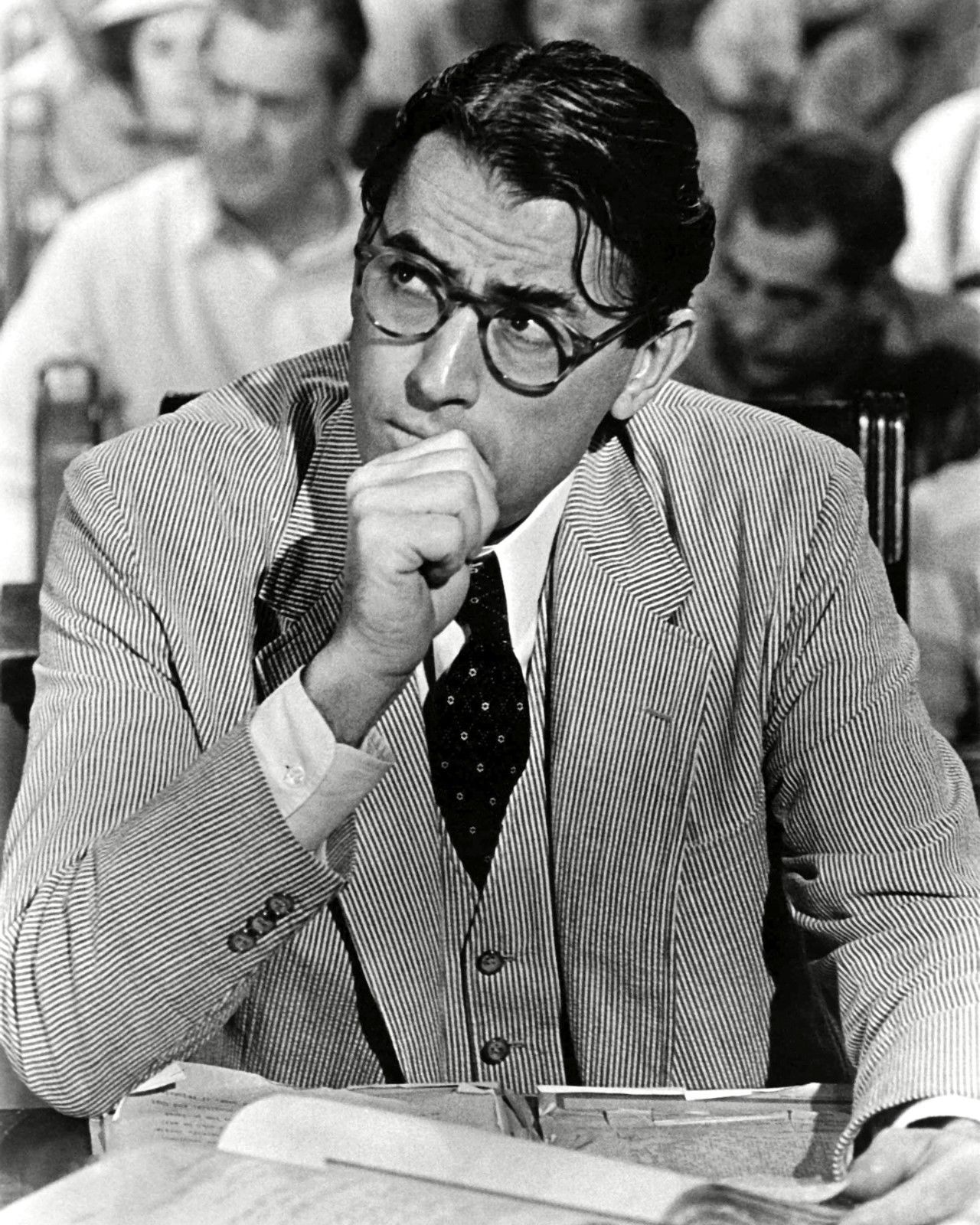 Gregory Peck as Atticus Finch in a publicity portrait for To Kill a Mockingbird (1962).
Gregory Peck : Cape Fear, Later Films and Changing Images
In Cape Fear (1962), Robert Mitchum’s Max Cady attacks the security attached to Peck’s respectable family man. Peck’s lawyer is not an invulnerable hero; fear pushes him towards ethically questionable choices. The film gains tension by making social authority look insufficient.
Later roles included The Guns of Navarone, The Omen, MacArthur and The Boys from Brazil. The Omen used Peck’s paternal credibility in a supernatural horror story, while The Boys from Brazil cast him startlingly against type as Nazi doctor Josef Mengele.
He worked less frequently from the 1980s, appearing in television projects and accepting honours. A cameo in Martin Scorsese’s 1991 remake of Cape Fear let him play an unhelpful defence lawyer, reversing his original position.
Gregory Peck : Spellbound, Twelve O’Clock High and the Burden of Command
Alfred Hitchcock’s Spellbound asked Peck to play a man whose identity is hidden even from himself. Ingrid Bergman supplies the investigative drive, while Peck makes physical unease visible beneath a conventionally handsome surface.
The film’s psychoanalysis is simplified and often fanciful, but the role showed that Peck’s stillness could register fear as effectively as authority. Hitchcock used the face audiences trusted and made uncertainty appear behind it.
Twelve O’Clock High gave him one of his strongest command roles. As General Frank Savage, he arrives to restore a bomber group’s discipline and gradually absorbs the psychological cost carried by his men.
Peck avoids turning leadership into speeches alone. Savage’s posture, clipped decisions and eventual collapse show authority as labour. The performance earned his fourth Academy Award nomination within five years.
In The Gunfighter, the burden belongs to reputation. Peck’s ageing gunman wants to escape the young men who gain status by challenging him. The moustache surprised studio executives, but the inward performance helped revise the heroic western image before the genre’s later psychological cycle.
These films reveal a recurring Peck subject: the decent or capable man discovering that responsibility cannot protect him from damage.
Gregory Peck as Producer and Industry Citizen
Peck did not remain only a contract actor. He formed a production company and became involved in projects including The Big Country and To Kill a Mockingbird, taking greater responsibility for material and tone.
He served as president of the Academy of Motion Picture Arts and Sciences and later chaired the American Film Institute’s board. These positions matched the seriousness associated with his screen roles, but they also involved practical work supporting film culture.
Peck was politically active, generally supporting liberal causes and opposing the Hollywood blacklist. He narrated and participated in civic projects while remaining selective about how directly politics entered his films.
President Lyndon B. Johnson awarded him the Presidential Medal of Freedom in 1969. The honour recognised a public presence that extended beyond box-office success.
His authority could become a limitation when scripts expected nobility automatically. The best directors complicated it, asking what moral certainty costs or how it survives pressure.
Gregory Peck : Marriages, Family and Loss
Peck married Greta Kukkonen in 1942, and they had three sons before divorcing. In 1955 he married French journalist Veronique Passani, with whom he had two children. Their marriage lasted until his death.
His eldest son, Jonathan, died by suicide in 1975. Peck spoke about the loss with restraint and supported mental-health and charitable work, but it would be reductive to treat later public service as a simple response to one tragedy.
Peck died in Los Angeles in 2003, aged 87. Veronique was with him. His death produced tributes that often merged Atticus Finch with the actor, a comparison Peck valued but one that can obscure the riskier performances.
Gregory Peck : Legacy
Peck made integrity dramatically interesting by allowing it to be tested. In weaker films, his authority could become static. In the best, honour requires decisions that cost the character something.
His legacy also rests on institutional service. The Academy, American Film Institute and Motion Picture & Television Fund benefited from his participation, while the Presidential Medal of Freedom and Jean Hersholt Humanitarian Award recognised public work beyond acting.
Start with Roman Holiday for charm, Twelve O’Clock High for command under strain, Cape Fear for vulnerability and To Kill a Mockingbird for the role that permanently joined Peck’s voice to an ideal of moral courage.
Selected Gregory Peck Filmography
1944 – The Keys of the Kingdom : First Academy Award nomination
1945 – Spellbound : Hitchcock thriller with Ingrid Bergman
1947 – Gentleman’s Agreement : Antisemitism drama and Best Picture winner
1949 – Twelve O’Clock High : Command under wartime pressure
1953 – Roman Holiday : Romantic comedy with Audrey Hepburn
1956 – Moby Dick : Captain Ahab for John Huston
1958 – The Big Country : Western rejecting performative violence
1961 – The Guns of Navarone : Ensemble wartime adventure
1962 – Cape Fear : Family man threatened by Robert Mitchum
1962 – To Kill a Mockingbird : Academy Award-winning Atticus Finch
1976 – The Omen : Supernatural horror hit
Gregory Peck : Frequently Asked Questions
What Oscar did Gregory Peck win?
He won Best Actor for To Kill a Mockingbird after four earlier acting nominations.
Was Gregory Peck related to Atticus Finch’s inspiration?
No, but Harper Lee based important aspects of Atticus on her father. Peck became close to Lee and received her father’s pocket watch.
What is a good Gregory Peck film to watch first?
Roman Holiday is the most welcoming introduction. To Kill a Mockingbird defines his public image, while Cape Fear and Moby Dick reveal less reassuring sides of his screen presence.
Related Articles
20 Classic Courtroom Dramas Every Film Fan Should See
20 Classic Hollywood Actors Everyone Should Know
Career and award details were checked against the Academy’s Gregory Peck collection and institutional records.