Montgomery Clift reached the screen as a complete actor rather than a promising beginner. He had already spent more than a decade on the New York stage, turned down Hollywood offers and developed a way of working that made thought visible in unfinished sentences, nervous movement and attention to other performers. When audiences saw The Search and Red River in 1948, the American leading man suddenly seemed less certain of himself.
Clift is now discussed through two images. The first is the astonishingly beautiful young actor of A Place in the Sun and From Here to Eternity. The second is the injured, dependent man whose later career has often been described as a slow act of self-destruction. Both images are incomplete. In this biography, we will look at the technique, choices and working relationships that made Clift important, then discuss the 1956 car crash and its consequences without treating disability or addiction as the end of his artistic life.
His career contains only seventeen released feature films, yet it changed what audiences expected from male vulnerability. Clift could play soldiers, ranch hands and priests without sealing emotion behind toughness. He did not remove masculinity from those roles. He showed that uncertainty, shame and need had been there all along.
 Montgomery Clift by Max Coplan, 1950. Image credit: Max Coplan of Paramount [1] / Modern Screen, February 1950, page 28 / public domain.
Montgomery Clift at a glance
- Full name: Edward Montgomery Clift
- Born: 17 October 1920 in Omaha, Nebraska
- Died: 23 July 1966 in New York City
- Occupation: Actor
- Years active: 1933 to 1966
- Best-known films: The Search, Red River, The Heiress, A Place in the Sun, I Confess, From Here to Eternity, The Young Lions, The Misfits and Judgment at Nuremberg
- Major recognition: Four Academy Award nominations
- Frequent collaborators: Elizabeth Taylor, Fred Zinnemann and acting coach Mira Rostova
- Distinctive quality: A leading-man presence built around listening, hesitation and psychological preparation
A mobile childhood and a mother determined to supply a lost inheritance
Clift was born in Omaha, the son of William Brooks Clift and Ethel Anderson Clift, known as Sunny. He had a twin sister, Roberta, and an older brother, Brooks. His father worked in finance, and the family lived comfortably before the Depression damaged their security.
Sunny believed that she had been born into a distinguished family and adopted after an irregular beginning. She devoted substantial energy to tracing that ancestry and educating her children according to the social position she believed had been denied to her. The family travelled in Europe, and tutors supplied much of the children’s education.
The background gave Montgomery cultural experience, languages and confidence around adults, but it did not create emotional stability. Frequent movement, parental ambition and the family’s changing finances produced a childhood that could feel privileged and unsettled at the same time. Later profiles often turned Sunny into the single explanation for her son’s difficulties. She was a powerful influence, but an adult life cannot be diagnosed backwards through one parent.
Clift entered professional theatre while still a child. He appeared on Broadway in Fly Away Home in 1935 and continued in productions including There Shall Be No Night, The Skin of Our Teeth, Our Town and The Searching Wind. He worked with respected actors and directors while most future film stars of his generation were still in school.
The theatre years gave him experience with new American writing and long rehearsal. They also made him sceptical of Hollywood’s desire to sign attractive young men before deciding what to do with them. Clift wanted to choose material, protect periods for stage work and avoid a studio agreement that could assign roles without his consent.
 Promotional photograph for the Broadway production of Dame Nature, starring Montgomery Clift and Lois Hall. Image credit: Stage Publishing Company, Inc., photograph by Vandamm Studio / Stage magazine for October 1938, Volume 15, Number 13 (page 45).
He delayed Hollywood until the terms allowed him to work his way
Studios approached Clift during the 1940s, but he resisted long-term contracts. He was medically classified out of military service during the Second World War because of chronic intestinal illness, a fact that sometimes produced guilt or public misunderstanding when other actors served. He continued working on stage and toured with productions connected to wartime morale.
When Clift finally agreed to films, he negotiated unusual control over scripts and directors. This independence has sometimes been described as arrogance. In an industry built on seven-year contracts, it was also an informed response from an actor who already had a career and understood what typecasting could do.
Howard Hawks cast him as Matthew Garth in Red River, opposite John Wayne. The western was filmed before The Search but released later, meaning audiences encountered Clift first as an American soldier in post-war Europe and then as a young rancher challenging an established masculine authority.
Clift prepared intensively. He did not simply learn lines and arrive with sensitivity. He studied physical tasks, altered dialogue and tried to build behaviour from what the character knew. Acting coach Mira Rostova became one of his closest professional advisers. Their working relationship could frustrate directors who expected decisions to remain on set, yet the results were visible.
Clift is often called a Method actor, but the label can mislead. He was not simply applying one Actors Studio system, and he resisted being placed inside a fashionable school. His technique drew on years of stage practice, close script analysis, personal observation and detailed rehearsal. The common feature was not emotional display. It was the attempt to make each choice belong to the character rather than the star.
The Search made a soldier look as though he had not rehearsed being one
Fred Zinnemann’s The Search (1948) was filmed in the ruins of post-war Germany. Clift played Ralph Stevenson, an American Army engineer who cares for a Czech boy separated from his mother. The location photography and displaced children gave the film a near-documentary atmosphere.
Clift’s performance fits that environment because he avoids the polished authority of a conventional movie soldier. Ralph speaks casually, moves without parade-ground precision and learns how to communicate with the child through practical repetition. The warmth is never announced as noble sacrifice. It grows from time spent together.
Clift worked on the dialogue and reportedly drew from observation of American servicemen. The result was natural enough that some viewers assumed the production had found a real soldier. That response pleased publicity, but it can hide the craft. Appearing unrehearsed on camera often requires more preparation, not less.
The film earned Clift an Academy Award nomination for best actor on his screen debut. It also established his resistance to the studio voice. He did not sound as though every sentence had been written to define the character. Thoughts changed during speech, and attention moved towards whoever else occupied the scene.
 Cropped screenshot of Montgomery Clift from The Search. Image credit: Trailer screenshot / The Search trailer / public domain.
Red River placed a new kind of man opposite John Wayne
In Red River (1948), Wayne plays Tom Dunson, a rancher driving cattle from Texas while imposing his will on the men around him. Clift’s Matt Garth is Dunson’s adopted son and most capable lieutenant. As Dunson becomes punitive and dangerous, Matt must decide when loyalty becomes complicity.
The casting creates the conflict before either man speaks. Wayne’s physical and vocal certainty fills the landscape. Clift is slighter, quicker and more visibly responsive. Matt does not defeat Dunson by becoming a younger copy. He watches the men, recognises the point at which authority has lost consent and acts.
The film includes a famous scene in which Matt and gunman Cherry Valance compare weapons. Its erotic suggestion has been widely discussed in queer readings of the western. We do not need to claim a single intended meaning to notice how unusual the exchange feels inside the genre. Clift’s presence made emotional and sexual ambiguity possible without removing the character’s competence.
Relations between Clift and Wayne were not warm, and their political differences have become part of the production legend. Accounts vary in detail. What matters on screen is that mutual resistance serves the story. Matt’s disagreement with Dunson is not teenage rebellion. It is a challenge to a model of leadership that treats obedience as proof of manhood.
The ending softens the conflict through comedy and reconciliation, a decision some viewers find unconvincing after the violence that precedes it. Clift nevertheless changed the western’s emotional balance. A hero could be physically brave, morally decisive and still appear open to doubt.
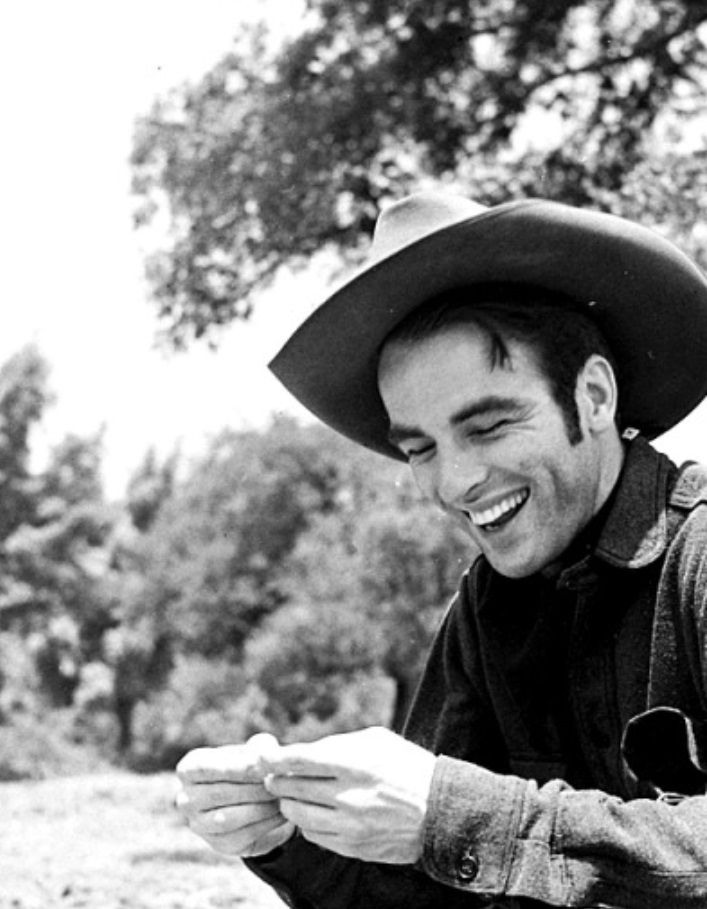 Actor Montgomery Clift on the set of the American western film Red River in 1946 (the movie was filmed in 1946 but not released until 1948). Image credit: Monterey Productions / United Artists / Montgomery Clift on the set of Red River, 1948. / public domain.
The Heiress used beauty as an unanswered question
William Wyler’s The Heiress (1949) cast Clift as Morris Townsend, the charming suitor to Olivia de Havilland’s shy Catherine Sloper. Catherine’s father believes Morris wants her money. Catherine believes that love offers escape from a household organised around contempt.
Clift disliked aspects of the role and felt the screenplay made Morris too obvious. That discomfort may help the film. His beauty and attention are real enough to make Catherine’s hope understandable, while small evasions keep motive uncertain. Morris may care for her, desire the inheritance or move between both feelings depending on what is possible.
Wyler and Clift had a difficult working relationship. Wyler demanded repeated takes and exact control, while Clift protected his own analysis. The tension did not prevent a remarkable final movement. When Morris returns and Catherine leaves him outside, Clift’s desperation is stripped of romantic assurance. For once, beauty cannot reopen a door.
The role is less sympathetic than the young men that made him famous, but it helped define his usefulness. Clift could allow audiences to desire a character without supplying the moral reassurance that desire was correct.
A Place in the Sun turned a love story into social panic
George Stevens’s A Place in the Sun (1951) paired Clift with Elizabeth Taylor and Shelley Winters. He plays George Eastman, a poor relation who goes to work in his wealthy uncle’s factory. George begins a relationship with factory worker Alice Tripp, then enters the glamorous world represented by Taylor’s Angela Vickers.
The film was marketed through the beauty of Clift and Taylor, and their close-ups remain central to its reputation. Their attraction appears private even in crowded rooms. Clift lowers his voice and allows George to seem astonished that Angela has noticed him. Taylor, still very young, responds with direct emotional confidence.
Yet the story is not simply a tragic romance interrupted by the wrong woman. Alice is pregnant, vulnerable and treated by George as the life he wants to escape. Shelley Winters makes her need impossible to dismiss. Clift shows the character thinking towards violence before he can admit the thought to himself. His indecision does not make him innocent. It makes the moral failure more recognisable.
Clift and Taylor became close friends, a relationship that continued through illness, professional difficulty and public attention. Their friendship is sometimes used to simplify his sexuality, as though deep affection between a gay or bisexual man and a woman requires a romantic explanation. The bond was significant on its own terms.
The film brought Clift another Academy Award nomination. More importantly, it established an image of masculine beauty under economic and psychological pressure. George wants the life that his face seems to promise. Clift makes us see that wanting it is not the same as deserving it.
 Elizabeth Taylor and Montgomery Clift in A Place in the Sun (1951). Image credit: Unknown author Unknown author / WorthPoint / public domain.
I Confess made listening the centre of suspense
Alfred Hitchcock’s I Confess (1953) gave Clift the role of Father Michael Logan, a priest who hears a murderer’s confession and is then suspected of the crime. The sacramental seal prevents him from revealing what he knows.
Hitchcock and Clift were an awkward pairing. Hitchcock preferred actors who would fit precisely into a visual plan, while Clift asked questions, revised behaviour and worked with Rostova. The director later expressed frustration. The finished film is stronger than the conflict suggests.
Father Logan cannot explain himself, so Clift has to make silence active. He listens to accusation, remembers a past relationship and calculates what can be said without breaking the obligation. The performance is built from pressure entering the face rather than emotion leaving it.
The Quebec locations and Catholic framework give the film a severe atmosphere. Viewers who find the premise implausible may resist it, but Clift commits to the moral problem without turning the priest into a symbol. Logan is afraid, angry and still bound by a choice that other people consider irrational.
This is Clift’s technique in its purest form. Suspense usually depends on when information will be revealed. Here, the actor knows that the central information cannot be spoken. We watch the cost of keeping it.
From Here to Eternity brought discipline, love and humiliation together
Clift returned to Fred Zinnemann for From Here to Eternity (1953), playing Private Robert E. Lee Prewitt, a soldier and former boxer stationed in Hawaii before the attack on Pearl Harbor. Prewitt refuses to join his unit’s boxing team because he blinded a sparring partner. His commanding officers respond with sustained punishment.
Clift learned to box and play the bugle, studied military behaviour and worked closely on the script. Prewitt’s stubbornness could be mistaken for passive suffering. Clift makes it a form of identity. If the Army can force him to box, then the one decision he has claimed as his own no longer exists.
The relationship with Alma, played by Donna Reed, gives the character another space in which names and roles are negotiated. She calls herself Lorene and wants enough money to escape the life she has. He insists on being called Prewitt rather than “Prew” by people who have not earned intimacy. Their romance is tender because both understand that tenderness does not remove the institutions around them.
Burt Lancaster and Deborah Kerr received the film’s most famous image on the beach, while Frank Sinatra’s supporting performance became a celebrated comeback. Clift’s work is quieter and, for many viewers, more painful. The bugle performance, the barracks abuse and the final attempt to return to his unit all turn pride into something admirable and destructive at once.
Clift received his third best-actor nomination. He had now made eight films and earned three Oscar nominations. The scale of the achievement helps explain why the later decline narrative became so powerful. Audiences had come to expect each performance to redefine the possibilities of the leading man.
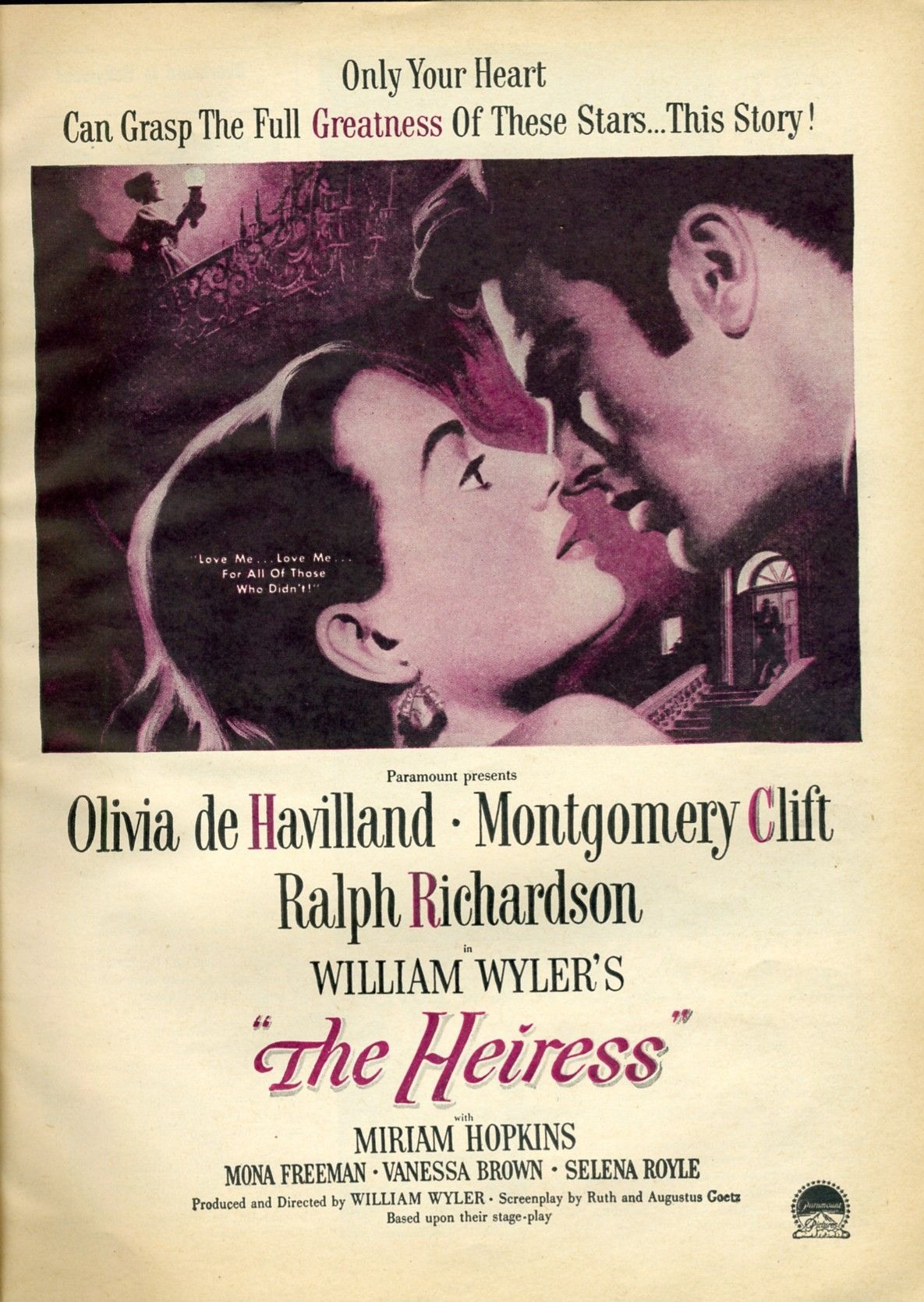 A poster for The Heiress, one of the early films in which Montgomery Clift made reserve and emotional conflict central to the leading man. Image credit: Wikimedia Commons.
The 1956 crash changed his face, health and working conditions
Clift’s car crashed after he left a party at Elizabeth Taylor’s home in May 1956 during production of Raintree County. He suffered severe facial injuries, including a broken jaw and nose, as well as damage that required surgery. Taylor came to the scene and helped him before medical assistance arrived. Some dramatic details have been repeated with differing certainty, so the event should not be embellished beyond established accounts.
Production stopped while Clift recovered. When filming resumed, the difference in his appearance was visible across scenes. Later commentators called the film a documentary of before and after, a phrase that turns injury into spectacle. Clift’s face changed, and pain, nerve damage and medication affected his work. He remained an actor rather than becoming evidence of ruin.
The crash did not create every difficulty that followed. Clift had experienced chronic health problems and used alcohol and medication before 1956. The injuries intensified pain and dependency, while studios became concerned about insurance and reliability. Public fascination with his appearance added another pressure: the actor celebrated for beauty was now watched for signs that beauty had been lost.
Disability is often written into star biographies as a moral turning point. The young face represents promise; the changed face represents decline. That structure is cruel and artistically inaccurate. Several of Clift’s post-crash performances are uneven, but others use fragility, anger and experience in ways the earlier image could not.
 Cropped screenshot of Montgomery Clift from the trailer for the film The Young Lions (1958). Image credit: Trailer screenshot / The Young Lions Trailer / public domain.
The Young Lions and Wild River showed that the later actor still had authority
In The Young Lions (1958), Clift played Noah Ackerman, a Jewish American soldier facing antisemitism within his own unit. Marlon Brando played a German officer, while Dean Martin completed the central trio. The prospect of Clift and Brando in one film encouraged comparisons between two actors associated with post-war naturalism.
Their roles rarely place them together, and the performances take different routes. Brando uses charm and gradual disillusionment. Clift makes Noah physically tense, socially exposed and determined to retain dignity. The changed face suits a man whom the institution has marked as vulnerable. Clift reportedly considered Noah among his best roles.
Elia Kazan’s Wild River (1960) cast him as Chuck Glover, a Tennessee Valley Authority official trying to persuade an elderly woman to leave land that will be flooded by a dam. Lee Remick plays her widowed granddaughter. The film examines progress, federal power, race and attachment to place without allowing any position to remain simple.
Kazan had reservations about Clift and later criticised his masculinity, comments that reveal as much about the director’s expectations as the performance. Clift’s Chuck is effective because he does not dominate the community. He negotiates, listens and becomes emotionally involved in a conflict that his job requires him to simplify.
The romance with Remick is one of his most mature. Chuck’s vulnerability no longer looks youthful or glamorous. It comes from recognising that official good intentions can still injure people. Wild River deserves a central place in Clift’s career because it shows the later work without the circus of visible collapse.
The Misfits placed damaged stars inside a story that knew we were watching them
John Huston’s The Misfits (1961) brought Clift together with Marilyn Monroe and Clark Gable in a screenplay by Arthur Miller. Monroe plays Roslyn, recently divorced in Reno, who joins ageing cowboy Gay Langland, mechanic Guido and rodeo rider Perce Howland.
The production has become inseparable from what followed. It was Gable’s final film, Monroe’s last completed film and part of Clift’s difficult later period. Knowing that history can make every scene feel like an omen. The film is better when the actors are allowed to play the characters in front of us.
Clift’s Perce is bruised by rodeo, family disappointment and a need for recognition he cannot state directly. In a telephone call to his mother, his confidence collapses into a boy’s request for approval. The moment is painful because Clift does not polish it. Words arrive at the wrong speed, and Perce hears himself failing to create the connection.
Roslyn’s horror at the capture of wild horses becomes the film’s moral crisis. Perce is neither simple rescuer nor hardened cowboy. He moves between group loyalty and the recognition that the work has become cruel. Clift’s presence keeps masculinity unstable, which is exactly what Miller and Huston’s exhausted western requires.
 Left to right: Marilyn Monroe, Clark Gable, James Barton, Eli Wallach, and Montgomery Clift in The Misfits (1961) – trailer (cropped screenshot).
Judgment at Nuremberg compressed a career’s sensitivity into minutes
Clift appeared briefly in Stanley Kramer’s Judgment at Nuremberg (1961) as Rudolph Petersen, a German man forcibly sterilised by the Nazi regime. The character testifies about the process that labelled him intellectually unfit and destroyed his trust in institutions.
The scene has often been surrounded by stories that Clift could not remember lines and that Spencer Tracy encouraged him through the performance. Some accounts describe chaos; others emphasise preparation and deliberate fragmentation. We should judge what appears on screen while treating behind-the-scenes recollections as recollections.
Clift’s Petersen struggles to organise memory under hostile questioning. His hands, eyes and broken phrases show a man who knows that the court is again measuring his intelligence. The performance refuses the distance of a respectable historical drama. Policy becomes something done to one body.
For a few minutes of screen time, Clift received an Academy Award nomination for supporting actor. It was his fourth and final nomination. The achievement disproves the idea that the post-crash career contained only failure. His altered speech and physical vulnerability were not obstacles the film had to hide. They became part of a precise portrayal of humiliation.
Sexuality, privacy and the stories Hollywood could not publish honestly
 Screenshot of Montgomery Clift from the film Judgment at Nuremberg (1961). Image credit: Roxlom Films/United Artists / Judgment at Nuremberg trailer / public domain.
Clift had significant relationships with men, and biographers have described him as gay or bisexual. Publicity during his career presented friendships with women and avoided open discussion of same-sex relationships. The studio era operated within legal, professional and social systems that made disclosure dangerous.
It is not helpful to turn every male friendship into proof or to describe women such as Elizabeth Taylor as romantic cover. Taylor was one of the most important people in his life. Friendship is not a lesser category simply because publicity preferred heterosexual romance.
Clift’s privacy also shaped the roles audiences saw. The tension between public masculinity and unspoken private life can inform our reading of Red River, A Place in the Sun or Suddenly, Last Summer. It should not be used as a master key that erases character, collaboration and historical context.
Later writers sometimes portray Clift as a victim destroyed because he could not live openly. Homophobia mattered, and secrecy imposed costs. Addiction, chronic illness, family relationships, injury, temperament and the pressures of work also mattered. A life becomes less human when one explanation is required to solve it.
Freud, The Defector and the end of the career
John Huston’s Freud (1962) was a difficult production. Clift played Sigmund Freud during the development of psychoanalysis, but conflicts over the script, length and performance were intensified by health and insurance concerns. Clift sued the studio after production, and the experience further damaged his employability.
He did not complete another film for several years. During that period, the idea of Clift as uninsurable became nearly as powerful as any performance. Elizabeth Taylor reportedly put her own salary at risk to help secure him for Reflections in a Golden Eye, although he died before production and Marlon Brando took the role.
Clift’s final completed film was The Defector (1966), a Cold War thriller made in Europe. It is not a major work, but it should not be treated simply as footage of a dying star. He plays an American physicist drawn into espionage, using fatigue and suspicion appropriately for the character.
Clift died at his New York home in July 1966. His live-in companion Lorenzo James found him after he failed to respond. The cause was a heart attack associated with coronary artery disease. He was forty-five.
The phrase “the longest suicide in Hollywood history” has followed his later life, usually attributed through acting teacher Robert Lewis. It is memorable and unhelpful. It turns years of pain, addiction, work and survival into a single intention that no biographer can prove. Clift did not spend a decade performing his death for us. He lived and worked under increasingly difficult conditions until his body failed.
Suddenly, Last Summer made vulnerability part of an unstable world
In Suddenly, Last Summer (1959), Clift plays a doctor caught between a wealthy woman’s demand for control and a younger woman’s traumatic memory. Katharine Hepburn and Elizabeth Taylor receive the most visibly dramatic material.
Clift’s relative stillness gives the film a point of attention, though production circumstances and his health affected the work. The performance belongs to the later career’s uneven conditions without being empty of purpose.
Where should you begin with Montgomery Clift’s films?
Begin with Red River and The Search. Together they show why Clift seemed new in 1948: a western hero who could challenge John Wayne without copying him, and a soldier whose warmth appears to develop in real time.
Then watch A Place in the Sun and From Here to Eternity. These are the central star performances, but do not let the beauty of the close-ups make you miss the moral failures and stubbornness inside them. I Confess is the best concentrated example of Clift listening under pressure.
For the later work, choose Wild River and Judgment at Nuremberg. The first is a complete, mature leading performance. The second shows what he could accomplish in a few minutes. Finish with The Misfits, allowing the film to be more than a memorial for famous people who suffered.
Montgomery Clift changed Hollywood’s leading men because he allowed the camera to see preparation, uncertainty and need. The change did not depend on youth or an undamaged face. Even when the industry began watching him for failure, he could still turn hesitation into the most honest event in the scene.