John Wayne : Personal Info
Full name : Marion Robert Morrison, later recorded as Marion Mitchell Morrison
Born : 26 May 1907, Winterset, Iowa
Died : 11 June 1979, Los Angeles, California
Nationality : American
Occupations : Actor, producer, director
Years active : 1926–1976
Known for : Stagecoach, Red River, She Wore a Yellow Ribbon, The Searchers, Rio Bravo, The Man Who Shot Liberty Valance, True Grit
Major honours : Academy Award for Best Actor; Congressional Gold Medal; Presidential Medal of Freedom
John Wayne : Introduction
John Wayne became the face of the American Western by learning how little a screen actor sometimes needs to do. The walk, measured speech and habit of taking possession of a doorway suggested authority before a line had finished. Yet his best performances complicate that authority. Ethan Edwards in The Searchers is heroic, racist, obsessive and finally unable to enter the home he has helped restore.
Wayne’s public identity grew larger than his acting. He became associated with patriotism, conservative politics and a version of national masculinity that admirers found reassuring and critics found exclusionary. His wartime record, political statements and the treatment of Native Americans in many Westerns now shape discussion alongside the films.
A useful biography therefore separates Marion Morrison from “John Wayne” without pretending the two were unrelated. The star image was constructed, but Wayne spent decades testing, defending and sometimes questioning it on screen.
 John Wayne in a 1952 studio publicity portrait.
John Wayne : Iowa Childhood and California
Wayne was born Marion Morrison in Winterset, Iowa, to Clyde and Mary Morrison. The family moved to Southern California when he was a child, eventually settling in Glendale. His nickname “Duke” came from an Airedale terrier that accompanied him, not from aristocratic ambition.
He attended the University of Southern California on a football scholarship. A bodysurfing injury ended his playing prospects, although later publicity sometimes blurred the details. Work as a prop man and extra at Fox brought him into contact with director John Ford, who became the most important creative relationship of his career.
The studio system taught Morrison practical filmmaking before stardom. He moved furniture, handled props, watched camera placement and appeared in small roles. That background helps explain the physical confidence of the later performances: he understood how a body related to a set and lens.
John Wayne : The Big Trail and Years in Low-Budget Westerns
Director Raoul Walsh cast him as the lead in The Big Trail (1930), an ambitious widescreen Western. Fox changed his professional name to John Wayne. The picture was visually impressive but commercially disappointing, and its failure did not create immediate stardom.
Wayne spent much of the 1930s making inexpensive Westerns and serial-like adventures. The work could be repetitive, but it provided an unusual apprenticeship in riding, staged fights, camera angles and the moral shorthand of the genre. He learned how to enter a scene, establish purpose and make sparse dialogue carry weight.
The California Museum biography records a career that ultimately exceeded 175 films. The long route matters because the apparently effortless Wayne style was built through years of unglamorous repetition.
John Wayne : Stagecoach and the Making of a Star
John Ford’s Stagecoach (1939) changed Wayne’s career. His entrance as the Ringo Kid—rifle in hand, camera rushing towards him—announces a star while the character remains an escaped prisoner. Wayne combines openness with danger, giving the group drama a clear emotional centre.
The film helped restore prestige to the Western, but its depiction of Apache characters as a largely anonymous threat reflects a long tradition of reducing Indigenous people to obstacles in white settlement narratives. Modern appreciation needs to recognise both Ford’s visual storytelling and the historical distortion built into the genre.
Wayne followed the breakthrough with action films, military pictures and Westerns. Stardom arrived at a moment when American cinema was preparing for war, and the difference between his screen service and personal military record later became controversial.
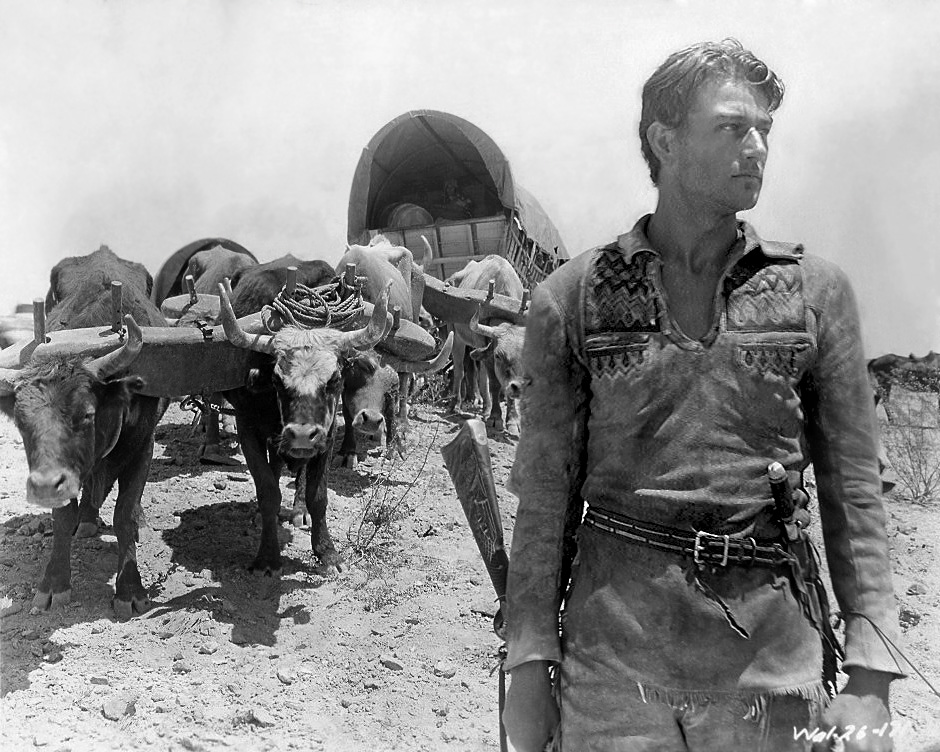 John Wayne in a publicity photograph for The Big Trail (1930).
John Wayne : The Second World War Question
Wayne did not serve in the armed forces during the Second World War. He was initially classified as exempt because of family responsibilities, and Republic Pictures regarded him as commercially important. Documents and later accounts have produced competing explanations of whether he sought to enlist, delayed action or accepted continued deferment.
The safest conclusion is the simplest: unlike James Stewart, Clark Gable and many contemporaries, Wayne remained a civilian and made wartime films. He visited troops and later became strongly identified with military patriotism, making the absence more conspicuous.
It would be unfair to invent cowardice from incomplete evidence, but equally misleading to turn studio-made heroism into service. Wayne’s subsequent concern about the issue may have contributed to the intensity with which he embraced patriotic roles and causes.
John Wayne : Red River and Conflict with Montgomery Clift
Howard Hawks’s Red River (1948) gave Wayne one of his first great opportunities to play authority turning destructive. Tom Dunson begins as a driven cattleman and becomes a tyrant during a punishing drive. Montgomery Clift’s more psychologically modern acting creates productive tension beside Wayne’s physical command.
The performance showed that Wayne could play against his heroic image before The Searchers. Dunson’s certainty is both the force that builds a cattle empire and the flaw that makes mutiny necessary.
Ford then used Wayne across the cavalry films Fort Apache, She Wore a Yellow Ribbon and Rio Grande. Captain Nathan Brittles in She Wore a Yellow Ribbon is an ageing soldier facing retirement. Wayne, only in his early forties, avoids caricature and finds weariness beneath ritual.
John Wayne and John Ford : The Searchers
The Searchers (1956) is central to Wayne’s reputation because it makes his familiar strengths morally unstable. Ethan Edwards returns from war with knowledge, competence and deep racial hatred. When his niece is abducted by Comanches, rescue gradually becomes an obsession that may end in murder.
Ford frames Ethan against vast landscapes and doorways, making him essential to the community but unable to belong within it. Wayne’s final gesture—lifting Debbie rather than killing her—does not erase the years of hatred that precede it.
The film’s Comanche characters remain constrained by a white perspective, even as it exposes racism within its hero. That contradiction is one reason The Searchers continues to provoke analysis. It is neither a simple endorsement of Ethan nor a complete correction of the Western mythology surrounding him.
 John Wayne arriving at Copenhagen Airport in 1957.
John Wayne : Rio Bravo and Relaxed Authority
Howard Hawks’s Rio Bravo (1959) offers a more generous Wayne performance. Sheriff John T. Chance accepts help from a recovering alcoholic, an old deputy, a young gunfighter and a woman who refuses to leave. Competence becomes collaborative rather than solitary.
Wayne’s scenes with Dean Martin are especially important. Chance can be impatient, but he gives Dude room to rebuild dignity instead of treating addiction as a single failure of will. Angie Dickinson’s Feathers also unsettles his control through wit rather than submission.
The film became a model for later action stories about a small group defending a contained space. Wayne is still the centre, but the picture works because authority recognises dependence.
John Wayne : Politics and Public Persona
Wayne was an outspoken conservative Republican and served as president of the anti-communist Motion Picture Alliance for the Preservation of American Ideals. He supported Barry Goldwater and Richard Nixon and made The Green Berets (1968), a rare major Hollywood film openly supportive of the Vietnam War.
His 1971 Playboy interview included comments about race and Native Americans that are widely criticised. They should be read as Wayne’s own statements rather than excused as dialogue from an old film. His defenders point to friendships and individual acts of support, but those do not cancel the assumptions expressed.
Politics became part of the product called John Wayne. That does not make every film a political tract, but it means modern viewers cannot treat the screen image as neutral.
John Wayne : The Alamo, True Grit and Later Films
Wayne directed and starred in The Alamo (1960), a large personal production that presented the battle as a defence of liberty. Its scale and sincerity are evident, while its history reflects the heroic Anglo-American version Wayne wanted to tell.
He won his only competitive Academy Award for True Grit (1969). Rooster Cogburn is boastful, comic, irritable and physically worn. The role lets Wayne parody his own authority without surrendering it, particularly opposite Kim Darby’s determined Mattie Ross.
Later work included The Cowboys, Rooster Cogburn and The Shootist (1976). In his final film, Wayne plays an ageing gunfighter dying of cancer. Wayne himself had survived lung-cancer surgery in 1964, so the role acquired unavoidable personal resonance. He resists easy sentiment and lets fatigue become part of the performance.
John Wayne : Marriages, Family and Death
Wayne married three times: Josephine Saenz, Esperanza Baur and Pilar Pallete. He had seven children, several of whom worked in film or in organisations connected with his legacy. His private life often sat uneasily beside the stable patriarchs he played.
He died from stomach cancer in 1979 at the age of 72. The John Wayne Cancer Foundation later developed programmes supporting research, education and patient care. Congress awarded him a Congressional Gold Medal in 1979, and President Jimmy Carter awarded the Presidential Medal of Freedom posthumously in 1980.
John Wayne : Legacy
Wayne’s acting is easy to imitate badly because its external signs are so familiar. The real technique lies in rhythm, spatial control and the willingness—at his best—to let confidence harden into isolation. Ford and Hawks understood that the image became more interesting when challenged.
His cultural legacy remains divided. For some viewers he represents courage, loyalty and plain speech. For others he embodies a Western mythology that marginalised Indigenous people and converted conservative politics into national identity.
Both responses belong to the history. The strongest films do not require the audience to settle the argument before watching. Stagecoach, Red River, The Searchers, Rio Bravo and The Man Who Shot Liberty Valance reveal how the Wayne image was created, revised and finally turned into elegy.
Selected John Wayne Filmography
1930 – The Big Trail : First major leading role
1939 – Stagecoach : Breakthrough as the Ringo Kid
1948 – Red River : Authority becoming tyranny
1949 – She Wore a Yellow Ribbon : Ageing cavalry officer Nathan Brittles
1952 – The Quiet Man : Irish romantic drama with Maureen O’Hara
1956 – The Searchers : Darkest examination of the Wayne hero
1959 – Rio Bravo : Ensemble Western built on professional loyalty
1962 – The Man Who Shot Liberty Valance : Myth and political history
1969 – True Grit : Academy Award-winning performance
1976 – The Shootist : Final film and farewell to the gunfighter
John Wayne : Frequently Asked Questions
What was John Wayne’s real name?
He was born Marion Morrison. Studio publicity changed his professional name to John Wayne when he received the lead in The Big Trail.
Did John Wayne serve in the Second World War?
No. He remained a civilian, initially under a family deferment, while continuing to make films. Claims about his intentions remain disputed, so screen military roles should not be confused with service.
Which film won John Wayne an Oscar?
He won Best Actor for playing Rooster Cogburn in True Grit.
What is the best John Wayne film for a beginner?
Rio Bravo is an accessible ensemble Western. The Searchers is the essential choice for understanding the power and problems of his screen image.
Related Articles
20 Classic Hollywood Actors Everyone Should Know
30 Classic Hollywood Movies Everyone Should Watch Once
Career chronology was checked against the official John Wayne career history and California Museum biography.