Gloria Swanson did not need Sunset Boulevard to make her a legend. By the time sound arrived, she had already been a Keystone comedian, Cecil B. DeMille’s great clothes horse, one of the highest-paid stars in Hollywood and an independent producer willing to risk her own money. Norma Desmond revived public attention, but Swanson had spent decades refusing to remain where the industry placed her.
The difficulty is that Sunset Boulevard looks like such a perfect mirror. A silent star plays a silent star living among photographs of herself, with her former director Erich von Stroheim operating the projector. In this biography, we will enjoy those connections without treating Norma as disguised autobiography. Swanson was practical, technically curious and constantly engaged with business, theatre, television, health and invention. Norma cannot live outside the past. Swanson kept building new versions of the present.
We will follow her from early studio comedy to DeMille spectacle, independent production, Sadie Thompson, the troubled Queen Kelly and the unexpected 1950 comeback. The result is not a rise, fall and rescue. It is a career in which fame changed form several times and the woman involved learned to change with it.
 Promotional photo of actress Gloria Swanson, 1917. Image credit: Albert Witzel / The Lake County times, April 12, 1917 The Lake County times / public domain.
Gloria Swanson at a glance
- Full name: Gloria May Josephine Swanson
- Born: 27 March 1899 in Chicago, Illinois
- Died: 4 April 1983 in New York City
- Occupation: Actor, producer and businesswoman
- Years active: 1914 to 1981
- Best-known films: Male and Female, Beyond the Rocks, Sadie Thompson, Queen Kelly, The Trespasser and Sunset Boulevard
- Major recognition: Three Academy Award nominations for best actress
- Marriages: Six, including actor Wallace Beery and Henri de la Falaise
- Distinctive achievement: Moving from studio star to independent producer, then returning in one of Hollywood’s greatest films about stardom
A military childhood made movement ordinary
Swanson was born in Chicago to Adelaide and Joseph Swanson. Her father served in the military, and the family moved through postings that included Key West and Puerto Rico. The changes gave Gloria experience of different places before she had any reason to imagine a film career.
Back in Chicago, she visited the Essanay studio and appeared as an extra. The early film industry could be entered through proximity, curiosity and willingness to work quickly. Swanson did not arrive with theatrical training or a carefully protected ambition. She learned by watching a new business invent its routines.
She moved to California and worked for Mack Sennett at Keystone. The company made physical comedy at speed, often using performers as types inside chases, bathing scenes and collisions. Swanson disliked some of the slapstick demands and later rejected the idea that comedy had been her natural destination.
The Keystone experience still mattered. It taught her how a camera reduced gesture, how a company organised production and how quickly a performer could be replaced. The famous later star who insisted on control had first seen how little control an inexperienced actor possessed.
Swanson married fellow actor Wallace Beery in 1916. Her later account described the marriage as abusive and included a traumatic pregnancy loss. Those claims belong to her testimony and should be handled with the seriousness given to a survivor’s recollection, while recognising that a biography cannot reconstruct every private event. The marriage ended in divorce.
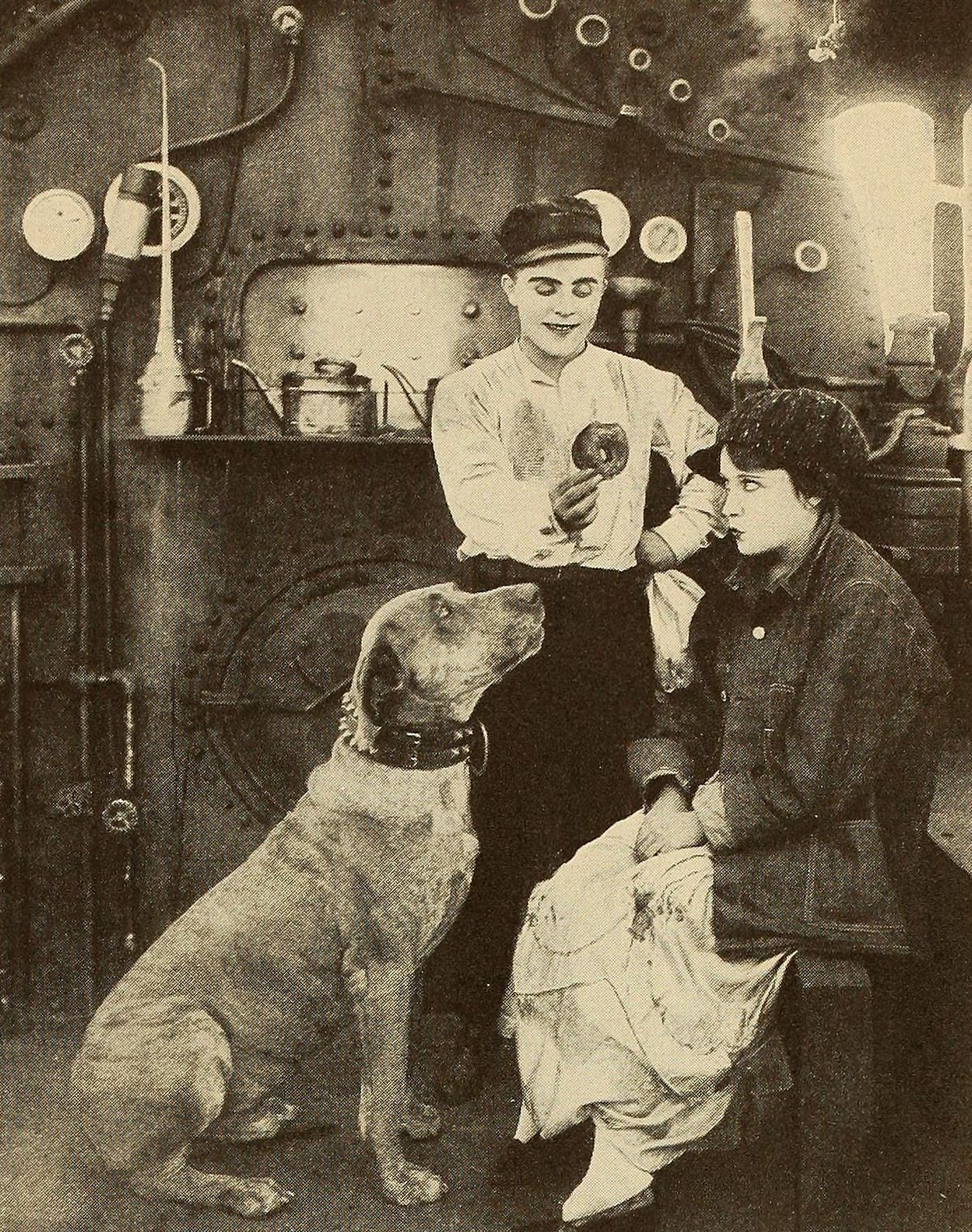 A scene from Teddy at the Throttle (1917) published in The New Movie, July 1930. Image credit: Keystone Film Company 1958, 1959 / public domain.
Cecil B. DeMille understood that clothes could be narrative
Swanson’s career changed when she worked with Cecil B. DeMille at Paramount. Films including Don’t Change Your Husband, For Better, for Worse, Male and Female, Why Change Your Wife? and The Affairs of Anatol placed her inside stories of marriage, temptation, wealth and display.
DeMille recognised that audiences wanted to see luxury as action. Bathrooms, gowns, furniture and jewellery were not background. They demonstrated desire and social transformation. Swanson could enter a room and make the costume feel like a decision the character had made rather than something the studio had placed on her.
In Male and Female (1919), adapted from J. M. Barrie’s The Admirable Crichton, she plays Lady Mary, whose class authority is disrupted when aristocrats and servants are stranded on an island. The film’s social ideas eventually restore hierarchy, but the fantasy gives Swanson one of her defining images, descending with a lion nearby as though luxury had become myth.
The “clotheshorse” label can sound dismissive, yet fashion performance required knowledge. Silent film could not rely on dialogue to explain class, appetite or self-invention. Fabric, posture and the speed of an entrance carried information. Swanson understood how to let a gown occupy the frame without allowing it to act alone.
The DeMille films made her one of Paramount’s most valuable stars. They also joined her permanently to the extravagance of the 1920s, even though her work and interests would later move far beyond it.
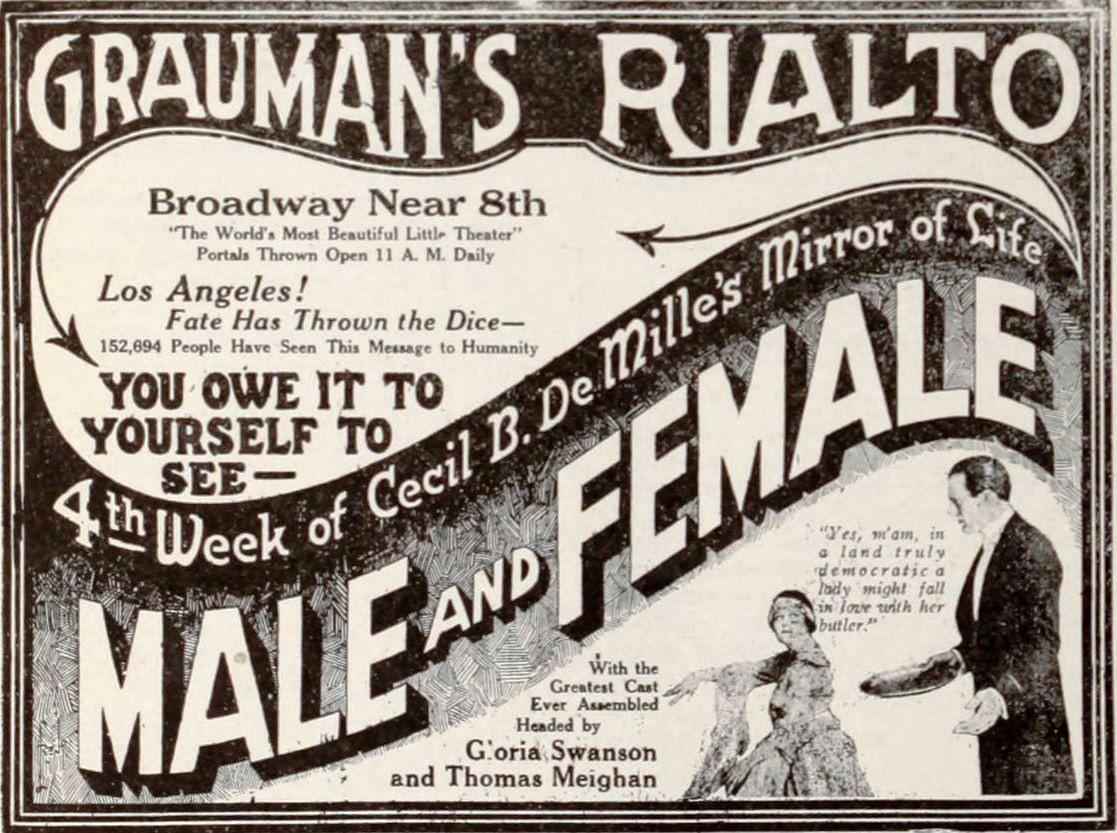 Gloria Swanson in Male and Female, one of the Cecil B. DeMille productions that expanded her silent-era stardom. Image credit: Paramount Pictures / Exhibitors Herald (Jan. – Mar. 1920) on the Internet Archive / public domain.
Stardom became a full-time production
Swanson’s fame grew through fan magazines, personal appearances, salaries and stories about extravagant living. Publicity described jewellery, pets, homes, servants and wardrobes because conspicuous consumption helped sell film stardom as a world above ordinary life.
She participated in the spectacle and understood its usefulness. She also recognised that the public wanted apparently private access. Photographs of domestic life, marriages and children turned a working actor into a continuing serial between releases.
Swanson’s second marriage, to Herbert K. Somborn, produced a daughter, Gloria. The marriage ended amid allegations and public legal conflict. She later married Henri de la Falaise, a French aristocrat whose title made the union valuable to publicity. Their ceremony and international life joined Hollywood money to European status.
The title did not give Swanson financial security. Her earnings were large, but so were taxes, staff, clothing, travel and production risks. The image of unlimited wealth could become a business obligation. A star had to look expensive enough to justify the salary required to look expensive.
She also adopted a son, Joseph. Motherhood existed alongside work rather than replacing it, though accounts of family relationships describe periods of distance. Children of stars appear in publicity as proof of normal life while living with schedules and public attention they did not choose.
Swanson increasingly wanted authority over projects and profits. The desire was not unusual among successful actors, but the practical barriers were considerable. Studios controlled finance, distribution and theatres. Independence required money and relationships powerful enough to replace those systems.
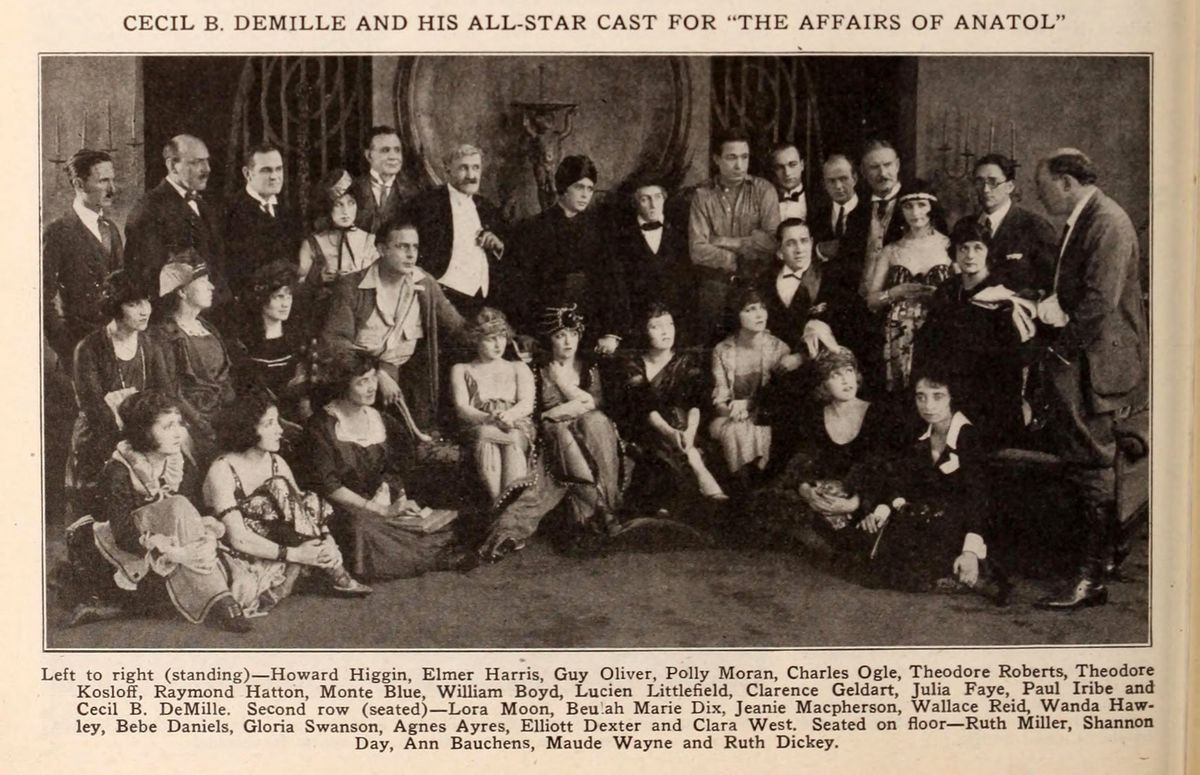 The cast of The Affairs of Anatol, a Paramount production from Swanson’s major collaboration with Cecil B. DeMille. Image credit: Paramount Pictures / Internet Archive / public domain.
Beyond the Rocks survived when most of the era did not
Swanson appeared with Rudolph Valentino in Beyond the Rocks (1922), an adaptation of Elinor Glyn’s novel. For decades the film was considered lost before a print resurfaced and was restored. Its survival offers a direct view of two major stars at the height of silent-era glamour.
The story involves an unhappily married woman and an aristocratic lover, material suited to the period’s fascination with luxury and forbidden desire. Swanson’s performance is restrained by modern assumptions about silent acting. Her face carries calculation while costumes and locations establish the social stakes.
The rediscovery also reminds us that star reputations depend on what remains available. Most silent films are lost. A performer may be remembered through publicity stills, later accounts and a small fraction of the actual work. Swanson’s DeMille image became dominant partly because those films and images circulated.
Preservation changes biography. Beyond the Rocks allows viewers to compare Swanson’s screen rhythm with Valentino’s rather than accepting written legend. The past does not remain fixed when a film returns.
Independent production led to Sadie Thompson
Swanson joined United Artists and created production arrangements intended to give her greater control. Independence allowed choice, but it also placed financial responsibility closer to the star. Budgets, censorship, distribution and personality conflicts could no longer be blamed entirely on a studio.
Sadie Thompson (1928) became the strongest result. Swanson played Sadie, a woman arriving on a South Pacific island where a religious reformer, Davidson, tries to control and punish her. Raoul Walsh directed and played the Marine who loves her.
The source material had faced censorship because of prostitution, sexual coercion and religious hypocrisy. The film adjusts details but keeps the conflict between Sadie’s vitality and Davidson’s authority. Swanson’s performance is physical, angry and far removed from DeMille society elegance.
Sadie changes under pressure, but the film does not ask us to believe that the reformer’s moral language makes his control benevolent. Swanson allows fear, defiance and exhaustion to move through the character. She received a nomination at the first Academy Awards.
The film proved that producing herself did not have to mean protecting the star image. Swanson chose a role in which the character is judged, cornered and visibly changed. Independence was most valuable when it allowed risk rather than only better lighting.
 Still from the American drama film Sadie Thompson (1928) Subjects (LCTGM): motion pictures, actresses, actors. Image credit: J. Willis Sayre Collection of Theatrical Photographs / public domain.
Joseph Kennedy, Queen Kelly and a production that collapsed
Financier Joseph P. Kennedy became involved in Swanson’s production company and her personal life. Their affair took place while both were married. Kennedy helped arrange financing and exercised business influence over projects, creating a relationship in which romance and financial dependency were difficult to separate.
Swanson hired Erich von Stroheim to direct Queen Kelly, with Walter Byron and Seena Owen in the cast. Stroheim’s reputation for expensive, sexually provocative productions was already established. The story moved from a European court to material in an African brothel that Swanson considered unsuitable and commercially dangerous.
She stopped the production and dismissed Stroheim. A version was later assembled for release in parts of Europe, while the complete intended film was never finished. The failure consumed money and damaged her independent operation.
Later accounts often present Queen Kelly as a struggle between an uncompromising artist and a frightened star. The situation was more complicated. Stroheim exceeded the project Swanson believed she had agreed to make, while Swanson had responsibility for a production that needed censorship approval and commercial release. Creative daring does not remove a director’s obligations to collaborators and finance.
The surviving footage is visually powerful and historically fascinating. It also became part of Sunset Boulevard, where Norma Desmond screens an old film for Joe Gillis and Stroheim, playing her former director and butler, operates the projector. Billy Wilder used a real failed production inside a fictional story about control over the past.
 Gloria Swanson with H. B. Warner in Zaza, a silent-era production from the period in which she pursued greater control and prestige. Image credit: Paramount Pictures / The New York Daily News, September 16, 1923, pg. 37 / public domain.
Sound did not defeat her, but the industry changed around her
Swanson made a successful transition to sound in The Trespasser (1929), directed by Edmund Goulding. She played a secretary whose relationship with a wealthy man leads to marriage, separation and sacrifice. Her voice was confident, and the performance earned another Academy Award nomination.
The idea that silent stars disappeared because their voices were unsuitable is one of Hollywood’s most persistent simplifications. Some actors struggled with speech, but sound also changed genres, production costs, contracts, audience taste and the age at which studios wanted to market women.
Swanson made further sound films, including Indiscreet, Tonight or Never and Music in the Air. None restored the scale of her silent stardom. She was in her thirties, financially damaged by production and associated with an era the industry was eager to describe as obsolete.
She withdrew from regular filmmaking rather than accepting every diminished opportunity. The decision created the later illusion that Norma Desmond’s isolation reflected Swanson’s own. In reality, she worked in radio, theatre, business and eventually television. Film was no longer the only medium in which a performer could remain public.
 Gloria Swanson photographed in her Manhattan apartment by Allan Warren during her later career. Image credit: Allan warren / Own work / CC BY-SA 3.0.
Business and invention occupied the years Hollywood calls absence
Swanson remained fascinated by technology and business. She subscribed to technical publications, developed ideas and worked with inventor George de Bothezat on a wireless signalling device intended initially for household use. A patent application emerged from the collaboration.
In the late 1930s she created Multiprises, a company intended to help European scientists and inventors escape Nazi persecution and develop their work in the United States. The Library of Congress has documented this less familiar part of her career through archival records and Swanson’s own memoir.
The enterprise involved patents, materials and attempts to match invention with commercial markets. It did not become a lasting industrial success, but it helped individuals relocate and demonstrated a technical curiosity that publicity about gowns had rarely acknowledged.
Swanson also became committed to health food and nutrition, sometimes promoting ideas that belonged to personal belief more than established medical evidence. Her advocacy should not be treated as expert health guidance. It does show the determination with which she built identities outside film.
The so-called missing years were therefore full. Hollywood history often counts only feature releases, making an actor appear inactive when the work has moved into media or businesses that filmographies do not record.
Sunset Boulevard used Swanson’s history without becoming her biography
Billy Wilder and Charles Brackett’s Sunset Boulevard (1950) cast Swanson as Norma Desmond, a silent-film star living in a decaying mansion and planning a return to the screen. William Holden plays Joe Gillis, the struggling writer who becomes her script editor, companion and dependent.
Other silent stars had been considered. Swanson was not simply waiting in Norma’s house for the role to arrive. She auditioned, a fact that initially offended someone who had once been among the world’s most famous actors. Director George Cukor encouraged her to understand the opportunity.
Norma’s photographs are Swanson’s, and the home movie is Queen Kelly. Stroheim had directed Swanson and now plays Max, the former director and husband who protects Norma’s illusions. Buster Keaton appears during a bridge game. The film fills fiction with real history, encouraging viewers to believe every parallel.
Swanson keeps Norma separate through scale. The character performs life as though every room contains an audience. Her hands, voice and eyes enlarge emotion beyond ordinary conversation. That style is not proof that silent actors behaved absurdly off screen. It is Norma’s method of maintaining power in a house where time has stopped.
The brilliance lies in moments when the performance drops. Norma watches herself, studies Joe or recognises that a studio visit is about her old car rather than a new film. Swanson allows hurt to appear before the star role returns to cover it.
The final close-up is terrifying because Norma believes she has regained the set. Swanson does not play madness as confusion. She plays absolute professional certainty directed towards a reality that no longer exists.
 Gloria Swanson in Sunset Boulevard (1950).
The comeback changed her reputation and created a new trap
Swanson received her third Academy Award nomination and won major critics’ prizes for Sunset Boulevard. The film introduced her to audiences who had never seen the silent work and confirmed her place in histories of Hollywood.
It also created a new form of typecasting. Offers often wanted another version of the ageing star, grand eccentric or self-aware survivor. Swanson did not reject every connection to Norma, but she resisted the idea that one fictional character had finally revealed her true self.
She worked on stage, toured, appeared on television and hosted programmes. Live television suited an actor trained when performance and technology were changing together. She could talk about the past while remaining in a medium defining the present.
Her later film appearances were selective. In Airport 1975, she played a version of herself among an ensemble of passengers. The casting depended on recognition and humour rather than psychological drama. She also continued public speaking and business interests.
The difficulty of escaping Norma demonstrates the film’s success. Swanson had made the character so complete that audiences preferred the fiction to a more complicated life. Her later interviews repeatedly corrected the assumption that she had spent the 1930s and 1940s alone in a mansion.
Six marriages do not provide six explanations
Swanson married Wallace Beery, Herbert Somborn, Henri de la Falaise, Michael Farmer, William Davey and writer William Dufty. The marriages varied greatly in length, circumstance and significance. Treating them as a list creates the impression that the number itself explains character.
Her relationship with Kennedy affected business and family life, while the marriage to Farmer produced a daughter, Michelle. Dufty, whom she married in 1976, remained with her until her death and helped support interests in nutrition and writing.
Swanson published Swanson on Swanson in 1980. Memoir gave her the opportunity to organise the story and answer decades of publicity. It is an essential source, but like all memoir it reflects memory, later judgement and the narrative an author chooses to make.
The marriages belong in the biography because they affected children, finances, travel and work. They do not need to be converted into a moral score. Swanson lived across periods when divorce carried different social consequences, and fame made every private change available for sale.
Death and the archive of a life larger than one close-up
Swanson died in New York in April 1983 after heart problems. She was eighty-four. By then, silent-film preservation and scholarship had begun restoring work that allowed audiences to see more than Norma Desmond.
Her papers went to the Harry Ransom Center at the University of Texas, preserving correspondence, business records, photographs and material connected with Multiprises. Archives matter because publicity selects the image most useful at the time. Papers preserve negotiations, failed ideas and practical labour that glamorous portraits cannot show.
Swanson’s influence extends through star fashion, independent production and every later film that casts an older performer in conversation with a famous younger self. The lesson is not that Hollywood cruelly forgot her and one role saved everything. She remained active while the industry narrowed its definition of where activity counted.
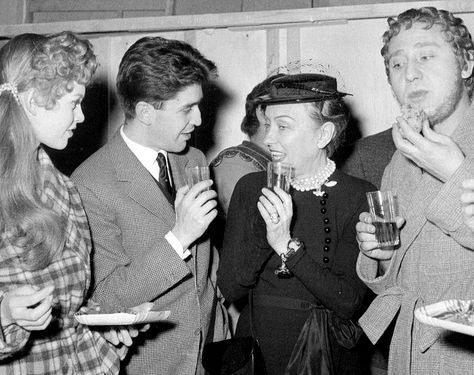 From left: Brigitte Bardot, Franco Cristaldi (producer), Glorya Swanson and Albert Sordi in 1956 when they recorded the movie “Mio Figlio Nerone”. It was released in September 1956. Public domain.
The Trespasser proved that her voice was never the real problem
The Trespasser (1929), directed by Edmund Goulding, was Swanson’s first full talking feature and earned her an Academy Award nomination. She plays Marion Donnell, a former stenographer whose marriage to a wealthy man is annulled under family pressure. Years later, she raises their child while working as a nightclub singer.
The melodrama asks Swanson to move between office practicality, romantic humiliation, performance and maternal sacrifice. Her speaking voice is confident and expressive, immediately disproving the idea that sound itself ended her stardom.
The film also shows why transition involved more than vocal equipment. Sound altered production costs, performance scale and audience fashion. A star could succeed in a talkie and still find that the economic structure supporting enormous personal vehicles was disappearing.
Swanson’s nomination is sometimes treated as an ironic footnote before Sunset Boulevard. It should be read as evidence. She adapted quickly enough to receive major recognition while managing independent production pressures that would have tested any career.
Sunset Boulevard required collaboration as well as self-exposure
Billy Wilder and Charles Brackett built Sunset Boulevard around Hollywood’s memory, but they did not simply point a camera at Swanson’s life. Norma Desmond is a fictional creation shaped by screenplay, direction, design, cinematography and a performance willing to become frightening.
Swanson understood silent-film scale and could reproduce it deliberately. When Norma performs for Joe or prepares to return to the studio, the gestures are not evidence that the actor had forgotten how modern people behave. They are technical choices showing a woman who now experiences life as her own private production.
The casting of Erich von Stroheim as Max adds another layer because he had directed Queen Kelly. Cecil B. DeMille appears as himself, and the bridge players include silent stars. These references create an archive inside the drama, but Norma remains different from every person contributing history.
The performance works because comedy and terror are never separated cleanly. Norma can be absurd when she corrects the scale of her fame, then painfully lucid when a light catches her face. Swanson does not ask the audience to approve of the character. She makes approval irrelevant by showing the complete need beneath control.
The final descent towards the news cameras has been imitated so often that it risks becoming a clip rather than a conclusion. Watch the entire movement. Norma receives the machinery of publicity as a form of mercy. Swanson gives her the star entrance she has wanted and the psychological collapse the story has earned at the same time.
Television, theatre and Airport prevented the comeback from becoming a final scene
After Sunset Boulevard, Swanson worked in theatre and television, appearing as herself and as fictional characters. The medium could use her fluency in live presentation, an ability developed long before Hollywood decided she belonged to the silent past.
She received another substantial film role in Three for Bedroom C and later appeared in Airport 1975. The disaster film placed her among a large ensemble and allowed her to play a version of herself without repeating Norma Desmond’s madness.
Public appearances made Swanson an articulate witness to early Hollywood, but she was not a neutral archive. Like every memoirist, she shaped emphasis, defended decisions and interpreted old conflicts through later knowledge. Her testimony is valuable when read alongside production records and the accounts of collaborators.
She also promoted interests in nutrition, fashion and business. Some health claims connected with celebrity culture require the same scepticism we would apply to any public figure. What matters for the biography is the continued appetite for work and self-definition.
The comeback did not restore a conventional annual film career, and Swanson did not need it to. She had already moved through silent shorts, major studio spectacle, independent production, sound, business, radio, television and theatre. Sunset Boulevard became the most visible bridge between those lives, not the only reason they mattered.
Preserving her films changes what the star can mean
Many films from Swanson’s silent peak are lost or survive incompletely. That absence affects reputation. Viewers who can easily see Sunset Boulevard but not the comedies and dramas of the 1910s and 1920s encounter the retrospective role before the career it was commenting upon.
The recovery of Beyond the Rocks, found decades after it was thought lost, demonstrated how one print can change access. Suddenly audiences could watch Swanson with Rudolph Valentino rather than rely on stills and plot summaries.
Preservation also corrects the idea that silent acting consisted entirely of Norma’s gestures. Surviving work shows variation between comedy, social drama and spectacle. The silent actor adjusted scale according to shot, scene and director, just as sound actors do.
Swanson kept papers, photographs and memories that became important to archives. She understood that stardom creates material history as well as publicity. The archive lets researchers test the grand stories against contracts, correspondence and production evidence.
Her legacy therefore depends on institutions and viewers as well as one performance. Every restoration makes Norma Desmond less able to stand in for Gloria Swanson.
The star and Norma Desmond should be allowed to separate
Swanson spent years explaining that she had not lived as Norma did. The correction matters because the performance has become so persuasive that fiction threatens to absorb biography.
She understood nostalgia but did not live entirely inside it. Business, broadcasting and later performance show a woman repeatedly finding new media rather than waiting in a mansion for one lost form to return.
Where should you begin with Gloria Swanson’s films?
Begin with Sunset Boulevard because the performance is as great as its reputation. Then resist the film’s invitation to stop there. Watch Sadie Thompson to see Swanson as an independent producer and actor taking on anger, censorship and sexual hypocrisy.
Move back to Male and Female for DeMille spectacle and the star image at full silent scale. Beyond the Rocks gives you Swanson with Rudolph Valentino and a valuable surviving example of 1920s glamour.
Then watch the surviving Queen Kelly material with its production history in mind. Finish with The Trespasser, which demonstrates that sound did not expose a fatal weakness. Her voice was never the problem.
The order matters because it turns Sunset Boulevard from a verdict into a conversation with the earlier films. Norma Desmond borrows the authority of Swanson’s history, but Sadie Thompson and The Trespasser show decisions, risks and adaptability that Norma cannot imagine. The performance grows richer once the difference is visible.
Gloria Swanson understood that stardom was an invention requiring continuous maintenance. She also understood invention in the more literal sense, as a technical and business process. Norma Desmond wanted the cameras to return because she believed nothing had changed. Swanson kept changing because she knew that everything had.