Dorothy Dandridge became the first Black woman nominated for the Academy Award for best actress, then discovered that Hollywood had almost no plan for what she should do next. Carmen Jones proved that she could carry a major colour musical, attract international audiences and represent modern glamour. The industry’s racial limits remained stronger than the evidence of its own success.
In this biography, we will follow Dandridge from a childhood act and nightclub performance to Bright Road, Carmen Jones, Island in the Sun and Porgy and Bess. We will also discuss motherhood, relationships, financial difficulty and her death at forty-two without turning a life shaped by structural racism into a simple tragedy of bad personal choices.
Dandridge’s poise could make the barriers around her difficult to see. She had to appear ready, elegant and untroubled in rooms where hotels booked her as a star but restricted where Black guests could enter. The career was not a smooth path broken by one setback. It was a repeated demand to prove an ability the industry kept refusing to use fully.
 Photo of Dorothy Dandridge in her first dramatic television role as a singer in Cain’s Hundred. Image credit: MGM Television / public domain.
Dorothy Dandridge at a glance
- Full name: Dorothy Jean Dandridge
- Born: 9 November 1922 in Cleveland, Ohio
- Died: 8 September 1965 in West Hollywood, California
- Occupation: Actor, singer and dancer
- Years active: 1933 to 1965
- Best-known films: Bright Road, Carmen Jones, Island in the Sun, Tamango and Porgy and Bess
- Major recognition: First Black woman nominated for the Academy Award for best actress
- Family: Sister of performer Vivian Dandridge and former wife of dancer Harold Nicholas
- Distinctive challenge: Achieving leading-lady fame in an industry that still restricted Black romance, casting and distribution
The Wonder Children made performance a family income
Dorothy was born in Cleveland to Ruby Dandridge and Cyril Dandridge. Her parents separated before or around her birth, and Ruby raised Dorothy and her older sister Vivian. Ruby pursued acting and comedy while organising the girls into a performance act.
The Wonder Children, managed and trained by Ruby’s companion Geneva Williams, toured churches and community venues. Later biographical accounts describe Williams as physically and emotionally abusive. The sisters were working while still very young, travelling extensively and receiving limited conventional education.
The family moved to Los Angeles during the Depression. Dorothy and Vivian joined Etta Jones, not the later jazz singer of the same name, to form the Dandridge Sisters. The trio appeared in clubs, films and touring programmes.
Child performance offered income and access, but it also placed adult responsibility on young bodies. Dandridge learned harmony, movement, costume and the need to appear composed regardless of what had happened before the curtain opened.
That discipline later became part of her glamour. Photographers saw calm. Audiences did not see the years in which calm had been a condition of keeping the act together.
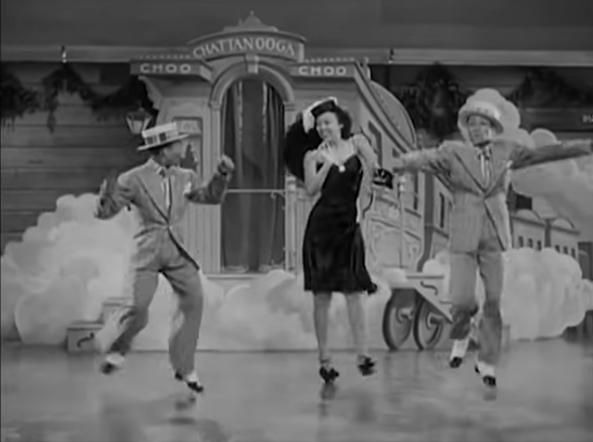 Nicholas Brothers and Dorothy Dandridge in a scene from the film Sun Valley Serenade (1941). Image credit: Creator not identified / Screenshot from the film Sun Valley Serenade (1941). / public domain.
Nightclubs offered opportunities that films withheld
The Dandridge Sisters appeared at venues including the Cotton Club and worked with performers such as Jimmie Lunceford. They made short film appearances, sometimes within segregated musical numbers that could be removed when films played in Southern markets.
Hollywood used Black performers for songs and dances while keeping them outside the main story. A sequence could be energetic, modern and essential to the audience’s pleasure, then cut without affecting the white characters. The production structure made talent visible and disposable at the same time.
Dorothy appeared in films including Four Shall Die, Sun Valley Serenade and Stormy Weather. She performed alongside the Nicholas Brothers, whose acrobatic dance remains among the era’s greatest screen work. The numbers gave her professional exposure but little character development.
Nightclubs allowed a more complete star presence. Dandridge developed a solo act and performed at leading venues, including the Mocambo in Hollywood and hotels in Las Vegas. She sang standards, managed audience attention and wore gowns that presented sophisticated adulthood rather than the servant and specialty roles available on screen.
Segregation followed success. Black entertainers could headline venues that restricted their accommodation, dining or use of public facilities. The contradiction was not incidental to the career. Dandridge’s glamour generated profit inside institutions that denied equal treatment to people who looked like her.
Live performance taught her how to turn glamour into authority
Dandridge’s nightclub work deserves more than a bridge between films. A live act required her to establish mood without a character or screenplay. She chose songs, managed an orchestra, moved between humour and longing and read audiences whose attention could shift without warning.
The voice was intimate rather than operatic. That distinction later became important when Carmen Jones and Porgy and Bess used trained singers to dub her. Dubbing was a production decision about the scores, not evidence that Dandridge could not sing. Her own recordings and live work belong to a different vocal tradition.
At venues such as the Mocambo, success also involved publicity strategy. A major engagement could persuade Hollywood that a performer already had the approval of fashionable white audiences. Dandridge prepared intensively, using coaching and carefully designed gowns to make the booking feel like an event.
The elegance was not passive beauty. Every entrance announced that the room would now operate at her pace. That authority helps explain Carmen. The film did not invent her power over an audience; it enlarged a skill built in clubs.
Live work also remained available when film roles narrowed. Returning to it was not a fall from legitimate acting. It was a return to the form in which she had the greatest direct control, even when financial pressure changed the conditions.
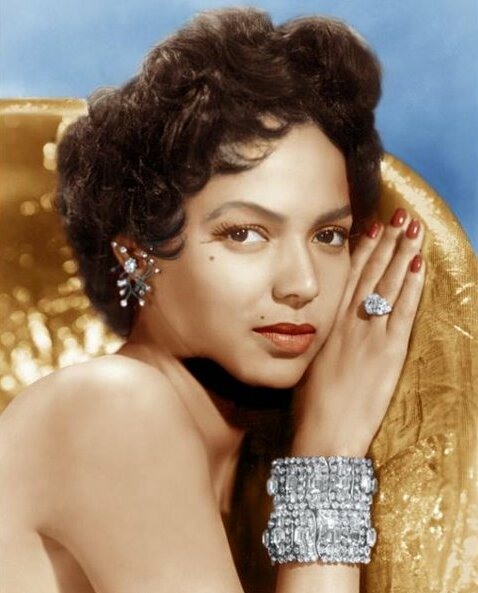 Publicity photo of Dorothy Dandridge. Image credit: Studio publicity / public domain.
Marriage to Harold Nicholas joined two demanding careers
Dandridge married Harold Nicholas of the Nicholas Brothers in 1942. Both were performers with touring schedules and strong professional identities. Their daughter Harolyn was born in 1943 with significant developmental and medical needs.
Accounts of the birth and diagnosis use changing terminology, some of it now offensive or medically imprecise. The established reality is that Harolyn required extensive care. Dandridge experienced guilt and financial pressure while trying to continue a career in which absence could make opportunities disappear.
The marriage deteriorated and ended in divorce in 1951. Later accounts describe Nicholas’s absences and infidelity, while Dandridge carried much of the day-to-day concern for their daughter. A biography should avoid using Harolyn as the tragic explanation for every adult difficulty. She was a person, not a symbol of burden.
Dandridge eventually placed her daughter in institutional care when finances and practical needs became overwhelming. The decision caused lasting pain and has often been judged without recognising the limited support available to families, particularly a Black working mother, in the 1940s and 1950s.
Professional glamour existed alongside appointments, bills, family conflict and a mother’s uncertainty about what care would be safest. The studio portrait did not remove any of it.
Bright Road gave her an ordinary woman worthy of a whole story
MGM’s Bright Road (1953) cast Dandridge as Jane Richards, a teacher trying to reach a struggling student. Harry Belafonte played the school principal. The film was modest in budget and scale, adapted from a story by teacher Mary Elizabeth Vroman.
Its importance lies partly in ordinariness. Dandridge is not a singer placed outside the plot or an exotic object of desire. She plays a professional woman whose attention, frustration and patience drive the story.
The production does not escape every simplification about education or Black community life. It still gave Dandridge sustained dialogue, emotional development and a relationship to Belafonte based on work rather than spectacle.
She reduces the nightclub polish for the classroom without making Jane dull. The voice, posture and clothes identify a capable adult. Her concern for the child does not become saintly perfection. We see a teacher testing approaches and recognising when authority has failed.
Bright Road did not become a major box-office event. It supplied evidence that Dandridge could carry narrative attention in a contemporary role. One year later, Carmen Jones would enlarge that evidence beyond anything Hollywood could ignore.
 Dorothy Dandridge with Alain Delon during production activity in Belgrade in 1962. Image credit: Stevan Kragujević / Transferred from sr.wikipedia to Commons. / CC BY-SA 3.0 rs, via Wikimedia Commons.
Carmen Jones made history through a role filled with contradictions
Otto Preminger’s Carmen Jones (1954) adapted Oscar Hammerstein II’s Broadway musical, which had relocated Bizet’s opera to an African American wartime setting. Dandridge played Carmen, with Belafonte as Joe and Pearl Bailey as Frankie.
Dandridge initially appeared closer to the respectable Cindy Lou type. Preminger saw the possibility of Carmen and encouraged a more openly sexual, independent screen presence. The transformation has sometimes been narrated as though the director created her sensuality. Dandridge had spent years controlling nightclub audiences. The film gave that authority a character and camera large enough to contain it.
Opera singer Marilyn Horne dubbed Carmen’s singing. Dandridge was an accomplished popular singer but not trained for Bizet’s operatic line. Belafonte was also dubbed. The decision belongs to the production’s musical requirements, though it meant that the actor’s body and another artist’s voice combined to create the role.
Carmen chooses, teases and refuses ownership. The film celebrates her freedom while shaping it towards punishment, as versions of the story have long done. Dandridge makes the character’s vitality more than sexual availability. Carmen reads weakness quickly and resists any promise that sounds like confinement.
The all-Black cast was a landmark in a major Hollywood production, but opportunity remained unequal. The film emerged within an industry where Black performers were still excluded from most romantic leads, and it used a story already associated with stereotypes of dangerous female sexuality.
Dandridge received the Academy Award nomination for best actress, losing to Grace Kelly. The nomination made history. It did not create a reliable supply of roles equal to the achievement.
 Theatrical poster for the film Carmen Jones (1954). Image credit: Saul Bass / public domain.
The Oscar nomination created expectation without changing the system enough
After Carmen Jones, Dandridge appeared on magazine covers and became an international symbol of Black glamour. She attended the Academy Awards as a leading nominee and stood within publicity spaces that had rarely centred a Black woman.
The next decisions were extraordinarily difficult. Repeating Carmen risked typecasting as the sexually dangerous woman. Accepting a smaller stereotyped part would look like retreat. Waiting for an ideal leading role could allow momentum to disappear.
Hollywood offered white actresses broad space between prestige and routine. Dandridge faced a much narrower choice because studios produced few stories with Black female leads and remained anxious about interracial romance in domestic markets.
She turned down or lost projects for reasons later accounts interpret differently. It is easy to review the choices with knowledge of which films succeeded. At the time, scripts, salary, image, censorship and the advice of representatives all mattered.
The industry’s failure is sometimes rewritten as Dandridge’s inability to manage success. She made mistakes, as stars do. The scale of the consequence came from a system offering few second chances.
Stardom could not guarantee an ordinary hotel room
Dandridge’s career took place within segregated American travel and entertainment. Black performers could be advertised on a hotel marquee while being denied the accommodation, restaurants or pools available to white guests. Las Vegas and other resort cities sold Black talent without consistently accepting Black presence.
Accounts of particular incidents have accumulated into legend, and exact details should be checked against contemporary evidence. The broader system is not in doubt. Contracts, local custom and management decisions forced performers to negotiate basic dignity as part of professional work.
This reality changes how we understand glamour photographs. Dandridge did not simply represent elegance. She carried the image through spaces organised to tell her that fame had limits.
The pressure also affected career choices. A role was never only a role when public representation was so scarce. Accepting a stereotype could damage how Black audiences saw her; refusing it could remove income in an industry with few alternative leads.
White stars experienced bad scripts and studio conflict. Dandridge experienced those ordinary professional problems inside a system that made her race part of distribution, censorship, publicity and accommodation. The distinction explains why equal talent did not produce an equal career.
Otto Preminger was director, adviser and intimate partner
Dandridge and Preminger had a relationship during and after Carmen Jones. He was married, and the affair took place within a significant professional power imbalance. Later biographies describe pregnancy and abortion, emotional dependence and his influence over career choices. These intimate claims rely heavily on biographical testimony and should be attributed rather than sensationalised.
Preminger helped create the role that transformed her career and could offer informed advice. He could also be controlling, and his priorities as a director and married man were not identical to Dandridge’s needs.
The relationship should not be used to explain her performance as personal chemistry. Carmen is the result of Dandridge’s work, Horne’s singing, Preminger’s direction, Hammerstein’s adaptation and the wider cast and crew.
Nor should the affair become a moral cause of later decline. Dandridge lived in a period when a Black woman had limited institutional power and intense public scrutiny. A private relationship with a powerful white director involved affection, opportunity, secrecy and risk at once.
Island in the Sun exposed the censorship surrounding interracial desire
Robert Rossen’s Island in the Sun (1957) used an ensemble to examine politics, class and race on a fictional Caribbean island. Dandridge’s Margot Seaton develops a relationship with David Boyeur, played by Belafonte, while another storyline suggests attraction between Joan Fontaine and Harry Belafonte’s character? The film’s racial pairings and censorship history became central to publicity.
The production approached interracial intimacy cautiously. American censorship, regional exhibition and fear of Southern boycotts limited what could be shown. Relationships could be suggested, discussed and interrupted more easily than completed.
Dandridge gives Margot ambition and social intelligence. The character understands that class position within the island does not protect her from racial hierarchy. The film’s politics are uneven, yet it placed Black romantic and political life within a large international production.
The controversy proved the barrier Carmen Jones had not removed. Dandridge could be sold as one of the world’s most beautiful women, but mainstream Hollywood still treated the visible fulfilment of interracial desire as dangerous.
 Dorothy Dandridge photographed in Belgrade in 1962, during one of the international productions pursued in her later career. Image credit: Stevan Kragujević / CC BY-SA 3.0 rs, via Wikimedia Commons.
Tamango found a stronger role outside Hollywood
The French-Italian production Tamango (1958), directed by John Berry, cast Dandridge opposite Curt Jurgens in a story about enslaved Africans rebelling aboard a ship. Berry had left the United States after blacklisting, and the international production operated outside some Hollywood restrictions.
Dandridge plays Aiche, forced into the captain’s household and caught between proximity to power and solidarity with the captives. The role is morally and politically complex, though the film’s treatment of sexuality and race remains shaped by European colonial viewpoints.
The interracial relationship led to censorship problems, and release varied by country. Dandridge’s performance uses the glamour that studios had marketed while refusing to make beauty a sign of safety.
Tamango demonstrates why international work mattered. European productions were not free of racism, but they sometimes offered roles and narrative possibilities American studios considered commercially impossible.
The film deserves more attention in Dandridge’s career because it prevents Carmen Jones and Porgy and Bess from becoming the only evidence of her dramatic authority.
 Dorothy Dandridge in a 1962 Belgrade production photograph, evidence of a career that continued beyond her best-known Hollywood films. Image credit: Stevan Kragujević / CC BY-SA 3.0 rs, via Wikimedia Commons.
Porgy and Bess brought prestige, controversy and another dubbed voice
Samuel Goldwyn’s Porgy and Bess (1959) adapted the Gershwin opera with Sidney Poitier, Dandridge, Sammy Davis Jr., Pearl Bailey and a major Black cast. Dandridge played Bess, with Adele Addison dubbing her singing.
The project carried prestige and serious controversy. Some Black artists objected to stereotypes and the representation of poverty, disability and community. Harry Belafonte declined the role of Porgy. Poitier accepted under professional pressure connected with Goldwyn and another production, according to his later account.
Dandridge’s Bess is torn between danger, addiction, desire for stability and the possibility of change. The character can be treated as a collection of weaknesses. Dandridge gives her attention and fear, making each shift in loyalty feel connected to the immediate pressure.
A fire damaged sets during production, and rights complications later kept the film difficult to see for long periods. Limited circulation affected Dandridge’s legacy. Audiences cannot reassess a performance easily when the film remains unavailable.
The role earned a Golden Globe nomination but did not restore the career momentum of Carmen Jones. Prestige had again arrived without a clear next path.
Dubbing should not erase what her own voice could do
Because Dandridge’s two most prestigious musicals use other singers, casual accounts sometimes imply that her musical stardom was artificial. The conclusion misunderstands both film production and vocal style.
Carmen Jones and Porgy and Bess draw on operatic writing. Marilyn Horne and Adele Addison supplied voices trained for that material. Dandridge supplied breath, phrasing, facial movement and the physical timing that made playback appear connected to thought.
Her own singing belonged to popular song and nightclub performance. The range was not the same, but communication does not depend on operatic range. Surviving recordings reveal careful diction, rhythmic control and a closeness suited to a microphone.
Screen dubbing was common enough to affect performers of many backgrounds, although studios often concealed the work of the singer. In Dandridge’s case, the fact has sometimes been used to diminish an achievement already restricted by race.
A fair assessment credits everyone. Horne and Addison should be named, and Dandridge’s complete acted performance should remain visible. Carmen’s turn of the head, Bess’s hesitation and the way a body prepares for a note are not supplied by an off-screen voice alone.
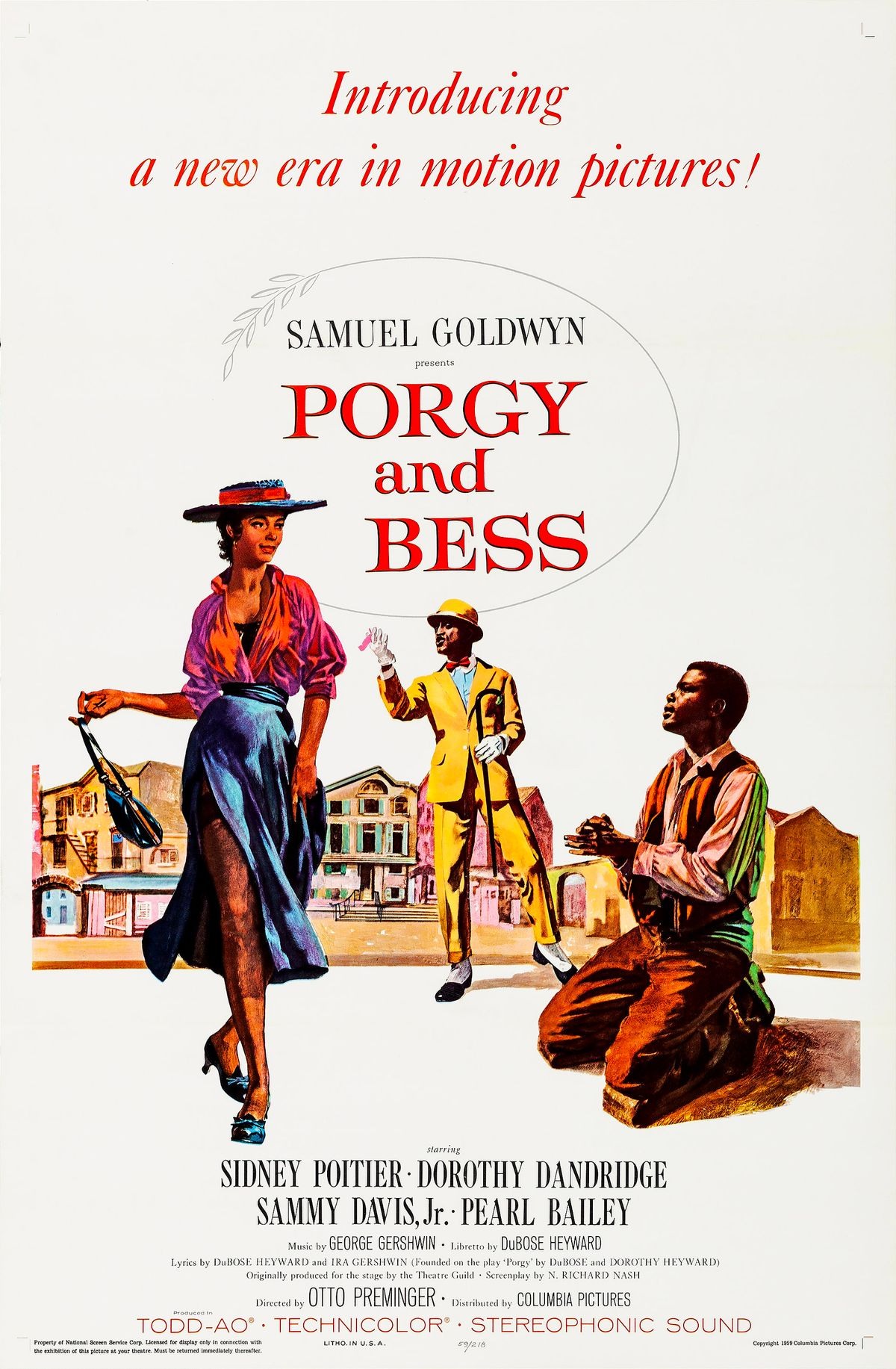 Theatrical release poster for the 1959 musical film Porgy and Bess, based on the 1935 opera of the same name. Image credit: Illustrator unknown. “Copyright 1959 Columbia Pictures Corp. ” / Scan via Heritage Auctions.
Jack Denison, financial losses and the narrowing of work
Dandridge married Jack Denison in 1959. Later accounts describe the marriage as abusive and financially damaging. It ended in divorce in 1962. The details should be handled through documented testimony rather than repeated as lurid episodes.
She also lost money through poor investments and management, including a venture connected with oil. Tax obligations and reduced film income intensified the crisis. By the early 1960s, she returned to nightclub work under conditions less secure than the triumphs of the previous decade.
Financial decline is often narrated as personal carelessness. Dandridge made decisions, but she also supported her daughter’s care, paid professional representatives and worked in an industry that had not built a durable career around her success.
Nightclub performance remained real work, not proof that a film star had fallen. She could still sing, hold a room and draw audiences. The humiliation came partly from a culture that valued film fame more highly than the live skill that had made the film opportunity possible.
Health problems, depression and substance use affected the final years. These conditions deserve accuracy, not a narrative in which every setback confirms that tragedy was inevitable.
Her death remains surrounded by conflicting interpretation
Dandridge was found dead in her West Hollywood apartment on 8 September 1965. She had recently injured her foot and was preparing for professional travel. She was forty-two.
The Los Angeles coroner concluded that the death resulted from an accidental overdose of the antidepressant imipramine. A separate medical opinion identified a fat embolism related to the foot injury. The existence of differing conclusions is important. It is not accurate to state with certainty that she intended to die.
Public discussion quickly joined the death to career disappointment, finances and relationships. Those factors formed part of her life, but a disputed medical death should not be turned into the final scene of a Hollywood morality play.
Her daughter Harolyn outlived her by many years. Family arrangements after Dandridge’s death have also been treated as celebrity detail, though Harolyn had no control over the public story built around her mother’s choices.
Halle Berry and a later generation restored attention
Interest in Dandridge grew through scholarship, film retrospectives and Donald Bogle’s biography. The 1999 television film Introducing Dorothy Dandridge, starring Halle Berry, brought the life to a large new audience.
When Berry became the first Black woman to win the Academy Award for best actress in 2002, she named Dandridge among the women whose work had made the moment possible. The gap of nearly half a century between Dandridge’s nomination and Berry’s win revealed how little institutional progress one breakthrough had guaranteed.
Later attention should not turn Dandridge into only a pioneer waiting for someone else to complete the achievement. Carmen Jones remains a performance with its own energy, and Bright Road and Tamango show different parts of the actor.
Her glamour also has cultural importance. Dandridge demonstrated that Black beauty could occupy the centre of international star photography without being presented as novelty. The industry accepted the image more readily than it accepted the authority that should have followed.
The breakthrough did not create a ladder for the women behind her
Dandridge’s Oscar nomination is often celebrated as a door opening. The much longer history shows that the opening did not become a reliable route. Black actresses continued to face limited leading roles, and another Black woman did not win best actress until Halle Berry in 2002.
Progress is not measured only by awards. The more revealing questions concern how many characters were written, what budgets they received and whether one disappointment ended access. Dandridge’s career demonstrates the danger of treating an exceptional appointment as evidence that a structure has changed.
Later performers could cite her image and achievement, but they could not inherit a studio category built around her. There was no dependable line of glamorous Black dramatic leads following Carmen Jones.
That absence makes recovery important. Seeing Bright Road prevents us from reducing Dandridge to sensuality. Seeing Tamango complicates the idea that her career belonged entirely to Hollywood. Hearing her records returns the nightclub artist to the screen icon.
The aim is not to build a flawless heroine. It is to restore range to a woman whose industry repeatedly made range difficult.
 Nicholas Brothers and Dorothy Dandridge in a scene from the film Sun Valley Serenade (1941). Image credit: Creator not identified / Screenshot from the film Sun Valley Serenade (1941). / public domain.
Publicity celebrated beauty more easily than it accepted authority
Dandridge’s photographs circulated a version of Hollywood elegance that had been denied to Black women in most mainstream star systems. Gowns, jewellery and carefully controlled lighting placed her within the visual language used for leading ladies rather than novelty performers.
The images mattered to audiences who rarely saw Black beauty presented at that scale. They also created a risk. Beauty could be praised as an exception while the industry avoided changing who received scripts, contracts and romantic endings.
Dandridge understood that publicity was part of the work. She used style to argue for the roles her appearance supposedly proved she deserved. The argument should not have been necessary, and its success remained incomplete.
Modern celebration sometimes repeats the imbalance by reproducing photographs without making the films available. A portrait confirms glamour. Bright Road, Carmen Jones and Tamango reveal decision, rhythm and dramatic intelligence.
The best recovery therefore joins image to performance. Dandridge was beautiful, but beauty was never the limit of what the evidence showed.
Her singing belongs in that recovery too. Film histories sometimes treat the nightclub years as preparation for Carmen Jones or as the work to which she returned when Hollywood failed her. That description misses the discipline involved. A live performer has to establish rhythm, character and intimacy without editing, close-ups or a second take. Dandridge learned how to hold attention in that exposed setting long before a studio trusted her with the centre of a feature.
The fact that Marilyn Horne dubbed the operatic passages in Carmen Jones should not erase Dandridge’s musical intelligence. She still had to shape breath, gesture and timing so that the voice and body appeared to belong together. Her nightclub work helps explain why the illusion is persuasive. It also lets us hear an artist whose own recorded voice was warmer and more conversational than the operatic sound the film required.
Where should you begin with Dorothy Dandridge’s films?
Begin with Carmen Jones. Watch the confidence, but also watch how carefully Dandridge changes when Carmen recognises danger. Remember that Marilyn Horne supplies the singing voice while Dandridge supplies the complete physical performance.
Then watch Bright Road. Its scale is smaller and its representation of a working professional corrects the idea that she could play only sensual stars. Move to Tamango for a more politically difficult international role.
Add Island in the Sun to understand how censorship shaped the career after the Oscar nomination. Watch Porgy and Bess when a legitimate restoration is available, keeping the production’s representational debates in view.
Dorothy Dandridge was denied a career equal to the success she had already proved possible. That does not make her work a sad footnote. It makes the work evidence. The industry saw the talent, sold the glamour and still failed to build enough space around either.