Claudette Colbert could make a romantic comedy feel as though a sensible adult had wandered into it and decided to enjoy the trouble. She was glamorous without appearing fragile, funny without surrendering authority and emotional without advertising every change of feeling. That balance made her one of Hollywood’s most dependable stars through the 1930s and 1940s.
In this biography, we will follow Colbert from a Paris birth and New York stage career to The Sign of the Cross, It Happened One Night, Cleopatra, Midnight, The Palm Beach Story and Since You Went Away. We will also look at the work behind her famous control, two marriages kept relatively private and a later career that moved successfully between film, theatre and television.
The shorthand version calls her sophisticated. That is true, but it can hide the comic risk. Colbert was willing to hitchhike badly, sleep in a haystack, wear men’s pyjamas and puncture the dignity of almost any leading man. The elegance worked because it contained thought, not because the films kept her untouched.
 Clark Gable and Claudette Colbert in It Happened One Night (1934) publicity still. Image credit: Unknown author / FilmAffinity / Public domain, via Wikimedia Commons.
Claudette Colbert at a glance
- Birth name: Émilie Claudette Chauchoin
- Born: 13 September 1903 in Saint-Mandé, France
- Died: 30 July 1996 in Speightstown, Barbados
- Occupation: Actor
- Years active: 1923 to 1987
- Best-known films: It Happened One Night, Cleopatra, Midnight, The Palm Beach Story, So Proudly We Hail! and Since You Went Away
- Major award: Academy Award for best actress for It Happened One Night
- Other Oscar nominations: Private Worlds and Since You Went Away
- Distinctive strength: Combining polished star presence with quick, practical comic intelligence
A French birth became a New York childhood
Colbert was born Émilie Claudette Chauchoin in Saint-Mandé, near Paris, to Jeanne and Georges Chauchoin. Her family emigrated to New York when she was a small child, and she grew up in Manhattan.
French origins later fitted the studio image of continental elegance, but New York shaped the performer more directly. She spoke English without a French accent and developed within American education and theatre. The glamorous European label was partly biography and partly useful publicity.
As a young woman she intended to work in fashion design. She studied at the Art Students League, and visual judgement remained apparent in her attention to costume, lighting and presentation. Acting arrived through amateur theatre and then professional opportunity.
The stage required a different kind of control from silent film. Dialogue, timing and the ability to repeat a performance before a live audience became her foundation. She adopted Claudette Colbert as her professional name, combining a family name with one that was easy to remember on a theatre programme.
Her Broadway debut came in the 1920s, followed by years of regular stage work. She was not an overnight discovery lifted from a soda counter. By the time films made her famous, she had already learned how to carry dialogue, recover from a weak response and hold a scene without the camera rescuing her.
 Promotional photograph of Claudette Colbert for the Broadway production La Gringa. Image credit: Hal Phyfe (1892-1968) / Public domain, via Wikimedia Commons.
Silent film did not initially persuade her to leave the theatre
Colbert appeared in the silent film For the Love of Mike (1927), directed by Frank Capra. The production was troubled and the film did not establish her screen career. She reportedly received no pay when the company failed, an experience hardly designed to make motion pictures attractive.
She returned to theatre, where her skills and professional standing were clearer. The change to sound then gave Broadway performers new value. Studios needed actors who could speak naturally, manage long scenes and make dialogue seem spontaneous.
Colbert signed with Paramount and began making films in New York before production concentrated more fully in California. Early sound could be static, with cameras and microphones limiting movement. Her stage training helped, but she also learned to reduce theatrical projection for the lens.
The voice became a major asset. It was warm, quick and capable of a dry edge without turning brittle. Colbert could deliver exposition as though she had already considered and rejected the obvious alternatives.
She moved between drama and comedy before the studio had settled on one type. That variety mattered. The later romantic comedies work because we believe the woman could survive a melodrama if the jokes stopped.
The Smiling Lieutenant showed how lightly she could carry sophistication
Ernst Lubitsch’s The Smiling Lieutenant (1931) paired Colbert with Maurice Chevalier and Miriam Hopkins in a musical triangle involving a Viennese officer and a sheltered princess. Colbert plays Franzi, the violinist whose worldly confidence contrasts with Hopkins’s royal innocence.
Lubitsch’s comedy depends on implication. Desire appears through doors, songs, objects and changes in social rhythm rather than direct explanation. Colbert understood how little pressure the style required. She could suggest experience without making Franzi cynical.
The character faces a conventional danger: the sophisticated woman may be asked to step aside so innocence can claim marriage. Colbert gives the surrender feeling while maintaining humour. Franzi becomes the film’s emotional adult, but not its humourless judge.
Working with Lubitsch helped refine a screen manner suited to pre-Code comedy. Colbert could acknowledge sex, money and disappointment without asking the audience to be shocked. She played women who knew the world and still found it amusing.
That quality separated her from the decorative glamour sometimes associated with early sound. The dresses and lighting mattered, but we watched because the character had assessed everyone else in the scene.
 Claudette Colbert in a publicity portrait for The Secret Fury in 1950, showing the controlled star image that survived changing genres. Image credit: John Engstead / Gettyimages / Public domain, via Wikimedia Commons.
The Sign of the Cross created one of pre-Code Hollywood’s most famous images
Cecil B. DeMille’s The Sign of the Cross (1932) cast Colbert as Empress Poppaea in a spectacle about ancient Rome and Christian persecution. The film combined religious seriousness with violence, nudity and sensual display in the way DeMille understood very well.
Colbert’s milk-bath scene became one of the enduring images of pre-Code cinema. It has often been separated from the performance and circulated as proof of the era’s daring. Within the film, Poppaea uses luxury and sexuality as forms of political presence.
The role could have become an arrangement of costumes. Colbert gives Poppaea bored intelligence. She treats excess as ordinary, which makes the world more convincing than visible astonishment would.
Modern viewers may find the film’s politics, religious binaries and spectacle difficult. That discomfort should remain part of the assessment. Colbert’s work demonstrates professional control inside material designed to provoke.
The production also strengthened the idea that she photographed best from one side of her face. Stories about her preference for the left side became part of Hollywood legend, sometimes accompanied by elaborate claims about sets being rebuilt. She did care about lighting and camera position, as major stars commonly did. The legend has grown because control in a female star is easily retold as temperament.
It Happened One Night nearly happened without her
Frank Capra’s It Happened One Night (1934) cast Colbert as Ellie Andrews, a wealthy heiress who runs away from her father to reunite with a husband he opposes. Clark Gable plays Peter Warne, an unemployed reporter who recognises her and offers help in exchange for the story.
Both stars arrived with doubts. Gable was on loan from MGM, and Colbert was not enthusiastic about the script or the location work. Accounts of exactly how reluctant she was have been polished by later storytelling. What matters is that the finished performance does not look disengaged.
Ellie begins protected by money but not helpless. She learns the practical difficulties of buses, meals, rain and travelling without staff. Peter explains the world with masculine confidence, and the comedy repeatedly demonstrates that his knowledge is incomplete.
The famous hitchhiking scene works because Colbert allows Ellie to win without a speech. Peter demonstrates techniques, cars pass and Ellie raises her skirt enough to stop the next driver. The joke concerns gender and spectacle, but her expression keeps control with Ellie. She knows what she is doing and has no need to celebrate.
The blanket hung between their beds, called the Walls of Jericho, gave the film a playful way to manage sexual tension under changing censorship conditions. Colbert and Gable make the intimacy conversational. Attraction grows through shared inconvenience and the recognition that each has misjudged the other.
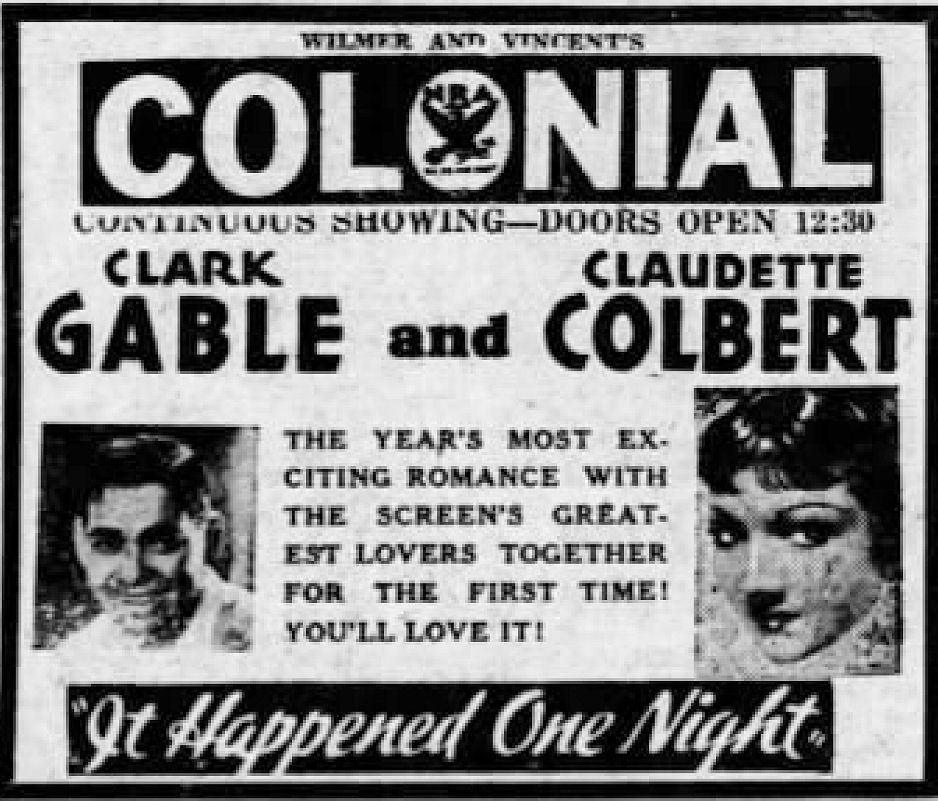 Colonial Theater advertisement for the American film It Happened One Night (1934) – 13 Mar. 1934 Morning Call, Allentown PA. Image credit: Columbia Pictures Corp. / Public domain, via Wikimedia Commons.
One film swept the five major Oscars and changed romantic comedy
It Happened One Night became the first film to win the Academy Awards for best picture, director, actor, actress and screenplay. Colbert’s best-actress win completed a reversal from doubtful assignment to defining success.
Stories say she was preparing to leave on a train and attended the ceremony in travelling clothes, convinced she would not win. The details have been repeated in several forms, and photographs confirm an acceptance far less formally dressed than later Oscar ritual. The anecdote survives because it fits the film itself: glamour caught in transit.
The award did not turn Colbert into a single-film star. It confirmed qualities her earlier work had developed. She could be wealthy without becoming remote, comic without being foolish and romantic without waiting for a man to explain her feelings.
The film influenced screwball comedy, though it is less frantic than some later examples. Its structure places social opposites on the road, strips away supporting institutions and lets conversation perform the courtship.
Colbert’s Ellie is central to that design. If the heiress were only spoiled, Peter’s education of her would become smug. If she knew everything already, the journey would have no movement. Colbert lets competence and inexperience occupy the character together.
Cleopatra turned historical spectacle into a modern star vehicle
Later in 1934, DeMille cast Colbert as the Egyptian queen in Cleopatra. The production treats antiquity as an opportunity for Art Deco sets, revealing costumes, military spectacle and contemporary romantic confidence.
Historical accuracy is not the organising principle. The film compresses politics and relationships, while its representation of Egypt belongs to Hollywood fantasy. Colbert plays Cleopatra less as a remote monument than as a woman managing men who mistake desire for control.
With Warren William as Julius Caesar and Henry Wilcoxon as Mark Antony, she changes tone according to the opponent. Seduction is strategic, but the performance also allows pleasure. Cleopatra can enjoy the theatre of power without confusing it with security.
The film was released as stricter Production Code enforcement transformed what Hollywood could show. Colbert’s pre-Code image gave way to comedy and domestic drama, but the authority remained. She had proved capable of carrying one of the year’s largest productions only months after making a road comedy appear effortless.
These two 1934 roles explain her range better together. Ellie Andrews loses the protections of wealth and discovers practical life. Cleopatra turns display into political equipment. Both characters think while men are speaking.
 Cropped screenshot of Claudette Colbert from the trailer for the film Cleopatra. Image credit: Trailer screenshot, from DVD Cleopatra, Universal Studios, 2006 / Cleopatra trailer / Public domain, via Wikimedia Commons.
Private Worlds brought another Oscar nomination through dramatic restraint
In Private Worlds (1935), Colbert played Dr Jane Everest, a psychiatrist working in a hospital where sexism affects authority and treatment. The film’s approach to mental illness belongs to its period and should not be mistaken for modern clinical understanding.
The role nevertheless allowed her to play a professional woman whose intelligence was explicit. Jane’s conflict with a male superior concerns institutional judgement rather than romantic misunderstanding, even though melodrama enters the story.
Colbert received her second Academy Award nomination for best actress. The performance is valuable because it challenges the idea that control was only a comic device. Her listening can carry empathy without turning the doctor into a saint.
The film also reveals the limits surrounding professional women on screen. Competence needs to be tested through personal feeling, and the narrative works to make authority reassuringly feminine. Colbert negotiates that pressure without weakening the character’s command.
She continued making dramas and historical pictures, including Under Two Flags and Maid of Salem. The output was rapid. Studio stardom required moving from one setting and co-star to another while maintaining a recognisable identity for audiences.
Midnight let her play class as a costume anyone might learn to wear
Mitchell Leisen’s Midnight (1939), written by Billy Wilder and Charles Brackett, cast Colbert as Eve Peabody, an American showgirl who arrives in Paris with little money and becomes involved in an elaborate deception. Don Ameche plays a taxi driver searching for her, while John Barrymore’s wealthy character recruits her to interrupt his wife’s affair.
Eve enters high society under a false title, and the comedy depends on her ability to learn the performance faster than the people who believe status is natural. Colbert makes elegance look acquired and intelligence innate.
The role brings together her pre-Code sophistication and later screwball speed. Eve understands money and romantic fantasy without treating either as shameful. She wants security but remains alert to the cost of allowing someone else to define it.
Barrymore expands, improvises and threatens to take possession of every scene. Colbert does not compete with volume. She waits until Eve can redirect the arrangement with a practical sentence.
Midnight is one of the best places to see her comic craft because the character is always acting within the story. We watch Colbert play Eve, and Eve play a baroness, while small differences in confidence tell us when the disguise is under pressure.
 Theatrical release poster for the 1939 film Midnight. Image credit: Illustrator unknown. “Copyright 1939 by Paramount Pictures Inc. ” / Scan via Heritage Auctions / Public domain, via Wikimedia Commons.
Marriage to Norman Foster ended, while Joel Pressman remained her partner for decades
Colbert married actor and director Norman Foster in 1928. The marriage ended in divorce in 1935. They reportedly spent substantial periods living separately, a practical arrangement that sat awkwardly beside conventional publicity about marriage.
In 1935 she married Dr Joel Pressman, a surgeon. Their marriage lasted until his death in 1968. They had no children and maintained a comparatively private life by Hollywood standards.
Pressman’s profession and Colbert’s income created a household not organised entirely around the film business. She guarded time, negotiated work carefully and developed a reputation for knowing exactly how she wanted to be photographed and scheduled.
Descriptions of her as demanding should be read with context. A star responsible for a production’s financing and publicity had reason to care about light, costume and working hours. Male control was often described as professionalism; female control more easily became difficulty.
That does not mean every reported conflict was invented. Colbert had preferences and the power to enforce some of them. The useful question is what the control produced. On screen, it created consistency without stiffness.
The Palm Beach Story made economic desperation look elegantly absurd
Preston Sturges’s The Palm Beach Story (1942) cast Colbert and Joel McCrea as Gerry and Tom Jeffers, a married couple whose financial problems lead Gerry to decide that divorce and a wealthy new husband might fund Tom’s inventions.
The premise gives Colbert an extraordinary comic position. Gerry is practical and preposterous at once. She understands that beauty operates as currency, and she is willing to use it, while the film keeps asking whether the plan is sacrifice, escape or entertainment.
On a train she encounters the Ale and Quail Club, wealthy men whose drinking and shooting turn privilege into chaos. Colbert holds the centre by reacting just enough. Gerry is endangered, amused and already calculating the next move.
Rudy Vallee’s gentle millionaire and Mary Astor’s enthusiastically romantic princess complicate the couple’s reunion. Sturges pushes the plot beyond realism, then ends with a revelation about twins so outrageous that it exposes the machinery of romantic comedy itself.
Colbert never asks us to believe Gerry is morally simple. She makes the character’s calculation attractive because it is honest. Money matters, desire matters and marriage does not magically solve either.
 Screenshot of Claudette Colbert from the film The Palm Beach Story. Image credit: Paramount Studios / The Palm Beach Story, trailer / Public domain, via Wikimedia Commons.
Wartime films asked glamour to carry national feeling
In So Proudly We Hail! (1943), Colbert played an Army nurse serving in the Philippines during the Second World War. Paulette Goddard and Veronica Lake co-starred, and the film combined combat, sacrifice and romance.
The production was made while the war continued, giving its tribute to nurses immediate patriotic purpose. Colbert’s authority suited a character responsible for maintaining order when normal systems had collapsed.
The film recognises women’s military service while still using romance and sacrifice to make that service acceptable within familiar expectations. Colbert allows exhaustion and fear to enter the polished image without turning the nurse into an abstract symbol.
Since You Went Away (1944), produced by David O. Selznick, shifted attention to the American home front. Colbert played Anne Hilton, a mother managing rationing, work, daughters and uncertainty while her husband served overseas.
The large production turns domestic life into national epic. Modern viewers may find its sentiment deliberate, but Colbert keeps Anne specific. Worry appears in interrupted routines, money decisions and the effort to remain steady for children.
She received her third Academy Award nomination for the role. Once again, control was not the absence of emotion. It was the action the character performed because other people depended on her.
 Joseph Cotten & Claudette Colbert in American epic drama film Since You Went Away (1944) directed by John Cromwell. Image credit: Selznick International Pictures, Vanguard Films / Public domain, via Wikimedia Commons.
She was one of Hollywood’s highest-paid stars because reliability had value
At the height of her career, Colbert ranked among the industry’s highest-paid performers. Salary lists are often presented as glamour trivia, but they reflect leverage. A Colbert film offered studios a recognisable promise across comedy, romance and drama.
She worked frequently with major directors and leading men without becoming permanently attached to one screen partnership. Gable, McCrea, Fred MacMurray, Gary Cooper and Ray Milland could enter her comic world because her star identity was already complete.
Reliability did not mean repetition. In The Gilded Lily, Bluebeard’s Eighth Wife, Arise, My Love and The Egg and I, she adjusted speed and social position while maintaining the audience’s expectation of intelligence.
The less successful films also matter. No star made only classics, and the studio production line sometimes placed performers inside material that depended on their presence to appear more substantial than it was. Colbert’s professionalism could disguise a weak structure, which may be one reason her individual technique receives less discussion than the best titles.
Her glamour was manufactured, as all film glamour is, but it was not empty manufacture. Costume, cinematography, editing and the actor’s decisions worked together to create a woman who seemed prepared for the scene before it began.
The Egg and I created a rural hit and an uncomfortable legacy
The Egg and I (1947), adapted from Betty MacDonald’s memoir, paired Colbert with Fred MacMurray as a city couple attempting to run a chicken farm. The contrast between modern expectations and rural hardship produced a major commercial success.
Colbert makes the physical discomfort comic without losing the character’s frustration. Mud, broken equipment and endless labour challenge the composed image, but the joke is not simply that a glamorous woman cannot cope. It is that the husband’s dream has assigned both people work without equal consultation.
The film introduced Ma and Pa Kettle, characters popular enough to generate a series. Their broad rural caricature belongs to the era’s class comedy. The production also includes the Geoduck family, whose depiction of Indigenous people relies on racist stereotype.
That element should not be ignored because the central comedy remains appealing. Classic films can contain lively performance and harmful representation at the same time. Honest viewing does not require either pleasure or criticism to cancel the other.
Commercial success extended Colbert’s career into the post-war period, when changing audience tastes and the decline of long-term studio structures were altering the place of established stars.
Three Came Home brought wartime imprisonment close to her own experience
In Three Came Home (1950), Colbert played writer Agnes Newton Keith, who was imprisoned with her child in a Japanese camp in Borneo during the Second World War. The film adapted Keith’s memoir and required a physically and emotionally demanding performance.
The production distinguishes some individual captors from the system, particularly through Sessue Hayakawa’s performance, but it remains a post-war American account of Japanese imprisonment. Historical context and the memoir basis should guide modern assessment.
Colbert injured her back during production, and the effects contributed to reduced film work. The role strips away much of the comic protection associated with her image. Hunger, fear and maternal responsibility are presented through endurance rather than speeches designed to collect sympathy.
Her control becomes almost severe. Agnes must manage what the child sees while knowing she cannot guarantee safety. Colbert’s refusal to display every feeling makes the pressure more convincing.
The film is a useful corrective for anyone who knows only the comedies. It shows that the intelligence behind glamour could remain compelling when costume and romantic structure disappeared.
Television and theatre offered mature roles film provided less consistently
Colbert continued in films including Let’s Make It Legal and The Planter’s Wife, but stage and television became increasingly important. Theatre allowed her to play sophisticated adult women without pretending they were still ingenues.
She appeared on Broadway and in touring productions, including The Marriage-Go-Round and The Irregular Verb to Love. Live performance returned her to the form in which she had begun, now with decades of screen fame shaping audience expectation.
Television anthology dramas and later series work offered another route. Her performance in the television film The Two Mrs Grenvilles (1987) earned a Golden Globe and an Emmy nomination. She played a wealthy matriarch whose social composure contains ruthlessness and family damage.
The role understood what Colbert’s age could provide. Authority no longer needed romantic qualification, and elegance could become intimidating rather than reassuring.
Her final screen work did not attempt to recreate Ellie Andrews. It used the same capacity to watch, decide and reveal only what the character considered useful.
 Cropped screenshot of Louise Beavers and Claudette Colbert from the film Imitation of Life (1934). Image credit: Universal Pictures / Imitation of Life, trailer / Public domain, via Wikimedia Commons.
Barbados became home after decades of Hollywood movement
After Joel Pressman’s death, Colbert spent increasing time in Barbados, where she owned a home known as Bellerive. The island offered distance from Hollywood and a social life she could manage more privately.
She also maintained connections in New York and continued selective work. Retirement for a star of her generation was rarely a single date. Projects became less frequent, while public appearances and awards kept the career present.
Colbert died in Barbados in July 1996 at ninety-two. She left much of her estate to a friend, a decision that led later writers to speculate about the exact nature of relationships. As with other private matters, legal bequests establish affection and trust without requiring unsupported romantic conclusions.
The length of her life can distort the scale of the early career. It Happened One Night, Cleopatra and The Sign of the Cross were released within roughly two years. She moved through major changes in censorship, technology and genre while operating at the centre of the industry.
Where should you begin with Claudette Colbert’s films?
Begin with It Happened One Night. Watch beyond the familiar hitchhiking and Walls of Jericho scenes. Notice how Ellie learns without becoming a pupil and how often Colbert allows a practical reaction to defeat a long speech.
Then watch Midnight, where sophistication becomes a performance inside the performance. Follow it with The Palm Beach Story for a faster and stranger comedy about marriage and money.
Add The Sign of the Cross and Cleopatra to understand the scale and daring of her pre-Code image, keeping the productions’ historical fantasy in view. Private Worlds and Three Came Home show the dramatic range behind the comedies.
Finish with Since You Went Away. Its wartime sentiment is deliberate, but Colbert makes national feeling operate through the daily effort of one household.
If you want a lighter final film, choose The Egg and I and view its pleasures alongside a clear recognition of the stereotypes around the central couple.
Why does Claudette Colbert still matter?
Colbert matters because she made intelligence compatible with almost every kind of studio-era femininity. She could be an heiress, queen, doctor, showgirl, wife, nurse or mother without allowing the category to finish the character.
Her famous control was part of the artistry. She understood how the camera, costume and voice assembled a star, and she protected that assembly. The result was not rigidity. At her best, it created room for risk because the audience trusted the woman at the centre.
It Happened One Night remains the defining title, but it does not explain the whole career. Midnight shows social performance, The Palm Beach Story makes economic calculation comic and Three Came Home removes glamour to reveal endurance.
The easiest word for Colbert is sophisticated. The better word may be alert. She always seemed to know where the scene was going, what the man had missed and how much of her answer the audience needed to hear. That is why the work still feels alive. The glamour attracts attention, but the intelligence keeps it.