Burt Lancaster arrived in The Killers with the body of an athlete and the stillness of a defeated man. Hollywood immediately knew what to do with the body. It took longer to understand the ambition. Lancaster wanted to act, but he also wanted to choose stories, control production and build a company powerful enough to work outside the usual studio arrangements.
That independence produced adventure films, social drama, commercial successes and one of the boldest international careers of any American star of his generation. In this biography, we will follow Lancaster from East Harlem and the circus to film noir, From Here to Eternity, Sweet Smell of Success, Elmer Gantry, The Leopard and Atlantic City. We will also look at the politics and producing work that made him more than a performer waiting for the next offer.
Lancaster’s grin could make physical confidence look uncomplicated. His best characters reveal what happened when confidence became appetite, vanity or fear of losing power. He was most interesting when a film allowed the impressive surface to become part of the problem.
 Burt Lancaster, 1949. Image credit: Bob Beerman [1] / Modern Screen, January 1950, page 29 / public domain.
Burt Lancaster at a glance
- Full name: Burton Stephen Lancaster
- Born: 2 November 1913 in Manhattan, New York
- Died: 20 October 1994 in Los Angeles, California
- Occupation: Actor and producer
- Years active: 1945 to 1991
- Best-known films: The Killers, Brute Force, From Here to Eternity, Sweet Smell of Success, Elmer Gantry, Judgment at Nuremberg, Birdman of Alcatraz, The Leopard and Atlantic City
- Major recognition: Academy Award for best actor for Elmer Gantry, with three other acting nominations
- Production legacy: Co-founder of independent companies that developed films including Marty, Sweet Smell of Success and Separate Tables
- Physical foundation: Acrobatics and circus performance with his lifelong friend Nick Cravat
East Harlem, friendship and a body trained before acting
Lancaster was born in Manhattan and raised in East Harlem, the son of Elizabeth and James Lancaster. The neighbourhood was crowded, working class and ethnically mixed. He attended DeWitt Clinton High School, where sport gave his restless energy a structure.
At a settlement house he met Nick Cuccia, later known as Nick Cravat. The friendship would last for life. They developed acrobatic skills together, performing on bars and building routines around strength, timing and absolute physical trust. Lancaster attended New York University on an athletic scholarship but left without completing a degree.
He and Cravat formed the circus act Lang and Cravat. They worked in carnivals, vaudeville houses and the Kay Brothers Circus during the 1930s. The act required more than muscle. An acrobat has to understand where an audience is looking, how to prepare a risk and how a partner’s weight will move before it moves.
An injury ended Lancaster’s regular acrobatic career. He took a succession of jobs, including singing waiter and department-store work. During the Second World War he served with the US Army’s Special Services, entertaining troops. Performance returned as part of military life rather than a planned route to Hollywood.
The circus years followed him into films. Lancaster could move with unusual confidence and performed demanding action, but the deeper inheritance was partnership. He understood that a stunt, scene or production depended on people making one another look secure. His later companies extended that principle into business, even when the partnerships themselves became difficult.
 Photograph of Burt Lancaster and Nick Cravat, performing as Lang & Cravat with the Federal Theatre Project Circus. Image credit: Federal Theatre Project / Library of Congress / public domain.
One Broadway role led to The Killers
After the war, Lancaster appeared on Broadway in A Sound of Hunting. The play ran briefly, but his physical presence attracted the attention of producer and agent Harold Hecht. Within a short period, a man with limited dramatic experience had a Hollywood contract and a leading film role.
Robert Siodmak’s The Killers (1946) begins with Lancaster’s Ole Anderson waiting passively for two gunmen. He knows they have come to kill him and refuses to run. The mystery then moves backwards through his boxing career, criminal involvement and obsession with Ava Gardner’s Kitty Collins.
Lancaster’s inexperience helps the opening. He lies in shadow and allows resignation to occupy the large body. Later flashbacks use his physicality differently. The Swede is powerful enough to imagine that force will protect him, yet emotionally unprepared for manipulation. Gardner’s stillness meets his openness, and the imbalance drives the tragedy.
The film made both actors stars. Lancaster received the label of overnight discovery, but the circus and military entertainment years had already taught him discipline, repetition and the management of attention. What he lacked was camera technique. He learned quickly because the body had spent years being organised for an audience.
The danger of The Killers was typecasting. Hollywood could see a handsome, athletic man suitable for noir, westerns and adventure. Lancaster could see the financial leverage of becoming a star before the studios had decided how permanently to own him.
 Screenshot of Ava Gardner and Burt Lancaster from the trailer for the film The Killers. Image credit: Trailer screenshot / The Killers trailer / public domain.
Brute Force and Criss Cross made strength look trapped
Jules Dassin’s Brute Force (1947) placed Lancaster inside a prison ruled by Hume Cronyn’s sadistic Captain Munsey. The film uses the prison as both institution and political warning. Men are controlled through surveillance, informers and punishment while the administration describes domination as order.
Lancaster’s Joe Collins is physically formidable, but walls and organised authority make strength insufficient. The final violence is not a clean liberation. Dassin gives it the desperation of men who have run out of legal or personal space.
In Criss Cross (1949), Lancaster reunited with Siodmak as Steve Thompson, an armoured-car driver drawn back towards his former wife Anna, played by Yvonne De Carlo. Steve invents a robbery partly to disguise their relationship and partly because desire has damaged his judgement.
The title describes both plot and emotional structure. Every plan contains another betrayal. Lancaster makes Steve’s size almost embarrassing. He can handle guards and machinery, yet one glance from Anna removes the practical intelligence he uses everywhere else.
These films established a recurring Lancaster character: the man who appears capable of mastering the environment but cannot master the need driving him. The grin, shoulders and speed promise action. Noir asks whether action will only complete the trap.
Independence was a business strategy, not a rejection of popular films
Lancaster and Harold Hecht formed Norma Productions, named after Lancaster’s wife, Norma Anderson. The company evolved through partnerships, including Hecht-Lancaster and Hecht-Hill-Lancaster with writer-producer James Hill. At a time when studios still controlled distribution and theatres, the arrangements gave Lancaster unusual influence over projects.
Independence did not mean that every film was austere or personal. The Flame and the Arrow and The Crimson Pirate used Lancaster’s acrobatics, colour and Nick Cravat’s physical comedy. These were popular adventure pictures designed to entertain, and Lancaster performed the athletic hero with delight.
The companies also developed serious work. Marty, starring Ernest Borgnine, became an unexpected commercial success and won the Academy Award for best picture. Lancaster did not star in it. That fact demonstrates that producing was not simply a device for creating better vehicles for himself.
Independent production gave him leverage but also risk. Financing, distribution, budgets and partnerships could become as restrictive as a studio contract. Lancaster’s reputation for forceful involvement was not always comfortable for collaborators. He wanted control and could be intimidating when he believed a project required it.
The important point is that he treated stardom as capital. A successful performance could finance a smaller film, secure a director or create a role unlike the one audiences expected. His career became varied because the business structure allowed variety to be planned.
 Theatrical release poster for the 1946 film The Killers. Image credit: “Copyrighted 1946 – Universal Pictures Corp. ” / Scan via Heritage Auctions. Cropped from the original image. / public domain.
From Here to Eternity put vulnerability inside authority
Fred Zinnemann’s From Here to Eternity (1953) gave Lancaster the role of First Sergeant Milton Warden, serving at Schofield Barracks in Hawaii before Pearl Harbor. Warden is efficient, respected and more capable than the officers above him. He also begins an affair with his commander’s wife Karen, played by Deborah Kerr.
The beach embrace became one of classic Hollywood’s best-known romantic images. Its fame can make the scene look like pure glamour. Water repeatedly interrupts the couple, and the relationship begins within frustration, loneliness and professional danger. Lancaster’s physical authority is not enough to make Warden free.
The other central story belongs to Montgomery Clift’s Prewitt, the soldier punished for refusing to box. Lancaster and Clift use very different techniques. Lancaster seems outward, controlled and alert to hierarchy. Clift makes thought and hurt move across the surface. Warden respects Prewitt because he recognises another man whose pride cannot be managed through ordinary pressure.
Lancaster fought for the role when some executives considered him too closely associated with swashbucklers. The performance earned an Academy Award nomination and changed the direction of his career. A body trained for spectacle could carry compromise, desire and institutional responsibility without losing command.
 L. to R. : Tony Curtis, Gina Lollobrigida & Burt Lancaster in Trapeze – trailer (cropped screenshot). Image credit: trailer screenshot (Hecht-Lancaster / United Artists) / Trapeze trailer / public domain.
Trapeze returned him to the circus on a much larger screen
Carol Reed’s Trapeze (1956) allowed Lancaster to use his circus background directly. He played Mike Ribble, an injured former aerialist training the ambitious Tino Orsini, played by Tony Curtis. Gina Lollobrigida’s Lola wants a place in the act and understands how attraction can alter professional loyalties.
Lancaster performed much of the physical work, with specialist doubles handling the most dangerous material. The film’s widescreen spectacle celebrates the circus, but its story is about trust damaged by ambition. A trapeze partnership cannot survive if one performer treats the other as replaceable.
The role also gave age an early place in Lancaster’s image. Mike possesses knowledge but cannot simply return to his former physical peak. Teaching becomes both generosity and a threat to identity. Lancaster would revisit that tension throughout the later career as younger men inherited the kinds of roles his body had once owned.
Producing the film through his company joined personal history to commercial scale. It was not a small memoir. It was an international star vehicle built around the exact skill that existed before anyone knew Burt Lancaster could act.
Sweet Smell of Success turned charm into social violence
Alexander Mackendrick’s Sweet Smell of Success (1957) gave Lancaster one of his darkest roles. He plays J. J. Hunsecker, a powerful Broadway columnist who uses publicity to reward obedience and destroy anyone who threatens his control. Tony Curtis is Sidney Falco, the press agent willing to carry out the dirty work.
Hunsecker barely needs to move. Lancaster sits behind glasses, listens and lets other people calculate the danger. The smile appears without warmth. Power comes from knowing that a sentence in tomorrow’s column can alter careers and relationships.
The film was produced through Hecht-Hill-Lancaster and initially disappointed commercially. Its New York locations, hard dialogue and contempt for publicity culture were less inviting than Lancaster’s adventure films. The reputation grew because the world it describes never stopped being recognisable.
Hunsecker’s possessive treatment of his sister gives the power a private ugliness. Lancaster does not supply a psychological speech explaining it. He shows a man who has arranged an entire city so that no one can tell him his behaviour is abnormal.
The role is the negative image of independent stardom. Lancaster had used fame to create choices. Hunsecker uses fame to remove choice from everyone else.
 Screenshot of Ava Gardner and Burt Lancaster from the trailer for the film The Killers. Image credit: Trailer screenshot / The Killers trailer / public domain.
Elmer Gantry rewarded the full force of his personality
Richard Brooks’s Elmer Gantry (1960), adapted from Sinclair Lewis, cast Lancaster as a travelling salesman who joins evangelist Sister Sharon Falconer, played by Jean Simmons. Gantry discovers that religious performance can use the same appetite, voice and instinct for an audience that once sold ordinary goods.
Lancaster’s energy fills the film. Gantry is persuasive because he partly believes himself while speaking. He can be cynical, sincere, sexually reckless and genuinely moved within the same sermon. The contradictions do not cancel one another. They are the source of his power.
The performance risks becoming too large, but largeness is the subject. Gantry understands that a crowd needs rhythm, repetition and a visible body through which belief can move. Lancaster’s circus and star experience give the sermons physical structure.
Jean Simmons refuses to let Sharon become merely his audience. Her faith, ambition and vulnerability follow a different route. Their partnership asks whether performance makes belief false or whether belief always requires some form of performance.
Lancaster won the Academy Award for best actor. The Oscar recognised a role unlike the quiet naturalism often rewarded in retrospect. He had found a character who could contain the grin, voice, physical authority and suspicion of authority at once.
 L. to R. : Burt Lancaster, Gina Lollobrigida & Tony Curtis in Trapeze – trailer (cropped screenshot). Image credit: trailer screenshot (Hecht-Lancaster / United Artists) / Trapeze trailer / public domain.
Judgment at Nuremberg and Birdman of Alcatraz moved power inward
In Stanley Kramer’s Judgment at Nuremberg (1961), Lancaster played Ernst Janning, a respected German judge accused of participating in Nazi legal crimes. For much of the film Janning remains silent. His reputation and the arguments made on his behalf occupy the courtroom before he does.
When Janning finally speaks, Lancaster avoids asking sympathy for a good man who made one mistake. The testimony recognises a process by which professional compromise becomes participation. His stature makes the admission heavier because the character had every qualification required to know better.
John Frankenheimer’s Birdman of Alcatraz (1962) cast him as Robert Stroud, the convicted murderer who became an expert on birds while imprisoned. The film presents a heavily shaped version of Stroud and softens aspects of his behaviour. It should not be used as a complete biography of the prisoner.
Lancaster’s performance is still remarkable. He reduces movement, ages across decades and turns close observation into the central action. A man known for acrobatics sits in a cell studying fragile creatures. The contrast is not a trick. It reveals how much authority he could create without physical display.
The role earned another Academy Award nomination. Lancaster’s career had moved from a victim waiting for killers to men whose greatest conflicts occurred inside institutions they could not overpower.
The Leopard gave him an aristocratic farewell to an old order
Luchino Visconti cast Lancaster as Prince Don Fabrizio Salina in The Leopard (1963), an Italian epic set during the Risorgimento. The choice surprised people who expected an Italian or European actor. Visconti reportedly faced pressure to accept an international star, while Lancaster entered a production culture and role far from his usual American image.
The partnership became productive. Lancaster learned how to carry the prince through gesture, stillness and attention to ritual. Don Fabrizio understands that his class is losing political power and that survival will require alliance with the energetic middle class. He is perceptive enough to see change and privileged enough to remain protected from much of its cost.
The long ballroom sequence turns social ceremony into historical time. Lancaster dances, watches younger people and recognises that beauty will continue without him. The physical star is still imposing, but the film measures the approaching end of the body’s authority.
Different release versions damaged the film’s initial reception in some markets, particularly the shortened English-language edition. Restored versions allow Lancaster’s performance to breathe within Visconti’s pacing and design.
The Leopard opened a major European strand in his career. He later worked in films by Bernardo Bertolucci and other directors who used him as both actor and emblem of American power ageing in public.
 A Federal Theatre Project circus poster recalls the world in which Lancaster and Nick Cravat developed their acrobatic act. Image credit: Federal Theatre Project; Dick Rose, photographer / This image is available from the United States Library of Congress ‘s Prints and Photographs division under the digital ID ds.01244.
Politics placed him on the public side of arguments
Lancaster supported liberal and left-leaning causes, civil rights and opposition to the blacklist. He participated in the 1963 March on Washington and spoke publicly on political issues at moments when many stars preferred safer charity work.
His positions changed across decades and should not be compressed into a perfect record. Celebrity activism includes conviction, publicity and the unequal attention fame supplies. Lancaster understood that his name could bring cameras to an issue. He used that attention more consistently than many peers.
He opposed the Vietnam War and supported Democratic candidates. Later he campaigned against AIDS stigma and spoke in favour of colleagues when fear threatened careers. His politics sometimes caused commercial friction, but the independence built through production reduced the ability of one studio to silence him.
The relationship between politics and roles was not automatic. Playing a principled character did not prove political virtue, and activism did not make every film progressive. The important connection is structural. Lancaster wanted control over work and believed concentrated power should be challenged beyond the film set as well.
Family, sexuality and the limits of a public account
Lancaster married June Ernst briefly during the circus years. His second marriage, to Norma Anderson, lasted from 1946 to 1969, and they had five children. The family lived with the pressures of travel, production and a star whose professional life demanded constant movement.
Biographers have discussed relationships outside the marriage and have reported that Lancaster had relationships with men as well as women. Some accounts rely on interviews and industry recollection; others repeat rumours. A careful biography can acknowledge the evidence without turning private partners into a list or assigning a label more confidently than Lancaster did publicly.
He married Susan Martin in 1990. By then his health had declined, and family relationships had developed over many separate adult lives. Lancaster’s forceful public character could make people around him disappear into supporting roles. They should not.
Privacy has particular importance for stars who worked during periods when same-sex relationships could threaten employment. Silence in publicity is not proof that nothing occurred, but it is also not permission to treat every anecdote as established fact.
Atlantic City found tenderness in a man living among old stories
Louis Malle’s Atlantic City (1980) gave Lancaster one of his finest late roles. He plays Lou Pascal, an ageing small-time criminal who tells stories about a more glamorous past. Susan Sarandon’s Sally works in a casino and dreams of becoming a dealer in Monte Carlo.
The city is being demolished and rebuilt around them. Old hotels disappear while casinos sell a brighter version of the future. Lou’s memories function the same way. Some are true, some enlarged and all protect him from recognising how modest his actual criminal life has been.
Lancaster makes the vanity touching without asking us to believe it. When danger arrives, Lou finally performs a version of the courage he has long described. The act does not transform him into a young gangster. It gives an old man one experience that can survive the story he will later tell about it.
The film earned Lancaster his fourth Academy Award nomination. His body, once evidence of unlimited ability, now moved carefully. Malle used that change with affection rather than pity.
Later work, illness and death
Lancaster continued in American and European productions, including 1900, Conversation Piece, Local Hero and Field of Dreams. Bill Forsyth’s Local Hero cast him as an oil executive whose interest in astronomy complicates the company’s plan to purchase a Scottish village. The performance is light, eccentric and free from the need to prove dramatic weight.
Health problems increasingly limited work. Lancaster survived heart attacks and underwent bypass surgery. A stroke in 1990 left him partially paralysed and affected his speech. He died in October 1994, shortly before his eighty-first birthday.
His career cannot be contained by one genre or nation. Noir gave him fatalism, the circus films returned joy to movement, independent production gave him institutional power and European directors taught the American star how to represent a class or era passing away.
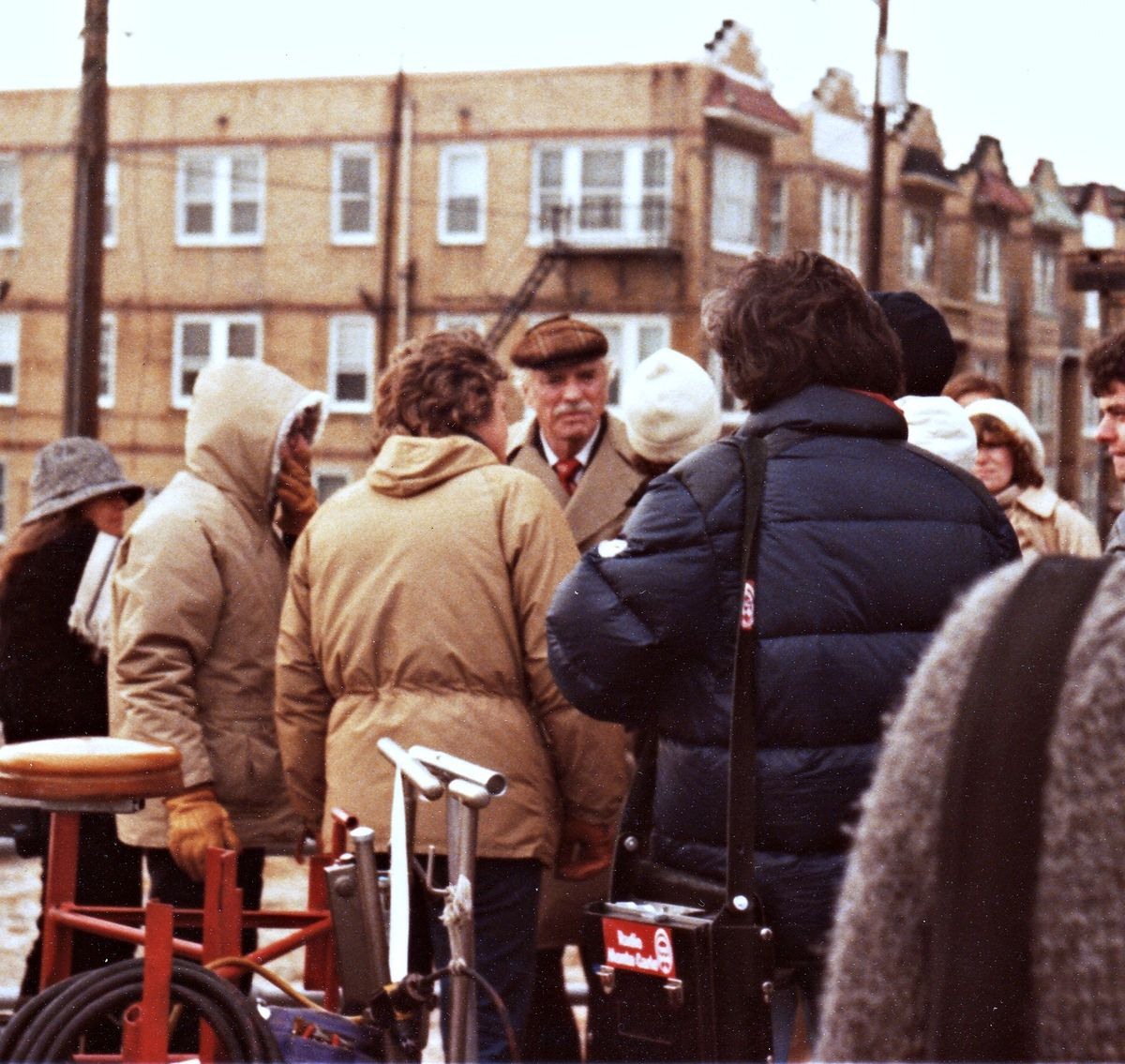 On set of movie Atlantic City. Director Louis Malle on left. 35mm. Image credit: David Swift via Wikimedia Commons.
Vera Cruz and Apache questioned the clean adventure hero
Lancaster’s independent ambitions did not mean he abandoned popular westerns. Apache and Vera Cruz, both released in 1954, used action to test the heroic body he had spent years constructing.
In Apache, he played Massai, an Apache warrior resisting confinement after Geronimo’s surrender. The production gave a Native character unusual centrality for a major western, but Lancaster was a white star performing the role, and the film’s politics remain shaped by Hollywood’s control over Indigenous stories.
The ending was changed from the harsher conclusion director Robert Aldrich preferred, reducing resistance into a more reassuring settlement. Lancaster’s physical commitment is real, but modern assessment must keep the representational problem in view rather than treating progressive intention as a complete defence.
Vera Cruz, also directed by Aldrich, paired Lancaster with Gary Cooper as American adventurers in Mexico. Cooper’s restraint and Lancaster’s exposed grin create competing forms of danger. Lancaster turns teeth, shoulders and sudden movement into the signals of a man whose charm has never promised loyalty.
The film anticipates the cynical westerns that followed. Alliances depend on money, national politics become opportunity and heroic appearance offers no moral guarantee. Lancaster enjoyed making the audience uncertain whether energy should be admired or feared.
These films also demonstrate the advantages and limits of independence. Control made ambitious subjects possible, but it did not place the productions outside the racial casting habits or commercial demands of their period.
The Swimmer and Seven Days in May used power against itself
John Frankenheimer’s Seven Days in May cast Lancaster as a general involved in a possible military coup against an American president. Kirk Douglas plays the officer who uncovers the plan. Lancaster removes the openness of his adventure roles and turns command into a sealed system.
The general does not think of himself as a villain. He believes national danger justifies replacing democratic process with his own judgement. Lancaster’s certainty makes the threat credible because charisma and patriotism appear to support it.
In The Swimmer, adapted from John Cheever, he plays Ned Merrill, who decides to cross an affluent Connecticut landscape by swimming through a sequence of neighbours’ pools. The body initially suggests health, success and freedom. Each encounter removes part of the story Ned tells about himself.
Production difficulties and changes of director affected the film, yet Lancaster’s willingness to appear emotionally exposed holds it together. He uses physical confidence as denial. The shoulders remain heroic after the social world has stopped agreeing.
The final arrival at an empty, locked house transforms the journey. Ned has not been travelling towards home so much as towards the knowledge he has avoided. Lancaster lets confusion enter in stages, refusing the comfort of one explanatory breakdown.
The Swimmer was commercially risky and initially misunderstood. It now stands among his boldest performances because it turns the star instrument against the star myth. The trained body cannot carry a man across consequences he refuses to remember.
Producing Marty showed that independence could create space for other actors
Lancaster and Harold Hecht’s company did not exist only to manufacture Lancaster vehicles. It helped produce Marty (1955), directed by Delbert Mann and starring Ernest Borgnine as a lonely Bronx butcher.
The small-scale drama was far removed from the athletic spectacle associated with Lancaster. Its success, including the Academy Award for best picture, showed that star-derived business power could support stories about people the glamour system rarely centred.
Independent production remained a commercial enterprise, and the company’s record included disputes and uneven decisions. Marty is still significant because it demonstrates a broader definition of control. Lancaster wanted not only to choose his own roles but to influence which films could exist.
That business history helps explain the range of the acting career. A performer thinking about scripts, financing and distribution encounters films as constructed objects, not simply opportunities to appear. Lancaster’s strongest risks came from understanding that the structure around a role could be changed.
Where should you begin with Burt Lancaster’s films?
Begin with The Killers. It shows the new star before the public knew how large the ambition would become. Follow it with From Here to Eternity for the move from physical adventure into mature drama.
Then watch Sweet Smell of Success and Elmer Gantry. One compresses power into a glance across a restaurant table. The other releases it through voice and movement. Together they show why no single acting style defines Lancaster.
Move to The Leopard, preferably in a restored version, and allow the ballroom sequence its full length. Finish with Atlantic City or Local Hero to see how lightly he could carry age.
Burt Lancaster made his own rules when the film business gave stars fewer choices than their fame suggested. The independence did not guarantee good decisions or easy partnerships. It made possible a career in which the same man could be a doomed boxer, a gossip tyrant, a fraudulent preacher, a Sicilian prince and an old dreamer watching a city replace him.