The quickest way into Buster Keaton is not necessarily The General or Sherlock Jr. It may be a 20-minute film in which a house rotates through a storm, a police parade chases one small man or a newly married couple receives the world’s least helpful set of building instructions.
In this countdown we will rank ten Buster Keaton short films from his independent peak in the early 1920s. These are not museum exercises or homework before the features. They are complete comic machines, made to move fast and finish before a brilliant idea has time to wear out.
 Buster Keaton, film actor Subjects (LCTGM): actors. Image credit: Unknown author / J. Willis Sayre Collection of Theatrical Photographs / Public domain, via Wikimedia Commons.
Why start with Keaton’s short films?
A short lets you understand Keaton’s screen character almost immediately. He is practical without being sensible, emotionally reserved without being cold and physically brave in ways that can make a modern viewer wince. The famous “Great Stone Face” is not an absence of feeling. It is the calm surface beneath which thought, panic and stubbornness keep changing places.
The shorts also show him learning what cinema can do. A stage comedian could perform a dangerous fall. Keaton could build an entire world in which space, editing, machinery and the camera itself become part of the joke.
How we ranked these Buster Keaton shorts
We chose the order for first-time viewers. Comic invention, clarity, rewatch value and the quality of Keaton’s physical performance all matter. Historical importance helps, but the highest-ranked films are the ones most likely to make somebody say, “Show me another one.”
The best Buster Keaton shorts for beginners
10. The Haunted House (1921)
Keaton begins as a bank clerk, becomes a robbery suspect and eventually takes refuge in a supposedly haunted theatre. The ghosts are part of a criminal scheme, but the staircase that turns into a slide is real enough within the film’s beautifully unstable world.
This is a lively introduction to Keaton’s love of engineered spaces. Floors, steps and trapdoors refuse to behave as architecture should. Not every routine connects as elegantly as it does in the films higher on our list, and the racial stereotyping in one passage needs acknowledging rather than excusing. Even with that reservation, the collapsing environment contains several irresistible ideas.
 Theatrical poster for The Haunted House (1921). Image credit: Joseph M. Schenck Productions / Metro Pictures / Public domain, via Wikimedia Commons.
The first half and second half operate like two different comic laboratories. At the bank, Keaton turns glue, money and suspicion into a chain reaction in which every attempt to separate one object attaches him to another. At the theatre, the criminals have mechanised superstition: costumes, trapdoors and collapsing stairs are business equipment designed to frighten witnesses away. Buster survives by treating the supernatural as another faulty machine.
That practical attitude is central to Keaton’s appeal. He rarely stops to announce that a ghost is impossible. He watches what the room does, tests it with his body and tries to locate the mechanism. The film also contains material that reflects racist stage conventions, and a responsible introduction should not glide past it. Acknowledging the stereotype does not erase the short’s visual invention; it helps us see the whole artefact rather than selecting only the parts that remain comfortable.
Start here if: you enjoy spooky-house comedy and elaborate mechanical gags.
9. Hard Luck (1921)
After a series of failed attempts to end his life, Keaton’s discouraged character joins an expedition searching for an armadillo. The premise is dark, but the treatment keeps turning despair into absurd persistence. Keaton fails at failing, which becomes its own reason to continue.
For decades the short survived only in incomplete form, and its most famous final joke was missing until footage resurfaced. The restored film remains rougher than the masterpieces above it, yet the willingness to push a bleak idea towards surreal comedy is unmistakably Keaton. Beginners should know that the subject is treated as farce, but they should also decide whether that subject is right for them.
 Buster Keaton in Hard Luck 1921 at Otis group statues in MacArthur Park Los Angeles Image credit: Buster Keaton, producer Joseph Schenk / Public domain, via Wikimedia Commons.
Keaton’s face makes the opening premise possible. He does not sentimentalise despair or ask for our pity; he approaches each failed suicide with the same baffled concentration he might bring to a broken engine. The repetition becomes a grim contest between intention and a universe that refuses to cooperate. That tone will not suit every viewer, but it reveals how far Keaton was willing to take emotional understatement.
Once the armadillo expedition begins, the short loosens into outdoor incidents, including a spectacular dive whose outcome depends on the restored ending. That lost footage changed the film’s reputation because the final transformation pushes the joke beyond realism. It also introduces a racial caricature that needs context rather than nostalgic protection. Hard Luck is therefore not the cleanest beginner film. It is valuable because it shows Keaton testing comedy’s limits—subject, continuity and taste—while still building gags with extraordinary physical conviction.
Start here if: you want Keaton at his most macabre and unpredictable.
8. The Balloonatic (1923)
A fairground mishap sends Keaton aloft in a hot-air balloon and deposits him in the wilderness, where he meets a capable young woman played by Phyllis Haver. Civilization disappears, but the problems remain practical: food, shelter, a river and two people whose courtship consists largely of surviving each other.
The film is looser than Keaton’s best shorts, almost a string of outdoor adventures, but the scenery gives his physical comedy unusual scale. It also lets Haver challenge him rather than simply wait to be rescued. Their competition keeps the romance from becoming sentimental.
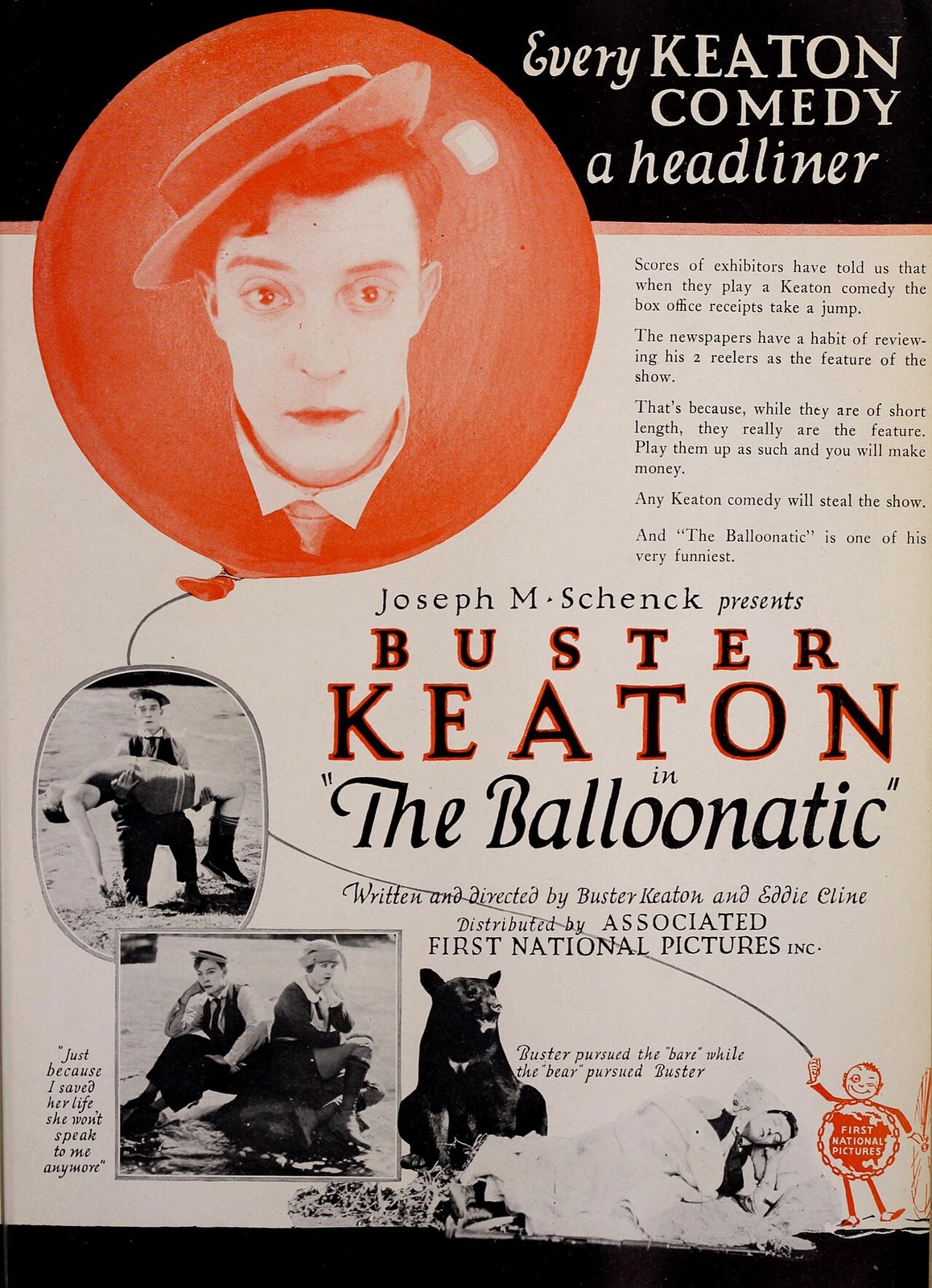 From Motion Picture News. Image credit: Motion Picture News / Public domain, via Wikimedia Commons.
The opening fairground sequence is almost a catalogue of modern amusements refusing to amuse Buster in the intended way. He enters attractions by accident, mistakes artificial experiences for real ones and finally becomes attached to a balloon he cannot control. The movement from crowded entertainment to open wilderness is one of the short’s pleasures: the scale changes, but his struggle with objects does not.
Phyllis Haver gives the second half its competitive spark. Her character is often better prepared than Buster, and Keaton is funniest when masculine confidence produces an obviously inferior solution. The river material turns courtship into joint engineering under pressure. Because the short wanders rather than tightening around one perfect device, individual gags can feel like stops on an excursion. Yet the looseness has charm, and the landscape lets us see how small Keaton is willing to make himself within a frame before one precise movement draws the eye back to him.
Start here if: you want outdoor adventure with the comedy rather than a tightly wound urban chase.
7. The High Sign (1921)
Keaton is hired by a shooting gallery and accidentally becomes involved with a criminal organisation called the Blinking Buzzards. He is soon expected both to assassinate a man and to protect the intended victim. The climax unfolds inside a house cut open like a doll’s house, allowing us to watch rooms, ladders, trapdoors and pursuers work at once.
Keaton made the short early in his independent career and initially held it back because he thought it looked too much like an imitation of his previous work with Roscoe Arbuckle. He was judging himself harshly. The multi-level house anticipates the spatial precision that would define his filmmaking.
 The High Sign (1921) in Motion Picture News Image credit: Metro Distributors / Public domain, via Wikimedia Commons.
The Blinking Buzzards are funny before they do anything because criminal secrecy has become childish ritual. Their hand signal grows more elaborate each time Buster attempts it, turning the idea of belonging into a physical exam nobody has properly explained. Keaton’s character gains employment, criminal membership and two opposing assignments largely because he is too adaptable to say no quickly enough.
The cutaway house is the major achievement. Instead of hiding action behind walls, the set lets us watch several threats travel through the building at once. Ladders slide, panels open and Buster moves between floors as though the rooms were pieces of a puzzle. This is not merely a backdrop for stunts; it is an early statement of Keaton’s belief that the audience should understand space clearly enough to anticipate danger. We laugh because we can see the trap being constructed a few seconds before the character reaches it.
Start here if: you want to see Keaton learning how to turn a set into a diagram of comic cause and effect.
6. Neighbors (1920)
Two lovers live in adjoining tenements separated by a fence and opposed by their families. Keaton and Virginia Fox pass messages, improvise meetings and attempt an escape while parents and policemen keep restoring the barriers.
The story is essentially Romeo and Juliet rebuilt as a collection of ladders, clotheslines and human towers. Keaton’s body seems to understand the geometry before his character does. The film is not gentle—slaps and domestic combat belong to its comic vocabulary—but its best sequences have the clean inevitability of a solved equation.
 Lobby card for Neighbors (1920). Image credit: Metro Pictures / Public domain, via Wikimedia Commons.
The fence is a wonderfully simple invention because it represents both the families’ hostility and the lovers’ determination to ignore it. Messages pass through holes, bodies climb over it and every adult effort to enforce separation produces another route. Keaton and Virginia Fox play the romance as shared practical work. There is little time for yearning when balance, timing and escape require full attention.
The human-chain sequence shows Keaton’s background in family acrobatics becoming cinematic design. Bodies are stacked into a moving structure, and the joke depends on our awareness that a tiny failure of balance would collapse the whole arrangement. Big Joe Roberts gives the opposing father the weight of an architectural obstacle. Some of the hitting belongs to a rough slapstick tradition that modern viewers may find aggressive, but the short’s deeper energy is cooperative. The lovers are funniest when they use the very community trying to stop them as material for their escape.
Start here if: you like acrobatics and want a very fast example of Keaton’s architectural imagination.
5. The Scarecrow (1920)
Keaton and Joe Roberts share a one-room house designed to make domestic life absurdly efficient. A phonograph helps deliver food, books hang from the ceiling and the room transforms around them. Both men then pursue the farmer’s daughter, played by Sybil Seely, and the controlled inventions spill into rural chaos.
The opening house is the reason to watch: Keaton is not merely using props but imagining an alternative way to live. Later there is a frantic dog chase and one of his stranger wedding arrangements. The sections do not join perfectly, yet the generosity of invention is hard to resist.
 Advertisement for The Scarecrow (1920), starring Buster Keaton . Image credit: Unknown author / Public domain, via Wikimedia Commons.
The automated bachelor home is still one of Keaton’s most inviting fantasies. A bed becomes a piano, the table disappears and household objects perform several jobs because space has been planned like a comic machine. The sequence is not about luxury. It imagines efficiency designed by people who enjoy mechanisms for their own sake, and Keaton allows us enough uninterrupted time to understand how every transformation works.
Once competition over Sybil Seely begins, domestic order explodes into fields, motorcycles and pursuit. Luke the Dog is not merely an animal accessory; he becomes a relentless moving problem whose speed forces Keaton to invent new uses for whatever enters the frame. The short’s halves are uneven, yet they express two sides of the same imagination: first control the environment, then discover how quickly control can vanish. Seely’s brisk presence also matters. The final romantic solution feels less like rescue than a decision made in the middle of practical chaos.
Start here if: you love gadget comedy and want to see how many jokes can grow from one room.
4. The Playhouse (1921)
Keaton opens with a dream in which he plays every performer, musician and member of the audience in a theatre. The multiple-exposure sequence is more than a technical stunt. It is a joke about authorship: Buster supplies the whole show, right down to the spectators applauding Buster.
Once awake, he works backstage and encounters a pair of twins, a trained monkey and an increasingly wet theatre. Some material reflects the racial conventions of its period and should be viewed critically. At its best, however, The Playhouse reveals a filmmaker fascinated by identity, performance and the possibility that cinema can multiply one body into an entire company.
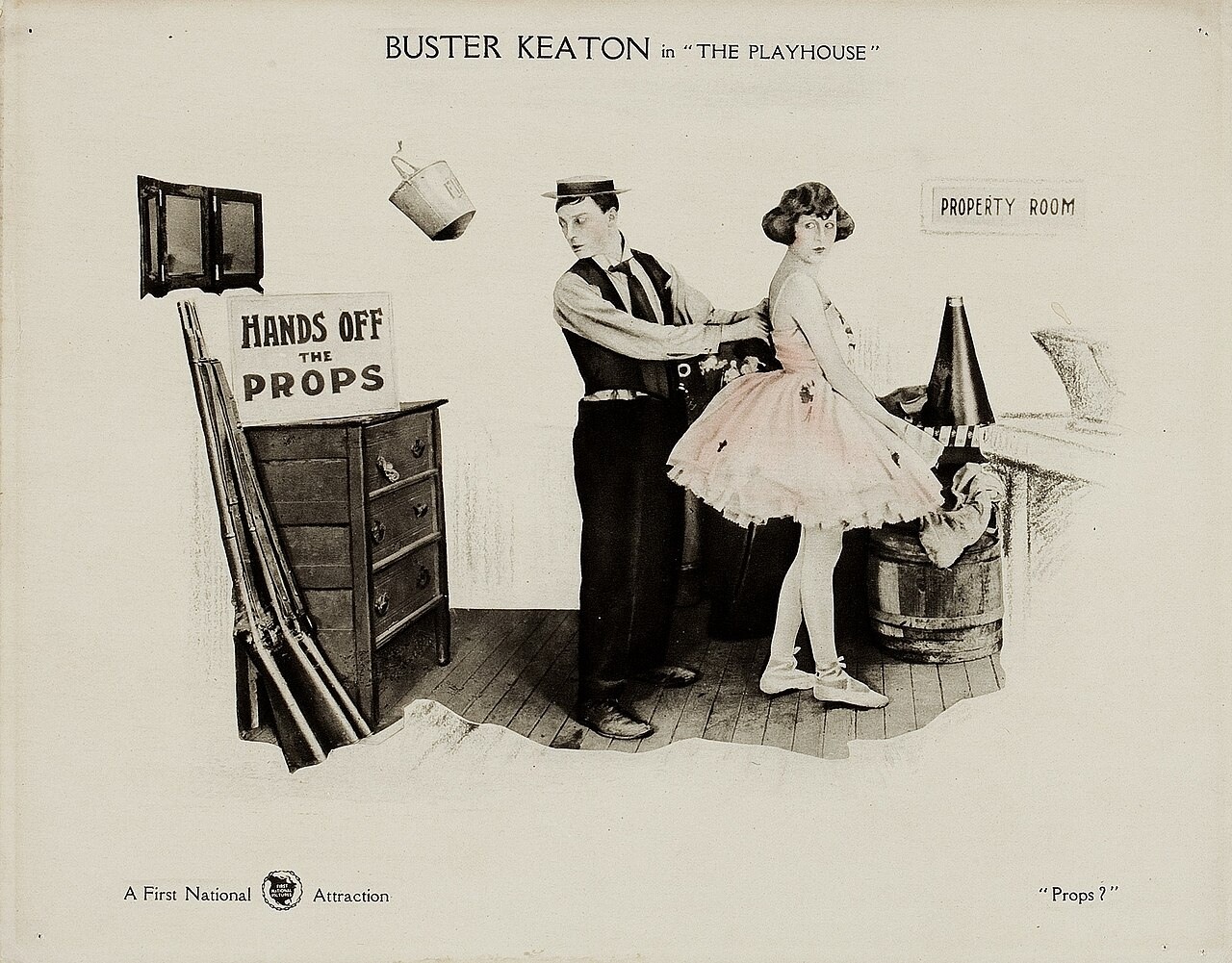 Lobby card for The Playhouse (1921). Image credit: Joseph M. Schenck Productions / First National Pictures / Public domain, via Wikimedia Commons.
The multiple-Buster opening remains astonishing because the effect serves a complete comic idea. Keaton is not demonstrating that cinema can duplicate a performer; he is imagining the ego of an entertainer who writes, plays, watches and applauds his own show. Each copy has a slightly different task, and their coordinated timing makes technical sophistication feel casual.
Backstage, identity keeps slipping. Twins confuse recognition, a monkey requires a human substitute and the theatre itself moves between competent performance and disaster. The period minstrel material is impossible to separate from the history of American entertainment and should be discussed plainly: technical ingenuity and racist convention occupy the same film. That tension is part of why The Playhouse rewards thoughtful viewing. Keaton is asking who creates spectacle and how audiences believe it, even while he remains bound to some of the spectacle his era took for granted.
Start here if: you want Keaton the cinematic experimenter as well as Keaton the stunt performer.
3. The Goat (1921)
A police photograph is taken at exactly the wrong moment, and Keaton is mistaken for the murderous outlaw Dead Shot Dan. From there, the city becomes a machine designed to keep the misunderstanding alive. Elevators, telephones, windows, trains and crowds all join the pursuit.
The short contains one of the great Keaton images: his wanted face apparently filling the side of a building. It also gives him a wonderfully simple emotional motive when he tries to help a young woman played by Virginia Fox. The gags arrive quickly, but the geography stays clear. We always understand where Buster is, what he thinks and why the next decision is going to make everything worse.
 Theatrical poster for The Goat (1921). Image credit: Metro / Public domain, via Wikimedia Commons.
The mistaken photograph is a perfect Keaton premise because an instant of mechanical accuracy produces a complete social falsehood. The camera records Buster beside a number intended for Dead Shot Dan; once the image circulates, every policeman trusts the picture more than the harmless man standing in front of him. Keaton turns modern identification into fate.
From there, the city provides a succession of precisely readable escapes. A train changes direction, an elevator separates pursuers and a telephone connection brings danger straight into what Buster thinks is safety. Virginia Fox gives him a reason to stop running, while Joe Roberts’s police chief transforms potential domestic approval into another trap. The giant wanted image is especially Keatonesque: an ordinary face enlarged until the environment itself accuses him. The short’s speed never destroys geography, which is why each escape feels invented under pressure rather than assembled later in the editing room.
Start here if: you want an urban chase with a perfect mistaken-identity premise.
2. Cops (1922)
Keaton accidentally acquires a horse, a wagon and a load of stolen furniture, then drives into a police parade carrying a bomb planted by an anarchist. Soon almost every officer in Los Angeles appears to be chasing him.
The scale is astonishing, but the short never becomes anonymous spectacle. Keaton remains a small, precise figure trying to read the moving patterns around him. A ladder pivots across a fence, a horse refuses the expected direction and the massed police become one enormous comic organism. The ending turns surprisingly bleak, another reminder that Keaton did not always separate laughter from defeat.
We ranked it second only because One Week is an even friendlier first meeting. Once you understand Keaton’s rhythm, Cops may be the short you replay most often.
 Lobby card for Cops (1922). Image credit: Associated First National Pictures / Public domain, via Wikimedia Commons.
The first joke is economic. Buster wants to prove himself worthy of marriage and becomes a businessman without understanding that every apparent opportunity is part of somebody else’s theft. Horse, wagon and furniture accumulate around him until he looks successful, while the audience can see that success turning into evidence. Keaton builds the chase before a single officer begins running.
When the police parade erupts, mass movement becomes design. Hundreds of uniforms flow around corners and through streets, but Keaton keeps the small figure at the centre legible. His famous ladder escape works because we understand the wall, the pivot and the timing before he commits to it. The anarchist’s bomb adds an abrupt note of modern political danger, then the ending refuses the triumphant release a lesser chase would provide. Cops is exhilarating and oddly fatalistic: the more brilliantly Buster adapts, the more completely the city defines him as the man it must pursue.
Start here if: you want the purest chase film Keaton ever made.
1. One Week (1920)
Newlyweds Buster and Sybil receive a build-it-yourself house. A rejected rival secretly changes the numbers on the packing crates, so the couple follows the instructions and constructs a home that looks as though every wall has disagreed with every other wall.
That would be enough for a good short. Keaton keeps developing the idea. The house rotates during a storm. A private moment is protected by the camera operator’s hand over the lens. A removal goes wrong because the couple has misunderstood exactly where the building stands. Every gag grows from the house, the marriage or the attempt to solve a new practical problem.
The film is romantic without becoming soft. Sybil Seely is a partner in the work and the comedy, and Keaton lets the couple’s shared determination matter more than whether the house resembles the plan. One Week is inventive, self-contained and immediately understandable. It is the best Buster Keaton short for beginners because it shows his whole method in 20 minutes.
![Screenshot from the 1920 [1] Buster Keaton film](https://moviestarbiographies.com/wp-content/uploads/2026/08/msb-v2-03-v2-03-01-one-week.jpg) Screenshot from the 1920 [1] Buster Keaton film Image credit: Eddie Cline, Buster Keaton / Public domain, via Wikimedia Commons.
Screenshot from the 1920 [1] Buster Keaton film Image credit: Eddie Cline, Buster Keaton / Public domain, via Wikimedia Commons.The sabotaged crate numbers are a brilliant narrative economy. They explain why the house is wrong without making the newlyweds stupid, and they allow every later distortion to remain a plausible result of sincere work. Keaton and Sybil Seely build together, which gives the comedy an affectionate centre. The walls lean, but the marriage does not.
Several gags also reveal how playfully Keaton understood the camera. When Seely needs privacy in the bath, a hand covers the lens; the film briefly treats the audience as another person in the room. During the storm, the rotating house turns architecture into a fairground ride while the couple continue trying to inhabit it. The final encounter with the railway is both inevitable and startling because the film has taught us to think about location as carefully as construction. One Week is a miniature manifesto: people, machines, buildings and cinema itself can all participate in the joke.
Start here if: you have never seen Keaton. Then show it to somebody else.
A three-short Buster Keaton starter route
Begin with One Week for the perfect construction. Follow it with Cops for scale and movement, then watch The Playhouse for cinematic experimentation. Those three shorts show Keaton designing a building, a city and the image itself.
If you prefer romance, replace The Playhouse with The Goat. If you prefer strange machinery, choose The Scarecrow.
What should you watch after these shorts?
Move to Sherlock Jr. It has the concentrated invention of a short and the ambition of a feature. Then try The General, The Cameraman, Steamboat Bill, Jr. and The Navigator. By that point you will recognise ideas from the shorts returning on a larger canvas.
A note about music and versions
Silent films were never meant to be watched in silence. Different restorations may use different scores and run at slightly different speeds. A sensitive accompaniment can change the whole experience, so do not assume the film has failed if a poor transfer or frantic music makes the comedy feel remote.
Look for a reputable restoration, check that the image is not unnaturally fast and give yourself permission to try another version. Keaton’s timing is precise; presentation matters.
Final thoughts
Keaton’s shorts are welcoming because they begin with ordinary wants: build a house, find work, marry somebody, escape trouble. The world then reveals that it has its own plans. His characters rarely win by becoming stronger than the world. They survive by observing it, adapting quickly and continuing with a straight face.
Start with One Week. If the rotating house makes sense to you—and somehow it always does—the rest of Keaton’s cinema is waiting.
Frequently asked questions
What is the best Buster Keaton short?
We chose One Week as the best starting point. Cops is the strongest alternative if you prefer a large-scale chase.
How long are Buster Keaton’s short films?
Most of the independent shorts run roughly 20 to 25 minutes, although the exact length can vary with the print and projection speed.
Are Buster Keaton films suitable for children?
Many children respond immediately to the visual comedy, but adults should remember that the films include dangerous-looking stunts, comic violence and occasional period stereotypes. A little context helps.