Anna May Wong became an international film star while Hollywood continued to behave as though a Chinese American woman could be visible, fashionable and famous without being allowed the full range of a leading lady. She worked in silent cinema, British and German films, Broadway theatre, radio and television. At every stage, she had to negotiate roles shaped by other people’s ideas about race.
In this biography, we will follow Wong from her childhood near Los Angeles film sets to The Toll of the Sea, The Thief of Bagdad, Piccadilly, Shanghai Express and Daughter of Shanghai. We will also look at the part she was denied in The Good Earth, her complicated 1936 visit to China and the way later recognition has changed how we understand her career.
It is tempting to describe her only as a pioneer. She was one, but the word can become a polite way of admiring barriers without examining who built them. Wong was also a clever screen actor whose stillness, timing and modern style made thinly written characters more alert than the stereotypes surrounding them.
 Publicity photo of Anna May Wong. Image credit: Paramount photo / Public domain, via Wikimedia Commons.
Anna May Wong at a glance
- Birth name: Wong Liu Tsong
- Born: 3 January 1905 in Los Angeles, California
- Died: 3 February 1961 in Santa Monica, California
- Occupation: Actor
- Years active: 1919 to 1961
- Best-known films: The Toll of the Sea, The Thief of Bagdad, Piccadilly, Shanghai Express and Daughter of Shanghai
- Historic importance: The first Chinese American film star to achieve sustained international fame
- Other work: Stage performance, radio, television and writing about her 1936 journey through China
- Central career problem: Hollywood wanted her image while denying her romantic and dramatic possibilities routinely available to white stars
Los Angeles placed the film industry outside her family home
Wong was born in Los Angeles to Wong Sam Sing and Lee Gon Toy. Her parents ran a laundry, and the family lived near the city’s Chinatown before moving to a more diverse neighbourhood. She was a third-generation Californian on her father’s side, yet the country of her birth treated Chinese American identity as permanently foreign.
The legal setting matters. The Chinese Exclusion Act restricted immigration, citizenship and family formation, while discrimination shaped housing, schooling and employment. Wong did not enter an industry separate from those conditions. Hollywood carried the same assumptions into casting and storytelling.
Film companies used streets near Chinatown as locations. The young Wong watched productions, learned where crews were working and became so fascinated that relatives reportedly called her the curious Chinese child. The nickname has survived because it gives the story charm, but the curiosity was practical. She was studying a new business from its edges.
She sought extra work despite family concern about film’s reputation and the attention placed on a young woman. An early appearance in The Red Lantern in 1919 led to more small parts. School became difficult as other pupils subjected her to racist abuse, and she eventually left to pursue acting more directly.
There was no established path for a Chinese American girl to become a Hollywood star. Wong learned by watching, waiting and making a distinct impression in moments that might last only seconds.
The Toll of the Sea made her a leading lady and repeated a familiar sacrifice
The Toll of the Sea (1922) was an early feature made with the two-colour Technicolor process. Wong played Lotus Flower, a young Chinese woman who falls in love with an American man. He returns to the United States and later reappears with a white wife. Lotus Flower gives up their child and dies.
The story relocates the basic pattern of Madama Butterfly: an Asian woman loves a Western man, is abandoned and removes herself through death. Wong received rare centrality, but the role also established the sacrificial ending that Hollywood repeatedly attached to interracial desire.
Her performance is more controlled than the plot’s emotional machinery. Early colour gives costume and landscape unusual importance, while close shots ask her to carry changes in hope without spoken dialogue. Wong does not play innocence as emptiness. Lotus Flower watches the man, the promises and the returning wife with increasingly clear understanding.
At seventeen, she had already demonstrated that an Asian American actor could hold a feature. The industry’s response was not to build varied leading roles around her. It treated the film as a special case and continued assigning Chinese and other Asian characters through stereotype or white actors in makeup.
The film survives when much silent cinema does not, allowing modern audiences to see more than a famous still. Its value is double. We can recognise an important technical and representational milestone while also seeing how early the industry linked Wong’s visibility to loss.
 United States actress Anna May Wong calls out in the 1922 Hollywood film The Toll of the Sea. Image credit: Cinematography J.A. Ball / Editing by Hal C. Kern / Distributed by Metro Pictures Corporation / Screenshot from The Toll of the Sea. Digital image published at silentera.com. / Public domain.
The Thief of Bagdad turned a supporting role into a star image
Douglas Fairbanks’s The Thief of Bagdad (1924) was a lavish fantasy built around enormous sets, athletic movement and Orientalist spectacle. Wong played a Mongol slave who helps the film’s villain and is eventually killed.
The character has limited psychological development. Costume, makeup and the production’s imagined East do much of the writing. Wong nevertheless registers immediately. Her movement is precise, and her gaze suggests that the slave understands more than the powerful figures who use her.
Publicity photographs from this period established the bobbed hair, sculptural poses and fashionable modernity that made Wong influential beyond individual films. Hollywood presented her as exotic and contemporary at the same time. That contradiction became commercially useful. She could appear on magazine pages as a symbol of modern style while screen stories located her outside ordinary American life.
The film expanded her fame, but fame reinforced typecasting. She was asked to play servants, treacherous women, dancers and figures of dangerous sexuality. White actors continued to receive Asian leading roles, including characters who might have offered her greater dramatic scope.
Anti-miscegenation laws and the Production Code’s later restrictions affected what studios believed they could show. Those rules were not the only cause. Producers also chose white stars, underestimated audiences and treated racism as a commercial fact rather than a practice they were helping maintain.
Wong could be desired if the story contained, punished or killed the character. What she could not easily be was the woman whose romance supplied a conventional happy ending.
 United States actress Anna May Wong in the 1924 Hollywood film The Thief of Bagdad. Image credit: Cinematography Arthur Edeson, Distributed by United Artists / Public domain, via Wikimedia Commons.
Europe offered leading work without offering freedom from stereotype
By the late 1920s Wong had good reason to be frustrated. She was famous enough to attract attention but not powerful enough to change the roles Hollywood offered. In 1928 she left for Europe, working in Germany and Britain and appearing on stage as well as screen.
The move was neither surrender nor simple liberation. European culture carried its own Orientalist fantasies. Wong was still advertised through racial difference, and interviewers often treated her as a representative of an imagined China rather than an American individual.
What changed was the amount of work available. She could play larger parts, speak in different languages and develop a public identity that was not completely controlled by one American studio. Her ability to perform in English, German and French became evidence of professional adaptability.
On stage she appeared in productions including The Circle of Chalk. Theatre required vocal projection and continuity across a complete performance, skills silent Hollywood had not asked audiences to notice. European fashion and artistic circles also recognised her as a modern figure rather than only a costume-film accessory.
Leaving the United States made a point Hollywood understood. Wong’s talent had international value. The fact that she needed to travel to demonstrate it exposed the narrowness of the industry closest to her home.
Piccadilly gave Shosho ambition, danger and control of the room
E. A. Dupont’s British silent film Piccadilly (1929) gave Wong one of her finest roles. She plays Shosho, a dishwasher at a London nightclub whose dancing attracts the manager’s attention. Her rise displaces the club’s existing star, Mabel, and creates professional and sexual rivalry.
Shosho is still viewed through racialised fascination. The camera and the nightclub customers discover her as an exciting object. Yet Wong does not perform the character as a passive discovery. Shosho understands attention, negotiates costume and salary, and tests how much authority her new position provides.
The first dance is powerful partly because Wong withholds effort. She does not plead for the room’s approval. Her movements are compact and self-possessed, making the spectators appear more exposed than the performer they are watching.
When Shosho insists on wearing a Chinese-style costume supplied by her community, the scene connects glamour with identity and commerce. The film does not fully escape the idea of the dangerous foreign woman, and its crime plot ultimately contains her ambition. It still allows Wong to create a person whose desire for advancement drives the action.
For viewers beginning her work, Piccadilly is essential because it shows what happens when the role provides time. Wong’s intelligence does much more than decorate another star’s story. It changes the balance of the entire film.
 Anna May Wong in Piccadilly, the British silent film that gave her one of the richest roles of her career. Image credit: Unknown author / J. Willis Sayre Collection of Theatrical Photographs / Public domain.
Sound revealed a voice that publicity had taught audiences not to expect
The arrival of sound threatened many silent careers. Wong’s international theatre experience gave her an advantage. Her speaking voice was low, clear and controlled, with an American accent that contradicted the broken-English dialogue often written for Asian characters.
That contrast could surprise audiences trained to assume that appearance determined speech. Wong sometimes had to deliver stylised or stereotyped lines, but vocal rhythm allowed her to add distance. A pause could suggest that the character understood the absurdity of the white people around her.
She returned to the United States and appeared on Broadway in On the Spot. Paramount then cast her in Daughter of the Dragon (1931) as Princess Ling Moy, the daughter of Fu Manchu. Sessue Hayakawa co-starred, giving the production rare major roles for two Asian stars, but the story remained built on the Yellow Peril fantasy of Chinese conspiracy and danger.
Wong could give Ling Moy dignity, but no performance could remove the politics of the premise. The film illustrates a recurring problem when assessing her career. We should recognise skill inside a role without pretending skill makes the stereotype harmless.
Shanghai Express placed her beside Dietrich and gave her the film’s moral clarity
Josef von Sternberg’s Shanghai Express (1932) is organised around Marlene Dietrich’s glamour. Dietrich plays Shanghai Lily, travelling through civil conflict in China with an international group of passengers. Wong plays Hui Fei, described through the period’s language as a courtesan.
Von Sternberg photographs faces, smoke, veils and uniforms as a world of controlled surfaces. Wong fits the visual design without disappearing into it. Hui Fei observes the passengers with dry scepticism and refuses the moral superiority claimed by characters who look down on her.
After a rebel leader assaults her, Hui Fei takes revenge. The film handles the violence through implication, and the character’s response is more decisive than the surrounding authorities. Wong gives the action weight without asking the audience for sentimental permission.
Dietrich received the central romance and most of the publicity. Wong nevertheless gives the film its sharpest understanding of power. Hui Fei knows that class, nationality and race determine whose suffering the passengers consider important.
The performance demonstrates how Wong worked inside supporting roles. She did not try to compete by enlarging every gesture. She created attention through judgement. When Hui Fei looks at another character, we often reassess that person before the plot tells us to.
 Shanghai Express (1932). Image credit: Unknown author / Public domain, via Wikimedia Commons.
The Good Earth rejection exposed Hollywood’s casting logic
MGM’s adaptation of Pearl S. Buck’s The Good Earth became the most famous role Wong did not play. She wanted to be considered for O-Lan, the Chinese farmer’s wife whose labour and endurance form the emotional centre of the story.
The studio cast Paul Muni, a white actor, as Wang Lung. Luise Rainer, also white, received the role of O-Lan and later won the Academy Award for best actress. Wong was considered or tested for Lotus, a more sexualised character who threatens the marriage, and she did not take it.
Accounts often say the Production Code made it impossible to cast Wong opposite Muni because their characters were married. The Code’s rule against cinematic miscegenation and American anti-miscegenation law formed part of the industry’s thinking. The explanation should not let MGM avoid responsibility. The studio had already chosen yellowface for the male lead and treated that choice as a reason the Chinese American actor could not play the Chinese heroine.
This was not simply an unfortunate technical rule. It was a chain of decisions that protected white stardom. Hollywood could transform white actors into Chinese characters through makeup, yet it viewed Wong’s actual identity as an obstacle to romance.
Rainer’s award is part of the history, but the issue is larger than one performance. O-Lan might have changed Wong’s career by allowing audiences to see her as wife, mother, worker and moral centre rather than exotic danger. The absence shows us what the screen lost.
Her journey through China was a homecoming to a country she did not simply belong to
In 1936 Wong travelled to China, visiting cities, villages, family connections and film communities. American newspapers published her writing about the journey. The trip followed the disappointment of The Good Earth, but it should not be reduced to a dramatic escape from Hollywood.
Wong arrived as an American celebrity of Chinese ancestry. Some Chinese audiences admired her international success. Critics objected to roles they believed presented Chinese women as immoral or degraded. Nationalist expectations asked one actor to carry responsibility for images created by Western studios.
She studied language, culture, theatre and film production, while confronting the gap between ancestral connection and lived nationality. Her Cantonese family background did not make every region or dialect familiar. She could be treated as foreign in China after being treated as foreign in the United States.
That double displacement shaped her public identity. She resisted the idea that a person must fit one national category cleanly, though the period’s journalism repeatedly demanded an answer. The journey gave her knowledge and family contact, but it did not resolve the industry’s casting problem on her return.
Wong’s travel writing deserves attention because it shows her as an interpreter rather than a photographed object. She was deciding what American readers would see.
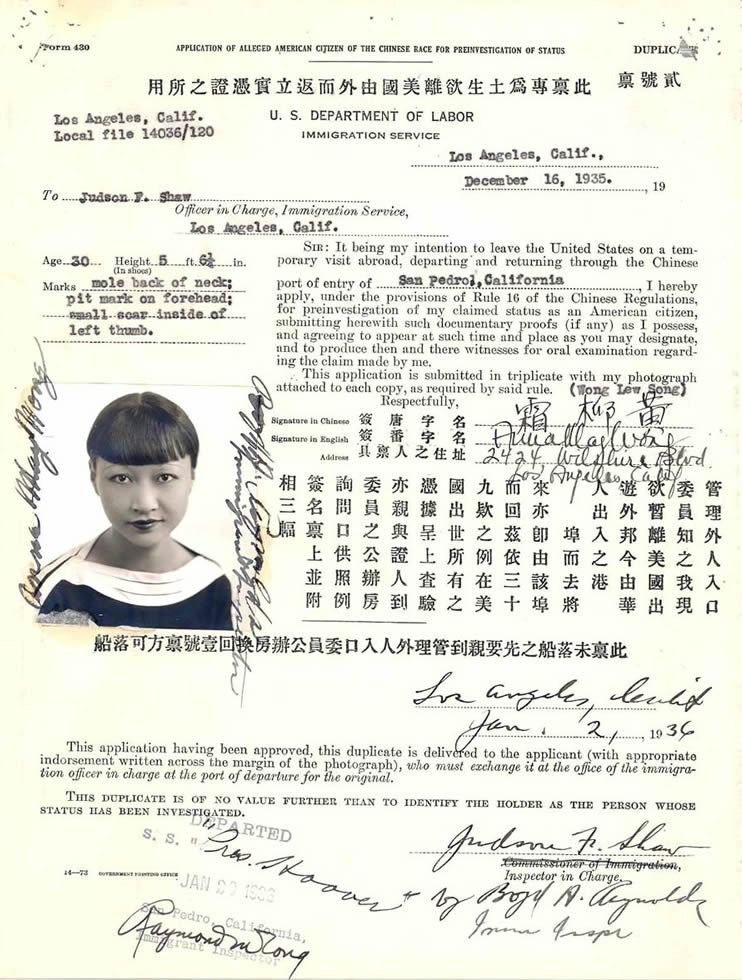 An archival image associated with Wong’s re-entry to the United States after her 1936 visit to China. Image credit: United States Department of Labor / National Archives and Records Administration / Public domain.
Daughter of Shanghai finally allowed her to investigate rather than suffer
Daughter of Shanghai (1937) cast Wong as Lan Ying Lin, whose father is killed by traffickers. She pursues the criminal organisation, working with government agent Kim Lee, played by Korean American actor Philip Ahn.
The film was made on a modest budget, but its casting and narrative remain remarkable. Asian American performers play the heroes, speak fluent English and direct the action. The story addresses human trafficking without requiring a white saviour to discover the crime for them.
Wong’s Lan Ying is active from the beginning. Grief does not make her helpless, and romance does not replace the investigation. She disguises herself, gathers information and takes risks with a clear understanding of what she is doing.
The production still contains period assumptions, and its running time limits character development. It gives Wong something Hollywood had frequently withheld: a contemporary Chinese American woman whose intelligence is the solution rather than the danger.
The Library of Congress selected Daughter of Shanghai for the National Film Registry. That recognition has helped move the film from specialist interest towards a central place in discussions of Asian American screen history.
Watch it after Shanghai Express. The comparison shows how much changes when Wong’s character owns the objective of the story.
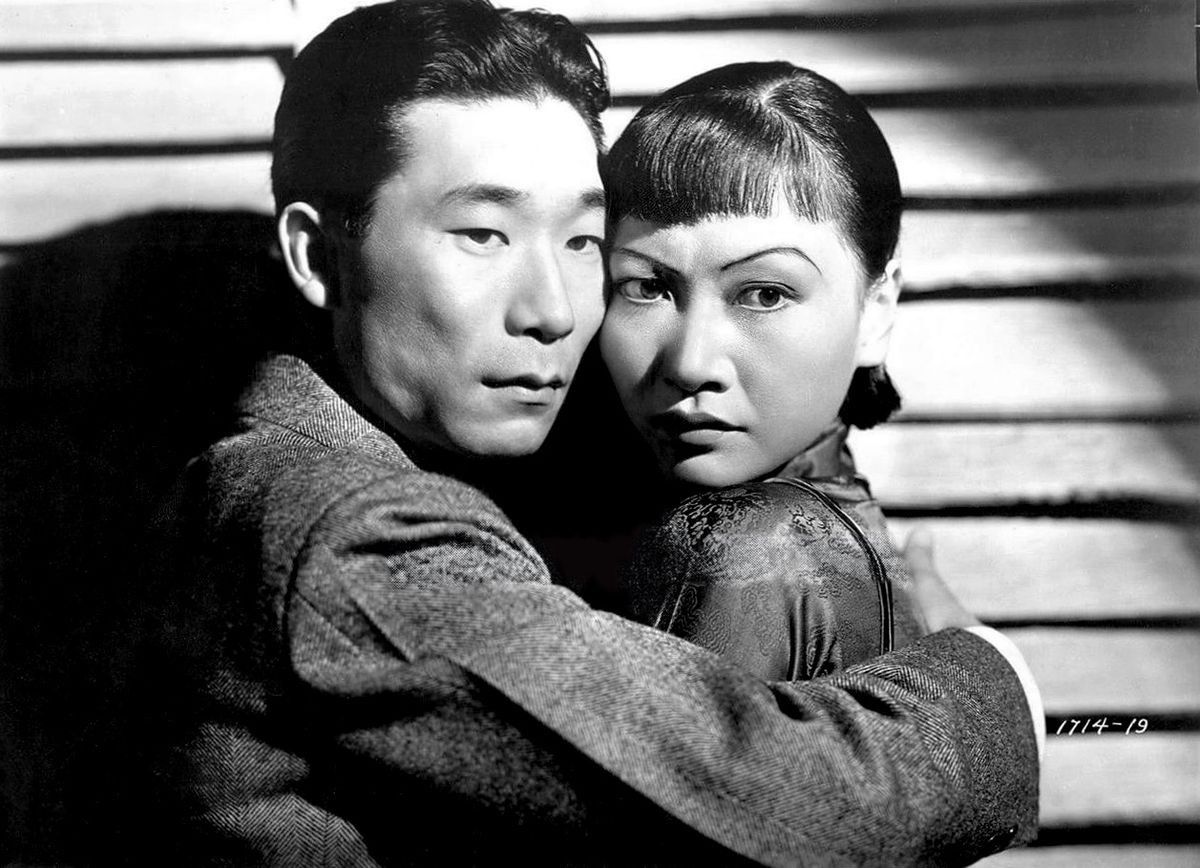 Publicity photo of Philip Ahn and Anna May Wong for the 1937 film Daughter of Shanghai. Image credit: Photographer unknown. “© 1937 Paramount Productions, Inc. ” / Public domain, via Wikimedia Commons.
Wartime films combined support for China with difficult propaganda
During the Second World War, Wong supported Chinese relief and donated earnings from some work. She appeared in films including Bombs Over Burma and Lady from Chungking, productions designed around resistance to Japanese occupation.
Her humanitarian commitment was genuine. The films also belong to wartime propaganda and use broad national and racial characterisation. Opposition to Japanese militarism could slide into hostility towards Japanese people as a group, and low budgets often simplified politics further.
Wong’s participation should be understood within the limited roles available and her desire to support China during invasion. It should not require modern viewers to accept every image the films contain.
She also worked in radio and returned to the stage. Film appearances became less frequent, partly because Hollywood had never built a durable category for her beyond the exotic roles she had criticised.
The pattern is frustrating because maturity might have widened her work. Her voice and authority were well suited to professionals, organisers and women with social power. Instead, the industry behaved as though the end of youthful exoticism meant the end of the star.
Television gave Madame Liu-Tsong a series of her own
In 1951 Wong starred in The Gallery of Madame Liu-Tsong, a television mystery series created around her. She played an art dealer and detective who travelled through cases involving international intrigue.
The programme made her the first Asian American star of a US television series. That distinction arrived more than three decades after she entered films. It also came through a character whose sophistication, profession and mobility directly answered the narrow roles of her early career.
Most or all episodes are now believed lost. The absence makes evaluation difficult and reveals another part of screen history: achievement can disappear when companies fail to preserve the work. Surviving publicity and programme records confirm the event but cannot replace the performances.
Wong continued making guest appearances on television and returned to film in Portrait in Black (1960). She was preparing to appear in Flower Drum Song, a major musical with an Asian American cast, but withdrew because of ill health.
She died of a heart attack in February 1961 at fifty-six. Her death just before a production that might have connected her to a new generation gives the chronology sadness, but it should not make the earlier career seem like a waiting room. Wong had already worked across continents and technologies.
 Press photo of Anna May Wong for the 1954-1958 television series Climax!. Image credit: CBS Television Network Photo Division / Public domain, via Wikimedia Commons.
She never married, but privacy should not be treated as a missing explanation
Wong never married and had no children. Publicity and later biographies have speculated about relationships, sexuality and the effect of laws that restricted interracial marriage. Some relationships are documented; others rest on gossip or inference from social circles.
The absence of a conventional public marriage often encourages biographers to search for a secret capable of explaining it. A simpler truth is that Wong lived under unusual pressure. Marriage across racial lines faced legal and social obstacles, celebrity limited privacy and her work required international movement.
None of those factors permits us to convert possibility into fact. Her romantic life matters when reliable evidence connects it to decisions or public experience. It does not need to supply the dramatic key to her acting.
Wong’s public interviews often had to answer questions about race, belonging and marriage that white stars could avoid. The demand itself tells us more about the culture than an unsupported list of rumoured partners would.
The United States quarter changed recognition, not the films themselves
Later scholarship, restorations and Asian American film history returned sustained attention to Wong. Piccadilly, The Toll of the Sea and Daughter of Shanghai became easier to discuss as performances rather than footnotes.
In 2022 the United States Mint issued an Anna May Wong quarter through the American Women Quarters programme. The coin placed her image into everyday national circulation, making the Chinese American daughter of Los Angeles laundry owners part of an official account of American achievement.
Commemoration matters, particularly when the industry once treated her as foreign. It can also smooth conflict. A quarter cannot show the roles denied to her, the yellowface surrounding her or the compromises inside work she accepted.
Her legacy is strongest when recognition leads viewers back to the screen. Wong changes between Lotus Flower’s wounded clarity, Shosho’s ambition, Hui Fei’s judgement and Lan Ying’s investigation. Those differences disprove the stereotype that Hollywood used to limit her.
She did not open a door through personal determination alone. She revealed how often institutions praised a star while keeping the door narrow.
 Press photo of Anna May Wong for the 1960 film Portrait in Black. Image credit: Universal Pictures Company, Inc. / Public domain, via Wikimedia Commons.
Fashion made her modern even when scripts tried to place her outside modern life
Wong’s clothes, hair and photographic poses influenced the public image as strongly as many roles. She understood line and stillness, using costume to create a modern woman even when a film described the character through ancient or exotic fantasy.
This was not complete control. Studios and photographers designed images for commercial purposes, and Orientalist styling could turn Chinese identity into decoration. Wong nevertheless learned how to address the camera inside that arrangement.
The famous portraits often show asymmetry: a shoulder angled away, hands placed with unusual precision, eyes meeting the viewer without a smile that asks for approval. The result can feel contemporary even when the costume is elaborate.
Fashion also allowed a Chinese American star to participate in global modernity. Hollywood stories repeatedly treated Asian people as remnants of the past. Wong’s public presence contradicted that timetable.
The portraits should lead us towards the films rather than replace them. A still can show control, but Piccadilly reveals how that control changes through movement, and sound work reveals the voice a photograph cannot contain.
There is another reason the fashion photographs still deserve our attention. They show Wong refusing the industry’s assumption that an Asian woman belonged to one fixed period. In one image she could appear in Chinese dress, in another in a sharply modern evening gown, and in both she remained recognisably herself. The change was not a simple journey from tradition to modernity. It was an assertion that a Chinese American woman could inhabit several visual languages without becoming less authentic in any of them.
That flexibility also helps us read the films more carefully. When a production used costume to turn Asia into fantasy, Wong’s control of posture could either intensify the design or quietly resist it. When she played a contemporary character, the same precision communicated profession, class and independence. Her style was therefore not decoration added to the acting. It was one of the instruments through which the acting reached an audience before a line had been spoken.
Where should you begin with Anna May Wong’s films?
Begin with Piccadilly. It offers the richest silent performance and lets Wong control scenes through movement rather than exposition. Then watch Daughter of Shanghai, where an Asian American heroine owns the investigation and works beside Philip Ahn as an equal.
Move to Shanghai Express to see how Wong creates moral authority inside another star’s vehicle. Follow it with The Toll of the Sea, remembering both the technical importance of its colour process and the sacrificial stereotype in the story.
Add The Thief of Bagdad for the star image that made her famous, but do not mistake screen time for the measure of her effect. Daughter of the Dragon is useful when approached critically, because it shows the quality of the performer and the damage of the material at once.
If surviving recordings from television appearances are available, use them to hear the vocal intelligence silent portraits cannot capture. The lost Gallery of Madame Liu-Tsong should remain part of the viewing conversation even when we cannot see it.
Why does Anna May Wong still matter?
Wong matters because her career exposes the difference between visibility and power. Hollywood could sell her face around the world without trusting her with the ordinary privileges of stardom: varied roles, completed romance, contemporary American identity and the chance to fail without representing an entire community.
She responded through craft and movement. Europe offered larger roles. Stage and sound revealed a voice that stereotype had tried to pre-write. Daughter of Shanghai showed what changed when an Asian American performer was allowed to be the agent of the plot.
The films require honest viewing. We should neither reject every compromised role nor praise resilience so warmly that the system disappears. Wong’s skill is visible precisely because we can see the pressure against which it worked.
Anna May Wong was a Hollywood star, an international performer and a Chinese American woman repeatedly told that each identity made the others difficult. She made them visible together. The result is not simply a pioneering career. It is one of the clearest records we have of how a gifted actor can enlarge the screen even when the industry refuses to imagine enough for her.